Tag Archives: Sydney Fringe

I, Julia

24 Sep

Julia Louis-Dreyfus is a comedy icon. Audiences know and love her from Seinfeld and Veep.

Lily Hensby, writer and performer of this fun show, claims to be obsessed with her.

The premise of I, Julia is that if Hensby manages to evoke Louis-Dreyfus’ comic skills sufficiently, the woman herself will turn up – giving Hensby validation and a boost to her own comic career.

The spoiler rule prevents me from revealing if Louis-Dreyfus does show.

But we are treated to some classic moments from her body of work, such as Selina Meyer and the croissant, Elaine’s fear of having rabies, and (my favourite) Louis-Dreyfus’ acceptance speech when she won the Mark Twain Prize for American Humour.

Under the direction of Kate Ingram, what Hensby offers is not so much straight mimicry, as a joy in making the material and the characters come alive.

Hensby herself has a wonderfully engaging stage presence and terrific comic delivery. Constructed around a premise of the persona having to wait, the script throws out formidable challenges in terms of pace, with the performer having to navigate the variations between the moments of tight, high-energy when she plays Louis-Dreyfus’ characters and something slower and looser when she plays her own created persona.

The piece is an impish invitation to think about some pretty big issues.

One of those issues is validation. Performers often put extraordinary pressure on themselves by setting international fame as the only criteria for success. Considering the odds, it’s sadly akin to a gambling addiction.

Another issue is the nature of humour. We’re asked directly What do you find funny? At least one audience member, unsurprisingly, found this question difficult to answer. (Much laughter derives from a reversal of expectations; to explain a joke may not be to murder it, but it does usually result in accidental humourcide. Note: this pun is not Hensby’s, but mine. Second Note: Very little laughter derives from puns.)

Hensby admires the musicality of Louis-Dreyfus’ delivery, her ability to make every syllable funny. Many directors and writers will concur with this vision of the script as a score and will encourage actors to play every note.

But on a less technical level, Hensby suggests that Louis-Dreyfus’ popularity has come from her ability, and willingness, to play unpleasant people.  Often her characters are incredibly shallow and totally self-obsessed. We’re invited to laugh, with the performer, at such characters. By laughing at human faults, we remind ourselves that we’re susceptible to them, and that we can recognise and transcend them.

So the question becomes What is the value of laughter?

As Hensby notes, there aren’t many situations which laughter won’t improve – and this show embodies that spirit of playful jubilance.

Paul Gilchrist

I, Julia written and performed by Lily Hensby

At the Emerging Artist Share House (Erskineville Town Hall) as part of the Sydney Fringe

Until 27 September

sydneyfringe.com 

Image supplied.

Sh!t Theatre, Or What’s Left Of Us

22 Sep

This is beautifully written and wonderfully performed, very funny and deeply moving.

The title hints at the key theme. 

But we begin with the two writer-performers – Rebecca Biscuit and Louise Mothersole – in badger headgear. Think fur, fangs, whiskers, and snouts. Cute.

Apparently, when badgers hit hard times, they get into a torpor. (Yes, it’s a technical thing.) But you can’t remain in a torpor forever.

And I neglected to mention that these badgers begin the show by singing a folk song. Apparently, when human beings hit hard times, they get into folk music. (That’s not a technical thing.) But, as the performers suggest, folk revivals do seem to occur at times of disorder and uncertainty. Like the Industrial Revolution. Like the 60’s. Like Now.

They visit an old folk club. Everyone at the club takes turns singing. It’s not about being good. It’s like those Japanese bowls: when they’re broken, they’re put together again with a lacquer powdered with gold – and become more beautiful because their imperfections are acknowledged. (Those bowls, indeed bowls in general, are mentioned several times, and it’s the sort of thing that makes this such an exceptional piece of writing and performance; what begins as Play grows into Beauty and Truth.)

Many of the songs are about drinking: like The Barley Mow (a cumulative drinking game of a song, with its repeated refrain of Good luck to an increasing number of participants, and ending each time with Good luck to the round bowl.) And there’s the old John Barley Corn (a personification of the grain that becomes beer, and so must die. But He comes back again.)

There’s a lot of songs about death. This is a song about death, we are told repeatedly. (And these songs are performed delightfully.)

We learn the folk club burnt down a week after they visited, and there’s a suggestion the show might become a whodunnit. 

But some questions don’t have answers, and we begin to suspect that the torpor, the chaos, they’ve been speaking about is not especially political.

This is a song about death, we’re told again.

But this time, it isn’t a song. It’s two superbly written, intersecting monologues about personal loss. They’re funny, generous-spirited, courageous and incredibly affecting. They also give an enormous poignancy to so much of what preceded them, so much that earlier in the show seemed only for laughs. The bowls are just one example. Go along and find your own. There’s an extraordinary richness to it all.

Richness and wisdom. The piece is a glorious artistic expression of the most humane of wisdoms: that, if there is a path to salvation, it begins not with the seeking of perfection – in ourselves, in the world –  but with the acknowledgement of all that is broken.

Paul Gilchrist

Sh!t Theatre, Or What’s Left Of Us written and performed by Rebecca Biscuit and Louise Mothersole

Presented by Sh!t Theatre in association with Soho Theatre

At New Theatre, as part of the Sydney Fringe (Touring Hub)

Until Sept 27

sydneyfringe.com

Image by Ellie Kurttz

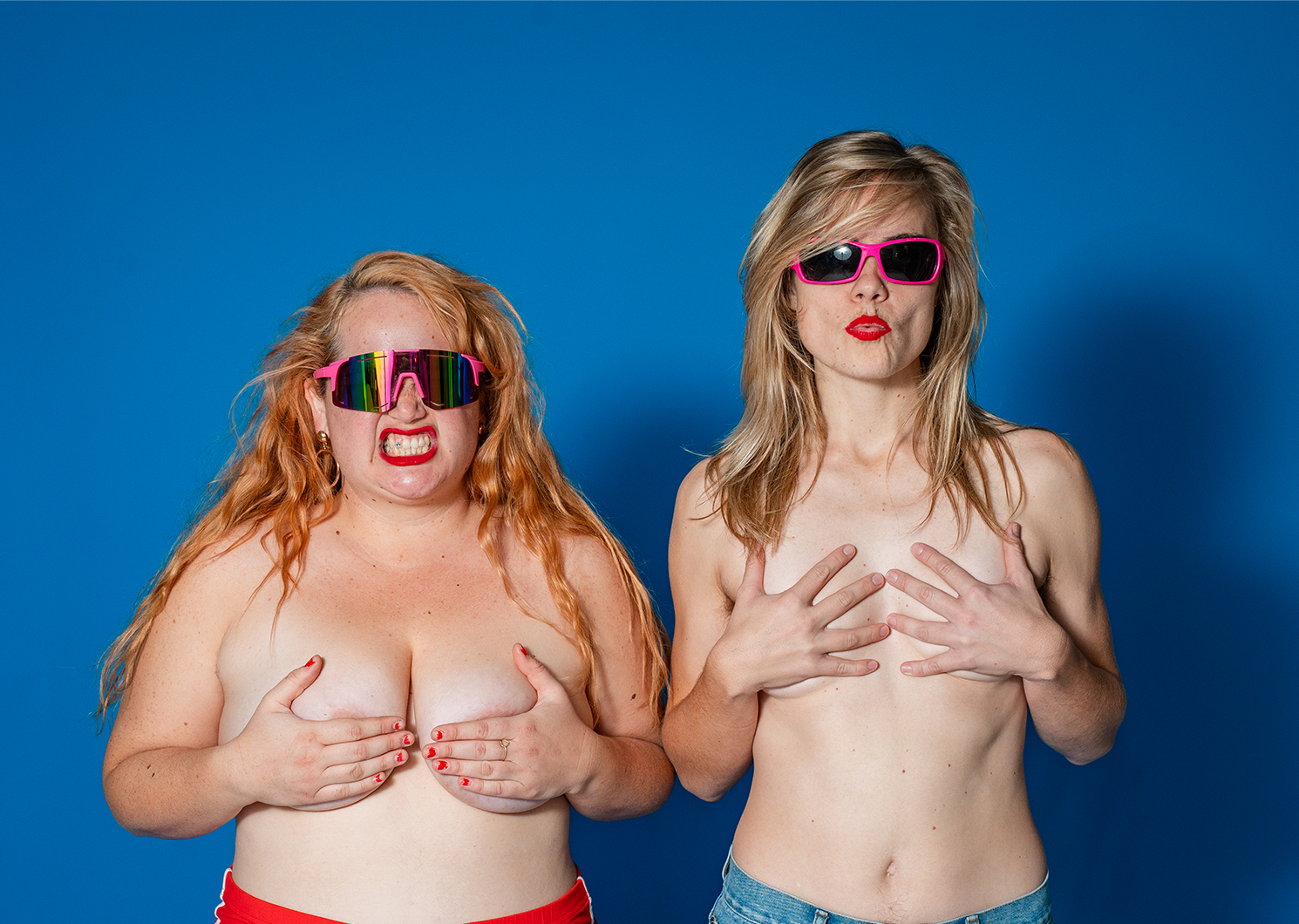
Lesbian Sex Diaries

19 Sep

This is absolutely joyous.

Constructed mainly from comic monologues, interspersed with some song and dance, it’s also very funny.

Co-creators Rebel Star and Melody Rachel are superb comic performers.

Warning – absurd generalisations that attempt to delineate performance styles: Star employs a giggly infectious effervescence, punctuated by devastating dead-pan. Rachel employs the well-placed pause and the slight but-oh-so-evocative vocal intonation.

Sometimes the monologues are honest sharings, such as Star’s beautifully sweet reminiscence of a teenage dalliance, or Rachel’s tale of her first LSD experience (which includes the best definition of God I’ve ever heard.)

At other times, the monologues are playful representations of aspects of dating, like Rachel’s brilliantly written and delivered piece on keeping it casual.  

It’s tempting to share some of the show’s hilarious one-liners – but, for reasons of critical integrity, I won’t. (But I did last night, as soon as I got home, to my partner’s delight.)

With simple production values, and a running time of 50 minutes, Lesbian Sex Diaries is fun fringe. And, if I can hazard a wider comment on queer theatre, it’s a glorious example of that genre as pure celebration.

Paul Gilchrist

Lesbian Sex Diaries by Rebel Star and Melody Rachel

At the Loading Dock, Qtopia, as part of the Sydney Fringe,

Until 20 September

sydneyfringe.com

Image supplied.

And What Will People Say?

19 Sep

This a very beautiful, very powerful show.

It’s testimonial theatre; that is, its purpose is to bear witness to the experience of a certain group of people.

Written by Amani Mahmoud and directed by Kersherka Sivakumaran, And What Will People Say? bears witness to those who suffer from domestic abuse in the Australian South Asian community.

We love our community, we are told, but there are dark places we need to talk about.

And that talk must involve deep listening, because the what will people say of the title is the idle gossip of those who don’t understand why a wife might need to leave an abusive husband.

The piece begins with a voice-over on a darkened stage. A woman tells us of the trauma she and her family have suffered at the hands of a man. She desperately wants to be heard, but she does not want to be seen; she believes nothing will be gained by shaming the perpetrator, her father, now an old man. It’s a deeply humane attitude (and it also hints at the ever widening circles of shame that can extend from any crime, any sin, waves of shame that threaten to overwhelm the perpetrator, the victim, the victim’s family, the community…..)

The piece uses several other devices to avoid the name-and-shame temptation and to present something more constructive. One is to have the story told through narration, read by an actor who moves between characters. Maithly Dhawan reads with a simple truthfulness that has maximum emotional impact.

The tale is told in three parts, and its telling, as against the choice of dramatic enactment, allows a fertile ambiguity as the listener decides if these are three parts of the one tale, or three different tales: are we going deeper or are we going broader? Dramatic enactment, for all its concrete embodiment of an issue – or, perhaps, because of it – lacks this richness, and so can struggle to present simultaneously the commonality of a problem and its multiple manifestations.

Interspersed between the parts of the narrative are magnificent dance sequences by a single performer, Gayatri Krishnamurthy. Working with tropes of South Asian dance, each sequence is suggestive of the narrative we’ve just heard, and this evocative echoing in a different artform is another creative choice that lifts the representation of the experience of abuse beyond limiting particulars.  Accompanying the dance are Indu Balachandran on veena, Pirashanna Thevarajah on percussion and Narthana Kanagasabai on violin, creating music that is wonderfully expressive of both melancholy and the possibility of change. 

The narratives themselves are superbly written, replete with detail that makes us see the moment and feel the pain. Though the identity of the narrator changes, the perspective remains female, which means the experience of the innocent take precedence over the behaviour of the abuser.  Once again, the wisdom of the choice to use narration rather than enactment becomes apparent – the dramatic form, with its focus on conflict and action, all too easily grants centre stage to the abuser. 

Ironically, one of the strengths of this piece is that we don’t know why the abuser acts as he does. He remains only a frightening unfathomable threat – which is a perfect delineation of how he is experienced by those who live with him.

But without offering insight into the cause of the problem, how does the piece hope to facilitate its solution? (And, yes, for the average piece of theatre, that might seem an utterly unrealistic expectation.)

But I think the answer to that question is threefold:

One answer is, that by so powerfully representing the pain and trauma created by abuse, the perpetrators will be shocked into an understanding of the impact of their behaviour. (I’m not sure if belief in such a possibility would be a sign of a quaint psychological naivety or of a laudable moral commitment to hope.)

Another answer could be, that by so powerfully representing the pain and trauma created by abuse, the community might soften its heart towards women who need to escape their abusers. (The title of the piece implies this is the outcome most hoped for by the creatives.)

And the final answer: it is sufficient Truth be told.

Paul Gilchrist

And What Will People Say? written by Amani Mahmoud and directed by Kersherka Sivakumaran,

at Pottery Lane Performance Space, Lane Cove, as part of the Sydney Fringe,

until 21 Sept.

sydneyfringe.com

Image supplied.

Psycho or Psychic

18 Sep

In our culture of scientific materialism, psychic experience gets short shrift.

Claim to have had a vision of the future, or to have seen someone’s soul, and you won’t be credited. You’ll just be pitied. (Unless, of course, you’re attempting to benefit from the gullibility of the unfortunate – in which case, you’ll be pilloried.)

But, still, these psychic experiences are had, and the title of this show highlights our reductive thinking around the issue.

In this wacky one-person comedy, Sarah Francis creates Luna. She’s psycho only in the colloquial sense of the term; that is, manically unconventional (rather than dangerously egocentric and anti-social.)

Francis emphasizes Luna’s eccentric behaviour through direct interaction with the audience. Luna guesses people’s coffee orders – with statistically predictable success – and delivers to them empty cups. She conscripts one audience member to be her onstage boyfriend, another to be her pretentious boss, and another to be herself. This sort of audience participation is always risky, but it certainly results in a show that is intriguingly unpredictable.

As Francis swaps between roles herself, her physicality is excellent, creating in a flash both character and laughter.

However, there are pacing problems – partly due to costume changes, partly due to the challenges of audience participation.

And, despite the madcap mayhem, there’s a serious side to it all. Francis suggests the isolation of those who have psychic experiences, and the troubling bewilderment that comes from witnessing people trying to hide their pain while knowing all the time that their souls scream in agony. This is not charlatanism but rich empathy.

(For the sceptics amongst us, I’d point out that imagination and empathy are intertwined and, perhaps, the stronger the one, the stronger the other. Catherine of Siena, or one of the other medieval mystics, was once asked Do your visions appear in the real world or in your imagination? With soul-expanding sanity, she responded, In my imagination, of course. )

Paul Gilchrist

Psycho or Psychic by Sarah Francis

At the Emerging Artist Share House (Erskineville Town Hall)

As part of the Sydney Fringe

Until 20 September

sydneyfringe.com

Image supplied

Agony

11 Sep

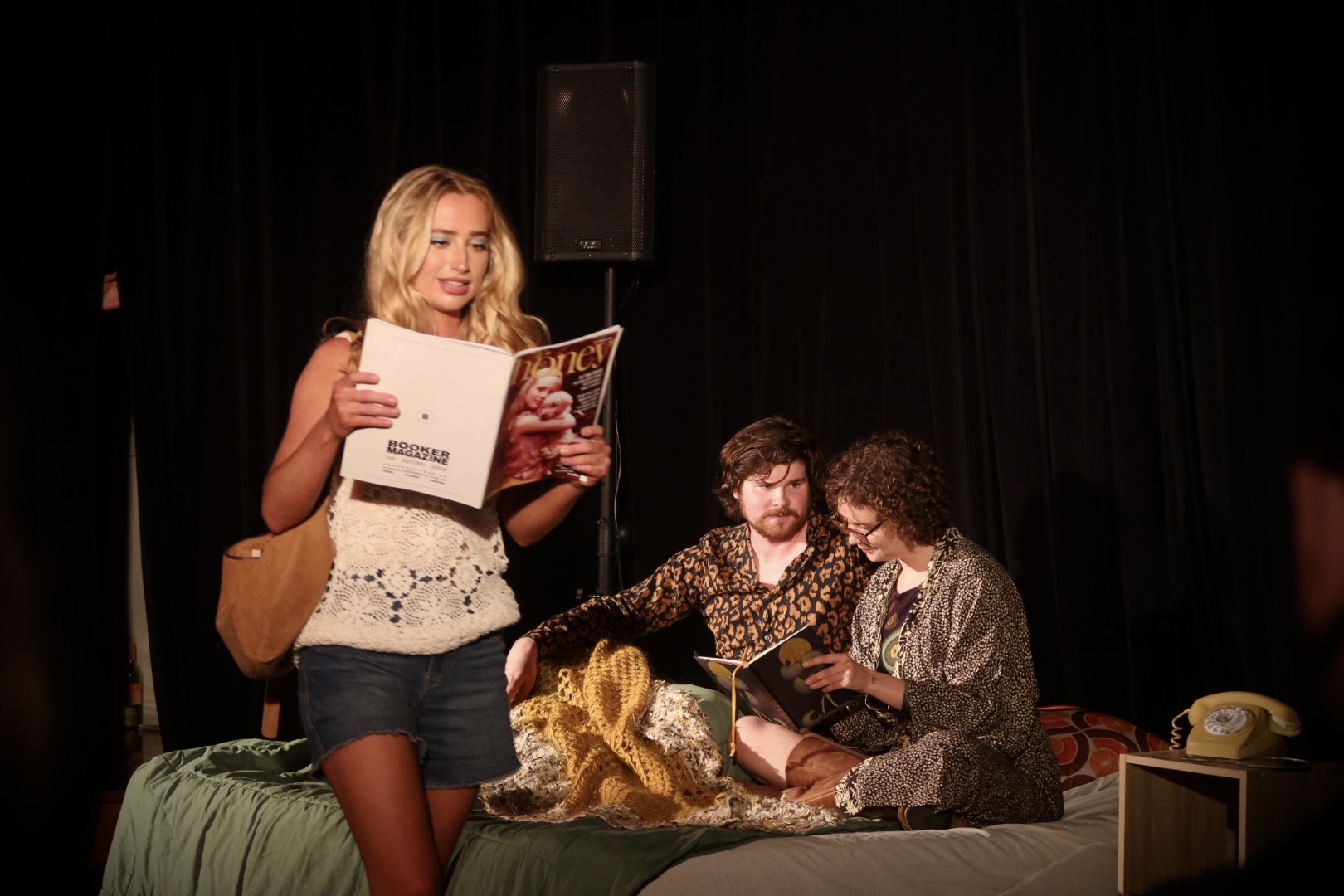
Written and directed by Mariika Mehigan, this is a delightful historical comedy.

It took me a while to clock that it actually was a historical piece – though the costumes, and the presence on stage of a landline, should’ve been a giveaway. (I guess it’s a symptom of my obtuseness – and of something far more important, which I’ll discuss later.)

Agony is set in the 1970’s, at the height of second wave feminism and the sexual revolution. And high school student Bronnie has just had sex for the first time.

It was less than satisfying.

She seeks advice from Tanya, the “agony aunt” for teen magazine Honey. Problem is Tanya’s having problems of her own in the bedroom.

This raises the thorny question: Who of us has sufficient authority to hand down advice? How easily the handing down of advice slips into the laying down of law. Tanya is unlikely to abuse her position, but she’s aware that a young woman genuinely asking for guidance may well receive instead only instruction in the conventional, heteronormative, patriarchal narrative (which is like asking for bread and being given stones.)

The script is funny and cleverly structured, evocatively juxtaposing the stories of two women seeking their authentic selves.

Mehigan’s characterisations are superb, surprisingly and stimulatingly subtle for a 50 minute comedy. And as director she draws from her cast captivating performances (though occasionally there could be a little more attention to vocal projection.)

Laetitia Opie as teenage Bronnie is excellent, having a wonderful stage presence, and displaying top class comic skills as she delivers her advice-seeking monologues. Her repeated refrain, that her boyfriend is a bit of a prick, beautifully recalls the deliberate ambiguity of the world of Puberty Blues, where self-assertion and tragic resignation combine to create both humour and pathos.

Sophie Newby plays both Dean (the above mentioned prick) and Kay, Bronnie’s best friend. Newby’s performance is admirably versatile. Dean is stupidly and suitably self-centred, and Kay (gay though never explicitly labelled as such) is an inspiring model of quiet confidence and independence. 

Louie O’Carroll plays Tanya, the advice columnist, and gives an engaging presentation of that trickiest of positions: the dizzyingly, enervating dance of determination and doubt. She marvellously captures the poignancy of the play’s closing moment. 

Callum Wilson as Tanya’s boyfriend, Sean, offers a terrifically amusing portrait of evolving masculinity. In response to the women’s libbers (who clearly terrify him) he’s too nice to adopt the chauvinistic cliché of the dismissive swagger. Ironically, his supposed sensitivity only further muddies Tanya’s journey to authenticity.

I began by suggesting that I didn’t immediately recognise Agony as a historical piece. That’s a testament to its contemporary relevance. The tension inherent in sexuality is that while it’s deeply personal, it can’t be entirely private. Individual desires can only be fulfilled in the social world (even if we try to reduce that world to the supposed secrecy of the bedroom.) The tensions navigated by the characters in Agony are still faced by young people today. And to be reminded of what happened in the 60s and 70s, when activists strove to bring into the open these tensions, and to have sexual diversity honestly acknowledged, is a glorious gift of hope.

Paul Gilchrist

Agony by Mariika Mehigan

at the Emerging Artist Sharehouse (Erskineville Town Hall)

as part of the Sydney Fringe, until 13 Sept

sydneyfringe.com

Image supplied.

Traffic Light Party

10 Sep

This shouldn’t work, but it does – gloriously  – and that’s a testament to the skill of the creative team.

Written by Izzy Azzopardi and directed by Brea Macey, Traffic Light Party is a beautiful snapshot of youth as it navigates love.

The setting is an end of semester uni party. It doesn’t appear much has changed in the 40 years since I was last invited to one. (Except for the traffic light concept: wear green if you’re available, red if you’re not, and yellow if it’s complicated. I don’t think that was a thing in 1985. Is it a thing now? Regardless, it’s a magical gift to be shown once again, with such crystal clarity, that most wondrous time of Life.)

I began with the suggestion the piece shouldn’t work, and that’s because parties, by definition, are messy. But Azzopardi’s splendid script keeps a tight thematic focus. Despite the large number of characters, everything centres explicitly on relationships; and, because of the large number of characters, that theme is satisfyingly explored from multiple angles.

Another device that holds it all together is the motif of driving. Between the scenes set at the party, scenes of realism, are interspersed movement and choral sequences. These juxtapose the certainty of the rules of the road with the certainty we long for in that far more murky sphere of human experience: relationships. This correlation has its antecedents, famously in F Scott Fitzgerald’s The Great Gatsby. But Azzopardi makes it her own, and its use simultaneously draws attention to the key themes and gives the piece a pleasing texture. As is the way with theatre, the exuberant fun of these sequences is the result of disciplined work by Macey and the entire ensemble.

But, for me, the highlight of Azzopardi’s script are the one-on-one conversations. These are superbly crafted and Macey elicits from the cast performances that are both candidly authentic and genuinely moving.

Let me describe a few of these scenes.

Ivy (Azzopardi) talks to Samson (Isaac Harley). There’s obvious sexual tension though, it seems, he’s taken. He calls her Fletcher, her last name, an apparent denial of attraction yet, in its very oddness, intimate. It’s these sort of touches that give the script its shine.

Samson is later asked by Amber (Caitlin Green), the girl he has actually been seeing, whether they are boyfriend and girlfriend. He quibbles about the labels. This scene is particularly good in its slow burn, in the gradual growth of tension, and in the way it lets the conversation be untidy, in the painfully and ironic way such defining moments in relationships so often are.

Phoenix (Travis Howard) confronts Reid (Jordy Stewart) about whether he’ll ever come out. Reid’s But what will my rugby mates say? is suitably dismissed by Phoenix, but the scene bravely refuses to deny the reality of Reid’s fear.  

Ivy and Scarlett (Meg Denman) argue about their friendship and if it’s lost, now that Scarlett has found romance. Is there a hierarchy of relationships? If so, why is friendship placed so low? The sense of bitter bewilderment shines in Ivy’s eyes, only to be honestly countered by the tired frustration in Scarlett’s voice.

Chloe (Grace Easterby) has drunk too much and Hunter (Caleb Jamieson) tries to take advantage. Once again, this scene is perfectly paced, and Hunter’s duplicity and Chloe’s vulnerability is appropriately painful to witness.

And now an exception from the paired conversations: the one sided phone call. Sunny (Renée Billing) speaks to their partner, whose absence at the party, a flapping red flag, is deftly rendered as both a giving of offence and a granting of freedom.

Traffic Light Party was my first Fringe show for 2025. I hope to see many more that are as enjoyable. It’s thoroughly engaging and poignantly truthful.

Paul Gilchrist

Traffic Light Party by Izzy Azzopardi

presented by Jezebel Productions as part of the Sydney Fringe

The Actors Pulse Playhouse, Redfern, until 13 Sept

sydneyfringe.com

Image supplied.

I Worked with Heath Ledger Once…

28 Sep

It would be natural to assume, that as a theatre critic, I would relate to a story of a failed artist.

Jarred Keane plays Jeremy, an actor who’s made a pact with himself that he’ll quit if he hasn’t “made it” by 35.

Trouble is, 35 is hurtling towards Jeremy with the velocity of a dinosaur-ending rock.

Written and directed by Keane, this piece asks questions every performer should ask themselves:

Am I doing this for fame?

If so, WHY?

And how, EXACTLY, do I define success?

And is success really a HELPFUL concept?

Let me lay my cards on the table: I think the pursuit of fame is disturbing, at best symptomatic of a deep insecurity or at worst indicative of a myopic self-obsession. Similarly, I think success is a sloppy, problematic concept. Doing something successfully is a secondary virtue. The crucial issue is what you’re trying to do, not how well you do it. Surely, it’s better to fail at something worthwhile than succeed at something worthless. For example: Who’d want to be remembered for producing a piece of art that most effectively keeps the world small and cold? Alternatively, if being a success as an actor only means being able to earn a living wage from the craft, the concept loses its magic aura, and becomes akin to the success or failure you might have as, say, an Uber Eats delivery driver.)

Jeremy’s pact implies he isn’t really interested in art. (Stanislavsky said you should “love the art in yourself, not yourself in the art”.)

But as his deadline gets closer, Jeremy’s beginning to realise his simple ultimatum might just be that – too simple.

One possible catalyst for his change might be that a young filmmaker is shooting a documentary – with Jeremy as the subject. I don’t know why. It does allow the production to be a hybrid, with most scenes being played live but with sections of the documentary shown on a screen.

There are problems with pace. Everything would benefit from being faster, from the changeovers between scenes to the delivery of many of the lines. Some of the cast would also gain from a greater focus on vocal projection.

Jade Nicholson-Lamb as Nikki, Jeremy’s ex, has a wonderful stage presence, effectively portraying a woman who’s definitely moved on from a past relationship but refuses to dismiss it as merely a step in some upward progression, something to be kicked away and forgotten when finished.

Richard Cotter is very amusing, presenting a subtly satirical portrait of the experienced actor who’s worked with everyone – and makes sure you know it.

Lisa Hanssens plays a famous, successful filmmaker, more interested in art than fame and success. Hanssens has a gentle easy-going gravitas that makes for a magnetic performance.

I Worked with Heath Ledger Once playfully pokes at some unhealthy values that permeate the artistic world, and with some further tightening, it could prove the revitalising detox we need.  

Paul Gilchrist

I Worked with Heath Ledger Once… by Jarred Keane

At 107 Projects as part of the Sydney Fringe

until 28 September

sydneyfringe.com/events/i-worked-with-heath-ledger-once/

Image by Matej Hakl

Tom Moran is a Big Fat Filthy Disgusting Liar

25 Sep

Sometimes, when I’m tired or sick or hungry, I worry about silly things – like if I’m liked. And then I remember that some of the people in history I admire the most were burnt at the stake in the public square.

The desire to be liked is pretty universal, and sometimes problematic. When I work with young people, I always try to slip in the same piece of advice: Don’t worry if you’re disliked, because you’ll often be disliked for qualities and actions of which you should be rightfully proud. I’m looked at blankly, or with boredom tinged with disdain – and it becomes apparent that my advice, though unsolicited, is entirely sound.

In Tom Moran is a Big Fat Filthy Disgusting Liar, Moran tells us how so very desperately he has wanted to be liked. So desperate, that the desire has often trumped the truth.

Moran’s delivery is utterly superb, trippingly-on-the-tongue fast and strong … until it’s not, until it slows, until it softens, and with enormous emotional impact he shares moments of shame. The lighting design (Colin Doran) and soundscape (Aoife Kavanagh) beautifully accentuate this journey.

Directed by Davey Kelleher, the show is very funny and incredibly powerful; a brilliant performance by Moran.

If performance is the correct word. Presumably it’s a sharing, not a piece of fiction. (It’s odd how commonly we now do this on stage. Genuine honesty is rare enough in Life; in the theatre, until recently, it was completely unknown.) The whole thing feels a little like being at a support group – except that the guy whose turn it is to speak is absolutely riveting for 70 minutes straight.

The piece is about Moran and his family, and audiences will no doubt respond to the psychological particulars in different ways. Some might feel they’ve been invited to gaze through a portal into a bizarre alternative universe. From others it all might evoke a there-for-the-grace-of-God sort of response. Others still might feel the thrill of recognition, a realisation which can be either comforting or confronting, either assuring them they’re not alone, or challenging them that it can’t go on.

Of my three imagined responses, mine was of the first variety.

But undoubtedly, Moran is exploring one of the fundamental tensions in the human experience: the outside world is filled with people but your inside world is filled with you. How do we reconcile our social needs with the solitary aspect of consciousness? How does anything from that outer world become an unquestioned part of our inner world?

Is the only way out of these thorny dilemmas to focus on loving, rather than being loved?

This piece is fun, thought-provoking and soul-expanding.

Paul Gilchrist

Tom Moran is a Big Fat Filthy Disgusting Liar by Tom Moran

At New Theatre, as part of the Sydney Fringe Touring Hub

Until 28 September

https://sydneyfringe.com/events/tom-moran-is-a-big-fat-filthy-disgusting-liar/

Image by Owen Clarke

Drink Rum with Expats

24 Sep

This is classic fringe theatre.

Sh!t theatre (creators and performers Rebecca Biscuit and Louise Mothersole) tell us how they got a gig to develop a piece of theatre in Malta. It’s to be presented at The Pub, a favourite haunt of British expats. (My choice of noun is deliberate; not expats, haunt; it’s the bar where Oliver Reed died. Not that the great actor has a continuing spectral presence; it’s just that, apparently, the venue milks the unfortunate incident for all it’s worth.)

Drink Rum with Expats is an intentionally playful, laidback telling. It’s constructed of bits and pieces: songs and sing-alongs (mainly drinking songs); slide shows and videos (caricatures of expats, screen shots of the daggy local media, snaps and reels revealing the beauty of the island); flash language lessons (fundamentals, like how to say penis in Maltese); free beer and rum (no joke); crowd surfing – and dancing (at least, impressions of Oliver Reed dancing).

Think of it as a trash and treasure stall, where in the ragged wildness of detritus true gold lies hidden. Or think of it as a mosaic, where the impressive, the inspiring, is made from many unlikely little parts. You could call it the theatrical equivalent of scrap-booking, except it’s terrific fun.

But what begins as a collection of cheeky anecdotes from a sun and booze holiday grows into a story of political awareness.

Ultimately, the show explores corruption and the plight of refugees. Expats party in Malta while those who manage to make it by raft from Libya are held in detention centres. But, at a more insidious level, we hear of the selling of European passports and the assassination of journalist Daphne Caruana Galizia who dared to challenge the practice. We see a deeply moving video of a protest attended by the performers, a candle lit vigil demanding truth and justice. (Convictions have since been made.)

The straightforward, overtly political approach works because the performers present as easy-going and fun-loving. What they say about the issues becomes indubitable – simple common sense. If only the world were cakes and ale. Alas, it’s not.

However, the show is a splendid example of theatrical exuberance, an invaluable reminder, that in the confrontation with the dark and dirty, the torch of truth might best be wielded by joy.

Paul Gilchrist

Drink Rum with Expats by Rebecca Biscuit and Louise Mothersole

at New Theatre, as part of The Sydney Fringe Touring Hub

until 28 Sept

https://sydneyfringe.com/events/drink-rum-with-expats/

Image supplied by Sh!t Theatre