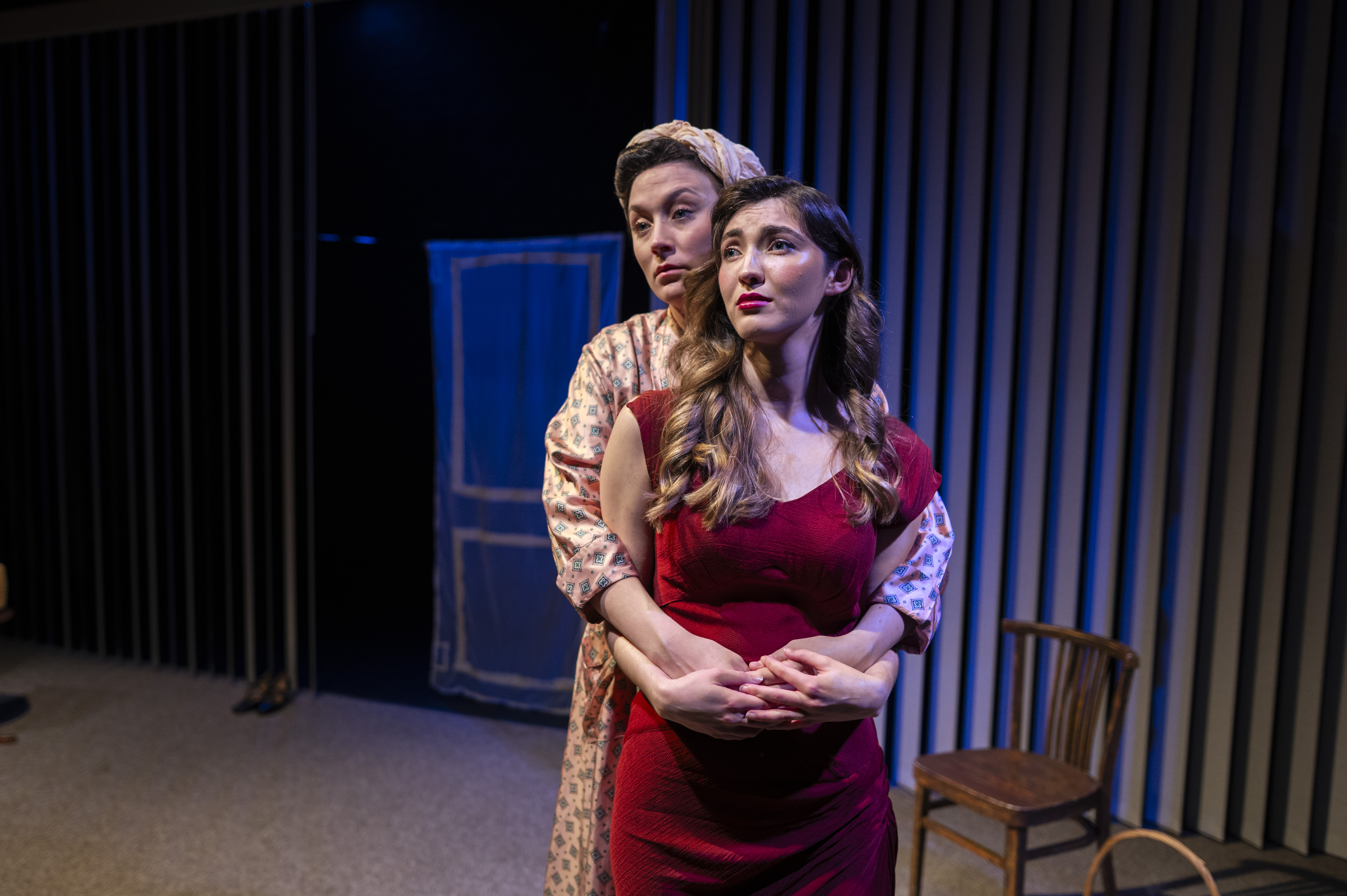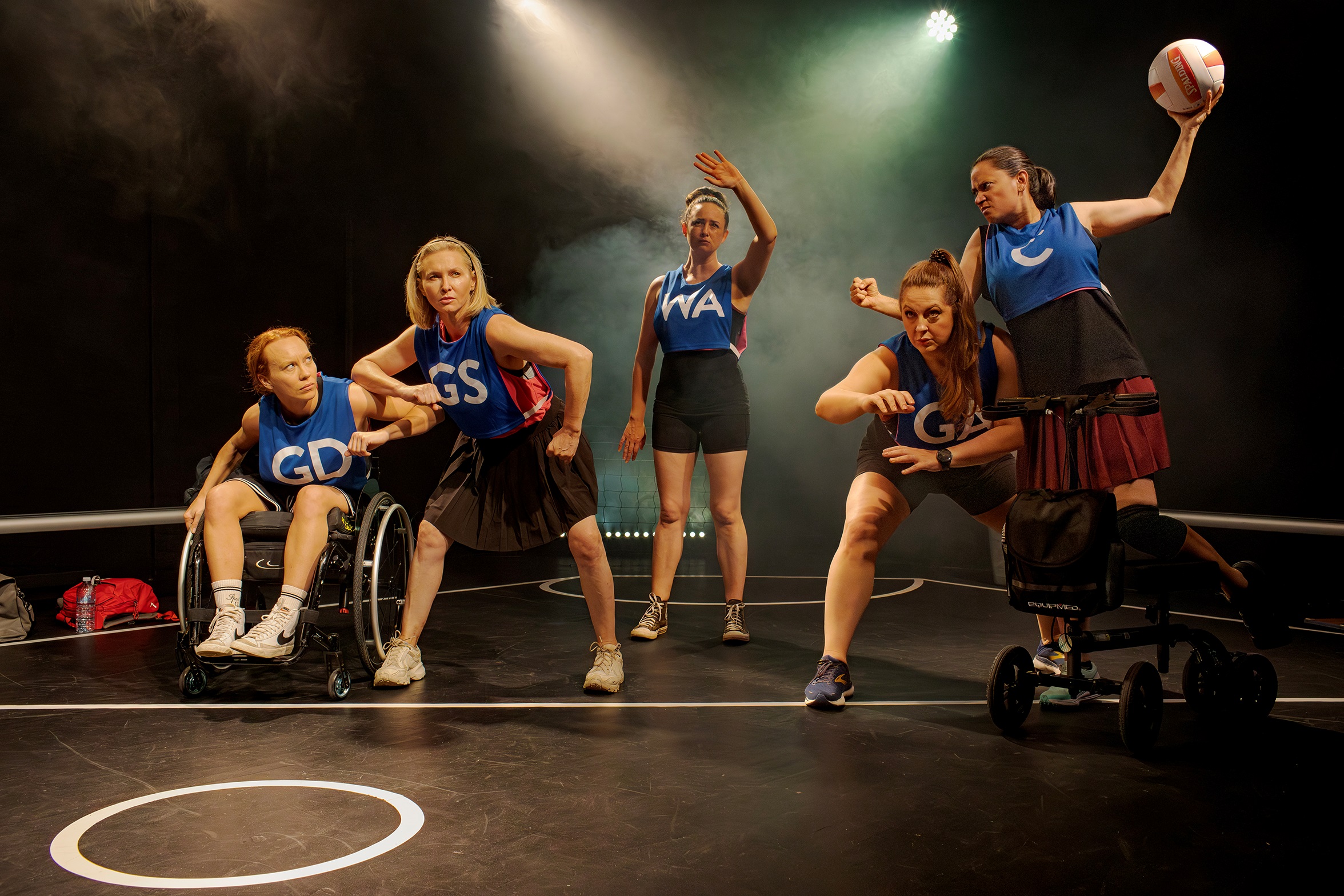
Tag Archives: theatre

Sh!t Theatre, Or What’s Left Of Us

22 Sep

This is beautifully written and wonderfully performed, very funny and deeply moving.

The title hints at the key theme. 

But we begin with the two writer-performers – Rebecca Biscuit and Louise Mothersole – in badger headgear. Think fur, fangs, whiskers, and snouts. Cute.

Apparently, when badgers hit hard times, they get into a torpor. (Yes, it’s a technical thing.) But you can’t remain in a torpor forever.

And I neglected to mention that these badgers begin the show by singing a folk song. Apparently, when human beings hit hard times, they get into folk music. (That’s not a technical thing.) But, as the performers suggest, folk revivals do seem to occur at times of disorder and uncertainty. Like the Industrial Revolution. Like the 60’s. Like Now.

They visit an old folk club. Everyone at the club takes turns singing. It’s not about being good. It’s like those Japanese bowls: when they’re broken, they’re put together again with a lacquer powdered with gold – and become more beautiful because their imperfections are acknowledged. (Those bowls, indeed bowls in general, are mentioned several times, and it’s the sort of thing that makes this such an exceptional piece of writing and performance; what begins as Play grows into Beauty and Truth.)

Many of the songs are about drinking: like The Barley Mow (a cumulative drinking game of a song, with its repeated refrain of Good luck to an increasing number of participants, and ending each time with Good luck to the round bowl.) And there’s the old John Barley Corn (a personification of the grain that becomes beer, and so must die. But He comes back again.)

There’s a lot of songs about death. This is a song about death, we are told repeatedly. (And these songs are performed delightfully.)

We learn the folk club burnt down a week after they visited, and there’s a suggestion the show might become a whodunnit. 

But some questions don’t have answers, and we begin to suspect that the torpor, the chaos, they’ve been speaking about is not especially political.

This is a song about death, we’re told again.

But this time, it isn’t a song. It’s two superbly written, intersecting monologues about personal loss. They’re funny, generous-spirited, courageous and incredibly affecting. They also give an enormous poignancy to so much of what preceded them, so much that earlier in the show seemed only for laughs. The bowls are just one example. Go along and find your own. There’s an extraordinary richness to it all.

Richness and wisdom. The piece is a glorious artistic expression of the most humane of wisdoms: that, if there is a path to salvation, it begins not with the seeking of perfection – in ourselves, in the world –  but with the acknowledgement of all that is broken.

Paul Gilchrist

Sh!t Theatre, Or What’s Left Of Us written and performed by Rebecca Biscuit and Louise Mothersole

Presented by Sh!t Theatre in association with Soho Theatre

At New Theatre, as part of the Sydney Fringe (Touring Hub)

Until Sept 27

sydneyfringe.com

Image by Ellie Kurttz

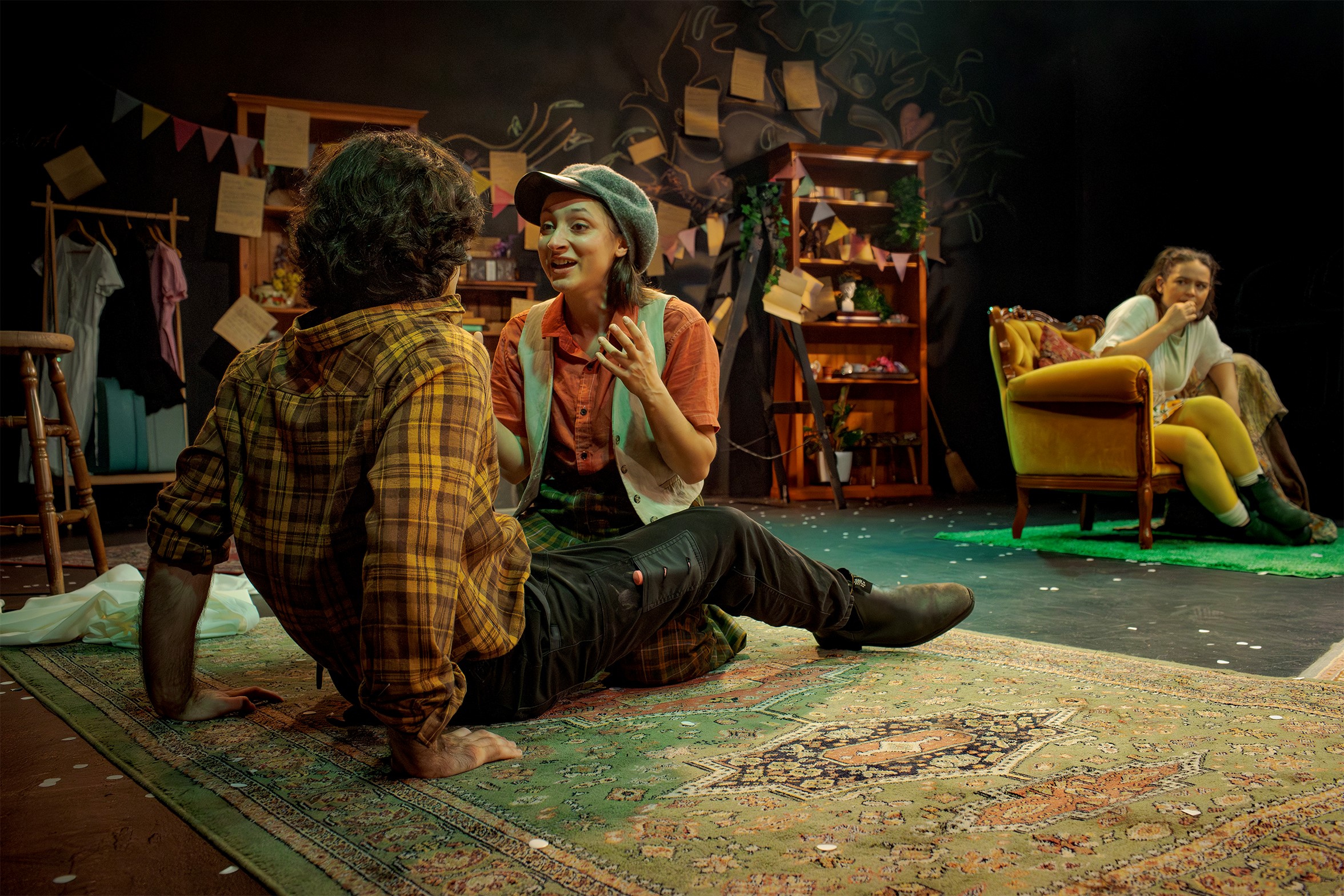
The Frogs: In Hell They Sing Show Tunes

26 Aug

Adapted by Alex Kendall Robson, after Aristophanes (about twenty-four centuries after Aristophanes.)

Robson’s adaptation follows a very similar plot to the original.

In an attempt to save the world, Dionysius visits the underworld to bring back the greatest playwright. It might seem an odd strategy, but as the God of Theatre, Dionysius might be excused for overestimating the impact of the artform.

The original play, first produced in 405 BCE, was a mixture of satire and broad humour. Robson’s adaptation is similar in tone, though with slightly more focus on the second of these comic elements.

Aristophanes included songs, though not show tunes. (The Ancient Greeks can be blamed for a lot, including theatre and philosophy, but not for the abomination that is modern American musical comedy.)

With amended lyrics, this adaptation of The Frogs includes versions of Putting on the Ritz and Singing in the Rain, as well as Wayfaring Stranger and something (I think?) from Bizet’s Carmen. The last two aren’t show tunes, but then, the manner in which all the musical numbers are presented doesn’t justify the title’s joking implication that songs such as these are the essence of the tortures of Hell. (Nor does their presentation justify my earlier cheap shot at musical comedy.) Under musical director Zachary Aleksander, the talented cast perform the songs beautifully. (Though I wonder whether amplification might have better delivered the wacky, high-spirited energy this production clearly values.)

Working with Robson’s fun script, and under his direction, the comic performances are excellent. I’ll cherry pick a few. Pat Mandziy as Dionysius is a delicious blend of camp and privileged naivety. Eddy O’Leary as his underling, Xanthias, is a fine inheritor of the long tradition that the disempowered see truths to which the powerful are blind. (The script mischievously asks whether we can call this character a slave – but I’ll get back to that later). Axel Berecry as Heracles is gloriously over the top in his presentation of the stupid he-man. Larissa Turton and Meg Bennetts deliver a terrific parody of two tough-speaking old-school landladies. Bennetts also turns up as Sappho, and her portrayal of a character of gravitas, dignity and wisdom is a sensationally effective change in tone from the rest of the production’s madcap hijinks.

I’ve expressed previously that I think it’s odd that Australian theatre makers are fascinated with Ancient Greece. It’s odd because Ancient Greece is truly a foreign culture – yet we seem to see it as a sort of universal. It’s not. Example: Up to 40% of Ancient Greece’s population were slaves – yet, as this production implies, we have trouble even saying the word. And don’t get me started on the misogyny of the ancient world.

Not that audiences will have any trouble following this adaptation. Robson makes this foreign world accessible – a challenging task when you consider that the original play’s dramatis personae consists of a mixture of mythical characters and historical individuals who are hardly household names in modern Australia. Sensibly, when we get to the two historical playwrights who are contending for the title of the greatest – Euripides and Aeschylus – this adaptation slips into a musical number and a quick bawdy sight gag. It’s a smart choice, as contemporary audiences are likely to find a debate concerning the relative merits of the competing styles of Ancient Greek tragedy more soporific than stimulating.

Another change to the original is the addition of Sappho. As I’ve suggested, it’s a scene that makes for fascinating theatre. But curiously, it also functions as a criticism and rejection of Dionysius’ quest. I say curiously because – up to this point – the assertion of theatre’s ultimate value seemed to be the only serious justification for the piece. (If one was needed.)

But the Sappho scene also highlights what I’ve suggested about the Ancient Greeks being a very different culture from our own. And I know I’m close to spoiler territory here – but, when you go, note Sappho’s prayer. Who she prays to is not anachronistic, but what she asks for is. It involves a conception of human relationships which lay centuries ahead, at least in Western culture.   

By now, reading my response, you’ve probably come to the conclusion that it’s not show tunes that are the essence of Hell, but rather nit-picking, such as mine. (The devil being always in the details.)

But, by pointing out an anachronism, I’m not criticising the script. With such a deliberately playful piece that type of petty fault finding would be utterly misguided. (Especially since the piece consciously indulges in it’s fair share of impish anachronism.) And, anyway, I agree with Sappho’s imagined-though-anachronistic solution. I’m merely pointing out that the actual answer the Ancient Greeks would offer to our problems might not satisfy us (…..which is why Robson has rewritten the end of the play.)

Ultimately, this production is an exuberant celebration of love and laughter, and whether that’s a timeless panacea or not, it’s sure as hell welcome now.

Paul Gilchrist

The Frogs: In Hell They Sing Show Tunes adapted by Alex Kendall Robson, after Aristophanes

At New Theatre until 6 September

newtheatre.org.au

Image by Bob Seary

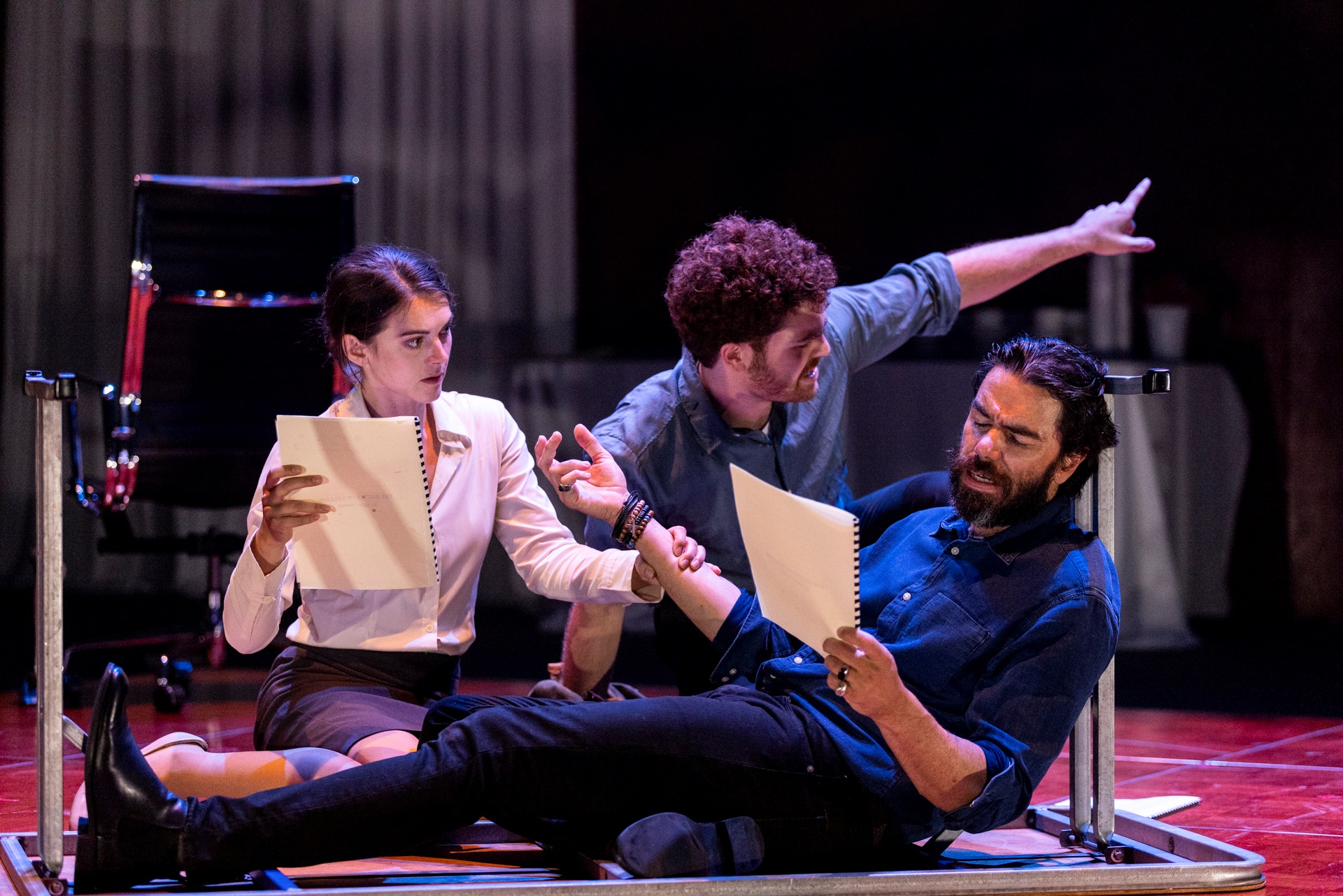
Three (Short) Plays by Tennessee Williams

11 Aug

An increasing familiarity with a writer’s body of work offers real delight.

And it’s not just the delight of the know-it-all or the systemiser, the sort of pleasure that comes from a sense of superiority or control.

It’s the joy of meeting the artist behind the work, of getting a sense of their world view, their fascinations and their fears, what they feel they can attempt and what, for whatever reason, they eschew.

Jane Austen famously described her writing as a little bit (two inches wide) of ivory on which I work with so fine a brush, as produces little effect after much labour – and if you’ve had the good fortune to read her six novels, you’ll know that even in her throw away aphorisms she was the master ironist.

But what of Tennessee Williams?

Many of us are familiar with Williams’ full length plays The Glass Menagerie, Cat on a Hot Tin Roof and A Street Car Named Desire, but we’re less familiar with his short works. This production presents three of those playlets: At Liberty, Auto-Da-Fe and This Property is Condemned.

Williams was very proud of many of his short works.

And they further the impression of the artist and his art that many audiences get from his better known plays. On a linguistic level, they’re constructed from a beautifully heightened language that never loses its connection with the genuine vernacular. On a thematic level, they’re built from the tensions between sexuality and respectability, purity and pretension, and loneliness and fulfilment. And because they’re usually performed in a Southern accent (as they are here) they seem to offer a portrait of a particular part of the USA at a particular time. (You might assert that all theatre does something like my last point; that is, depict a specific place and time, but I think that’s true to varying degrees. Williams always seems aware of Society – that demographic cultural phenomena which is the subject of study of sociology, and is posited by modernity because it recognises the ubiquity of the arbitrary. Williams is aware of this Society in a way that, say, Shakespeare is not. You could argue this is because Williams is more interested in the outsider, but Shakespeare has characters like Othello and Shylock. Williams’ outsiders, however, are not obviously outsiders: he’s the great playwright of the hidden subversive.)

Directed by Megan Sampson, this production is a wonderful opportunity to consider the exact nature of the playwright’s genius (and, if you read this before you go, offers the added pleasure of concluding that my assessment of Williams is utterly inadequate or simply absurd.)

I’ll forgo filler and refrain from a description of each playlet; with the whole evening only 50 mins long, scenarios too easily slip into spoilers. Suffice to say, each piece is a treat, and the six different roles, doubled by Helena Cielak, Will Manton and Emma Wright, are brought to life with a precise energy. Cielak portrays two different women who each in their own way balances a radiant presence with a pathos-inducing bluster. Manton creates portraits of both uptight repression and bewildered innocence. And Wright brings fitting focus to two distinct characters who represent firmness in the face of flailing volatility.

Paul Gilchrist

Three (Short) Plays by Tennessee Williams

Presented by Ground Floor Theatre Company

At the Old Fitz, as the Late Show, until 15 August

oldfitztheatre.com.au

Image by Robert Miniter

Othello

26 Jul

There’s currently another company in Sydney producing another play by Shakespeare – and they’re employing the slogan All Bard, No Bull.

In contrast, the marketing for this production of Othello led me to expect something somewhat closer to the bull end of that imagined spectrum.

And, yes, bold choices are made – but, at heart, what we’re given is an engaging presentation of Shakespeare’s classic script.

As for most modern productions, that script has been slightly abbreviated. I’ll admit, some of my favourite lines and speeches are missing, but all the key elements of the story remain.

The cast is all female. Some might think this an usual choice, but it’s worth noting that each of the characters retains the gender Shakespeare originally gave them.

Casting is also colour blind. Some might think this an even more unusual choice, as a common reading of the play is that Othello is susceptible to Iago’s deceit and manipulation because of his outsider status. (There’s plenty of textual evidence to suggest Iago takes advantage of Othello’s potential vulnerability as the only black man in a white society.)

The marketing states the production has a “movement-based performance style”, but don’t fear, Shakespeare’s incomparable poetry is not sacrificed to an undue focus on physicality. Director Diana Paola Alvarado’s interest in movement mainly manifests itself in the rearrangement of the set between and within scenes. Designed by Jason Lowe and Leandro Sanchez, and consisting of four industrial-style pillars, the set is moved by the performers with a beautifully fluent choreography, and complemented by Theo Carroll’s wonderfully evocative haze-tinted chiaroscuro lighting design, as the play moves to its climax, the mood becomes increasingly and disturbingly claustrophobic. This perfectly captures the tragedy of Othello and Desdemona: a man who has been through so much, whose life story of “most disastrous chances, of moving accidents … of hair-breadth scape(s)” has elicited from Desdemona “a world of sighs”; a tale that “in faith, ’twas strange, ’twas passing strange; ’Twas pitiful, ’twas wondrous pitiful” is what wins her love – and the ultimate pity of the play is that the lives of two such great souls as these should end in a horror of pettiness.

Sometimes the performers deliver the verse at too great a pace, but intriguing choices are made regarding characterisation. Cassio, played with suitable sophistication and charm by Chloe Schwank, may seem recognisable to audiences, as will be Lucinda Jurd’s delightfully foolish Roderigo, but other choices are less expected. Doubling, Jurd’s Emilia is less earthy than usual, Lisa Hanssens’ Iago is less hail-fellow-well-met in his duplicity than usual, Sedem Banini’s Desdemona is less refined and demure, and Natasha Cheng’s Othello, in the play’s initial acts, less calmly commanding. I’ve deliberately phrased my descriptions of these performances to highlight what they don’t do – and I’m sure that’s frustrating –  but I’d rather not spoil the surprising freshness of the choices.   

Paul Gilchrist

Othello by William Shakespeare

Presented by La Fábrica de Microbios and Gente Perdida

At Flight Path Theatre until August 9

flightpaththeatre.org

Image by Felipe Godoy

Betrayal

23 Jul

I know a lot of us justify the fact we’re yet to win a Nobel Prize in Literature by telling ourselves that it’s really just about who you know.

However, Betrayal by Nobel laureate Harold Pinter raises the disturbing spectre that the prize might also be awarded to those of genuine genius.

Several years ago, and for quite some time, Jerry had an affair with Emma, the wife of Robert, his best friend. Pinter tells most of the story through a reverse chronology, ultimately ending at the beginning.

The impact of reversing the tale’s chronology is twofold.

Firstly, it facilitates dramatic irony. Lies become more apparent, like shards of glass in sunlight. The audience delights in discovering the ways the characters have not been open and honest about the past.

But Pinter’s unconventional structure is not about giving the characters some sort of back history that explains or justifies their infidelity. (I’ve never been a fan of plays that use flashback to explain the present, feeling the question What happens next? is always more interesting than Why did that happen?) What Pinter does is more akin to what a craft-person working in the plastic arts might do. He crafts an object from the concept of betrayal, leaving us as unconcerned with narrative as we would be with, say, a small glass ornament. Instead, the concept is held up to the light, and we’re given glimpses from different angles, to marvel at the way the Truth is tainted.

This leads me to the other stroke of genius displayed in this unconventional structure: it weakens the sense of the passing of Time, as though whatever it is that is being betrayed is beyond Time – which, of course, it is. Every committed relationship we have is an attempt to transcend Time, to deny its inevitabilities, to say This Always, despite all Life’s vagaries.

And this hope filled fantasy of permanence aligns with how we usually think about ourselves as individuals. We imagine we’re like some solid object somehow caught in the current of Time. It’s as though we’ve accidentally fallen into that mysterious river and our natural element is elsewhere. Yes, we acknowledge the current will ultimately beat and batter us till destruction – that’s just a matter of Time – but we don’t see ourselves as fundamentally a part of the world that does that, but somehow outside and opposed to it. The soul-expanding thrill of Pinter’s play about deception is that the characters are continually shocked to discover that their secrets were always known, that their belief in their separation from the wider world was an illusion all along.

Cristabel Sved directs a wonderful production of this superb play. The staging is suitably and deliciously simple. Performances are excellent, offered in a gorgeous understatement that both highlights the glib naivety of those who deny realities greater than themselves, and which creates all the more poignancy when genuine vulnerability and passion are revealed.

Let me highlight a few moments of utter dramatic magic: the deeply human fragility of Ella Scott Lynch as Emma when she is simultaneously known to be unfaithful and aware the affair is over; Andrew Cutcliffe as Robert at a restaurant, cutlery in hand, barely containing his anger towards his supposed best friend; and Matt Hardie and Lynch as the two lovers, in the scene where their affair begins, so wanting to see life-affirming magic in what’s just a garden-variety curse; and Diego Retamales in a terrific comic cameo.

Paul Gilchrist

Betrayal by Harold Pinter

presented by Sport for Jove

until 10 Aug at the Old Fitz

oldfitztheatre.com.au

Image by Kate Williams

Conscience

19 Jul

This is a fine piece of provocative political theatre.

Written by Joe DiPietro and first produced in 2020, Conscience tells the story of American Republican Senator Margaret Chase Smith in her battle against McCarthyism. 

The Greek Theatre can be a challenging stage on which to play, but director Madeleine Stedman uses the space superbly, giving the production a beautiful flow (the type seen in quality performances of Shakespearean drama.) Stedman also elicits some excellent performances from her cast. Alison Chambers as Margaret Chase Smith gives us the iconic symbol of moral integrity, but richly shades that symbol with the warmth of human weakness. As Smith’s assistant, Matthew Abotomey offers a brilliant portrait of determination and fierce intelligence when they’re pitifully tainted with (undeserved) shame. Ben Dewstow as Joe McCarthy plays the buffoon splendidly, presenting both the self-interest and the sleaze that makes this variety of clownish laughability so politically dangerous. McCarthy’s assistant, Jean Kerr, has probably the largest character arc, and Jordan Thompson’s performance is mesmerising, a heart-rending journey of seduction and corruption. 

The play raises some fascinating questions.

Firstly, there are questions concerning the nature of historical drama. Directors are often asked Why this play now? And playwrights are asked Why this story now? Why tell a tale that’s set 70 years ago? To answer, Relevance is usually trotted out – as if Truth and Beauty were insufficient justification for a work of art. (It’s the equivalent of choosing a minor hobgoblin to defend Two of the Persons of the Divine Trinity.) The script of Conscience has a firm sense of its own relevance, with McCarthy portrayed as a type of Trump. History does not repeat, as Mark Twain may have said, but it does rhyme. However, as every part-time poet knows, chase the rhyme and you lose the sense. There are times this script left me wanting to know more about the historical McCarthy and less about the implied similarity to Trump. I refer to Relevance as a hobgoblin because, when many commentators say a play is relevant, they only mean that it’s telling whatever story is currently being told by the media. And when that story is Trump, you might feel you don’t need to hear it again.  (To misquote a critic greater than, I asked for bread and you gave me stones.)

The second set of questions raised by the play concerns politics. The play left me thinking about the word conscience in relation to what might be called the political sphere of life. The title pulls no punches. Margaret Chase Smith followed her conscience in opposing McCarthy and the play portrays this as admirable. The play suggests many other people did not follow their consciences and that was reprehensible. But what impact did Smith’s actions ultimately have? How did her following of her conscience impact 1950’s America? The spoiler rule means I can’t unpack this line of thought further – but see the play, and ask yourself the same question.

It’s a common trope to assert, when someone chooses political actions different to our own, that they have silenced their conscience. It’s also a convenient trope – because it neglects to consider whether that other person ever really shared our values in the first place. Conscience is a private thing, and (talk to any priest who has heard confession) a rather complex and varied thing. What one person considers shameless compromise another embraces as unavoidable pragmatism. I’m making no comment about the historical individuals who didn’t stand up to McCarthy or about Smith’s attitude to them; it’s just that the play left me wondering whether the word conscience is really at home in the political sphere of life. Maybe home is where it belongs, keeping us from sleep in the small hours of the morning, as we stand solitary judge on our own souls. Only I know my own conscience. Everyone else can only guess at it – and why they should bother when there’s a better world to build is beyond me.

It’s through these invitations to thought that I feel the play achieves Relevance (and not because of that media-mimicking minor demon.) It’s relevant because it asks us to consider the Third Person of my imagined Divine Trinity – Goodness.

How do we personally manifest Goodness? And how can we encourage Goodness in others? Do people become Good by being told they are Bad? Are people only Good when they align with our vision of Goodness? How is individual Goodness related to a Good society?

As you can see, the play invites some awfully good questions.

Paul Gilchrist

Conscience by Joe DiPietro

Presented by Joining the Dots Theatre

At The Greek Theatre, Marrickville until July 26

joiningthedotstheatre.com.au

Image by Iain Cox Photography

Mr Red Light

11 Jul

A group of innocent people are held hostage for an hour and a half, which is coincidentally also the story being told on stage. (Thus would I seriously begin my review, if I were to accept my role in the grand tradition of theatre criticism, a role that posits my superiority to the storytellers. But I won’t – for reasons that will become apparent by the end of my response.)

After a failed attempted to rob a bank, Mr Red Light ends up in the Joker’s Pies store next door.

Despite a gun being waved around for the entirety of the show, the vision is comic and the key word wacky. There’s fun wordplay, set-based visual gags and very committed slapstick humour.

Written by Carl Bland (with Peter Bland and Peta Rutter) the play is absurdist or surrealist in intent, with the incredible scenario serving to invite thought about the human condition.

Dramatists love the trick of offering their characters no possibility of escape (and audiences go along with it because – as I’ve suggested – it often mirrors their own experience of being in a theatre.) But it’s a trick that demands careful consideration of the physicality of the performances; it’s inevitable that close proximity will have to reflect both intimacy and antipathy, and in so far as this genre is a distant cousin of naturalism, there’s enormous pressure to get the pacing right to make this all appear, if not believable, then at least somehow related to reality.

This production is certainly a giggle generator, but it suffers from an imprecision in the physical humour which is matched by a lack of rigour in the linguistic performances. And though the set by Andrew Foster impresses, some of the visual puns seem gratuitous. 

The plot plays out in real time, but texture is created by breaks into flashbacks, imagined scenarios and surprising perspectives.

This suggests the aspect of the human condition being explored is our ability to tell stories. Stories are shelter one character says. But not when they’re merely ever-repeated internal monologues: that sort of unexamined private narrative only prevents us experiencing Life’s fullness. Two of the characters have succumbed to the habit of telling themselves the story that they’re perpetually unlucky. (Always hitting red lights.) Another tells herself a constant narrative of guilt. We are storytelling creatures, but it’s only when we share those stories that their magic becomes apparent. It’s only when we sit around the fire and share with others the journey we’ve survived that stories perform their miracle: the transformation of disparate individuals into a close-knit community.

The unlikely conclusion of this piece is a hyperbolic assertion of this magical ability of stories. And though I feel this production struggles to cast that spell, it’s indubitably a joyful celebration of why theatre matters.

Paul Gilchrist

Mr Red Light by Carl Bland (with Peter Bland and Peta Rutter)

Presented by Nightsong

At Riverside Theatres until 12 July

riversideparramatta.com.au

Image supplied

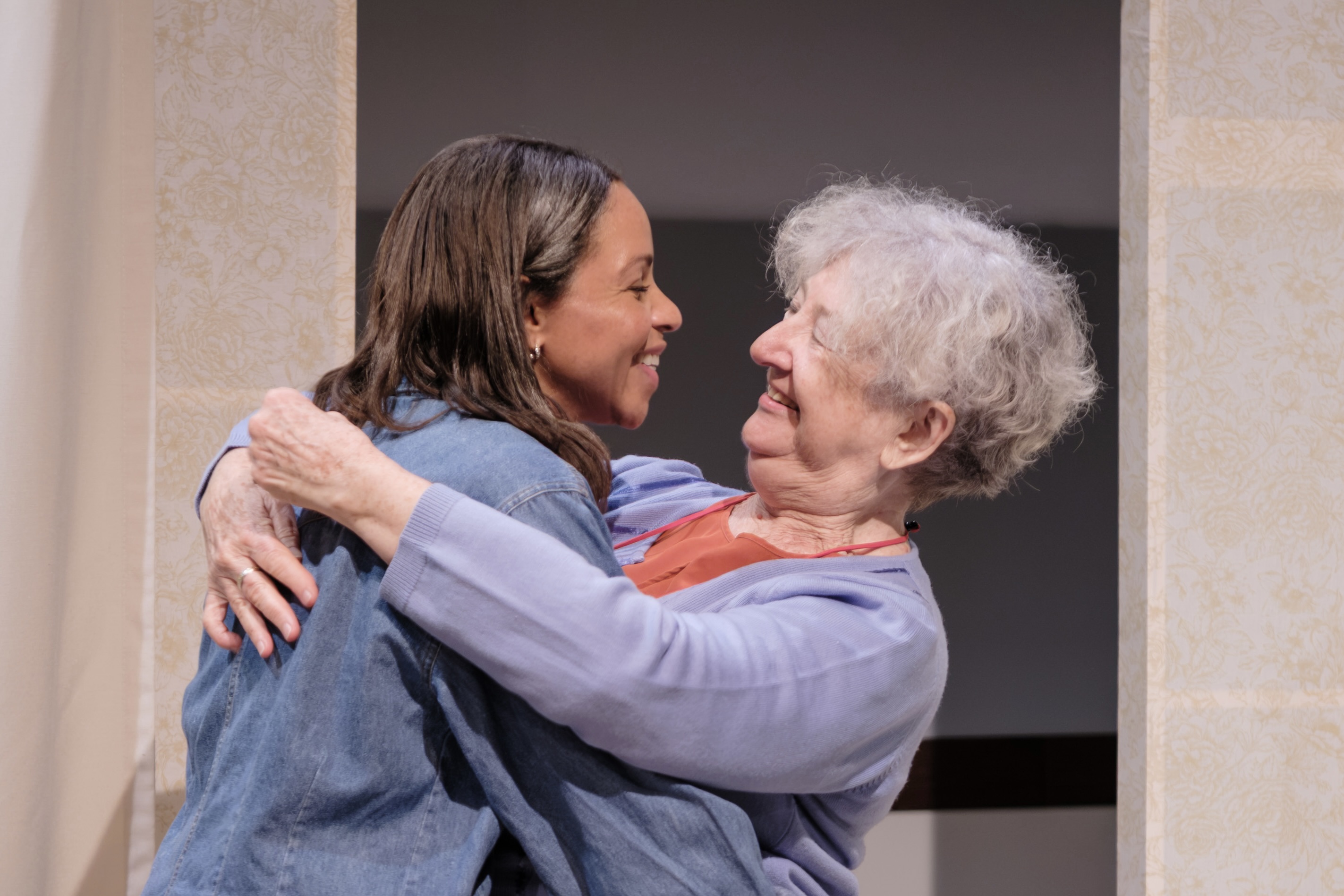
Primary Trust

26 Jun

To misquote Gandhi, We’re all children of God, it’s just that some of us are more childlike than others.

Kenneth is such a person.

Gentle, hesitant, uncertain, he lives a plain life and keeps to himself. He works at a second-hand bookstore. Every night he goes to Wally’s and drinks Mai Tais with his only friend, Bert. It’s difficult for Kenneth to imagine Life without Bert – and that’s curious, because Life doesn’t give many of us a Bert after the age of four. (Bert is the only character in Eboni Booth’s Pulitzer Prize winning play who transcends – in his own wondrous way – the inescapable doubts and wistful regrets of this sublunary world.)

When Kenneth’s bookshop is sold, he’s worried how he’ll find employment. (He got his first job only thanks to a social worker.) At the advice of Corrina from Wally’s, he applies for a position at a bank with the evocative name Primary Trust. According to Kenneth, the manager employs him because he reminds him of his brain-damaged brother.

As his friendship with Corrina develops, his special relationship with Bert changes, in a way that’s confronting (for Kenneth) but beautiful and hopeful.

The supreme importance of relationships like friendship is emphasised by an exquisitely simple speech by Corrina about her best friend, Denise. Corrina loves Denise. We don’t know why: in fact, we know virtually nothing about the briefly mentioned and never seen Denise – except that she doesn’t look after her cat as well as she might. But sometimes, when Corrina thinks about Denise, she cries. Perhaps this sounds sentimental? I think Corrina is just being honest, and being honest with Kenneth is life-changing. It’s this sort of openness that helps him find the connections he so desperately needs.

Primary Trust is an absolutely delightful comedy, informed by a sense of small town dagginess reminiscent of Thornton Wilder’s Our Town. (The set, by James Browne, with a back wall of many coloured doors emphasises this sense of the parochial presented playfully.) But unlike Wilder’s play, this story is one character’s (Kenneth’s), and the view from eternity that warmly infuses the conclusion of Our Town is absent, replaced by the vision, courageous and true, that the only heaven there is we must find here, amongst the struggling souls who surround us.

Except for one alluded-to-but-not-expanded-upon instance of racial injustice, the world around Kenneth is not malignant, only forgetful. (Or a little too complaisant: The sky is blue, what can you do?) But a little reaching out goes a long way.

Yes, it’s an exploration of trauma, highlighting the humanity of those who suffer – but what the play primarily offers is not a portrait of pain but rather models of kindness (the consistent, persistent type that engenders trust.)

Directed by Darren Yap, performances are gorgeously engaging. As Kenneth, Albert Mwangi is superb, both immensely likeable and poignantly pathetic. With a compassionate charisma, Charles Allen plays Bert, wonderfully portraying the perpetual patience and positivity of the best friend of our dreams. Angela Mahlatjie’s Corrina is magnificent: honest and humble yet hopeful; softly unassuming and utterly soul-expanding. And she and Peter Kowitz do some hilarious doubling, with Kowitz’s bank manager true comic gold. Booth’s script –which captures the wavering richness of real speech – calls for virtuoso vocal work, and the cast delivers (aided, no doubt, by the remarkable skills of dialect coach Linda Nicholls-Gidley.)

This Ensemble production is a glorious invitation to laugh, and an irresistible reminder of our shared humanity.

Paul Gilchrist

Primary Trust by Eboni Booth

at Ensemble until 12 July

ensemble.com.au

Image by Prudence Upton

Eureka Day

5 Jun

Set almost entirely in the P&C meetings of a primary school, you might assume this is a fun satire of contemporary society.

And you’d be right. Eureka Day by American writer Jonathan Spector is extraordinarily funny. But it doesn’t just make fun, it confronts one of the biggest rifts in our culture.

Eureka Day Elementary is a school built on social justice and inclusivity: a place where everyone feels seen and heard; a place where decisions are reached by consensus; a place where all points of view are valid.

The last of these is the issue. (And possibly the second last.)

Eureka, of course, means I have found it! – and there’s a sense that’s what the P&C believe: that their place is special, that it encapsulates, somehow, the perfect way forward.

But, for all their good intentions, it doesn’t.

Watching their meetings – bursting with thoughtless condescension, moral pedantry and obsession with policy, yet empty of soul-felt kindness, honest humility and genuine openness – is utterly painful. Yes, it’s hilarious, but it’s also excruciating. Earlier, I called the piece satire, but that genre usually employs hyperbole to make its point. But there’s no exaggeration here; it’s just the reality of our present day.

(A reality that feels like one of the rings of punishment in Dante’s Divine Comedy, one in which we’re condemned to an endless repetition of what seem to be absurdities but are actually perverted echoes of our true sins. However, I do think it’s a ring of Purgatory we’re stuck in, rather than Hell; we are purging ourselves; things will improve; there’s no need to abandon hope.)

There are beautiful moments in the piece where our societal problem is artfully diagnosed. One parent jokes that her daughter was very smart but also good-natured, so they knew she would become a benevolent dictator. Another compliments the work of a mime artist, for his subtlety and, we can only imagine, for his rare ability to just remain silent. Another parent says it straight out: she’s sick of the hubris.

This hubris, the belief that they’ve found the correct way, is tested by an outbreak of mumps at the school. Can all decisions be made by consensus? Are all points of view really valid?

As a society, we’ve fallen in love with policy and forgotten politics. And by politics, I mean the sphere of life in which we have to work with other people (as against just shout at them over and over that they are wrong or evil.) The fact that this play centres on meetings where adults must come together and solve problems makes it essential viewing.

(Though I must admit, I’m a little uncertain about the play’s exploration of vaccination. This hot button issue threatens to overwhelm everything else, burying from common view the representation of the political sphere that I so value. But, yes, I know, I know, the dramatic form must deal in the concrete…)

Directed by Craig Baldwin, the production bubbles away at just the right pace, evoking the awful enervating reality we currently endure, yet still assuring us the dramatic boil-over is imminent.

Performances are excellent.

Jamie Oxenbould as Don, a school official, is perfectly, perpetually, and pathetically polite and patient.

Katrina Retallick as Suzanne is both wonderfully comic and deeply poignant, offering a rich portrait of an individual traumatised by the universe’s chaotic cruelty and who overcompensates with a commitment to control.

Christian Charisiou’s Eli is brilliant as the epitome of overtalking privilege, the misguided good that knows not when to stop.

Branden Christine as the newcomer to the school community is magnificent, presenting a fascinating study in intelligence encountering its nemesis: the holding back, the bitten tongue, the seductive whisperings of despair as we wait to speak the Truth.

Deborah An as May has a gloriously warm energy. Her character’s journey is perhaps the biggest of the play, and she pitches it superbly. Her speech in which she posits what she wants for her kids is a highlight, and represents the best of what the play has to offer: the petty hobgoblin of certainty dispelled by a courageous vision of hope.

With this production, Outhouse Theatre shows once again why they are a vital part of the Sydney scene, presenting work that dares to walk our societal fault lines, and keeps its balance with honesty and humour.

Paul Gilchrist

Eureka Day by Jonathan Spector

Presented by Seymour Centre & Outhouse Theatre Co

At Seymour Centre until 21 June

seymourcentre.com

Image by Richard Farland

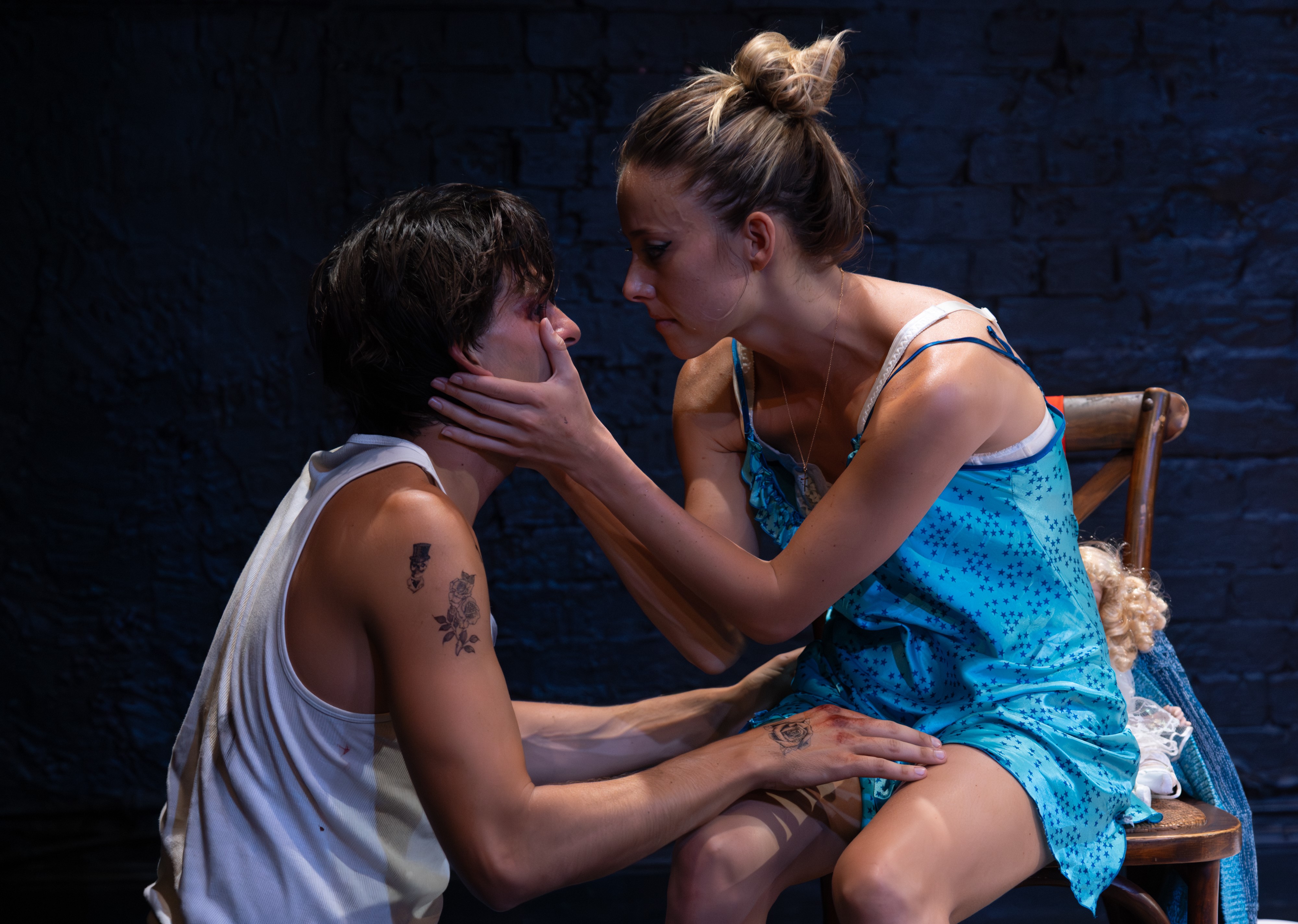
Heaven

19 May

This is a beautiful play, beautifully presented.

Written by Irish writer Eugene O’Brien, it tells the story of a middle-aged couple at a crisis point, and it does so with humour and insight.

Kate Gaul’s direction is wonderfully simple, unaffected in a way that allows the brilliance of the writing and performance to shine.

The piece is constructed from two intertwining monologues. Husband and wife Mal and Mairead attend a family wedding. The couple seem to get on well, but they’re never shown speaking to each other because each is in the process of exploring something that will challenge their relationship. Fitting the setting, that challenge is sexual.

Mairead has met an old flame, the man with whom, in her twenties, she had the best sex of her life. Mal is confronting his repressed homosexual desires.

The title? Heaven? Do they both seek a joy that will utterly transcend their merely comfortable relationship? Have both become aware that Eternity fast approaches, with its mysterious, unsatisfying promise of either oblivion or pleasures of a less certain nature?  

In contrast to the metaphysical connotations of the title, both characters use very physical metaphors to express their needs and doubts, underlining that they’re far from finished with this plane of existence. She asks is this where my 50 years has lead? He wonders whether he has the courage to enter the world below, the lower dimension.

Because of my peculiar (and un-Australian) penchant for digging into metaphor, I should make clear that the play is not in any way religious (except what it has in common with all serious philosophies: an awareness of the tension between our inner lives and our outward relationships.)

This is, however, modern Ireland, and the hand of Catholicism is still heavy. Mairead tells of going to England for an abortion. Mal’s sexual fantasies are couched in the language of his desire for Jesus, effectively suggesting the complexity of his emotional situation, its guilt and its passion.

As the couple, Lucy Miller and Noel Hodda are absolutely superb.

Miller’s Mairead is gloriously tough. She doesn’t edit her speech. She’s a proud playground bully. She’s utterly disdainful of her daughter’s choice of partner. Reflecting on the death of her abusive father, she hisses that cancer sometimes takes the right ones. She’s deeply sensual and unafraid to fulfill her needs. Yet, she never speaks a word against Mal. It’s a magnificently rounded portrait, strength sparring with uncertainty, delivered with captivating power.

Hodda’s Mal is gentler, softer – desirous of the direction Mairead gives his life. Hodda plays the humour of the-dag-who-dares with consummate skill, but also marvellously portrays the internal battle between desire and doubt.

It’s a temptation with a production like this to be so taken by the skill of the makers that you forget the meaning, that (to mangle Yeats) you fall in love with the dancers, and forget the dance. But this production – an exploration of the tension between our inner and outer worlds, epitomised in its presentation of a marriage under threat – achieves the perfect marriage between artistry and Art.   

Paul Gilchrist

Heaven by Eugene O’Brien

Presented by Bitchen Wolf

At the Loading Dock Qtopia, until May 31

qtopiasydney.com.au

Image by Alex Vaughan