Tag Archives: Theatre Review Sydney

The Face of Jizo

27 Aug

What people do to other people.

So says Mitsue’s perplexed father.

Mitsue is a survivor of the bombing of Hiroshima. She now works in a library. She’s also a member of a club that collects folktales. She insists they be handed down as they were traditionally told. During story week, she shares them with the local children.

A young physicist, and a potential suitor, has arrived in the city. He’s collecting mishappen objects that illustrate the ferocity of the nuclear explosion that was unleashed only three years ago.

Mitsue’s father suggests ways that these objects could be incorporated in her stories. She’s reluctant. She says no art can be made from what happened to the people of Hiroshima.

This play by Hisashi Inoue proves Mitsue wrong. A story of Little People caught in Big History, it’s both beautiful and profoundly moving. It does what theatre can do so well; it makes concrete what otherwise is lost in abstraction. We all know what happened at Hiroshima 80 years ago, but bewildered by the sheer numbers, the human face of the horror is hidden.

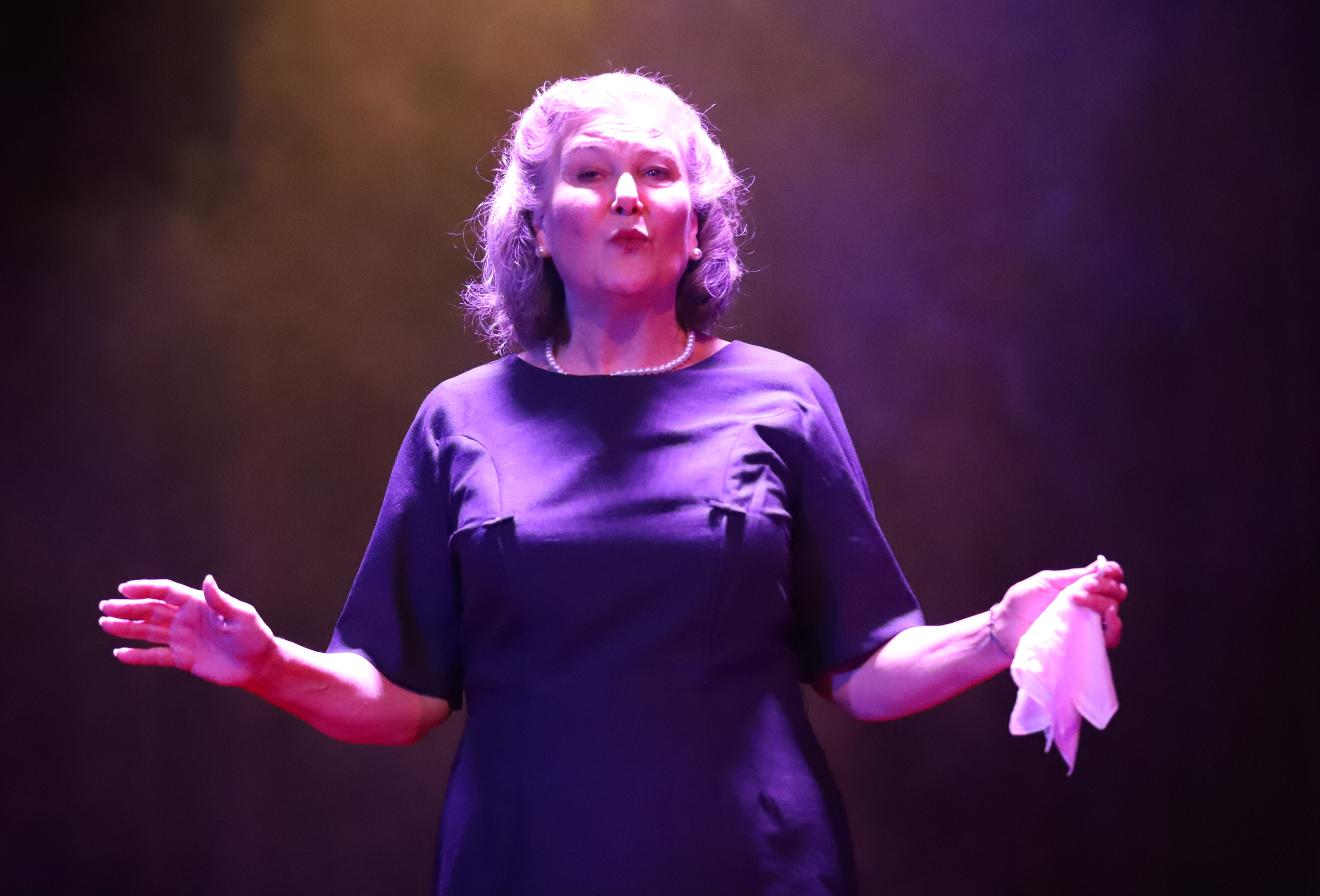
Directed by Shingo Usami and David Lynch, this production is extraordinarily powerful. Mayu Iwasaki as Mitsue and Usami as her father deliver magnificently poignant performances. It’s the gentleness, the restraint, the unforced nature of these performances that have such an effect. “Dripping water hollows out stone” wrote Ovid. Plotwise, we know what’s happened to Mitsue, and we soon guess what’s happened to her father, but over the show’s 70 minutes, which is sprinkled with humour and infused with the warmth of the love between father and daughter, we come to feel their true humanity, in all its wondrous fragility.

In our mad world, the plenitude of pain can petrify us, can turn our hearts to stone. But stone can soften, and by arousing such deep sympathy for those who suffer, The Face of Jizo revitalises hearts that have become too heavy.

Paul Gilchrist

The Face of Jizo by Hisashi Inoue (translated by Roger Pulvers)

Presented by Seymour Centre and Omusubi Productions

At Seymour Centre until 7 September

seymourcentre.com

Image by Philip Erbacher

Conscience

19 Jul

This is a fine piece of provocative political theatre.

Written by Joe DiPietro and first produced in 2020, Conscience tells the story of American Republican Senator Margaret Chase Smith in her battle against McCarthyism. 

The Greek Theatre can be a challenging stage on which to play, but director Madeleine Stedman uses the space superbly, giving the production a beautiful flow (the type seen in quality performances of Shakespearean drama.) Stedman also elicits some excellent performances from her cast. Alison Chambers as Margaret Chase Smith gives us the iconic symbol of moral integrity, but richly shades that symbol with the warmth of human weakness. As Smith’s assistant, Matthew Abotomey offers a brilliant portrait of determination and fierce intelligence when they’re pitifully tainted with (undeserved) shame. Ben Dewstow as Joe McCarthy plays the buffoon splendidly, presenting both the self-interest and the sleaze that makes this variety of clownish laughability so politically dangerous. McCarthy’s assistant, Jean Kerr, has probably the largest character arc, and Jordan Thompson’s performance is mesmerising, a heart-rending journey of seduction and corruption. 

The play raises some fascinating questions.

Firstly, there are questions concerning the nature of historical drama. Directors are often asked Why this play now? And playwrights are asked Why this story now? Why tell a tale that’s set 70 years ago? To answer, Relevance is usually trotted out – as if Truth and Beauty were insufficient justification for a work of art. (It’s the equivalent of choosing a minor hobgoblin to defend Two of the Persons of the Divine Trinity.) The script of Conscience has a firm sense of its own relevance, with McCarthy portrayed as a type of Trump. History does not repeat, as Mark Twain may have said, but it does rhyme. However, as every part-time poet knows, chase the rhyme and you lose the sense. There are times this script left me wanting to know more about the historical McCarthy and less about the implied similarity to Trump. I refer to Relevance as a hobgoblin because, when many commentators say a play is relevant, they only mean that it’s telling whatever story is currently being told by the media. And when that story is Trump, you might feel you don’t need to hear it again.  (To misquote a critic greater than, I asked for bread and you gave me stones.)

The second set of questions raised by the play concerns politics. The play left me thinking about the word conscience in relation to what might be called the political sphere of life. The title pulls no punches. Margaret Chase Smith followed her conscience in opposing McCarthy and the play portrays this as admirable. The play suggests many other people did not follow their consciences and that was reprehensible. But what impact did Smith’s actions ultimately have? How did her following of her conscience impact 1950’s America? The spoiler rule means I can’t unpack this line of thought further – but see the play, and ask yourself the same question.

It’s a common trope to assert, when someone chooses political actions different to our own, that they have silenced their conscience. It’s also a convenient trope – because it neglects to consider whether that other person ever really shared our values in the first place. Conscience is a private thing, and (talk to any priest who has heard confession) a rather complex and varied thing. What one person considers shameless compromise another embraces as unavoidable pragmatism. I’m making no comment about the historical individuals who didn’t stand up to McCarthy or about Smith’s attitude to them; it’s just that the play left me wondering whether the word conscience is really at home in the political sphere of life. Maybe home is where it belongs, keeping us from sleep in the small hours of the morning, as we stand solitary judge on our own souls. Only I know my own conscience. Everyone else can only guess at it – and why they should bother when there’s a better world to build is beyond me.

It’s through these invitations to thought that I feel the play achieves Relevance (and not because of that media-mimicking minor demon.) It’s relevant because it asks us to consider the Third Person of my imagined Divine Trinity – Goodness.

How do we personally manifest Goodness? And how can we encourage Goodness in others? Do people become Good by being told they are Bad? Are people only Good when they align with our vision of Goodness? How is individual Goodness related to a Good society?

As you can see, the play invites some awfully good questions.

Paul Gilchrist

Conscience by Joe DiPietro

Presented by Joining the Dots Theatre

At The Greek Theatre, Marrickville until July 26

joiningthedotstheatre.com.au

Image by Iain Cox Photography

Mr Red Light

11 Jul

A group of innocent people are held hostage for an hour and a half, which is coincidentally also the story being told on stage. (Thus would I seriously begin my review, if I were to accept my role in the grand tradition of theatre criticism, a role that posits my superiority to the storytellers. But I won’t – for reasons that will become apparent by the end of my response.)

After a failed attempted to rob a bank, Mr Red Light ends up in the Joker’s Pies store next door.

Despite a gun being waved around for the entirety of the show, the vision is comic and the key word wacky. There’s fun wordplay, set-based visual gags and very committed slapstick humour.

Written by Carl Bland (with Peter Bland and Peta Rutter) the play is absurdist or surrealist in intent, with the incredible scenario serving to invite thought about the human condition.

Dramatists love the trick of offering their characters no possibility of escape (and audiences go along with it because – as I’ve suggested – it often mirrors their own experience of being in a theatre.) But it’s a trick that demands careful consideration of the physicality of the performances; it’s inevitable that close proximity will have to reflect both intimacy and antipathy, and in so far as this genre is a distant cousin of naturalism, there’s enormous pressure to get the pacing right to make this all appear, if not believable, then at least somehow related to reality.

This production is certainly a giggle generator, but it suffers from an imprecision in the physical humour which is matched by a lack of rigour in the linguistic performances. And though the set by Andrew Foster impresses, some of the visual puns seem gratuitous. 

The plot plays out in real time, but texture is created by breaks into flashbacks, imagined scenarios and surprising perspectives.

This suggests the aspect of the human condition being explored is our ability to tell stories. Stories are shelter one character says. But not when they’re merely ever-repeated internal monologues: that sort of unexamined private narrative only prevents us experiencing Life’s fullness. Two of the characters have succumbed to the habit of telling themselves the story that they’re perpetually unlucky. (Always hitting red lights.) Another tells herself a constant narrative of guilt. We are storytelling creatures, but it’s only when we share those stories that their magic becomes apparent. It’s only when we sit around the fire and share with others the journey we’ve survived that stories perform their miracle: the transformation of disparate individuals into a close-knit community.

The unlikely conclusion of this piece is a hyperbolic assertion of this magical ability of stories. And though I feel this production struggles to cast that spell, it’s indubitably a joyful celebration of why theatre matters.

Paul Gilchrist

Mr Red Light by Carl Bland (with Peter Bland and Peta Rutter)

Presented by Nightsong

At Riverside Theatres until 12 July

riversideparramatta.com.au

Image supplied

Blackbird

30 Jun

This one’s probably not for date night.

Late twenties-something Una confronts middle-aged Ray about what he did to her fifteen years ago.

To misquote Voltaire, if this play did not exist, it would be natural to assume it did. Written by David Harrower, it won the Olivier for Best New Play in 2007. And if you were a parochial Australian theatre reviewer – yes, the first two adjectives are tautologous – if you were a parochial Australian theatre reviewer, you might be inclined to view this piece as the epitome of the modern British play. It’s gritty. It presents two characters in a room in real time. It goes to a place most of us don’t want to go. It’s constructed from staccato dialogue that eventually blossoms into beautifully written monologues. It gives voice to characters who in public discourse are standardly reduced to stereotypes: either victim or villain.

As a result, it’s tempting to see it as a well-executed writing exercise or some sort of feat of dramatic ability. And there’s certainly much to admire about the skill. It would be terrific to show aspiring playwrights: What does it do? What doesn’t it do?

I’ve suggested a little about what it does, but what about what it chooses not to?

Despite Ray getting half the dialogue, we don’t really ever learn much about him. This is partly because we’re always deliberately left uncertain whether he is being honest or whether he is performing. This could engage an audience or it could tire them. The challenge is that the more realistically Ray is played, the more banality there is in his evil, the less we will see and enjoy – if enjoy is the right word –  what might be a theatrical Machiavellian duplicity. But another reason we’re left not knowing much about Ray is because his faults, obvious on an ethical level, remain opaque on an ontological level. If you’re of the hopelessly hopeful school that assumes that every human fault is only the desire for some good somehow gone wrong, then it’s difficult to see, with his particular fault in this presentation, what that good ever was. I suspect twenty years ago, the play encapsulated the movement, the moment, when for the first time this particular crime and its prevalence was openly and seriously discussed. And that was sufficient.

There’s another thing the play deliberately doesn’t do. What we’re shown on stage occurs fifteen years after the original crime. Ray has tried to move on. Una can’t. We hear a lot about the past, but we don’t see it. (Would we want to? No. But then, do we want to be shown the present?) This is a play primarily about consequences rather than causes. What we are shown is how individuals – both perpetrator and victim – try to deal with the past, how they create narratives to try to make sense of their guilt, their pain. But as we haven’t been shown that past, this personal narrative building is oddly untethered, pushing us back on assumptions we held before we entered the theatre. As I’ve said, perhaps twenty years ago ….

But, in the face of those who suffer, and who continue to suffer, it’s ENTIRELY INADEQUATE to say But we’ve talked about this already. Every evil must be faced anew; the price of innocence is eternal vigilance.

Directed by Pippa Thoroughgood, this production powerfully urges that vigilance. Performances are committed and courageous. Charlotte De Wit’s Una is a pathos-inducing portrait of fracture: assertiveness battling uncertainty. Her monologue in which vulnerability predominates is delivered superbly. Phil McGrath’s Ray is aptly unsettling: mundanity blends with belligerence, despondency becomes indistinguishable from duplicity.

Paul Gilchrist

Blackbird by David Harrower

Presented by HER Productions in association with bAKEHOUSE Theatre Co.

At KXT until 5 July

kingsxtheatre.com

Image by Ravina Jassani

Instructions for Correct Assembly

28 Jun

Poet Philip Larkin earnt a place eternally in the hearts of many a son and daughter when he expressed perfectly the magical wonder of filial gratitude: “They fuck you up, your mum and dad.”

(More fortunate souls might relate instead to Adrian Mitchell’s parodic response “They tuck you up….”)

The idea of child-rearing is the main focus of Thomas Eccleshare’s speculative comedy.

I use the term speculative because the major conceit is that Max (Jane Wallace) and Hari (Nick Curnow) have purchased a do-it-yourself flat-pack artificially intelligent young man, Jån. Trouble is, as friends quickly notice, Jån bears an uncanny resemblance to the couples’ lost son, Nick. As parents, can Max and Hari get right what they feel they got wrong before?

I don’t have children and, when I’m in the company of anyone who does, I feel enormous admiration for the immensity of their effort and complete bewilderment at the oddness of their choice. I’m inclined to feel that child-rearing should be left to those most suited to it: wolves.

Yet, despite the emotional immaturity and self-obsession that fits me for theatre reviewing, I am aware that a large number of parents, especially middle-class ones, experience a prodigious amount of angst about their chosen role. Am I doing what’s best for my kids? And, the disturbing corollary, how do my kids reflect on me?

Eccleshare’s mischievous script offers huge comic potential, and under the direction of Hailey McQueen, the cast delivers the laughs. As robot Jån, Ben Chapple is absolutely hilarious – and, as the troubled Nick, he offers in counterpoint an honest portrayal of fickle, flawed humanity. It’s a doubling opportunity that allows an actor to show off a tremendous range and Chapple seizes it, giving a virtuoso performance.

The doubling does epitomise the piece’s greatest challenge (that is, apart from the large number of short scenes). The piece has titanic tonal ambition. A certain smallness is being satirised, that middle-class desire for control in the face of Life’s wildness, that determination to make the world one of neat, smooth, straight lines. Yet we’re also invited to care about the characters, or at least to find the genuine or the recognisable in their emotional responses. Throw into the mix that the setup is speculative – or to put it less euphemistically, untruthful – and you’ve got one provocative, audacious piece of theatre.

Paul Gilchrist

Instructions for Correct Assembly by Thomas Eccleshare

Presented by Clock and Spiel Productions

at Flight Path Theatre until 5 July

flightpaththeatre.org

Image by Patrick Phillips

The Amazing Lucas Girls

25 Apr

This is set in Ballarat during the First World War and its direct aftermath.

The Lucas Girls are the women who work in E. Lucas & Co, a clothing and corsetry factory.

They’re Amazing because of their response to the war. Losing husbands, lovers, brothers and fathers to the conflict, they work to give solace to those who grieve, and they fight against the introduction of conscription to ensure no other lives are unnecessarily sacrificed.

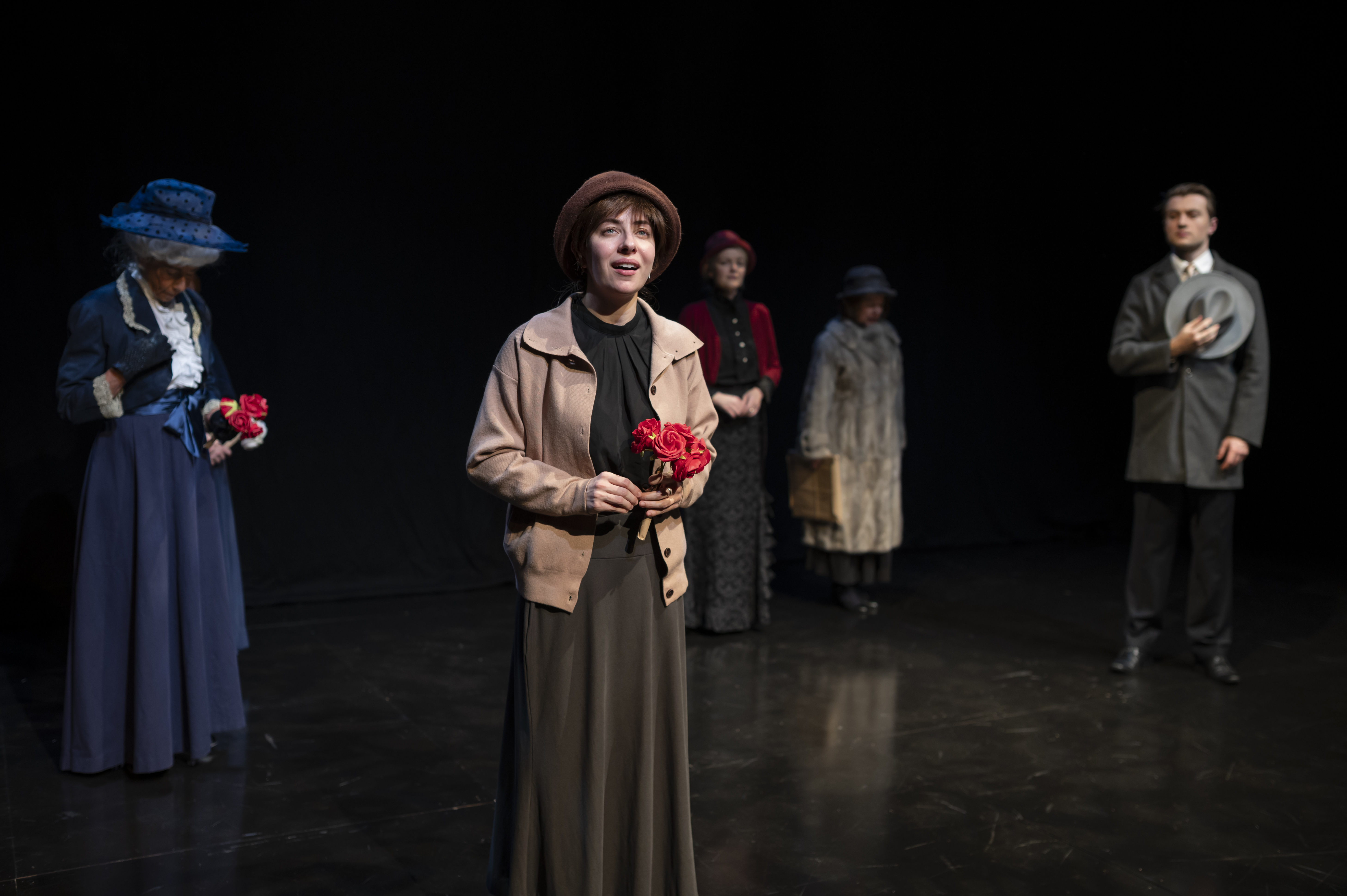
Writer and director Cate Whittaker tells this tale through a focus on two sisters, Tilly and Clara. The tensions and affections between the siblings are well presented by Joanne Booth and Amy Joyce. The sisters work in sales and management, and so are not the working class factory hands. In the main, these women are left off stage, represented only by Casey Martin, who portrays a wonderfully cheeky Mavis.

Martin also briefly plays Vida Goldstein, a character whose mere mention drew applause from the audience. This underlined one of the play’s unmistakable goals: to recognise the efforts of the women who have made our society more humane.

As an opportunity to present possibly forgotten historical facts, the play ticks the boxes, but Whittaker also works hard to give us an engaging character-driven story. Though both purposes are laudable, sometimes they seem at loggerheads. On some occasions, characters give slightly unnatural speeches of historical exposition. On all occasions, I was left uncertain whether these particular people once lived or whether they’re simply fictional creations. (The Lucas Girls are undeniably real, but I’m not so sure about these specific characters.)

Such are the perennial challenges of historical drama.

But I have to admit, I love the genre.

In contemporary theatre we often talk of sharing our stories and giving voice to particular communities, phraseology that creates the impression that theatre is merely a type of reportage.

But historical drama is clearly not reportage: when a play is set in a distant historical period the creating artists were simply not there. No matter how much research has been done, we know things are being made up, that we’re being thrown back onto fiction, and that’s a delightful thing. Rather than merely informing the audience, fiction is a glorious invitation to engage, to enjoy, to flourish.

It’s right to recognise and honour those who came before us. And from them we can take inspiration, whether they were made of flesh and blood, or of the stuff of dreams.  

I saw the first night of this run, and production values will hopefully improve. The play has a large number of scenes, which means a large number of exits and entrances – and these could do with more pace and pizazz. Similarly, on this first night, operation of the lighting was patchy, including at least one occasion when the house lights were raised mid-action. (I’ve never felt more seen by a piece of theatre.)

But, seriously, who is seen by this piece of theatre? Everyone who works to make the world a better place.

Paul Gilchrist

The Amazing Lucas Girls by Cate Whittaker

presented as part of the HERStory Arts Festival

at Wharf 2 until 26 April

herstoryfestival.com

Image supplied

Amber

2 Apr

This is a consciously cartoon-candy confection.

It’s both deliciously sweet and deceptively sophisticated.

Ostensibly, it tells the story of a young woman seeking the One.

Amber openly acknowledges that this relationship-focussed worldview derives from the rom-coms of Nora Ephron and Richard Curtis, the sit-com Friends, the Twilight series and Peter Pan.

Her journey to secure love is presented with terrific humour and true heart.

This is not new territory; it’s standard fare of fringe shows around the world. But this piece gloriously transcends that genre, offering something as provocative as it is playful.

Firstly (and because of my reference to fringe, I should make this clear) the production values are excellent. Director Mehhma Malhi understands the gem of a show she has and allows it to shine. The set by Hailley Hunt is suitably puckish, replete with panels that slide to reveal mischievous surprises. The lighting by Isobel Morrissey is dominated by hues of pink and mauve, wonderfully suggestive of the girlish dreams of the protagonist, but it’s also constructed from a plethora of states that reflect and enhance the bubbly bounce of her narrative.

Secondly, writer and performer Nikita Waldron is brilliant. With a vibrant charm, she breaks the fourth wall, and with self-deprecating humour expresses Amber’s dismay when reality doesn’t align with her chosen narrative. In her scenes with the other characters – the men in her life and her best friend – she creates an Amber who is a superb portrait of the bewilderment of youth, certain and insecure, outward looking but still mesmerised by the miracle of self.

The supporting cast are splendid. As the men, Harry Stacey, Ashan Kumar and Kurt Ramjan all move between characters with impressive versatility, and Esha Jessy as Amber’s best friend, Gabby, is an engaging mix of support and sarcasm.

If you’ve read this far, you might still be wondering what lifts this piece above rom-com. Waldron’s script, for all its seeming fluffy fun, takes on some extraordinarily large concepts. (And, no, I don’t mean socio-political ones. So much new work by early playwrights purports to do this, but these plays are rarely constructed in a way that allows more than the airing of slogans and so, despite aspiring to transgression, remain wholly conventional. Not that Waldron ignores the socio-political. Amber asks in the first scene Am I a bad feminist? and then moves on to bigger game. Race gets similar treatment; in a later scene, at a late-night kebab shop, there’s a hysterical pun, and then we’re off again.)

The big game the show hunts is narrative itself. Amber is clearly trying to make her life fit a story, but the play addresses this all-too-human habit on levels far beyond what the packaging might suggest.

Let me mention just a few instances.

Amber is Catholic. And she talks to God. (He retains his usual reticence.) But, she asks, and – in a way – receives. Several people in her life question her faith, people she deeply loves, and she openly admires their atheism. She doubts her faith herself. But she’s loathe to let it go. Let a story go and you have to replace it, and this one she knows. (Quite understandably, Catholicism has got a bad rap recently. But for all its institutional crimes, and for all its focus on guilt, there’s a song of joy tucked away in there – as there is in so many religious traditions – and it’s owned eternally, not by the hierarchy, but by souls like Amber. Without in anyway being overtly or conventionally religious, this play and this production sing with that joy.)

We’re not being asked to agree with Amber’s religious choices, but we’re shown a character entirely conscious that she’s navigating a grand narrative. (It’s one of the dullest and most disappointing of modern phenomena that educated individuals will reject some grand narrative or other and then tell themselves they’re now realists – which is just another story, one still unconscious of itself. A digression: Catherine of Siena, or one of the other medieval mystics, was once asked whether her visions appeared in the real world or in her imagination? With soul-expanding sanity, she responded, In my imagination, of course. The real world is only known through story.)

The play’s focus on narrative is emphasised by the choice to make Amber, and one of her most important male friends, career storytellers. She’s a novelist, he’s a film-maker. Narrative is something to take seriously.

And the final instance highlighting that the play is, in fact, a profound and rewarding exploration of the phenomenon of narrative is the plot turn that takes it beyond standard rom-com territory: the experience of grief.

We construct narratives to make some sense of the living, to create some stability that might survive their incorrigible dynamism, that perpetual becoming that is the hallmark of the Other. But when they are gone, our narratives are no longer challenged. And so we forget that they are constructed fictions, and they diminish into mere illusion.

Faced with grief, Amber must learn this. And as she does, we’re offered a deeply affecting reminder of the power, pleasure and purpose of story.

Paul Gilchrist

Amber by Nikita Waldron

presented by essential workers,

at Old Fitz until 11 April

oldfitztheatre.com.au

Image by Phil Erbacher

This is L-O-V-E

10 Mar

Philosophers as great as Plato, Augustine and Foreigner have all wanted to know what love is.

So, a title like this has genuine swagger. Are we, finally, to be given a definitive answer to the greatest of questions?

No.

This is L-O-V-E is an anthology of playlets by American dramatist Allan Staples, here somewhat loosely linked together by a connecting piece written by director Kai Paynter.

The playlets are all about love (romantic love, that is) and they’re all either very funny or very touching – but, of course, no definitive answer to the question What is love? is being offered. It’s more of a shot-gun style scatter sample. Any overarching theory, if one were ever worth attempting, is up to us. (I’m not sure if the playlets were originally intended to be grouped together.)

The eleven-strong ensemble are a little uneven, especially in terms of vocal work, and the changeovers between the playlets would benefit from more pace and pizazz, but the writing is beautiful and some of the performances are magnificent.

A couple process some daunting medical news. Kate Jirelle and Kirk Hastings work brilliantly the surprising humour, and Jirelle as the woman facing the diagnosis finds a gloriously honest and deeply moving vulnerability.

Another couple suspect they may be pregnant, despite having a decidedly unserious relationship. With Georgia Britt and Dominic Di Paolo, the gags fire, but both actors also offer emotionally inspiring performances: Britt presents a poignant dignity and Di Paulo an unexpected chivalry.

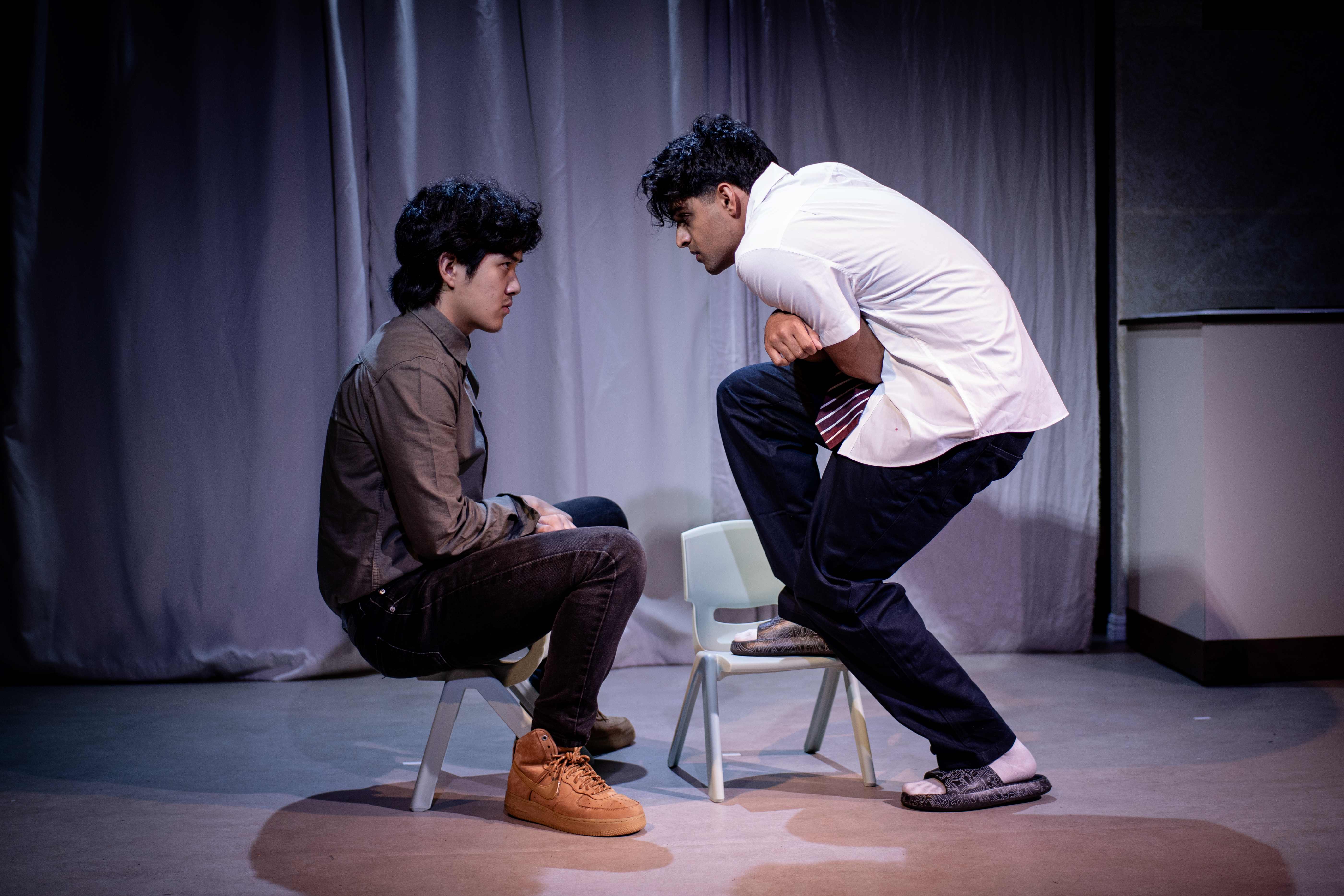
Two men bump into each other at an airport. Why did their romance fail? Alex Baum and Rhett Wilks superbly portray the heady mixture of residual resentment and ongoing chemistry.

Presented by The Americas A Theatre Company, there’s an intriguing focus on the USA. During each playlet, a photo of a recent American president is projected on the upstage wall. I was unsure whether these were meant to place the playlets in time. On occasions, I could draw a connection between the concerns of the particular playlet and the policies of the pictured president, or with events during his term, but often I couldn’t. I certainly didn’t need to see a two metre tall projection of Trump’s face.

This focus on the USA is curious, because it positions us to ask if the aim of the piece is to present love as it is experienced American-style. (It’s also quite brave, because since at least the 1940’s, Australian audiences have hardly been deprived of American culture. It’s only recent political events in the northern hemisphere that have left us wondering if America was always more foreign than we assumed.)

But perhaps that’s the point: despite the recent turn in American politics, both disturbing and bewildering – its people are still people, who like us all, worship before the great mystery of love.   

Paul Gilchrist

This is L-O-V-E by Allan Staples (with Kai Paynter)

Presented by BearTiger Productions in association with The Americas A Theatre Company

At the Loading Dock Theatre, Qtopia, until 15 March

qtopiasydney.com.au

Image by Tony Ling.

The Children’s Hour

17 Feb

This is a superb production of a magnificent play.

First written and produced in 1934, Lillian Hellman’s The Children’s Hour still has the power to thrill an audience.

Karen and Martha run a boarding school for girls. A disgruntled student makes accusations regarding the nature of the relationship between the two teachers.

The play is a masterclass in construction, powerfully building tension and suspense. (I’m not the first person to suggest Arthur Miller must have been a student at Hellman’s feet.)

And Kim Hardwick, the director of this production, handles the material brilliantly. Her entire cast is splendid. Jess Bell’s Martha is excellent, tough and purposeful, fraught and vulnerable, understanding the dangers more clearly than she understands herself. Romney Hamilton dazzles as Karen, displaying an extraordinary range, contented confidence giving way to dismayed fear, genuine warmth striving with helpless resignation. The presentation of the women’s relationship is gloriously honest, beautiful in its unaffected vision of two individuals sharing the walk through time, invigoratingly ambiguous in its prolonged refusal to reduce to any moral pigeonhole.

Mike Booth, as Karen’s fiancé, delivers a terrific portrait of intelligent, good-hearted determination doing its best to brush off the ubiquitous spider webs of rumour and doubt. Deborah Jones’ Aunt Lily, a down-on-her-luck thespian, creates hilarity through her self-importance, and deep poignancy through the heartbreaking imbalance between her insight and her courage. Kim Clifton as Mary Tilford, the accusing student, gives an utterly mesmerising portrait of manipulation and self-interest. Sarah Ballantyne as Rosalie, one of the students who suffers from Mary’s bullying, movingly portrays the descent from resistance to terror. Annie Byron as Mary’s grandmother effectively combines dignified concern with its bastard half-sister, self-righteousness.

Disrupting heteronormative assumptions, the play met both praise and derision on its first outings. One of the charms of this current production is that it evokes so strongly the theatrical (and filmic) style of the mid-thirties. This is achieved through performance choices, but also through set design by Emelia Simcox and costume design by Hannah Yardley. A translucent backdrop, painted scenery – a supposedly static world we know to be a façade, one that hides competing visions, and one that facilitates the pretence of the privileged to Truth.

On the simplest level, contemporary audiences will read the play as a passionate plea for open-mindedness (not a message that’ll get stale any time soon.) But produced in 2025, the play raises other questions of particular relevance.

In frustration at a system we fear doesn’t guarantee justice, we now often assert Believe the victim. But that’s a tragic (though understandable) begging of the question. And it so readily slips into that perilous territory Miller warned of in The Crucible: “Is the accuser always holy now?” Hellman’s characterisation of Mary Tilford is a forthright challenge to any hope that justice comes easily.

But the play’s killer blow to moral naivety comes in the portrait of Mrs Tilford. Karen asserts that granddaughter and grandmother are of the same stock, and she means not biology, but the close kinship between self-interested deceit and self-righteousness. Both are revealed as expressions of the lust for control. In The Children’s Hour, Truth maybe fragile, but Goodness is fatally flawed. (Or, at least, Goodness with a capital G.) It’s a radical indictment of assumptions of moral superiority, and a gentle endorsement of humility and kindness. (And one of particular value in our current era in which many of us are tempted to Goodness, to that oversimplification whereby we confidently cast ourselves as warriors against evil, positing enemies where there are just people, people with the very same access to Truth as ourselves.)   

The Children’s Hour is an absolutely gripping tale, and a deeply humane encouragement to moral maturity.

Paul Gilchrist

The Children’s Hour by Lillian Hellman

Presented by Tiny Dog Productions and Dead Fly Productions

at the Old Fitz until March 1

oldfitztheatre.com.au

Image by Phil Erbacher