Archive | February, 2025

They Will Be Kings

27 Feb

Despite being a delightful device for the creation of joy, running through this piece is a melancholic sense that the scene is less welcoming of drag kings than it has been – or, more importantly, might be.

And, judging by this production, that’s a real pity.

This is a thoroughly entertaining hour, and a magical celebration of life’s richness.

Directed by Kaz Therese and written by Therese & Danica Lani in collaboration with the cast, it’s part-sharing and part-performance.

The four cast members begin by asking each other to name a world famous drag king. They come up with few contenders. (Though the suggestion of Joan of Arc is marvellous food for thought; as one cast member says, the Maid of Orleans definitely would have been a they.)  

In amusing and affecting anecdotes, the cast members share personal stories of the joy of being a drag king. They also perform some of their own routines. As “Chase Cocks”, Chris McAllister delivers some terrific stand up, replete with some needle-sharp one-liners that puncture all parochiality. As “Jim Junkie”, Becks Blake performs a hilarious movement piece, playfully both burlesquing and saluting masculine swagger. Danica Lani as “Dario di Bello” presents a glorious lip-synced pop duo and dance number, in which the performer brilliantly takes both the (conventional) male and female roles. Angel Tan as “Fine China” offers a moving personal sharing, accompanied by themselves on a very evocative violin.

We’re told You can be any gender you want to be. And this is a golden reminder that life is larger than lethargy and fear might make it.

We’re told There are different masculinities (and even as a supposed straight cis-guy, that’s encouraging; I admit, as I limped home after the show with my bad back, I did try to put on a bit of a swagger.)

Though I present as a theatre critic, I identify as a philosopher – and I find the performative aspect of personal identities absolutely invigorating.

There are prejudices in our culture asserting that conscious performance is indicative of inauthenticity. However, WB Yeats (with his dramatist’s hat on) points out that performance is vital for a full life. For example, performance is the fundamental element of an ethical life. To act ethically is to act in a way different to our first, unthinking impulses. Goodness is something we perform.

But, what if you are accused of not being good? That there is something problematic about your identity? Essentialism becomes an understandable temptation: I was born this way, you respond.

No doubt true.

But like all our truths, only a partial one.

We are creatures of time; it’s the element in which we exist. And, as Catherine of Siena would say, The fish is in the sea, and the sea is in the fish. We’re not independent of time; we don’t swim through it immutable and unchanging. Not only with salt does the ocean permeate all, but with its very openness. We only ever know who we are incompletely, because who we are contains also who we might be.

And not merely who we become; that’s just a more sophisticated form of essentialism. The joy of the dance is not found only in its final step.

Embrace the play, the potential, the delicious possibilities….

Yeats (this time with his poet’s hat on) asks of essentialism How can we know the dancer from the dance? And the subtext is clear Why do we need to?

They Will Be Kings is life affirming and enriching, and wonderful fun!  

Paul Gilchrist

They Will be Kings by Kaz Therese & Danica Lani in collaboration with the cast,

presented by WEREWOLF & KINGS OF JOY,

at The Loading Dock, Qtopia,

until 28 Feb
qtopiasydney.com.au

Turpentine

24 Feb

This is new Australian work and it’s a Victorian Gothic comedy. Such bold choices are always invigorating.

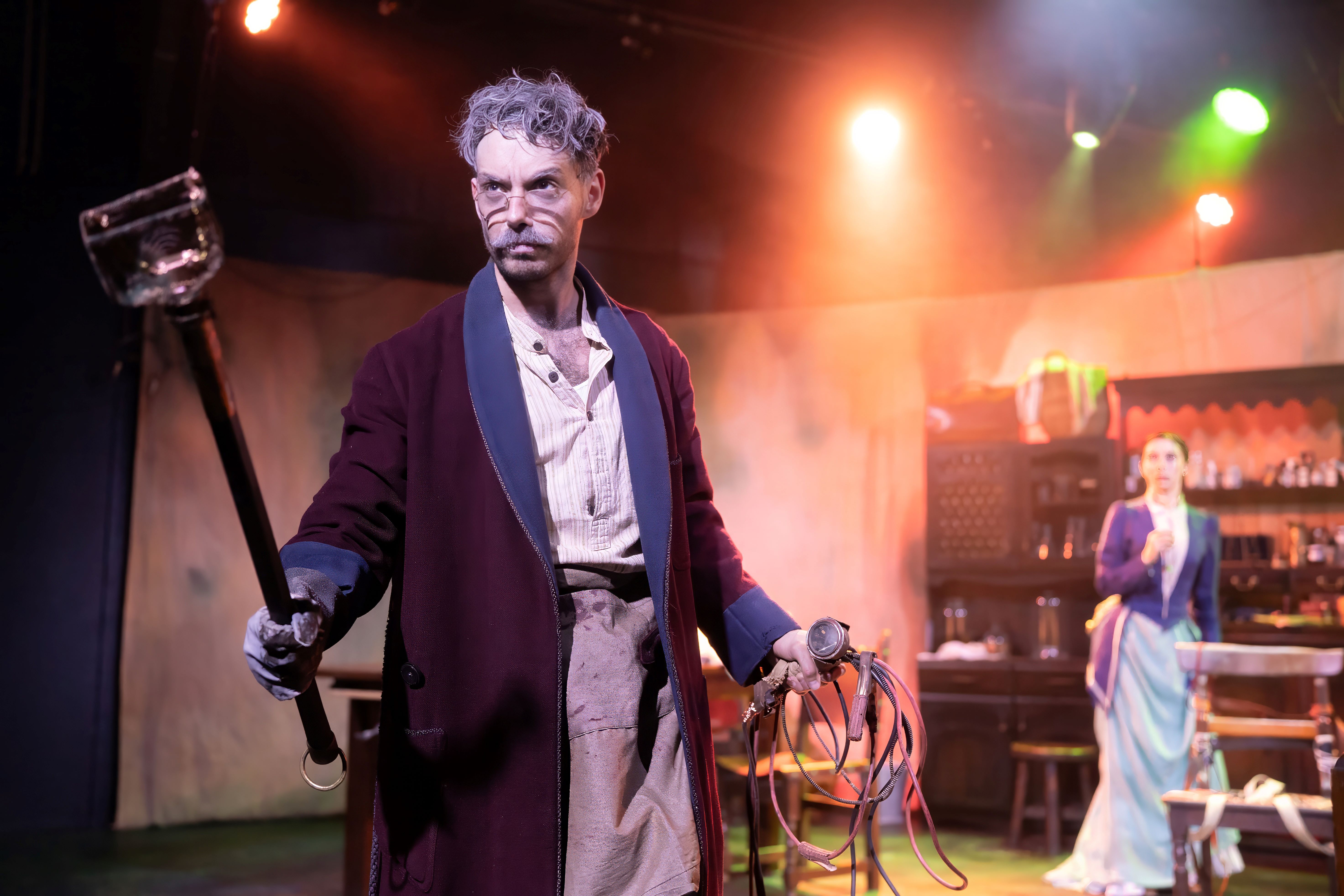
Set in the London of the late 1800’s, it tells of a desperate mother (Megan Elizabeth Kennedy) who begs a mad scientist (Tommy James Green) to enact a dreadful procedure.

In the broadest sense, the Gothic is a response to the Enlightenment and the Scientific Revolution – and to the extraordinary technological developments that followed. Often the Gothic is a plea: Not so fast! Be wary where all this is leading! Don’t so glibly dismiss the wild darkness within us!

It’s interesting how the Gothic changes through the nineteenth century. In Mary Shelley’s Frankenstein (1818), it’s a warning against intellectual hubris; be careful what you do with this newfound science. By Bram Stoker’s Dracula (1897) the warning has changed; now it’s an assertion that our rational scientific world view is limited, blinding us to the dangers that lie beyond its myopic vision. Shelley says be wary of the power, Stoker says don’t overestimate it.

Turpentine by Tommy James Green is closer to Shelley’s work thematically, but because it positions itself as comedy, the Gothic beast’s bite is softened. It’s tempting to see it simply as the unadulterated opportunity for larger than life characters and some entertaining mayhem.

Directed by Katherine Hopwood Poulsen, the cast energetically commit to the craziness. Vocal delivery (excluding that of the mute, played by Freddy Hellier) would benefit from more variety, both for the sake of emotional impact and comedic effect, but also for audience comprehension. Though the decision to set the play in London allows resonance with the grand tradition of the Gothic, I wonder whether an Australian setting might have freed the performers from the accent work that limits the production’s impact (though enhances its intended silliness.) As the piece stands, references to British colonialism effectively employ the Gothic’s ability to gaze into the darkest chambers of the human heart, but considering our nation’s troubled history, a change of setting wouldn’t diminish the potency of a similar, but more local, exploration.

Despite its playful intention, the piece takes its narrative structure seriously: it’s a genuine two act play, rather than a mere cavalcade of comic nonsense. Act One invites us into this wild Gothic world and cleverly sets up the events of Act Two. (Though I wonder if the dramatic question of the first act could be further clarified by establishing earlier the reasons for the doctor’s reluctance to perform the procedure. Let the question be whether the bereft mother can convince him despite what he fears. We know the procedure is impossible in the real world, but by introducing its nature and consequences earlier we know the rules of the game being played, and so can give our attention to the human truths that game serves to highlight. Note how Shelley’s Frankenstein spends little time on how the monster is created, directing our focus instead to the very real human experience of hubris and its terrible repercussions. My suggestion would also giving meaning to the doctor’s first act babbling, positioning it as a recognisable avoidance strategy, rather than merely colourful characterisation.)  

Yes, I know, I’m indulging in that most annoying – and pointless – of dramatic criticisms: describing the play I wish had been written, rather than discussing the play that actually was. We critics think we’re specialists, though we’re only ever called in for the autopsy.

Design by Alex Baumann and James Shepherd is especially evocative, establishing a world of potions and poisonous pleasures. Sound design by Kyle Stephens deals ingeniously with the curse that occasionally strikes this theatre, and which its name in glorious honesty acknowledges. If external noises do intrude, an ominous rumbling thunder disguises them, while simultaneously suggesting the frightening secret tensions which are the Gothic’s speciality.

I mentioned an autopsy before, but I don’t want to suggest Turpentine lies cold on the slab. It’s deliciously audacious, with the potential to be truly electrifying.

Paul Gilchrist

Turpentine by Tommy James Green

Presented by Popular Playhouse

At Flight Path Theatre until March 1

flightpaththeatre.org

Image by Jack Aliwood

Song of First Desire

21 Feb

Drama is in love with the productions of time, to misquote William Blake. Drama is an artform concerned with duration. Unlike, say, lyric poetry or sculpture, drama represents what happens next.

This was done and so This followed, and then This … and so on. As Arthur Miller has suggested, drama is the artform that portrays the chickens coming home to roost.

As a consequence, dramatists have long been attracted to historical stories. (Shakespeare wrote plenty, over a third of his output. But more on him later.)

Song of First Desire is set in Spain, and through intertwined stories, explores the ways in which the Civil War of the 1930’s continues to cast a dark shadow over that nation. If war is hell, then civil war is its innermost ring (to borrow from both Sherman and Dante.)

One strand of the story tells of a Columbian immigrant who comes to contemporary Spain and finds himself working in a house with some rather scarred occupants. The other strand of the story is set in the same house, but in 1968, nearly thirty years after the Civil War, but while the nation was still controlled by Franco’s victorious fascists (a dictatorship which lasted until at least 1975.)

The characters in the two story lines are personally connected, but I have to admit it took me a long time to figure out exactly the nature of those connections. Now, I know that there are members of the audience who like to have something to think about while the characters onstage are just talking – but for me, having to pay attention to the present action while simultaneously attempting to draw the connections with the past was a multi-tasking challenge: not so much chewing gum while walking as putting together a 3D jigsaw puzzle while riding a unicycle. Homer is rightly blamed for inventing the flashback, and it’s probably worth noting that Shakespeare maintains a healthy abstinence from the technique. (What happens next? always being a more interesting question than Why did that happen?)

But having said all that, this production is one hour fifty minutes long without an intermission – yet the time flew, and offered the glorious, heartrending vistas born of such flight.

Writer Andrew Bovell and director Neil Armfield are Australian theatre legends, and masters of the craft, and this piece is utterly enthralling. The four-strong cast (Kerry Fox, Borja Maestre, Jorge Muriel and Sarah Peirse) are brilliant, embracing the challenges of doubling and creating remarkably vivid characters in each of the two storylines.

If Bovell is more interested in disrupting a story’s chronology than, say, Shakespeare, it’s possibly because as a modern he’s working our contemporary interest in historical sociology. We knowing our present is a product of our past, but is it also its prisoner?

In Song of First Desire several characters suggest there are some doors to the past that should be left shut, but they say it in such pained desperation we wonder if it’s a word of the wise or a cry of the wounded.

Now, I know there are members of the audience who like to have something to think about after the characters stop talking – and Bovell’s powerful play is a provocative invitation to consider our own nation’s dialogue with its past. As a society, do we consciously forget in order to move forward? Or do we consciously remember in order to heal? And is either of these options actually psychologically possible?

Though no Spaniard, French philosopher and later mystic Simone Weil volunteered for the Republicans in their battle against the fascists in the Civil War. And though not concerned exclusively with the history that each of us carries, she wrote a line that resonates with Bovell’s vital interrogation, and which here I’ll paraphrase: What’s taken from us does us harm; what we relinquish does us good.

Paul Gilchrist

Song of First Desire by Andrew Bovell

At Belvoir until 23 March

belvoir.com.au

Image by Brett Boardman

Cruise

19 Feb

In the war between the generations, the final result is inevitable. All that’s in doubt is what the victors will learn from the vanquished, before they too ultimately join the ranks of the defeated.

Jack Holden’s Cruise was first performed in 2021 in London. A young gay man works at a phone help line. An older man calls, and is disgruntled to be answered by such an inexperienced responder. Already annoyed at one of the older gay men working at the centre, the young man is taken aback. The tension between the generations is established.

This is a 90 minute monologue, with Fraser Morrison playing an astounding number of characters. Morrison’s control of voice and movement is superb. It’s an absolutely extraordinary performance. (And credit must also go to his terrific support team: director Sean Landis, accent coach Linda Nicholls-Gidley and movement director Jeremy Lloyd.)

The basic set up of the piece is that the older man tells the younger man his personal history, of his time in Soho in the 1980’s. It’s parties and promiscuity, dancing and drugs, and true love… and true love’s awful nemesis. There’s oodles of charm, plenty of humour, and at the dawning of that cruelly indiscriminate plague, distress, dread, and soul-deep sorrow.

As an outsider to this world – I spent the 80’s not in dance clubs but in libraries – a piece like this is a beautiful gift. To witness a community in the process of building itself, to observe it openly constructing its history, is a wonderful privilege. (Self-indulgent digression: While in those libraries, I was learning about love in a way very different to that of the characters in Cruise, reading the history of mysticism, first in Christianity, then in Judaism, then Islam and then from further east. So, History and Love – where the lesson is that Eternity is in love with the productions of Time, to quote William Blake.)

And that’s the glorious wisdom of this piece: by knowing our history, by knowing the sorrows and solaces of those who came before, we gain the strength to step into the future. And what’s more, knowing our place in Time is the best preparation for the joys which seem to transcend it.

Paul Gilchrist

Cruise by Jack Holden

presented by Fruit Box Theatre in association with bAKEHOUSE Theatre Company

at KXT until 22 Feb

kingsxtheatre.com

Image by Abraham de Souza

The Children’s Hour

17 Feb

This is a superb production of a magnificent play.

First written and produced in 1934, Lillian Hellman’s The Children’s Hour still has the power to thrill an audience.

Karen and Martha run a boarding school for girls. A disgruntled student makes accusations regarding the nature of the relationship between the two teachers.

The play is a masterclass in construction, powerfully building tension and suspense. (I’m not the first person to suggest Arthur Miller must have been a student at Hellman’s feet.)

And Kim Hardwick, the director of this production, handles the material brilliantly. Her entire cast is splendid. Jess Bell’s Martha is excellent, tough and purposeful, fraught and vulnerable, understanding the dangers more clearly than she understands herself. Romney Hamilton dazzles as Karen, displaying an extraordinary range, contented confidence giving way to dismayed fear, genuine warmth striving with helpless resignation. The presentation of the women’s relationship is gloriously honest, beautiful in its unaffected vision of two individuals sharing the walk through time, invigoratingly ambiguous in its prolonged refusal to reduce to any moral pigeonhole.

Mike Booth, as Karen’s fiancé, delivers a terrific portrait of intelligent, good-hearted determination doing its best to brush off the ubiquitous spider webs of rumour and doubt. Deborah Jones’ Aunt Lily, a down-on-her-luck thespian, creates hilarity through her self-importance, and deep poignancy through the heartbreaking imbalance between her insight and her courage. Kim Clifton as Mary Tilford, the accusing student, gives an utterly mesmerising portrait of manipulation and self-interest. Sarah Ballantyne as Rosalie, one of the students who suffers from Mary’s bullying, movingly portrays the descent from resistance to terror. Annie Byron as Mary’s grandmother effectively combines dignified concern with its bastard half-sister, self-righteousness.

Disrupting heteronormative assumptions, the play met both praise and derision on its first outings. One of the charms of this current production is that it evokes so strongly the theatrical (and filmic) style of the mid-thirties. This is achieved through performance choices, but also through set design by Emelia Simcox and costume design by Hannah Yardley. A translucent backdrop, painted scenery – a supposedly static world we know to be a façade, one that hides competing visions, and one that facilitates the pretence of the privileged to Truth.

On the simplest level, contemporary audiences will read the play as a passionate plea for open-mindedness (not a message that’ll get stale any time soon.) But produced in 2025, the play raises other questions of particular relevance.

In frustration at a system we fear doesn’t guarantee justice, we now often assert Believe the victim. But that’s a tragic (though understandable) begging of the question. And it so readily slips into that perilous territory Miller warned of in The Crucible: “Is the accuser always holy now?” Hellman’s characterisation of Mary Tilford is a forthright challenge to any hope that justice comes easily.

But the play’s killer blow to moral naivety comes in the portrait of Mrs Tilford. Karen asserts that granddaughter and grandmother are of the same stock, and she means not biology, but the close kinship between self-interested deceit and self-righteousness. Both are revealed as expressions of the lust for control. In The Children’s Hour, Truth maybe fragile, but Goodness is fatally flawed. (Or, at least, Goodness with a capital G.) It’s a radical indictment of assumptions of moral superiority, and a gentle endorsement of humility and kindness. (And one of particular value in our current era in which many of us are tempted to Goodness, to that oversimplification whereby we confidently cast ourselves as warriors against evil, positing enemies where there are just people, people with the very same access to Truth as ourselves.)   

The Children’s Hour is an absolutely gripping tale, and a deeply humane encouragement to moral maturity.

Paul Gilchrist

The Children’s Hour by Lillian Hellman

Presented by Tiny Dog Productions and Dead Fly Productions

at the Old Fitz until March 1

oldfitztheatre.com.au

Image by Phil Erbacher

Antony & Cleopatra

13 Feb

This is an odd one.

It’s probably the most abridged version of this play you’ll see outside a school incursion.

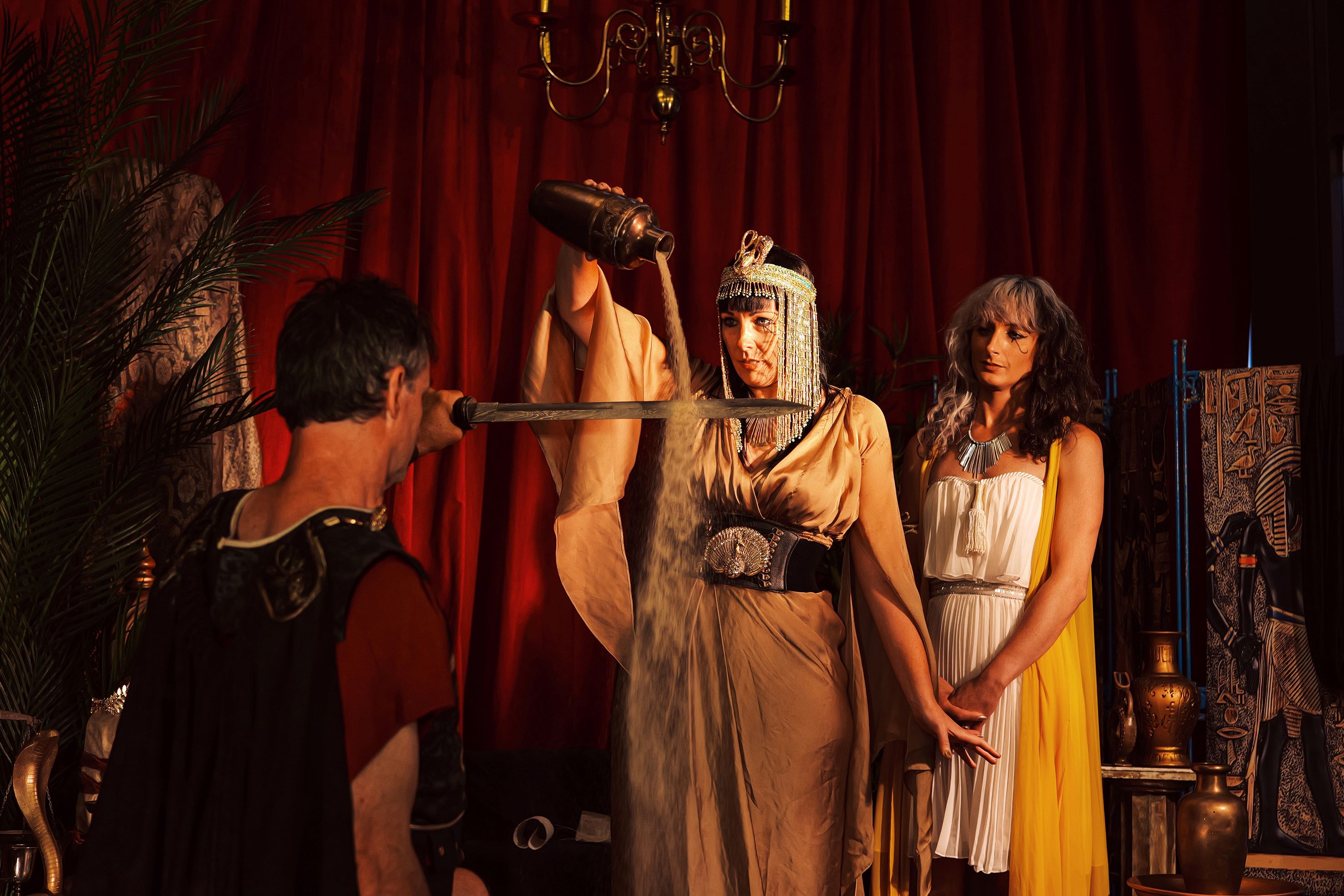
It’s all performed by three actors: Charles Mayer as Antony, Jo Bloom as Cleopatra, and Charley Allanah as everybody else (or at least everybody else who isn’t cut.) Performances are bold and spirited. For reasons that will become more apparent later in my response, design focuses on costume, and these by Letitia Hodgkinson are beautifully lavish.

There’s also a narrator or guide, a role taken by Nathan Meola. He almost gets as much stage time as Shakespeare, though far fewer words. He appears to be adlibbing. He speaks very slowly and quietly, as though he’s speaking to the guests at a spiritual retreat. We’re thanked for the journey each of us has made to get to the theatre, and it’s acknowledged that the journey may have been difficult. (There’s even talk of snow.) We’re asked several times if we feel safe, and at each repetition I feel a little less so. His speaking style is a curious mix of condescension and coercion, made all the more disconcerting by the very convincing illusion that it’s not a created dramatic character being performed. He asserts that we humans are not immune to stories and, for a moment, I question my own humanity – until I recall that he’s ignoring a rather vital point: the power of a story depends on how well it’s told. This narrator recaps what we’ve seen and tells us what we’re about to see – which may seem superfluous, even to those unfamiliar with the play. He also assumes we’re deeply affected by the performance. (In our current theatre scene, in which there’s far too much of telling audiences what to think, it’s refreshing to be told what to feel.)

The marketing describes the production as immersive – which can mean a lot of different things, but here means you may not get a seat. We’re needlessly shuffled back and forth between the foyer (where there aren’t enough seats) and the theatre (where there are plenty.) These changes of location, and the narrator, have a slowing effect, but the whole thing is only 90 mins, including interval.

Shakespeare’s play is reduced to the story of two people going through a dark night of the soul to find eternal love, or divine love, or some such thing. (At least that’s what the narrator tells us is happening.) The political tensions and the grand clash of civilizations are given little space. This reduction enhances the sense the play is being used as a vehicle for a certain New Age philosophy.

So is it “Shakespeare”?

That’s an absurdly conservative question, based on some disturbing essentialist assumptions. But I’ll answer it anyway.

On one level – a particularly academic one – the answer is No. Shakespeare and his contemporaries dragged theatre away from being what was almost a religious ritual, with narratives dominated by religious perspectives. They moved the artform away from the traditional Mystery play. These Elizabethans still acknowledged that spiritual experiences existed (in a way that, say, Jane Austen seemingly does not) – but they viewed those experiences as part of the wider human experience, not necessarily as its key. To be essentialist, they were humanists.

But, soaked in Renaissance humanism, Shakespeare was not an essentialist. He looked at the world with humility and wonder, and I suspect he wouldn’t dismiss a production like this, but would ever so gently chastise those who might. After all, as his most famous creation says, “There are more things in heaven and earth than dreamt of in your philosophy… “

Paul Gilchrist

Antony & Cleopatra by William Shakespeare

Presented by Come You Spirits

At The Lounge, The Concourse until 22 Feb

theconcourse.com.au

Image by Syl Marie Photography

The Flea

11 Feb

This is terrific fun. It’s also a very clever use of both the dramatic and theatrical forms.

Written by James Fritz and first produced in 2023, it’s inspired by the 1889 Cleveland Street scandal, in which it was claimed that gentlemen, high ranking members of British society, were frequenting a male brothel. (The accusation is obviously absurd, akin to suggesting that there are women who engage in homosexual activity.*)

One aristocratic visitor to this house of ill repute was Prince Edward, grandson of Queen Victoria, and second in line to the throne. Or so the scuttlebutt goes, and scuttlebutt it most certainly was – because the men who worked in this brothel were from a much, much, much lower class of society. Telegram boys, apparently, from the General Post Office. As if a gentleman would employ a telegram boy for anything other than the quick delivery of something urgent and rigidly to the point.

So, The Flea is an exploration of class and discrimination. Its title highlights one of the ways we try to avoid acknowledging the impact of these forces. How did these particular men end up working at a brothel, and why did it end for them the way it did? The play’s title implies that it was all just a case of bad luck, an unfortunate chain of causation beginning with an event as random and insignificant as a bite from a tiny insect. But that, of course, is dramatic irony. The play shows us something quite different; it powerfully presents the dreadful machinations of privilege and prejudice.

The Flea is beautifully written, fast paced and very funny, yet with deep emotional impact. It even manages that most difficult of achievements, what is the pinnacle of the dramatic artform: it engages us emotionally with both sides of the conflict. One way it does this is by building on motifs of intimidation; the intimidator in one scene becomes the intimidated in the next. It’s both amusing and disconcerting (like that nightmarish nursery rhyme There was an Old Lady who Swallowed a Fly.)

Director Patrick Kennedy creates an environment of theatrical playfulness while skilfully maintaining the strong narrative drive. His cast is brilliant, delivering great comic performances and embracing the script’s wild doubling. Sofie Divall is magnificent as the Queen and as Emily Swinscow, a no-nonsense working class mother, garnering wonderful laughs from both roles, and drawing tears with the latter. Similarly, Samuel Ireland doubles as the Prince of Wales and Emily’s son Charlie, and he’s delightfully entertaining as the first and heartrendingly poignant as the second. Jack Elliot Mitchell is marvellously versatile, playing Lord Euston, suave aristocratic man about town, in glorious contrast to Hanks, a super conscientious constable. James Collins achieves an equally laudable elasticity, jumping neatly between swaggering working class telegram boy and frightened upper class seeker of illicit love. Mark Salvestro balances portrayals of pimp and policeman, ingeniously highlighting the expected differences and the surprising similarities.  

Kennedy also designs, and all is gorgeously exuberant. The set, with its red and white colour scheme, its subversion of conventional lines and its inversion of traditional curves, evokes John Tenniel’s illustrations for Alice in Wonderland. And that’s appropriate – the production presents as an enchanting madcap cartoon, but it’s also a portrait of a disturbing world, one in which innocence finds no safety.

Paul Gilchrist

The Flea by James Fritz

At New Theatre until March 8, as part of Mardi Gras

newtheatre.org .au

Image by Chris Lundie

* Unlike male homosexual acts, female homosexual acts were not illegal in Britain; it doesn’t seem to have occurred to the establishment that they were possible.

Three Sisters

10 Feb

This is a fine production of a classic.

Director Victor Kalka has gathered a talented ensemble, and they give riveting performances.

There’s a fascinating tension between a simple truthfulness and the theatricality of created humour. (Though I’m not sure that a certain curtain-call gag doesn’t give too sharp a pull to one end of that tense tightrope.)

Kalka adapts Chekhov’s play. A few minor characters are cut and some of the subtleties of the plot are made more apparent, but the key alteration is the transference of the action to the present. (Though the word action takes on a different, deeper meaning when applied to a play by Chekhov.)

You could be critical of the decision to modernise the setting, arguing that many of the characters’ problems – Why can’t I be with who I love? Why must I live here? –  would simply evaporate in a society in which change has become so easy that it’s expected, normalised and, in an if-you-can’t-stop-it-you-may-as-well-embrace-it sort of desperation, even lauded.  

But what Kalka’s adaptation does is ensure the play is not read solely as a portrait of one particular decadent society.

It’s natural for us to read Chekhov through a sociological lens. After all, just sixteen years after Three Sisters was first produced came the epoch changing Revolution, sweeping into the dust bin of History the privileged lethargy of the old regime. And then, dominating the 20th Century, came the tension between that new Russia and the so-called free world.

But Chekhov didn’t know all that. Perhaps he saw the writing on the wall … but a solely historical, sociological approach to his work discounts the miracle that occurs on stage. The play itself is a revolution. It takes the inherently undramatic experiences of boredom and enervation – and turns them into an utterly watchable piece of theatre.*

Is lethargy being indicted? Perhaps. More importantly, it’s being acknowledged. A brilliant light is being shone down into the shadowy grey recesses of the human condition. Our current zeitgeist glibly pounces on inaction, equating it with complicity, and with a cavalier disregard for complexity, even conflates silence with violence. (If I were Satan, I’d be proud to have invented that slogan.) But Chekhov’s play reminds us, that sometimes, a mysterious, invisible weight holds an individual down; that for some inexpressible reason what we would do inexplicably remains undone. It’s a compassionate vision, reminding us that all those who don’t act or speak as we wish might be something other than enemies.

Modernising the setting – placing the characters in a world in which their problems should be more easily overcome but for some reason still aren’t – invites us to look beyond easy externals and shallow judgements. Kalka’s adaptation of Three Sisters draws to the fore the revolutionary aspect of Chekhov’s deeply humane art and, with rich poignancy, the excellent cast portray that eternal dance desire has with disappointment.

Paul Gilchrist

Three Sisters by Anton Chekhov, in a new version by Victor Kalka

presented by Virginia Plain

performed by Matthew Abotomey, Meg Bennetts, Alex Bryant-Smith, Nicola Denton, Barry French, Sarah Greenwood, Jessie Lancaster, Alice Livingstone, Ciaran O’Riordan, Mason Phoumirath, and Joseph Tanti

at Flight Path Theatre until Sat 15 Feb

flightpaththeatre.org

Image by Samuel Webster

*I think I might have borrowed this idea from Richard Gilman.

Chasing Dick

6 Feb

This is a rom-com. Yes, I know Shakespeare made this sort of thing work, with his poetry and multiple storylines, but it’s a genre I don’t usually enjoy, and one I don’t think particularly suited to theatre.

But, written by Dax Carnay with Aleks Vujicic, Chasing Dick is utterly charming.

A father (Jason Jefferies) and a son (Chris Colley) have both fallen for Dick (Carnay), a trans woman.

Directed by James Lau and Carnay, the performance style is a sort of naïve naturalism, and the characters created are warm and very likeable. Carnay, in particular, is a gifted comic actor.

The result is a show that’s cute, funny, and wonderfully effervescent.

But it’s not just bubbles; there’s some invigorating tensions that give the piece a glorious richness.  

Firstly, there’s a fascinating dual narrative in regard to Dick’s backstory. At one point, her Filipino culture is described as conservatively intolerant of her identity, retrograde in comparison to a more open Australia. In another telling, her original culture appears warmly accepting. Is the character indulging in revisionism? If so, it’s a penetrating portrait of the psychological complexity of migration. Or, are the competing narratives indicative of the inescapable contrast between our anxieties and reality? She feared coming out, but was then happily surprised? If so, it’s an insight into abuse’s inevitable and insidious ability to warp our world view; a single snarl erases a thousand smiles, and can hold us back from so many more.

Secondly, there’s a moving interrogation of the trope of the Manic Pixie Dream Girl (MPDG). The MPDG is a female character who sometimes pops up in romantic comedy, a woman of transgressive energy but no apparent interiority, a woman whose sole purpose appears to be aiding the male characters’ growth. Both father and son fall under Dick’s vivacious spell, but she complains You see me, but you haven’t listened to me! She refuses to be reduced to a fetish; she demands to be recognised as a full human being. But, at the same time as rejecting the dehumanising elements of the MPDG, the positive aspects of the trope are retained. Dick does encourage the men to mature. A cynic might reject the lessons these characters are asked to learn as mere psychobabble – of the Tennyson-inspired Better to have loved and lost variety. However, romance might be the silliest of the serious things, but in a world in which the silliest people seem to have gained control of the most serious things, lessons of acceptance, openness and the importance of genuine love have definitely not lost their vitality.

Thirdly, the play offers a transformative exploration of reductive thinking. Confronted by his unexpected feelings for Dick, the elder of her devotees wants to know What am I now? It’s a powerful poke at conservativism. (I, for one, wanted to scream from my seat Why do you NEED a label?) And yet, in a play that positions us to question the oversimplification of labels, Dick says very clearly I am a woman.

And it’s a truly beautiful moment.

The current fashion in our theatre is to be overtly political, to be direct, didactic – and dull. We like to tell our audience what to think. One way we do this is by loudly asserting the rights of marginalised peoples. Jeremy Bentham famously suggested that any talk of rights was nothing more than nonsense on stilts, meaning it was just airy-fairy fancifulness, rights ultimately being guaranteed nowhere and underwritten by nothing. Inadvertently (perhaps) Bentham’s dismissive metaphor highlights the appeal of the language of rights – after all, everyone does stop to watch a person walking on stilts – though he was correct in suggesting it’s not usually a sight that has a life-altering emotional impact.

But when Carnay as Dick asserts I am a woman, she is not speaking the language of rights, she is not furthering an agenda, she is not repeating the party line. She’s being far more radical than that – she is being honest.

I’m not completely dismissing theatre with political attitude, but a piece like this is an invaluable reminder of how we might best connect with our audiences. It is openness that breeds openness, and I suspect many more hearts are melted by sincerity than ever are by slogans. If justice is to stand, it will stand strongest when built on the knowledge of our shared humanity.

Paul Gilchrist

Chasing Dick by Dax Carnay with Aleks Vujicic

Presented by TayoTayo Collective

At the Loading Dock Theatre, Qtopia, until 15 Feb

qtopiasydney.com.au

Image by Jordan Hanrahan-Carnay and Matt Bostock