Archive | Responses to Plays RSS feed for this section

Jade Empress Discovers Australia

23 Sep

If you look to the right of my blog you will see that I divide my articles into various categories. One category is Interviews with Artists.

I do these interviews by email. I ask pretty much the same questions of everyone and then simply publish the answers. It’s an opportunity for artists to promote their shows. Each time, I tell the interviewee to write as little or as much as she likes, and I tell her to feel free to ignore any questions she thinks are just plain stupid.

And there is one question artists often choose to ignore: What would you like your audience to think about, or feel?

If artists do answer the question, it’s common for them to write that the audience can think or feel anything they like. (Which strikes me as simply stating the obvious. Of course audiences will respond in multiple ways to your production. But surely you had an aim.)

I’ve even had artists tell me they don’t want their audiences to think about or feel anything at all.

I find this sort of response extraordinary. Sometimes I imagine these artists have confused ‘think about’ with ‘think’. There’s a reluctance to present theatre that could be perceived as preachy. (Imagine, the audience might squirm uncomfortably in their seats.)

But if a play doesn’t lead its audience to think about particular things then perhaps it has no textual integrity. Romeo and Juliet is about love. What exactly it says about love might be a point of contention, but that’s what the play tries to do: get you thinking, and arguing, about it.

So what am I to make of artists who won’t answer the question ‘What would you like your audience to think about, or feel?’ That they have nothing to say? Or that they are frightened?
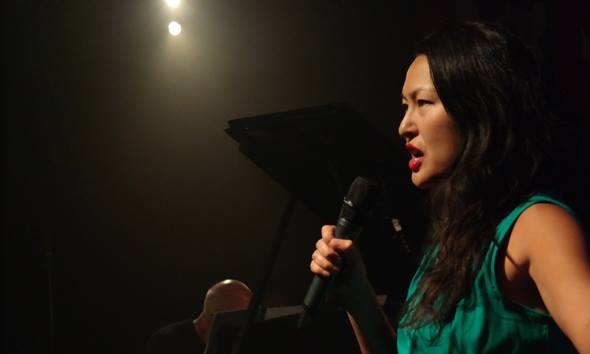
Photo by Diana Popovska

Photo by Diana Popovska


Neither is true of Jade Empress Discovers Australia.

This cabaret is genuine, heartfelt and courageous. (And it played to a full house. Including a newborn; her presence putting all our theatrical games into perspective.)

Jade tells stories from her life, beginning with her migration from Malaysia as a three-year old. There are stories of good fortune, of finding herself in a lucky country. And there are stories of bad fortune, as she and those around her find themselves victims of racism.

With clever appropriations and subversions of some classic Aussie songs, Jade questions whether Australia could do better. She questions our treatment of refugees and the poor, and asks how we can continue to work for reconciliation with the indigenous people of this land.

Jade has a strong voice, and the accompaniment by Pete Ogilvie is wonderful.

The piece as a whole could be more tightly structured, but it has a moving honesty. And it ends with a question that is simple, sincere and absolutely vital: What will you do to make our country a better place?

Did the audience squirm? Did they think ‘This is not what art is meant to do’?

There was applause, and cheering, and a baby cried.

Veronica Kaye


Jade Empress Discovers Australia

Imperial Hotel, Cabaret Room

The season for this production has closed.

https://www.sydneyfringe.com/whats_on/event/12a43b45-2734-42ee-bf3e-e5a84ad4d81e/

Four Dogs and a Bone

19 Sep

Brenda: I want to be famous!

Bradley: Why?

Brenda: I don’t know! *

First and third lines said with equal force.

This encapsulates John Patrick Shanley’s satire on the film industry.

This play is very funny. It’s jam-packed with tremendous one-liners.

Amanda Collins, photo Katy Green-Loughrey

Amanda Collins, photo Katy Green-Loughrey

It’s probably one of Shanley’s less substantial plays. The assertion that the film industry is laughable is hardly ground-breaking stuff. However, an enormous amount of money is invested in the triviality that is film while children starve (in the South Sudan as I write). So that means satires like Four Dogs and a Bone don’t lose their bite.

Shanley has created big characters and director Kate Gaul allows her cast to fill them. Design and blocking is kept appropriately simple, creating the space for linguistic brilliance and joyous hyperbole. There were a few opening night problems with pacing, but these will mend, and the cast will provide a terrific night’s entertainment.

Theatre’s revenge on film. Stage’s little brother is big on budget, but small on substance. And Shanley has fun with this. Victor, played by Paul Gerrard, is a stage writer hungry for money and therefore ripe for seduction by celluloid. Collette, played with glorious energy by Amanda Collins, is the star of the movie, but Collette is hampered by that most disgraceful of descents: she’s a theatre actor. Brenda is Collette’s support in the film and hence her rival in life. (Melinda Dransfield gives a delightful portrait of the nightmare performer: a façade of sweetness masking utter self obsession.) Belinda gleefully tells Colette that she looks grotesque in the daily rushes. As a stage actor, she is too big. A delicious irony – after all, regardless of performance style, big budget film rarely does subtlety.

Veronica Kaye

* Possibly a paraphrasing; my hunger for accuracy unequal to Brenda’s desire for fame.


Four Dogs and a Bone by John Patrick Shanley

Old Fitz til 27 Sept

http://www.sitco.net.au/


Europe

16 Sep

Old versus new. Stale versus fresh. Sophistication versus naivety. Decadence versus innocence.  Europe versus Australia.

One of these pairs is a false dichotomy: the last one.

Australia is European. (Or Europe is Australian, in case you’re tempted to think I’m making some sort of backward racist statement rather than philosophically dismantling an erroneous distinction.)

Michael Gow’s very funny and thought provoking play was written in 1987, nearly 30 years ago, and it feels like it. It harks back to the experience of an earlier generation, of the 60’s and 70’s, when every Australian intellectual fled to the Old World.

Has Australia become more European in that time? (Is that my ridiculous thesis?) Of course not, but the tyranny of distance has weakened, and we’ve grown more confident.

And that’s the value of James Beach’s very entertaining production; it explores that confidence.

Photo by Kurt Sneddon, Blueprint Studios

Photo by Kurt Sneddon, Blueprint Studios

In the play, Aussie fan Douglas chases European actress Barbara. They’ve had a brief fling when she toured Australia, and he sees no reason why it shouldn’t continue. She’s less certain. (The performances by Pippa Grandison and Andrew Henry are wonderful.)

Just as Barbara is about to go on stage she says ‘I’ll drag my body through this classic again’. (All my quotes are paraphrasing.) She wonders what would happen if she changed the end this time. But, alas, the audience has come to see that particular play. Again. A type of cultural obsessive compulsive disorder?

Barbara continues ‘We constantly redo the classics. Reinterpret them, reclaim them, reject them. And the new plays are just echoes of the old.’ (More paraphrasing.)

Why are we in love with the old? And, no, I don’t buy the whole ‘universals’ argument.

I started this response by suggesting that the obsession with Europe was a thing of the past. But I see the same thought patterns, the same conservativism, repeated every time we choose to produce another Patrick Shanley, Sam Shepherd or Neil La Bute play. (These productions, no matter how well done, often feel like cover bands; the theatrical equivalent of a Madonna Tribute show at the Rooty Hill RSL.) And it’s the same for the rewriting of the classics. Borrowed glory. (And, of course, highly effective pre-marketing. Postmodernism is not the reason why the Broadway musical is now inevitably an appropriation of an earlier text.) And there’s a similar conservatism lurking in our desire to create an Australian canon.

So maybe it’s not Europe. But it’s usually somewhere else, somewhen else. Not here. Not now.

But it could be.

And that’s what this very clever, beautifully performed production made me think about.

Veronica Kaye


Europe by Michael Gow

Seymour Centre til 27 Sept

http://www.seymourcentre.com/events/event/europe/

Year of the Abbott

9 Sep

Seriously, sometimes Sydney theatre can seem like a thought-free zone. Leave your intellect at the door.

But this is an intelligent production; sharp and very funny.

Year of the Abbott begins with Brent Thorpe as Deidre Flick, ‘self funded retiree from Mosman’. She chats to ‘Alan’ on talk-back radio. It’s a beautiful skewering of the uninformed Right.

Year of the Abbott GS pix IMG_0421

The majority of the show is Shane Addison and Timothy Hugh Govers presenting what looks like a TV talk show, but is actually a wonderfully performed satirical revue of the last year of federal politics. They chat to each other and to some fascinating guests. The impersonations of both Rudd (Nathan Lentern) and Abbott (Jonas Holt) are superb.

A show like this reminds us of the power of good satire: we laugh at certain individuals, but the laughter empowers us. We’re not left cynical about the political process; we’re reminded how truly fascinating the whole thing is, and how important.

Veronica Kaye


Year of the Abbott

The Den (Chippendale Hotel)

Sat 27 Sept 9.30pm

https://www.sydneyfringe.com/whats_on/search/presenter/24521f7d-3831-4bf1-b67d-4a2844e79484/

Harry and Liv

5 Sep

Harry and Liv are brother and sister, played with delightful irony by brother and sister Evan and Charlotte Kerr.

There’s a playful exuberance to this cabaret. Musical virtuosity is neatly balanced with fun, silly banter.

The venue, despite its lighting and acoustic challenges, has a lounge room charm.

harryliv1

Charlotte Kerr’s opening number, a gentle ballad, reminded me what an extraordinarily beautiful voice she has. As the show continued, I occasionally wished the pace would slow, so I could savour that beauty even more.

However, these two performers have a vibrant, utterly engaging stage presence. They close tonight, but hopefully they’ll be back with more.

Veronica Kaye

Harry and Liv

closes tonight 6 Sept

Glebe Justice Centre (37-47 St Johns Rd)

https://www.sydneyfringe.com/whats_on/event/3b7cc7f9-73f6-4c6e-9e1f-7c7aab51cb2d/


Sugarland

3 Sep

Is theatre a mirror,  reflecting our world as it is?

Or is it a window,  showing us a view of a world close by?

Or is it a telescope, revealing distant worlds?

Sugarland presents the lives of young people in a remote Australian town. It’s honest, confronting and hopeful.

Photo by by Tracey Schramm

Photo by by Tracey Schramm

Writers Rachael Coopes and Wayne Blair built this story after time spent in the Top End. Directors Fraser Corfield and David Page present it with great power and beauty.  Their ensemble is extraordinary, young and genuine. Dubs Yunupingu is brilliant. Her portrayal of Nina – of simple strength in the face of adversity – is deeply moving.

The youth of Katherine face a range of challenges; poverty, substance abuse, self harm, violence, and the spectre of racism. (One of the charms of the piece is, that for the most part, the characters see through the divisive aspects of race.)

Nina lives in a one bedroom house with twelve people. She has twenty stitches in the back of her head, courtesy of a female relative who’s thrown a brick at her.

Hunter Page-Lochard plays Jimmy, Nina’s cousin. He gives a powerful performance of a bright soul bustled by what the world has thrown at him.

Writer Rachael Coopes plays youth worker Penny. She encapsulates a patient, and inspiring, determination not to give into despair.

Of course, Sugarland is not ‘telescope’ theatre. These communities are our communities. (There’s a dreadful poignancy in the fact that the young people of the town are soaked in pop culture. Nina sings Rihanna’s Diamonds at the talent quest.)

This is a play to give confidence. There are things in our world to be fixed. But this play presents the challenges with heart-breaking honesty.

And honesty is a good midwife to hope.

Veronica Kaye


Sugarland by Rachael Coopes with Wayne Blair

ATYP Under the Wharf

til 13 Sept

https://www.atyp.com.au/whats-on/productions/sugarland

Phaedra

22 Jul

This is a brilliant production.

I’ve made no bones about the fact I don’t like the Greeks. (Not the current ones. The ones who died about 2,500 years ago.  And, no, the bones comment wasn’t an intentional pun.)

The great Greek dramatists explored ‘universals’, or at least that’s what we’re tempted to think. Distance has lent them a grandeur. But they wrote in a society every bit as fractured and filled with contention as ours, and much of what we have raised to the status of classics were in their day part of a hard fought cultural war.

In Greek society one of the great divides was that between the philosophy of rationality and the theatre of fate and deep dark forces. Socrates and Euripides were contemporaries.

When I see current productions of the ancient Greeks, I ask ‘Why are we interested in their myths?’

From a purely personal perspective, I’m suspicious of any view that sees the world as ruled by fate and irrationality. It seems like just one more way of disempowering ourselves, of trying to mask the fact that we enjoy lives of extraordinary privilege, and hence of unprecedented responsibility. If the Furies were to drag me off today and I was to die horribly, blind and in exile, it would not override the fact that up until this point I’ve lived 49 years without ever being hungry except through choice.

Photo by Sasha Cohen

Photo by Sasha Cohen

But I started by suggesting that Michael Dean’s production of Euripides’ play is brilliant. And it is. It’s extraordinarily inventive and a visual treat. The cast are marvellous. The individualised characters (Danielle Baynes as Phaedra, Melissa Brownlow as the Nurse, Richard Hilliar as Hippolytus and Katrina Rautenberg as Theseus) are played with a beautiful strength, which powerfully highlights the tragedy of the conclusion. The Chorus (Sinead Curry, Cheyne Fynn, Nathaniel Scotcher and Jennifer White) is wonderfully mischievous, both fun and foreboding. The use of pop music is frighteningly effective, suggesting the hidden menace lying behind our seemingly harmless daydreams and fantasies.

Phaedra is a reworking of Euripides’ Hippolytus. It’s a myth of the power of sexual desire. In the ancient Greek world, humans are the playthings of the gods. Phaedra’s passion is a divine punishment.

So what’s our modern myth of sexuality? A sort of flat biological reductionism. The consequence of our decidedly anti-existential myth is that sexuality is robbed of both its magic and danger. And where did our dull unhelpful myth come from? From the victory of the rational viewpoint. So perhaps the Greeks are worth a revisit.

Veronica Kaye


Phaedra (based on Hippolytus by Euripides)

TAP Gallery til 26th July

http://www.liesliesandpropaganda.com/


Book of Days

16 Jul

There’s a powerful set piece in the first act of Book of Days. I won’t spoil it, but suffice to say it deals with the way the announcement of a death is received. Beautifully staged and cleverly written, it perfectly presents the predominant theme of the play – hypocrisy.

Langford Wilson’s play is sort of Thornton Wilder’s Our Town, but with murder. (It’s not an appropriation. It’s definitely a subversion.)

Both plays are set in small Midwest towns.

Photograph © Bob Seary

Photograph © Bob Seary

Ultimately, Our Town presents small town life through the lens of the eternal; its mocking of the parochial is gentle to the extreme, and the play firmly asserts the value of the everyday, and of every life.

Book of Days offers a vision far less comforting. There are some seriously bad people in this play – and they’re respected members of the community.

Some audience members might find the second act unusual, undecided about the way the play becomes somewhat smaller, folding down to a whodunit.

But I think that’s the play’s purpose. It’s part of the American culture wars. It’s saying ‘What’s wrong with our simple dream?’ And it finds guilty parties.

Elsie Edgerton-Till’s production is terrific and her use of the space is magical. The performances are sensational. Kate Fraser creates a brilliantly engaging Ruth Hoch, the salt of the earth no-nonsense truth teller. The conceit of this play is that Ruth is playing Joan of Arc in George Bernard Shaw’s play. And like Joan, Ruth fights both Church and State. I’d further draw the contrasts and comparisons between Ruth and Joan, but I’d be guilty of dreadful spoilers.

In this play, there are characters guilty of far worse: Kyle Walmsley gives a chilling portrait of the intelligent, urbane and frighteningly calculating Reverend Bobby Graves. Simon Davey creates a marvelous portrait of a manipulative snake of a politician.

And a final word on Georgia Hopkins set design: a beautifully space to play, clean and pure, punctuated by only a single tree. The Garden of Eden? The Tree of Knowledge? The Fall from Paradise?

Veronica Kaye

Book of Days by Lanford Wilson

til 9 August

http://newtheatre.org.au/


Every Second

9 Jul

There are a lot of angry and envious people in this play.

Ok, there are only four characters, but they’re all in the same situation; they desperately want children.

I’m the worst possible audience for this.

I don’t understand the basic motivation of the characters. I want a child about as much as I want a rhinoceros.

Photo by Louis Dillon-Savage

Photo by Louis Dillon-Savage

So, on one level, I found the whole thing rather frustrating. There’s a grand secret but I wasn’t let in on it. The only explanation offered for the character’s desires was that everyone else had children – which, of course, wasn’t meant as an explanation at all.

The characters are middle class Australians. In one sequence, Georgina Symes’ character says she can control everything except her own uterus, which is a statement of staggering self delusion. It’s a pity this incredible power is not being used to slow climate change or solve third world poverty.

Vanessa Bates’ play is cleverly constructed with plenty of good laugh lines. Shannon Murphy elicits from her cast strong performances. But I couldn’t like any of the characters. (Yes, I’m a bad person – the weirdo who doesn’t want children.)

The set by Andy McDonell is intriguing. It suggests the lake in the park. It suggests a woman’s reproductive organs. It suggests a vortex, dragging the characters down.  This is not a play about finding, or sharing, joy.

Veronica Kaye


Every Second by Vanessa Bates

Eternity Playhouse until 27 July

http://www.darlinghursttheatre.com/


La Ronde

6 Jul

Written in the late nineteenth century, the question any current production of this play asks is its relevance.

This production contemporises costume and place names.  It’s happening now.

Foucault threw out an extraordinary challenge when he published The History of Sexuality.  Excluding the deep time of evolution, what history can sex possibly have? Isn’t sexuality just biological, not cultural? Isn’t it a timeless universal?

This production of Arthur Schnitzler’s play is fascinating because it makes an audience question whether a clear-eyed look at a supposed universal can, in fact, be historically specific. Forward looking in its time, is the play backward looking now? (It’s worth noting that the play is decidedly heterosexual. And, one would hope, the dynamic of class has changed.)

laronde-05

But the play is certainly about sex. Each of the scenes has a similar structure: pre-coital discussion, blackout for the act, then post-coital discussion. (The fact we don’t see the act itself is a powerful comment about its ineffable nature.)

The other aspect of the structure that’s intriguing is the suggestion of frequent infidelity. Perhaps not every one of the ten characters is actually being unfaithful, but each appears in two scenes, with a different lover. This highlights the strangeness of sexuality, so personal yet so ubiquitous.

The performances are good, both touching and funny (an achievement considering the tricky acoustics of the venue). Brendon Taylor as the Writer, Amanda Maple-Brown as the Actress and Emilia Stubbs Grigoriou as the Sweet Girl are particularly engaging.

Steven Hopley’s direction is simple and highly effective. He presents the play in the round and this evokes the dance of the title, and intensifies the oddity I referred to earlier: we watch beautiful young couples navigate the most private of moments and at the same time are aware of the social gaze of other audience members.

Is sex the place where the particular and the universal collide? (Or perhaps more accurately, rub up against each other?) And, if so, is this why sex is so crucial to both our sense of identity and our sense of connection?

Veronica Kaye


La Ronde by Arthur Schnitzler

til July 12

Coronation Hall, 95 Lennox St Newtown

Performances – July 9, 11, 12 – 8pm

Book Now at www.stickytickets.com.au/enigma