Archive | Responses to Plays RSS feed for this section

The Mercy Seat

30 Jun

Two mean spirited people with American accents remain in a room and argue about their relationship for 100 mins (including a 15 minute interval).

For many people, this would be the archetypal modern play. Which is why they stay at home.

But, in this case, context is all.  Our couple are arguing about their future while the rest of America, and much of the world, is in shock.

It is New York. It is September 12, 2001.

What to many was an unfathomable tragedy is to our couple an opportunity. They’re having an affair. He is married with children. Perhaps yesterday morning he was in one of the towers when the planes struck, instead of at his mistress’ place having his penis sucked. Is it their chance to just disappear and start again?

photo by Katy Green Loughrey

photo by Katy Green Loughrey

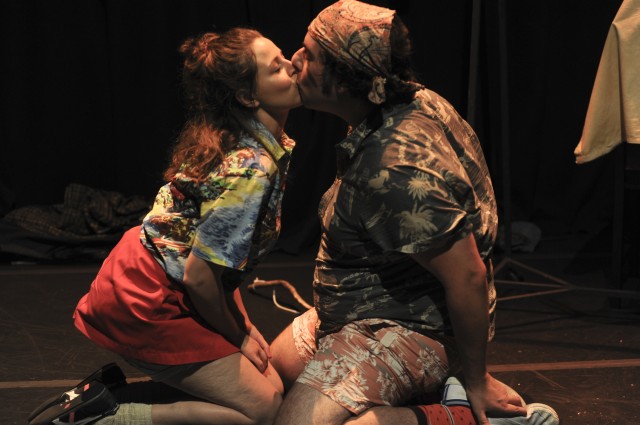
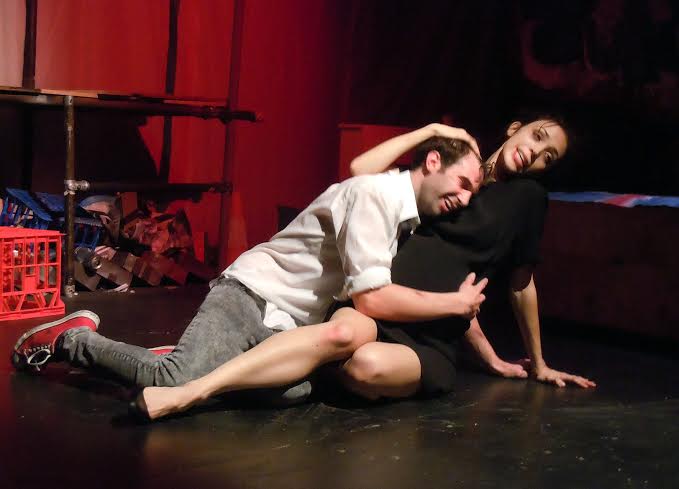
This production of Neil LaBute’s play is both funny and confronting. The performances by Rebecca Martin and Patrick Magee are powerful and intriguing.

Are we meant to take the characters as real people? Is this play gritty naturalism? If it is, it’s a vision of humanity so bleak that it approaches the immoral. (There’s a school of theatre that equates negativity with truthfulness. It’s the philosophy of those who wish to grant themselves moral holidays. If it’s just human nature to act dreadfully, how can my behaviour be at fault?)

The challenge of this play is the context. Presumably none of us have been in the situation represented.

Or have we?

Many of us are tempted to think the world is screwed, that it’s a chaotic mess, and that we’re all going to hell in a hand cart. I call it a temptation because it allows us to believe that it’s justifiable to be entirely self seeking. After all, in extremis, the call goes out “Every man for himself”.

The Mercy Seat is an intelligent and thought provoking production, a timely reminder that we must not use the magnitude of our society’s problems as an excuse to grant ourselves moral holidays.

Veronica Kaye


The Mercy Seat by Neil LaBute

Old Fitzroy Theatre til 5 July

http://www.sitco.net.au/

My Name is Truda Vitz

27 Jun

My Name is Truda Vitz, written and performed by Olivia Satchell, and directed by Pierce Wilcox, is a moving exploration of personal ties and the power of imagination. With stunning visual images and Satchell’s performance on the cello, it’s also a treat for the senses.

Satchell tells the story of three generations; herself, her father Paul, and her grandmother Truda. She slips between the characters with an unadorned simplicity. She forces nothing. These characters – these people – are granted dignity.

The most fascinating aspect of this personal history is that Satchell never met her grandmother. The closest she will ever get to her is in this play, she says.

Her grandmother’s personal history is therefore imagined. There are ‘facts’: the date Truda fled Vienna as a seventeen year old in order to escape persecution as a Jew; the date she was married; the date she was finally accepted as a British citizen after years of being an ‘illegal alien’. But the majority of Truda’s story is invented. As Satchell says, even if it didn’t happen to Truda, it probably happened to someone.

TRUDA7

One of the greatest tensions in life, and one that fuels the dramatic impulse, is that between otherness and empathy.

I sometimes suspect that every dramatist is a solipsist is denial. After all, how can we really know other people? I can never see through someone else’s eyes or walk around in their body. In fact, one of the most important gifts we can give someone else is an acknowledgement of our own limitations. I don’t know you. I can’t predict your behaviour. You can surprise me. I accept your otherness.

The other side of the coin is that we must make assumptions about people. If we don’t, our ethical systems falter. I have to be able to predict what causes you pain or gives you joy. And since I can’t know these things infallibly, or even contingently, it’s up to my imagination to make the human connection.

Ignorance and imagination. I don’t know you but I’ll try to guess.

It’s this gentle, warm balance that makes My Name is Truda Vitz such a beautiful piece of theatre.

Veronica Kaye


My Name is Truda Vitz by Olivia Satchell

Somersault Theatre Company

at TAP Gallery til July 6

http://somersaulttheatre.com/my-name-is-truda-vitz/

The Violent Outburst That Drew Me To You

25 Jun

Why do people keep telling me what to do with my life?

Finegan Kruckemeyer’s play is an intriguing exploration of teenage anger, positing both causes and solutions.

And Kate Gaul’s production of The Violent Outburst That Drew Me To You is extremely engaging theatre.

It’s visually exciting, with snappy dialogue and high energy performances (yes, I’m obviously holding down the cliché key on my keyboard).

Kruckemeyer’s script is a brilliant blend of both imitation and parody of teenage language – which is exactly what teenagers do. (How many adults parody their own language use?* Or, indeed, themselves?) And the cast do great work with Kruckemeyer’s words, finding their zing and mining their spirited humour.

 PHOTO BY HEIDRUN LOHAR


PHOTO BY HEIDRUN LOHAR

Michael Cutrupi is terrific as Connor, the angry teen.

Connor has difficulties at both home and school. Emily Ayoub and Anthony Weir give top portraits of dull-but-caring parents. Renee Heys produces a wonderfully vibrant school girl. Natalia Ladyko’s endlessly patient but smart-mouthed teacher is superb.

In an attempt to solve his difficulties, Connor is sent ‘into the woods’ to find himself. (Which is a little different from the way most teenage boys find themselves.) There he meets Lotte, another teenager with anger issues. She’s played by the three female members of the cast and it’s a device which effectively suggests the personality shattering effect of anger. It also helps push this sequence of the play into a sort of magical realism, and prevents the play’s conclusion from feeling too neat.

For our vision of the world is coloured by our emotions, and it is in our teenage years that this frightening and thrilling discovery is made.

Veronica Kaye

*The exception, of course, is theatre reviewers.


The Violent Outburst That Drew Me To You by Finegan Kruckemeyer

SBW Stables Theatre (Griffin) til 12 July

http://www.griffintheatre.com.au/


Why Torture is Wrong, and the People Who Love Them

10 Jun

Firstly, Why Torture is Wrong, and The People who Love Them is  ‘good’ theatre.

Now a digression:

A while back, standing in a crowded foyer, a friend of a friend shocked me by saying “Bad theatre is like being tortured”.

My heart went out to her.

I felt awful. I had thought she was just another complacent, comfortable, middle-class theatre goer.

But no. Perhaps, I thought, she’s a recovering victim of some deranged sociopath. Or, possibly, she’s an escaped dissident from a brutally repressive regime.

Or most likely, like myself, she was just another complacent comfortable middle class theatre goer who enjoyed indulging in absurdly hyperbolic language simply because her life of unparalleled privilege supplied her with everything she needed – except the occasional jolt of excitement to remind her she was alive.

This might be wild speculation, but I suspect sitting through an hour or so of less-than-engaging theatre bears very little resemblance to having electrodes attached to your genitals.

But if you choose to dumbly divide the entirety of existence into the simple categories of the good and the bad, with everything either on one side or the other of that enormous world-dominating watershed, then I guess torture and ‘bad’ theatre might sit on the same side, the very same side as suffering a terminal illness and having dandruff.

Digression over.

Photographs © Bob Seary

Photographs © Bob Seary

Why Torture is Wrong, and the People Who Love Them is a very funny and fabulously performed satire.

Director Melita Rowston does a fantastic job with Christopher Durang’s script. The performances are joyfully hyperbolic.

Terry Karabelas and Peter Astridge present perfectly pitched in-your-face alpha males.

The female characters are fascinating responses to the male absurdity. Ainslie McGlynn gives us a wonderfully flighty small ‘l’ liberal. Romy Bartz gives us Hildegarde, painfully and hilariously in love with a right wing lunatic. (What’s Sylvia Plath’s line about every woman adoring a fascist?*) And Luella is my comic favourite, played brilliantly by Alice Livingstone. Luella retreats from her domineering husband, and reality in general, through an obsession with theatre. (Yes, lets worry about theatre. There’s nothing else important going on in the world. Like torture.)

And while having terrific fun with these over-the-top characters, the final scene is thought-provoking, and an acknowledgement that satire is not the solution to the great world-dominating watershed between left and right.

It’s a brave move, laying down your greatest weapon, but it’s probably the way forward.

Veronica Kaye

* The line is “Every woman adores a Fascist”.


Why Torture is Wrong, and the People Who Love Them By Christopher Durang

at New Theatre til 28 June

http://newtheatre.org.au/


It’s Dark Outside

28 May

I don’t read the program before a show. Or after.

So I sat down in the theatre knowing nothing about It’s Dark Outside. What I experienced was bewildering, beautiful and sad.

Afterwards I broke my rule and had a peek. According to the program, dementia was the starting idea of the artists’ process – in particular, a phenomena called Sundowning Syndrome, which is a “confusion and restlessness” experienced by some patients.

Phot by Richard Jefferson

Photo by Richard Jefferson

So that’s what I saw. I could blame my lack of awareness on my own parochial nature, but I prefer to blame society. This disease affects so many, but we often ignore it.

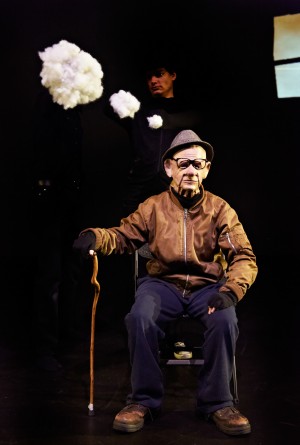
Creators Arielle Gray, Chris Isaacs and Tim Watts have produced some magical melancholy.  Built fundamentally from puppetry and projection, it’s visually stunning. Wordless, its power comes from the brilliant performances of the creators and the evocative musical composition of Rachael Dease.

An old man is being chased. Or is he doing the chasing?

Pursuing or being pursued; these are fundamental aspects of the human experience. They’re a direct function of the dimension of space. Unfortunately, they’re not a function of that other dimension we live in – time. It allows movement in only one direction. And that’s the sorrow.

Veronica Kaye


It’s Dark Outside by Arielle Gray, Chris Isaacs and Tim Watts

Riverside Theatre til 29 May

http://riversideparramatta.com.au/show/its-dark-outside/

It’s Dark Outside is currently on a national tour.

http://www.perththeatre.com.au/show/its-dark-outside/


The Young Tycoons

22 May

It’s obvious who The Young Tycoons is about. And some of the best laughs of the show come from this cheekiness.

This is the third outing for C J Johnson’s play and it’s a lot of fun.

Director Michael Pigott elicits good comic performances from all his cast. Edmund Lembke-Hogan and Laurence Coy both offer an amusing take on the volatile mix of privilege and stupidity. Terry Serio shines as the gruff commonsense right-hand man. Paige Gardiner, as the model girlfriend of a young mogul, is charming and ditsy in all the right places. James Lugton is articulate, intelligent and charismatic as a “Ferguson” journalist. (I think it was “Ferguson”. Definitely some F surname. Definitely not Fairfax.)

Photo by Noni Carroll

Photo by Noni Carroll

The Young Tycoons is witty and engaging, though the large number of scene changes proves a challenge.

This is a very precise satire. (Some might think my choice of adjective euphemistic.) The play doesn’t expose, or explore, all the dreadful ramifications of concentrating immense power in the hands of an oligarchy. It focuses more on the personal lives of the two billionaire media families. The characters come across as reasonably likeable, and only minor injuries are sustained as they clumsily stumble on the discarded remnants of a whole lot of broken moral compasses.

So, is this satire without bite? Just a sort of celebrity gossip piece?

No, I think it draws attention to an extraordinary fault line in our society. The dramatic tension of this play is the divisive concept of ‘dynasty’. Are you really going to get to run the business just because Daddy did?

It’s truly bizarre, that in a heartless capitalist society driven solely by profits, we would still consider passing on power through bloodlines.

For me, the play is not just a gentle taunting of privileged rich kids. Rather, it’s a forceful reminder that an all-consuming materialism simply will not meet our human needs. Not even the needs of those, who drowning in excess, have lost their way.

Veronica Kaye


The Young Tycoons by C J Johnson

Eternity Playhouse til 15 Jun

http://www.darlinghursttheatre.com/

Ghosts

20 May

On Saturday night, I went along to the Sydney University Drama Society production of Ghosts by Henrik Ibsen, and very much enjoyed it.

In the 1880’s, when it was first produced, Ghosts caused quite a scandal because of its discussion of sexually transmitted infections. To our standards, the discussion might appear subtle to the point of non-existence, but then again, a lot of modern theatre makers would feel the need to present the audience with a scene showing precisely how the characters got the STI in the first place.

Ghosts

This production, directed by Finn Davis, plays to the strengths of student theatre. Despite the characters ranging in age from early twenties to at least mid forties, all the actors are young. And they do good work. Diana Reid’s vocal work is particularly impressive. (However, the production as a whole would benefit from a more textured pace.) The set by Kryssa Karavolas is a beautifully simple white box, with an impressive (but suitably understated) mural on the upstage wall, exorcising the production of any alienating naturalism. The nineteenth century is evoked only gently by costuming.

The impact of all this is to prevent the play becoming trapped in its original context.

The characters talk a lot about ‘reputation’ and ‘duty’, and the easy way to deal with this challenge might be to dismiss such stuff as rather quaint. But a stripped back production like this makes that a difficult avoidance strategy to implement. Admittedly, reputation in the nineteenth century often hinged on one’s sexual behaviour, but an obsession with how we’re perceived by others is hardly a demon we’ve slain. And the renaming of vices as virtues (in the play ‘cowardice’ is rebranded as ‘duty’) is a life-denying habit that still haunts us.

Veronica Kaye

Ghosts by Henrik Ibsen, adapted by Monisha Rudhran  

Studio B,  Sydney University, til 24 May

http://sudsusyd.com/whats-on/ghosts/

Scenes from an Execution

19 May

Few people write dialogue better than Howard Barker; it’s funny, vibrant and explosive. And Barker’s Scenes from an Execution is a brilliant play.

It explores the relationship between the artist and society.

Galactia has been commissioned by the State to paint the Battle of Lepanto. She does, and the State is not happy. Galactia portrays war as something dreadful. The State wants it viewed as something glorious.

The play is set in Renaissance Venice. But, of course, it’s not. This is not a piece of historical realism. Barker’s characters could be here and now.

Photo by Katy Green Loughrey

Photo by Katy Green Loughrey

And director Richard Hilliar’s production is wonderful. His cast does terrific work. Lucy Miller as Galactia is magnificent; passionate, determined, and joyfully articulate. Carpeta is her lover. He’s another (competing) painter. Jeremy Waters delivers a beautifully pitched portrayal of cowardice that can’t help love its superior. And Mark Lee’s Urgentino, the Doge of Venice, is comic brilliance.

This is very rich theatre. Barker shares a swag of stimulating ideas. A particularly fascinating one involves the way society tames even the greatest art (but I’m not sure I can explore this one without a spoiler.)

So let me focus on just a single idea: the way society tries to control what art says.

In Galactia’s world, it’s the Church and the State who are the obvious powers. I began this response by suggesting it would be a mistake to assume this play is historical, to assume its message is that only in the dark past did we treat artists poorly.

This play demands we ask ourselves NOW what forces determine what art is allowed to say.

Our current patrons are the state, critics and the audience. What do they demand art say?

Let me offer the following list of absurd generalizations:

  1. Australian theatre must not question the extraordinary privileges that most of us enjoy in comparison to the majority of the world’s population.
  2. Australian theatre must not present characters that are intelligent, powerful political agents, as this would imply it might also be true of its audience (which would challenge the complacent acceptance of demand 1.)
  3. Australian theatre must be ‘professional’. That is, regardless of what the art says (not excepting demands 1 and 2) the focus of discussion must always be on the virtuosity of the production. This demand perpetuates a bourgeois emphasis on career, reduces art to a commercial product, and encourages the competition necessary for a capitalist society.

See this play. It’s very, very good. And come up with your own list.

Veronica Kaye


Scenes from an Execution by Howard Barker

Old Fitzroy Theatre til 31st May

http://www.sitco.net.au/

Amanda

15 May

Transgressive theatre dissolves received wisdoms in an acid bath of wit.

An old tension in psychology is that between nature and nurture. Are we born a particular way? Or is it our experiences that create the person we are?

Writer/director Mark Langham has presented a very funny, very clever play that pushes this tension centre stage. And then pushes it right off.

Amanda2

Amanda, played with an energetic kookiness by Amylea Griffin, is being held by the police for questioning. She has committed some heinous crime, though no-one seems quite certain what it is. In a series of flashbacks, both amusing and disturbing, Elizabeth MacGregor and Paul Armstrong wonderfully portray crazy characters who inhabit Amanda’s back history. This personal history is so wacky we’re clearly not getting reality – whatever that could be.

The concept of identity itself is being questioned (whereas the tired dichotomy of nature versus nurture merely takes the concept for granted and hence perpetuates it.) Langham’s thought provoking play highlights this exploration with a playful recurring motif, that of molecular transfer. If you sit on a bike, there’s a transfer of molecules; the bike seat becomes a little ‘human’, and the human a little ‘bike’. The hard and fast sense of identity is dissolved.

Langham further works this vein by incorporating Brechtian elements into the production. The stage manager (Noemie Jounot) grumbles hilariously in and out of the action. It’s a powerful reminder that this is all verisimilitude; the actors are only playing at creating characters or identities.

And then, thematically, there’s a tension that tears complacent realism apart. The question is raised: What part in our lives is played by fear? What by hope?

(Personal digression: Hope is the most radical of the three Christian virtues. The other two are Love and Faith. Love can speak for itself. Faith is out of fashion; it’s an assertion of knowledge we feel we have no right to claim. Hope, on the other hand, is a glorious unknowing, an appreciation that our visions of our world, and ourselves, are always incomplete.)

Hope is our forgotten virtue. Its very openness makes it difficult for conventionality to portray.

And it is impossible to own.

It requires a letting go.

Veronica Kaye


Amanda by Mark Langham

at TAP Gallery til May 18th

http://www.trybooking.com/Booking/BookingEventSummary.aspx?eid=81259&embed=81259

Trainspotting

9 May

Theatre is for people who can’t handle reality. But, though it can be mind altering, it’s a wiser choice than most illicit substances.

Thematically, this play shouldn’t interest me. I’ve never been much into drugs. (In fact, in 1996, whenever my friends would begin raving about the movie, I’d quietly slip away to the bar again.*)

But this production, directed by Luke Berman, is terrific. The cast of four create – with extraordinary energy, courage and commitment – the world of drug addled 80’s Edinburgh.

Trainspotting

Damien Carr plays Mark (whose story we most closely follow) with a winning, empathy-inducing stage presence. Taylor Beadle-Williams plays an array of ‘lassies’; beautiful portraits of tough women doing it hard in a misogynistic culture. Brendon Taylor’s scene as an unwillingly witness to sexist violence, with his fear that he must intervene, is magic. Leigh Scully perfectly captures a variety of imposing and physically threatening male characters, only later to display an extraordinary range when he so convincingly plays Mark’s mother.

Harry Gibson’s adaptation of the original novel by Irvine Welsh is episodic, wide ranging, and frighteningly effective.

When Life has become a disease, whose symptoms are boredom and disappointment, a cure will be sought.  This play presents the desperate measures people take to self medicate, often with catastrophic consequences.

This is confronting theatre. There’s sex, violence and two hours of Scottish accents. And it works.

It’s both funny and horrifying. It’s hard to imagine how anyone ever thought this tale glorified drug usage. It doesn’t preach – it’s far too cool for that – but honesty is the most powerful pedagogy.

As I began by saying, thematically this show shouldn’t be my cup of tea. I don’t have much patience with people who find Life dull and disappointing. (My parochialism, no doubt, the result of being privileged enough to sit around comfortably drinking too many cups of tea. And fine red wine.)

But this production is eye opening, sympathetic, electric.

And it does what theatre can do so well, throw open windows to other, sometimes harsher, realities.

Veronica Kaye

*Trainspotting is very conscious of the dangers of that most commonly abused of drugs – alcohol.


Trainspotting 

King Street Theatre til 24 May

http://www.kingstreettheatre.com.au/trainspotting/