Gravity

20 Nov

On the way to the theatre, my plus one asked if we were seeing a new play. I replied Yes, that considering the title, it must’ve been written at least post-1687, the year Isaac Newton published Philosophiae Naturalis Principia Mathematica.

A joke like that doesn’t belong in Bradford Elmore’s Gravity; his play is genuinely funny.

But there’s a connection. Elmore presents characters who are intelligent – and this is the surprise for an Australian play – they can read! And they do.

Not that the piece is overly cerebral. Far from it. It’s just that the characters in Gravity have an active interest in the written word – and actually discuss it!

Christopher and Heather have a love of literature and David has a fascination with astronomy.

And all this isn’t gratuitous, a case of a playwright choosing to focus on some bizarre corner of society in order to present a gritty new angle, or an example of a dramatist claiming to give voice to some neglected minority.

The literature and astronomy operate as motifs that give the play a wonderfully rich texture. But to discuss that, I must first outline the play’s basic scenario.

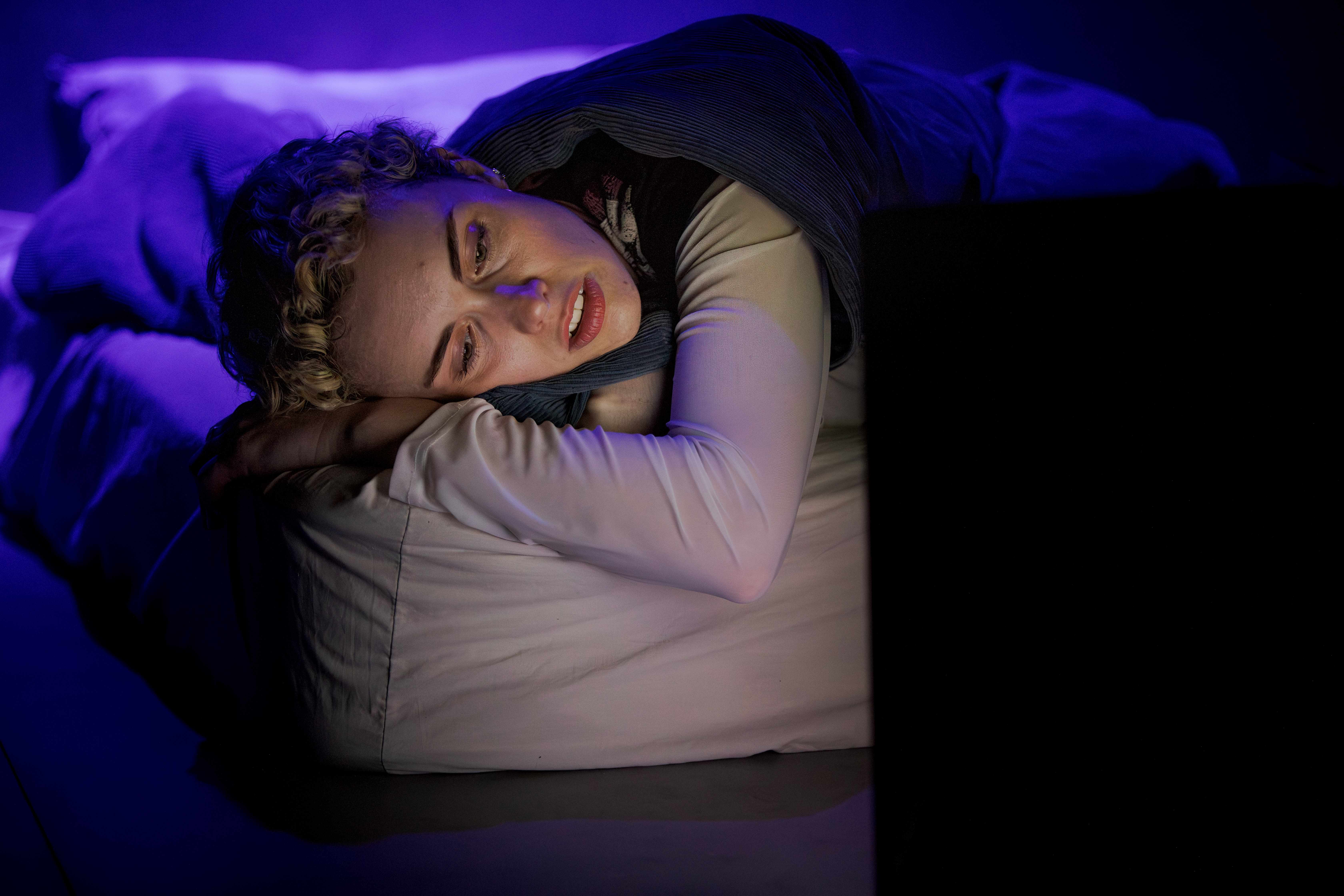
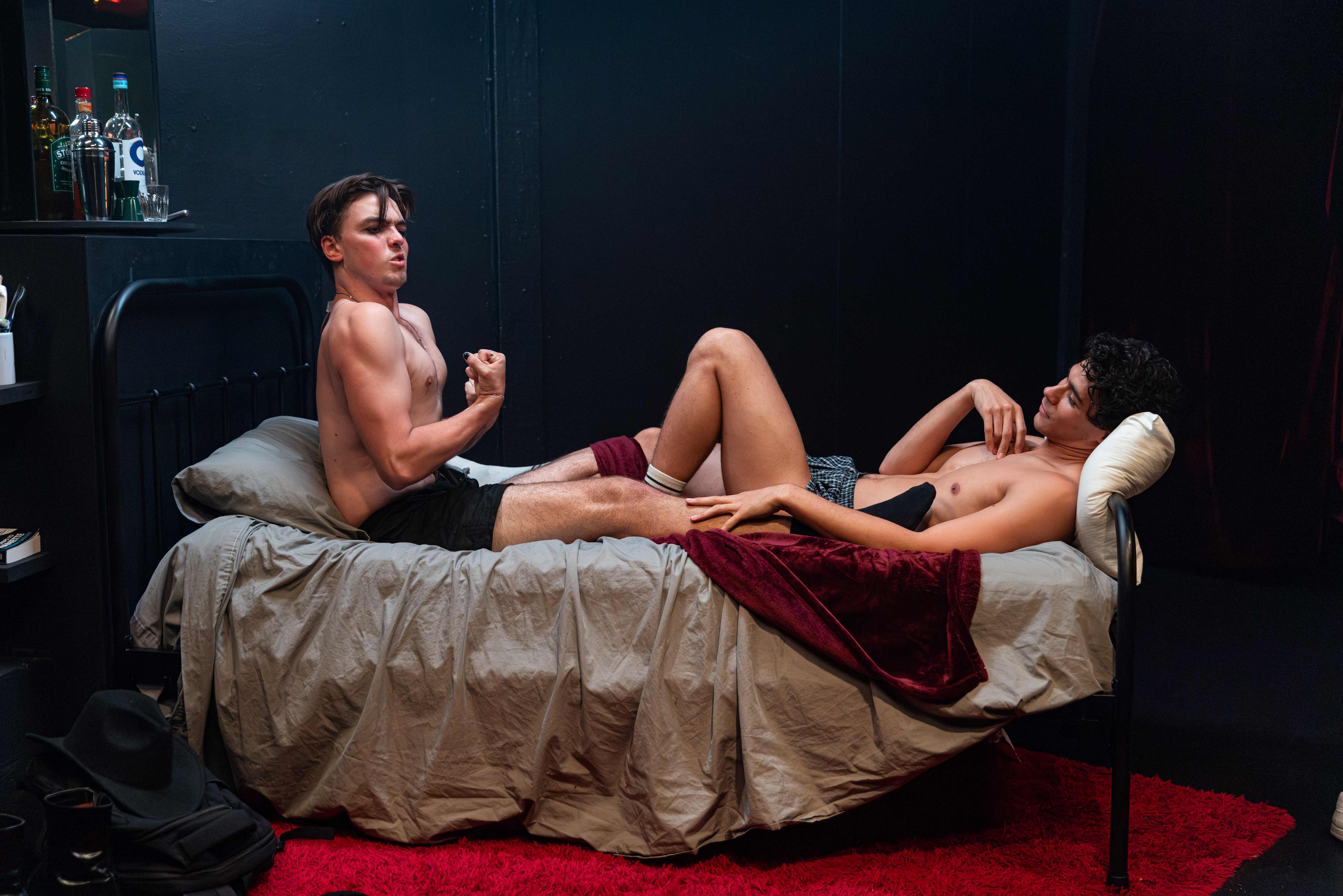
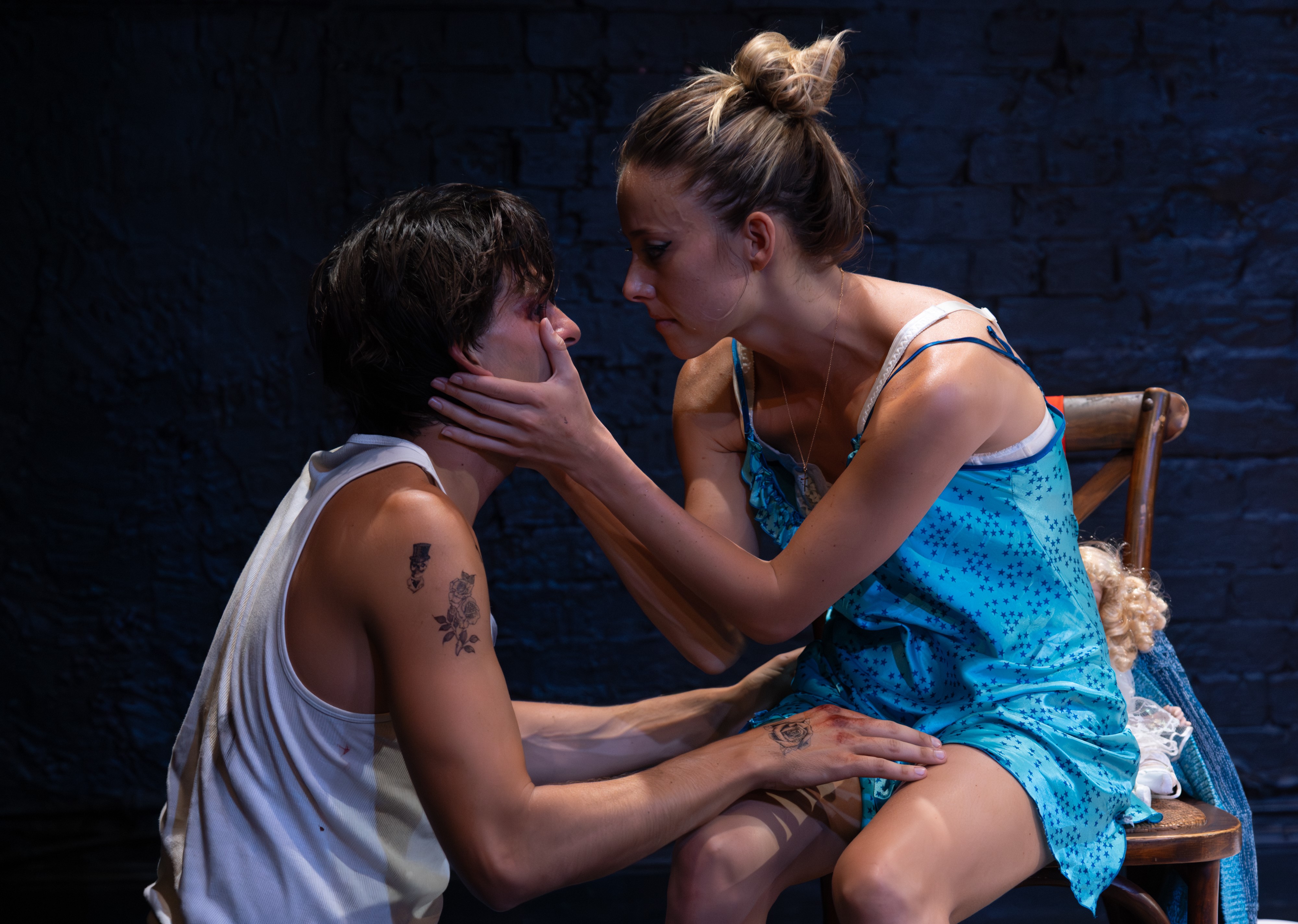
Christopher (Wesley Senna Cortes) and Heather (Annabelle Kablean) have been married for ten years, and he feels he still loves her. But he has now also fallen in love with David (Drew Wilson). How can this be resolved?

Back to the motifs.

David’s interest in astronomy allows consideration of opposing forces, of the difficulty of orbiting two bodies simultaneously, of the danger of being torn apart. But it also posits balance, the possibility of a smooth, untroubled, eternal motion (the type we imagine is enjoyed by the stars.) The relevance to the play’s scenario is beautifully thought-provoking.

Heather and Christopher’s interest in literature allows musings on narrative, and how we’ll stick to things, despite the emotional pain, because we need to know how it turns out. As a play about the challenges of fidelity, the connection is clear.  Discussions of literature also facilitate some playful games about preference, of the Austen-or-Dickens, Tolstoy-or-Dostoevsky type. I’ve made up these examples, but the mischievous premise behind these sort of games – that loving one somehow excludes loving the other – is central to the play’s exploration of relationships.

Anthony Skuse directs and designs, and in this deliciously simple space there’s a gorgeous flow to the movement. Skuse also elicits fine performances from his cast, who make the humour crackle and the heart cry.

Whether you ultimately find the conclusion of the piece satisfying will probably hinge on your willingness to watch it devolve from the higher stakes of dramedy to the easy cheerfulness of rom-com. But I suspect satisfaction might also depend on your own values and emotional experience; what you consider Love, and what you consider Truthful. (Though, if your sole aim in visiting the theatre is to see a reflection of yourself, a visit to the aptly named vanity in your bathroom would suffice. Embrace doubt and surprise; they’re some of the artform’s greatest gifts.)

Paul Gilchrist

Gravity by Bradford Elmore,

produced by Rogue Projects,

at The Loading Dock, Qtopia until 29 Nov

qtopiasydney.com.au

Image by Phil Erbacher

So Young

18 Nov

In writing this review, I’ve allowed the most time to pass I ever have between seeing a show and putting my response on the page.

This is partly because of that pesky thing called Life, which with annoying persistence tries to sideline Art.

But it’s also because – by the time I saw So Young at the Old Fitz – the whole run had sold out. (Though do check for wait lists – tix may become available.)

When responding to theatre I try to write in a way that doesn’t suggest that the producing company has simply outsourced its marketing – but Outhouse’s production of Douglas Maxwell’s play is brilliant.

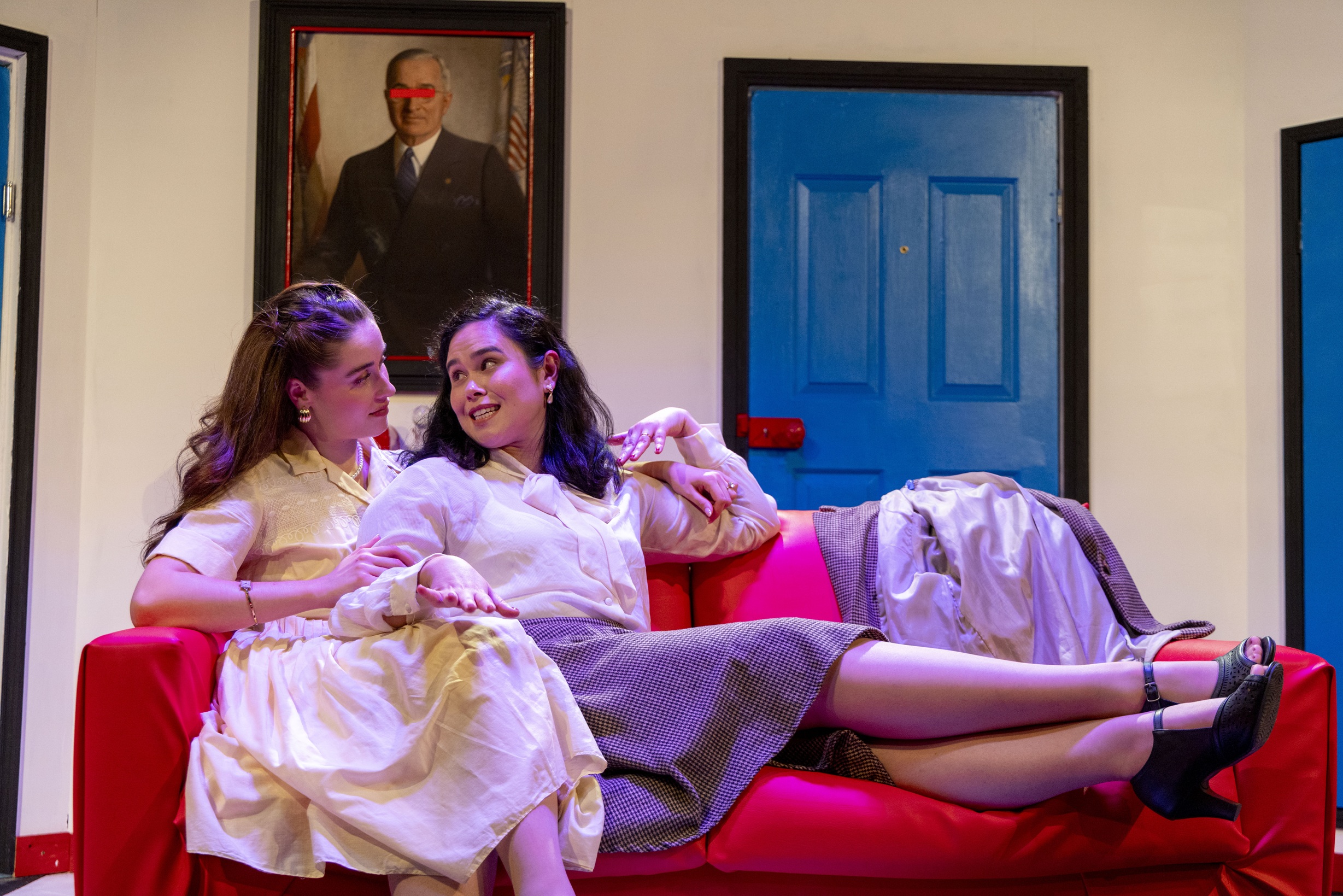
So Young is the story of forty-something Milo finding love again after the early death of his wife. His longtime friends Davie and Liane are shocked to find this new love, Greta, is only 20 years old.

We live in a culture obsessed with demographic divisions. Each one of us is labelled and firmly put in our box. This superb play is about two of the most dominant of these devilish divisions: youth versus age and male versus female. But it’s also about the only demographic division that ultimately matters: the quick versus the dead.

Under the direction of Sam O’Sullivan, the play blazes with humour and heart.

As Liane, Ainslie McGlynn’s performance is magnificent, beautifully boiling and bubbling with the grief that masquerades as anger.

As Davie, Jeremy Waters gives us a splendid portrait of blokeish bonhomie, with that longing for pleasant peace presented in all its complexity. Is it wisdom? Or is it weakness?

Henry Nixon as Milo offers a bewitching bewilderment in the face of Life’s two greatest mysteries – Death and Love.

Aisha Aidara as Greta is gloriously youthful. She marvellously captures youth’s perceived pitfalls – its social naivety, its careless certainty – while all the time radiating courage.

And courage and its close cousin compassion are the qualities most needed by those of us still on this side of the only division that matters.

Paul Gilchrist

So Young by Douglas Maxwell

Produced by Outhouse Theatre Company

At the Old Fitz until Nov 22

oldfitztheatre.com.au

Image by Richard Farland

Crotchless

5 Nov

This is a fine comedy. 

It’s written by Eloise Aiken, this year’s winner of the Katie Lees Fellowship.

The Fellowship is designed to support young female/female identifying theatre makers, and here it has once again shown itself to be a vital contribution to the Sydney theatre scene.

Crotchless is about how contemporary teenagers and their parents navigate the cultural reactions to feminism.

Aiken has a great ear for comic dialogue; the script is funny and truthful and shit. (And, in case it’s not obvious, the last of those three adjectives is meant as an admiring imitation of Aiken’s uncanny ability to portray the language use of the young, rather than some vocab-deficient, mean-spirited evaluation of the play.)

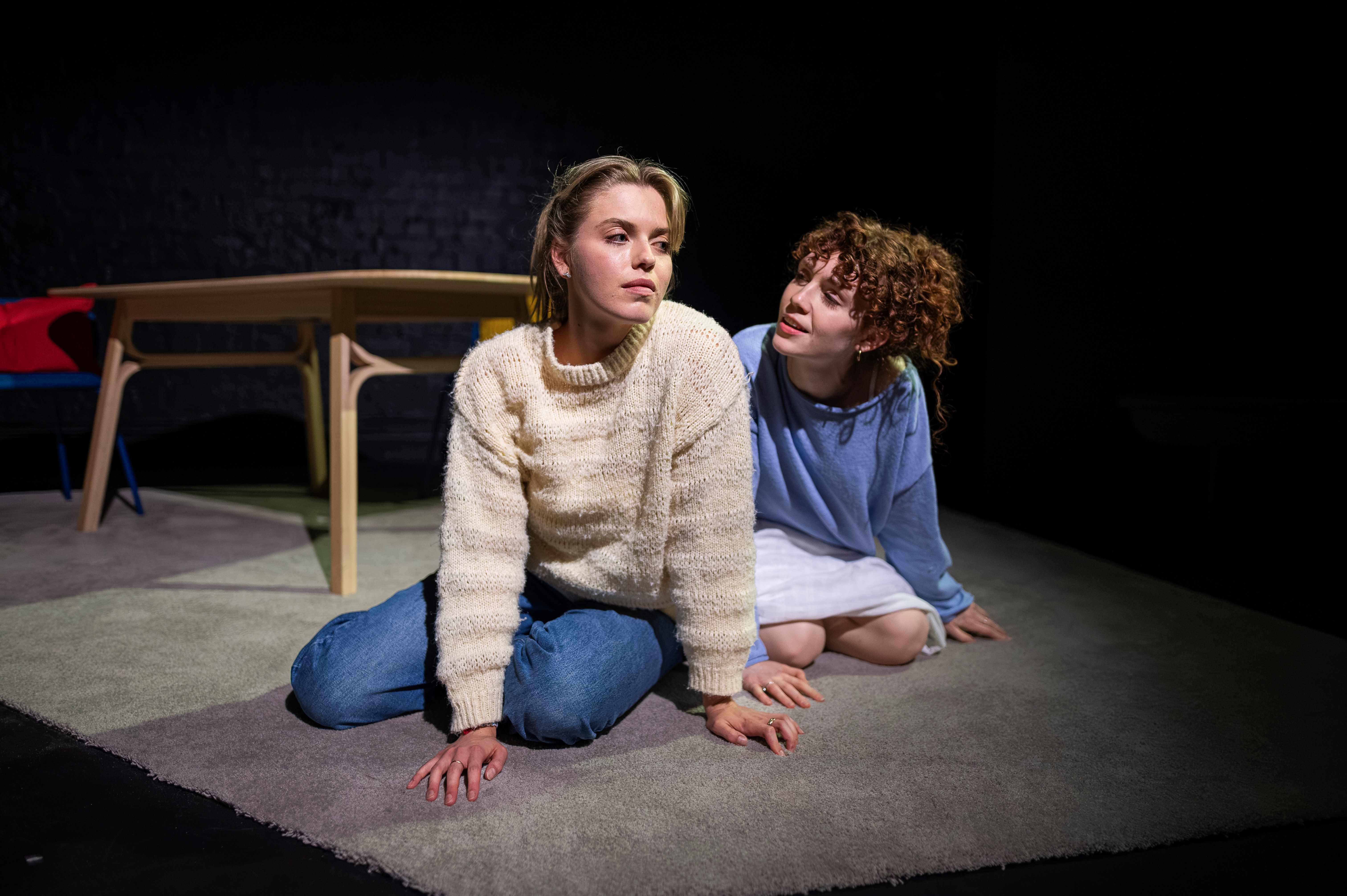
Teenage Shona has dating issues, but it’s her twin brother Owen’s dive into the rabbit hole of misogyny that especially troubles her. Trish, the twins’ single mum, acknowledges Shona’s concerns but is less certain how to prevent her son’s disturbing moral diminishment.

The piece is driven by some fascinating tensions.

One tension is that between the broader culture and personal agency. Owen is admonished for listening to misogynistic podcasts and told to read feminist texts. Of course, what we put into our heads is important, but we’ve come to view ourselves almost as if we were passive computers: just load the correct software and we’ll run appropriately. It’s an understandable but disconcerting assumption – because it seems to erase the possibility of both critical thinking and moral discernment.  (But, we do live in a culture that has rather suddenly become aware of the concept of Culture, and everyone who’s seen Terminator 2 knows the frightening consequences of suddenly becoming self-aware. Skynet isn’t alone in its over-reaction to the unexpected advent of choice.)

Closely related to the tension between instruction and intellectual agency is that between confrontation and love. Should we simply condemn those who disagree with us? Or, as Trish suggests, will that just drive them further away? Is a strict insistence on moral conformity merely counter-productive? Must individuals learn for themselves?  

That Crotchless posits both sides of these tensions suggests its maturity of vision, its beautifully honest awareness of the complexities of Life. If it ultimately comes down a little too heavily on one side of all this, the feel-good-tell-it-how-it-is-for-victory-and-empowerment side, that’s completely understandable. After all, it is a comedy. (And, anyway, is the conclusion of a play actually the sum of its meaning and value? Especially when it’s a comedy. Perhaps the comic happy ending is just one more dramatic convention, as meaningful, say, as the fourth wall.)

Madeleine Withington’s direction is splendid; the pace and bounce is spot on.

Performances are comic excellence. 

Esha Jessy is thoroughly engaging as Shona, the quick-witted teenage girl caught between vigorous assertions of female worth and a risky desire for the rather unworthy male Other.

As Owen, Ashan Kumar brilliantly captures the inarticulate energy of the teenage boy, the hilariously non-threatening high-modality, informed with just the right hint of danger: a cute, clumsy oversized wolf cub trying out his fangs.

Sarah Greenwood is utterly superb. Her performance dances with the lightness of comedy, yet her portrayal of Trish truthfully represents the challenges of maternal love, in all its poignant mix of strength and vulnerability. Greenwood also doubles as Shona’s best friend, Malory, and delivers a playful-almost-parody that is a delight in itself, but also serves to highlight the glorious complexity of her portrait of the more mature of the women.

Paul Gilchrist

Crotchless by Eloise Aiken

At Flight Path Theatre until Nov 8

flightpaththeatre.org

Image by Alex Macleay

Chicken in a Biscuit

10 Oct

Tyger Tyger burning bright,

In the forests of the night:

What immortal hand or eye,

Dare frame thy fearful symmetry?

Did he smile his work to see?

Did he who made the Lamb make thee?

So wrote William Blake, as he struggled to make sense of the eternal Other.

Blake is not the only writer to wrestle with our relationship with our animal relatives. Christopher Smart in Jubilate Agno asks us to consider his cat Jeffrey – and urges us to see him as a wondrous example of Creation. Jack London’s Call of The Wild invites us to note the huge gap between domestication and an animal’s natural state. Lord Dunsley’s My Talks with Dean Spanley (adapted to film in a version with Sam Neill) has a gentler take on this peculiar relationship.

Chicken in a Biscuit by Mary Rachel Brown and Jamie Oxenbould is the inheritor of a grand tradition.

These writers focus particularly on our relationship with pets, and the style is wacky fun.

It’s a loose collection of monologues. Half portray pet owners. Half portray pets. In a bold decision, all are performed by human actors.

In the portraits of pet owners, a common note is an interest in unusual expressions of sexuality and a gentle mocking of dagginess. Not that the piece presents as a satirical attack on pet owners – with 75% of Australian households owning a pet, it’s more a comment on humanity and what we find amusing about that very strange species.

The portraits of animals riff on familiar tropes – cats as proudly imperious and dogs as dumbly loyal. In our Age of Offence, I’m sure someone will find the anthropomorphism a little tasteless (maybe me)– but the writers are doing no differently than have generations of cartoonists.

Directed by Brown, performances by Mandy Bishop and Oxenbould are delightful committed silliness.

Paul Gilchrist

Chicken in a Biscuit by Mary Rachel Brown and Jamie Oxenbould

Presented by Fixed Foot Productions

At The Old Fitz until 18 October

oldfitztheatre.com.au

Image by Becky Matthews

A Behanding in Spokane

10 Oct

Twenty-five years ago, Carmichael’s hand was cut off. He’s been searching for it ever since.

This is a black comedy by Martin McDonagh, the writer of The Beauty Queen of Leenane, The Cripple of Inishmaan and The Pillow Man.

First presented in 2010, it’s the first of McDonagh’s plays set in America. 

75 minutes long, the action plays out (almost) in real time. Two grifters have come to Carmichael’s motel room, hoping to sell him a hand – which may or not be his.

It’s tremendous fun, with great laugh-out-loud lines. Directed by Kai Paynter, we’re treated to hilarious high-energy performances. (There were a few tiny hiccups, in vocal work and in staging, but I did see a preview.)

As the grifters, Cynthia Taylu and Alexander W. Hunter have a very amusing bickering repartee and both deliver terrific portrayals of comic fear.

As a motel employee, Christopher Northall is wonderfully quirky, a true loose cannon, brazenly outside usual motivations and empathies.

As Carmichael, James Yeargain brilliantly captures the character’s heartless determination, a frightening brutality which reaps enormous comic rewards when he falls into petty quibbles with the other characters.

But with the avalanche of politically incorrect language and suggestions of extreme violence, what’s it all about?

Crazed determination? Carmichael has been looking for his (unusable) hand for a long, long time.  

Crazed consistency? On the phone, Carmichael’s mother questions whether he can legitimately claim to be racist if he finds women of colour sexually attractive. And the motel employee hangs on to a resentment which the current horrific circumstances should render utterly irrelevant.

Or perhaps, like many black comedies, it’s more about clearing the air.

Black comedies often seem untruthful – some people dismiss them as such – but they function as an invitation to break free from the spell of language and artistic representation. (A critic with even more authority than me has warned of the danger of bewitchment by our own creations, commanding “Thou shalt not make unto thee any graven image….”)

Through their mischievous and vicious exuberance, comedies like this refuse to be confused with the real thing. They remind us that our words, and the worlds they conjure, are not actually reality – certainly not in its totality – and that spirit of cheeky rebellion is gloriously liberating.

Paul Gilchrist

A Behanding in Spokane by Martin McDonagh

Presented by The Americas, A Theatre Co, in association with Beartiger Productions

At Schell Medical Corp (Flow Studios 88) until 12 October

theamericas.beartigerproductions.com

Image by Lola Carlton

Samson

5 Oct

This is the first production by Luminar Theatre Company. Debuts are always thrilling, a sign of a vibrant scene and a promise of things to come.

Samson by Julia-Rose Lewis was first produced at Downstairs Belvoir in 2015.  I probably saw it; it’s reminiscent of a lot of new Australian plays from the time.

Set in a country town, it presents four teenagers dealing with grief.

It was Lewis’ first play and it throws down plenty of challenges for a director and their cast. It has a large number of short scenes. None of the characters seem to have sufficient dialogue. Some ideas are repeated too often (I need to get out of this town!) while others are left tantalisingly, or frustratingly, oblique (the recurring motif of burning.)

No one over twenty is given any stage time nor, it seems, has much impact on the lives of the characters we do see. I find this odd. What I take to be the themes of the piece – grief, guilt and metaphysical speculation – are experienced by everyone, not only teenagers. It could be argued that the piece’s purpose is to present a snap-shot of rural youth, but if so, why choose a moment in which they are confronted by problems that are so universal? Perhaps it all operates as a metaphor: the characters’ immaturity symbolising the inadequacy of us all in the face of Life’s grand questions.

Having suggested the play is an odd creature, one which some will find flawed while others will find powerfully resonant, what about this production? How does it deal with the challenges presented?

Director Chloe Callow and her design team use the space well. Sound design by Rhiannon Jean, lighting design by Julian Dunne and set design by Max Shaw effectively evoke a world of lost souls, tantalisingly suggestive of the gothic, but never giving in to the temptation to give that genre full rein – the character’s problems are genuinely existential, but aren’t soaked in a sensationalism that would reduce them to the rousing rather than the real.  

Callow also helps her eminently watchable cast (Samuel Ireland, Henry Lopez Lopez, Ava Jones and Jean) find the appropriate and always engaging tension between the characters’ natural youthful energy and the bewildering enervation of their loss.

Perhaps it would’ve been better for the company to choose a script in which the cast were asked to play characters of their own ages. But, even still, there are wonderful moments: of exuberant humour and lively physicality, and of honestly portrayed suffering and gentle commitment to the craft of truth-telling.

I look forward to seeing more from Luminar.

Paul Gilchrist

Samson by Julia-Rose Lewis

Produced by Luminar Theatre Company

At The Greek Theatre, Marrickville

Until Oct 11

Image by Simon Pearce

Port

27 Sep

This is a fine production of an intriguing play.

Written by Simon Stephens, it’s set in Stockport in the UK over a fifteen year period, beginning in the late 1980’s. I call it intriguing because, in some ways, it’s novelistic in its ambition.

Focusing on the life of Racheal, it’s a bildungsroman (of sorts.) We watch Racheal as she moves from a young girl to a young woman. The journey is difficult. Her parents are absent or abusive or lost. Her younger brother is hyperactive to a degree that promises little peace. She makes poor decisions regarding men.

Is she growing? Or just surviving? I’m not sure.

Racheal’s story (if story is the right word) is constructed from multiple vignettes. Presented in chronological order, each is a slice of fifteen minutes or so of her life. In one, she’s eleven and she’s sheltering in the car with her mother and brother. In the next, she’s perhaps fourteen and in a hospital waiting room, as her father watches over his dying father-in-law. Etc. There are large time jumps between these vignettes and only occasionally do characters remain in the story (if story is the right word.) Of course, much has happened in between these vignettes and we have to piece together the parts.

Sometimes, what happens has little background and not much follow up. There are a lot of unanswered questions. Examples: Racheal faces constant accusations of sexual misconduct, which we assume is garden-variety misogyny, but as so much of her life is excluded from the vignettes, we’re not sure; her father is supposedly weird, but in what way, we’re not sure; in one scene she’s extremely cruel, but how she later makes peace with this behaviour, or indeed, if she ever feels the need to, we’re not sure; she finds a man with whom she clicks, but why they don’t stay together, we’re not sure.

In the midst of all this uncertainty, one certainty is that some audience members will be frustrated. Others will see it as an invigorating invitation to make lively guesses, to wonder at connections, to play armchair psychologist – exactly what we do every day when faced with the inevitable mystery of other people’s lives. (And I don’t mean just the unknown and unknowable lives of the strangers we see on our daily commute; I mean everybody. While our own life is experienced in first person, existentially, everybody else’s life is experienced from the outside, with us relegated to mere audience. This is why drama seems to capture Life, or least large aspects of it, while remaining entirely and obstinately blind to other aspects.) 

In this honest presentation of mystery, its brave refusal to fill in gaps, the script achieves a thrilling level of verisimilitude. It reflects exactly how we know other people: only in patches. (Often, we try to sew those patches together, to make something whole, to make a thing of comfort – but, if we’re honest, we really only have a pile of scraps.)

The time jumps between vignettes demand substantial transitions, and director Nigel Turner-Carroll choreographs these beautifully.

And within each vignette wonderful opportunities are offered to actors, and Turner-Carroll’s first-rate ensemble makes the most of them. (Some people would could call this an actors’ play; that is, one in which the principal enjoyment comes from the appreciation of the craft done well.)

Owen Hasluck plays Billy with enormous energy, creating a character who is eminently lovable and heartrendingly vulnerable.

Megan O’Connell as Racheal’s mother gives us a terrifically believable portrait of toughness bred from circumstance.

Kyle Barrett as Racheal’s father effectively portrays the laconic working class man, intimations of brutality vying with fragility. Later, he doubles as one of Racheal’s lovers, and this characterisation fascinatingly and frighteningly develops elements of the older character.

James Collins, as another of Racheal’s lovers, splendidly portrays a gentler masculinity, and their final scene together is the play’s surprise standout moment of suspense.

But it’s Racheal’s play, and Grace Stamnas gives a performance that’s entirely engaging – astonishing in its range, yet always mysteriously, evocatively, (and appropriately) incomplete.

Paul Gilchrist

Port by Simon Stephens

Presented by December Theatre Company in association with bAKEHOUSE Theatre

At KXT until Oct 4

kingsxtheatre.com

Image by Philip Erbacher

I, Julia

24 Sep

Julia Louis-Dreyfus is a comedy icon. Audiences know and love her from Seinfeld and Veep.

Lily Hensby, writer and performer of this fun show, claims to be obsessed with her.

The premise of I, Julia is that if Hensby manages to evoke Louis-Dreyfus’ comic skills sufficiently, the woman herself will turn up – giving Hensby validation and a boost to her own comic career.

The spoiler rule prevents me from revealing if Louis-Dreyfus does show.

But we are treated to some classic moments from her body of work, such as Selina Meyer and the croissant, Elaine’s fear of having rabies, and (my favourite) Louis-Dreyfus’ acceptance speech when she won the Mark Twain Prize for American Humour.

Under the direction of Kate Ingram, what Hensby offers is not so much straight mimicry, as a joy in making the material and the characters come alive.

Hensby herself has a wonderfully engaging stage presence and terrific comic delivery. Constructed around a premise of the persona having to wait, the script throws out formidable challenges in terms of pace, with the performer having to navigate the variations between the moments of tight, high-energy when she plays Louis-Dreyfus’ characters and something slower and looser when she plays her own created persona.

The piece is an impish invitation to think about some pretty big issues.

One of those issues is validation. Performers often put extraordinary pressure on themselves by setting international fame as the only criteria for success. Considering the odds, it’s sadly akin to a gambling addiction.

Another issue is the nature of humour. We’re asked directly What do you find funny? At least one audience member, unsurprisingly, found this question difficult to answer. (Much laughter derives from a reversal of expectations; to explain a joke may not be to murder it, but it does usually result in accidental humourcide. Note: this pun is not Hensby’s, but mine. Second Note: Very little laughter derives from puns.)

Hensby admires the musicality of Louis-Dreyfus’ delivery, her ability to make every syllable funny. Many directors and writers will concur with this vision of the script as a score and will encourage actors to play every note.

But on a less technical level, Hensby suggests that Louis-Dreyfus’ popularity has come from her ability, and willingness, to play unpleasant people.  Often her characters are incredibly shallow and totally self-obsessed. We’re invited to laugh, with the performer, at such characters. By laughing at human faults, we remind ourselves that we’re susceptible to them, and that we can recognise and transcend them.

So the question becomes What is the value of laughter?

As Hensby notes, there aren’t many situations which laughter won’t improve – and this show embodies that spirit of playful jubilance.

Paul Gilchrist

I, Julia written and performed by Lily Hensby

At the Emerging Artist Share House (Erskineville Town Hall) as part of the Sydney Fringe

Until 27 September

sydneyfringe.com 

Image supplied.

Sh!t Theatre, Or What’s Left Of Us

22 Sep

This is beautifully written and wonderfully performed, very funny and deeply moving.

The title hints at the key theme. 

But we begin with the two writer-performers – Rebecca Biscuit and Louise Mothersole – in badger headgear. Think fur, fangs, whiskers, and snouts. Cute.

Apparently, when badgers hit hard times, they get into a torpor. (Yes, it’s a technical thing.) But you can’t remain in a torpor forever.

And I neglected to mention that these badgers begin the show by singing a folk song. Apparently, when human beings hit hard times, they get into folk music. (That’s not a technical thing.) But, as the performers suggest, folk revivals do seem to occur at times of disorder and uncertainty. Like the Industrial Revolution. Like the 60’s. Like Now.

They visit an old folk club. Everyone at the club takes turns singing. It’s not about being good. It’s like those Japanese bowls: when they’re broken, they’re put together again with a lacquer powdered with gold – and become more beautiful because their imperfections are acknowledged. (Those bowls, indeed bowls in general, are mentioned several times, and it’s the sort of thing that makes this such an exceptional piece of writing and performance; what begins as Play grows into Beauty and Truth.)

Many of the songs are about drinking: like The Barley Mow (a cumulative drinking game of a song, with its repeated refrain of Good luck to an increasing number of participants, and ending each time with Good luck to the round bowl.) And there’s the old John Barley Corn (a personification of the grain that becomes beer, and so must die. But He comes back again.)

There’s a lot of songs about death. This is a song about death, we are told repeatedly. (And these songs are performed delightfully.)

We learn the folk club burnt down a week after they visited, and there’s a suggestion the show might become a whodunnit. 

But some questions don’t have answers, and we begin to suspect that the torpor, the chaos, they’ve been speaking about is not especially political.

This is a song about death, we’re told again.

But this time, it isn’t a song. It’s two superbly written, intersecting monologues about personal loss. They’re funny, generous-spirited, courageous and incredibly affecting. They also give an enormous poignancy to so much of what preceded them, so much that earlier in the show seemed only for laughs. The bowls are just one example. Go along and find your own. There’s an extraordinary richness to it all.

Richness and wisdom. The piece is a glorious artistic expression of the most humane of wisdoms: that, if there is a path to salvation, it begins not with the seeking of perfection – in ourselves, in the world –  but with the acknowledgement of all that is broken.

Paul Gilchrist

Sh!t Theatre, Or What’s Left Of Us written and performed by Rebecca Biscuit and Louise Mothersole

Presented by Sh!t Theatre in association with Soho Theatre

At New Theatre, as part of the Sydney Fringe (Touring Hub)

Until Sept 27

sydneyfringe.com

Image by Ellie Kurttz

Lesbian Sex Diaries

19 Sep

This is absolutely joyous.

Constructed mainly from comic monologues, interspersed with some song and dance, it’s also very funny.

Co-creators Rebel Star and Melody Rachel are superb comic performers.

Warning – absurd generalisations that attempt to delineate performance styles: Star employs a giggly infectious effervescence, punctuated by devastating dead-pan. Rachel employs the well-placed pause and the slight but-oh-so-evocative vocal intonation.

Sometimes the monologues are honest sharings, such as Star’s beautifully sweet reminiscence of a teenage dalliance, or Rachel’s tale of her first LSD experience (which includes the best definition of God I’ve ever heard.)

At other times, the monologues are playful representations of aspects of dating, like Rachel’s brilliantly written and delivered piece on keeping it casual.  

It’s tempting to share some of the show’s hilarious one-liners – but, for reasons of critical integrity, I won’t. (But I did last night, as soon as I got home, to my partner’s delight.)

With simple production values, and a running time of 50 minutes, Lesbian Sex Diaries is fun fringe. And, if I can hazard a wider comment on queer theatre, it’s a glorious example of that genre as pure celebration.

Paul Gilchrist

Lesbian Sex Diaries by Rebel Star and Melody Rachel

At the Loading Dock, Qtopia, as part of the Sydney Fringe,

Until 20 September

sydneyfringe.com

Image supplied.