Masterclass

15 Jan

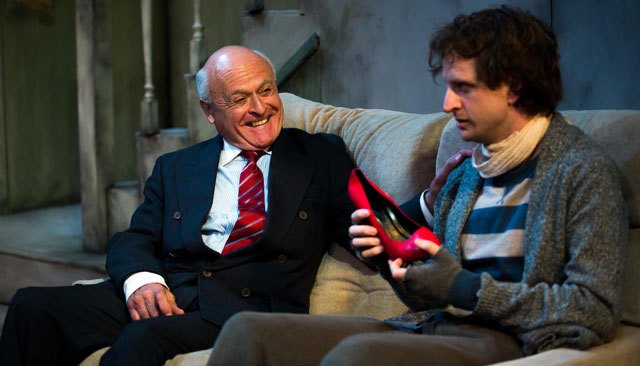
It’s tempting to call this a masterclass in comic acting, and not just because as a writer about theatre my natural default position is banality posturing as wit. Created by Gareth Davies and Charlie Garber, Masterclass is very funny and brilliantly acted.

Davies and Garber give beautifully measured performances. Both their physical and vocal work has a wonderful texture. They know when to go exuberantly large, and they know when to defer to a casual everydudeness. (OK, that’s probably not a word. Or at least not til now.)

Davies plays a great actor. Garber plays one of his creations. Garber attempts to convince Davies to return to the stage. However, the actor feels the risk to a potential audience is just too high – because of the enormous power of his performances.

Photo by Marnya Rothe

Photo by Marnya Rothe

Some people might call it undergraduate humour. It delights in silliness. It takes aim at tropes that the more world weary amongst us have long recognized and now thoughtlessly accept.

The play is an exploration of our obsession with the great actor. It’s a disturbing element of our theatre culture, and here it’s playfully parodied.  (An analogy of my own perverse invention: the obsession with acting in the drama theatre is like an obsession with anesthetic in the surgical theatre. Of course you have to get it right, but it’s hardly the point of the process. )

Masterclass also raises interesting philosophical questions about the concept of character. Clearly, characters are not real people and the play has a lot of self aware fun with this idea. Characters lack autonomy. That’s the worm in the heart of our grand tradition of representational theatre: our ‘great’ theatre that purports to tell us the way things actually are. Of course, it doesn’t, and can’t; not if it struggles to present the dynamic of choice. Though some might say my argument is merely undergraduate.

Veronica Kaye


Masterclass by Gareth Davies and Charlie Garber

presented by Red Line Productions

Old Fitzroy Theatre  til 31st Jan

http://www.oldfitztheatre.com/tickets-masterclass

Tell Me Again

11 Dec

It’s difficult to avoid spoilers with a production like this.

Both the structure and the subject matter attract them.

But I’ll try to resist the temptation, and so will no doubt write a frustratingly obscure response.

Firstly, I’ll consider the structure.

The play consists of a large number of very short scenes. There’s a pleasure in attempting to work out how these scenes might connect.

Like a cryptic crossword. (A phrase, which if it were question, some might reply with a ‘No thank you’.)

You could argue that empathy is sacrificed to curiosity.

Tell Me Again

I’m assuming that the play’s structure is a gimmick, that it’s purpose is to titillate. But perhaps it’s meant to represent an aspect of human experience.

If so,  it’s not an experience I’m familiar with.

But I suspect some audience members will connect this presented experience with the fate of one of the characters. Which would make for an oddly first person play. (Aside: theatre’s particular oddness is that it is not first person. Theatre presents Life from the outside, which is decidedly not how Life is experienced. It’s how Life is observed. So, both artistically and philosophically, Jeanette Cronin’s play is exceedingly intriguing.)

Now that I’ve discussed the structure with a criminal level of obscurity, let me move on to the subject matter.

A couple has a playfully gladiatorial relationship. She, in particular, is a pedantic language user. She derives power from it. She believes language is concrete. This vision eventually seems both ironic and tragic.

Performers Jeanette Cronin and James Lugton are marvelous.  They delicately weave in and out of scenes of humour and pathos.

The whole production, directed by Michael Pigott, has a transcendent beauty. In what could have been disturbingly frenetic, there is a poignant stillness.

Veronica Kaye


Tell Me Again by Jeanette Cronin

Old 505 Theatre til Dec 21

http://www.venue505.com/theatre


The God of Carnage

10 Dec

Two couples meet, with the intention of maturely discussing a fight between their children. It’s a neat comic set up, which playwright Yasmina Reza employs to good use.

It’s built upon an enduring myth, a common assertion: that what we call civilization is actually a thin veneer over our essential savagery.

So broad an assertion borders on meaninglessness. It certainly resists easy discussion of its truth or falsity.

So I’ll ignore its veracity, for now, and discuss its appeal.

Why might people choose to believe it? What is the possible purpose of this assertion?

Perhaps it’s an ethical indictment. There are harsh aspects of our society, but we either forget them or choose to ignore them. For example, most of us feel we live decent lives, even though we know there are people elsewhere who are quietly starving.

But there’s another possible purpose of the assertion that we are, in fact, savages. It justifies our moral failings. ‘It‘s just human nature, so how can I be to blame?’

God of Carnage

This production, directed by Steven Hopley, is high energy and good fun. The cast (Jacki Mison, Chris Miller, Hailey McQueen and Yannick Lawry) deliver lively, engaging performances. On the night I attended, there were a few problems with rhythm and pacing, but these are difficult to avoid considering the absurdly tight parameters Reza puts on the setting. Despite the building tensions, the characters must remain in close proximity.

In a single room.

In France.

This production transfers the setting to Australia. (Though there are some disquieting references to Le Monde and the repeated use of the word ‘madam’.) Are these characters Australian? You could question if the relocation works, if you assumed the play is meant to be representational.

Alternatively, you could let the play be an intriguing tease. It tantalizingly offers an old chestnut of reductionism, a broad generalization of supposed universalism, and laughingly asks “Is this really true?”

Veronica Kaye


The God of Carnage by Yasmina Reza

Downstairs TAP Gallery

26 Nov – 7 Dec. (This production has closed.)

Twisted Tree Theatre

The Legend of King O’Malley

1 Dec

The Faust myth is oddly enduring.

It’s fascinating how we’ll repeat stories in which people sell their soul to the devil for earthly rewards; fascinating because who actually believes in the devil? Or, indeed, the soul?

So what’s its meaning? That if you achieve anything (knowledge, influence, sexual allure) you must pay an enormous cost? A cost so disproportionate that you’d have to be mad with self importance to agree to it in the first place?

Nietzsche might call it a slave philosophy. It seems to suggest that anyone who succeeds in this world is inherently evil, and evil will inevitably come to them. A philosophy like that can only be of comfort to the powerless. (Or those wishing to pretend they are more powerless than they actually are – which I usually argue is pretty much anyone who has the time and money to attend theatre in Australia. Myself included.)

In The Legend of King O’Malley the titular character sells his soul for wealth and power. It’s a particularly strange take on the myth because O’Malley was a real person, an American preacher who migrated to Australia and was elected to our fledgling federal parliament.

As O’Malley was a real person, I think it’s safe to assume that the writers, Michael Boddy and Bob Ellis, have invented the whole ‘deal with the devil’ bit. I’m not sure why. (I’m also not sure why the first act, which deals with O’Malley’s time as a preacher, is as long as it is.)

Photo by Afshar Hodar

Photo by Afshar Hodar

Director Phil Rouse’s production is a relentlessly raucous ragtag rat bag revue. (OK, despite being wonderfully high energy, it’s not actually relentlessly raucous. I just got on a roll with the alliteration.) There are beautifully vibrant performances from the entire cast, but there are also some moments of stillness and emotional impact.

James Cook as King O’Malley and Matt Hickey as Billy Hughes do terrific work in the playful scenes, but they change gear magnificently to provide the dramatic heart of the piece.  (Spoiler Alert) It’s during World War One. Prime Minister Hughes supports conscription, but O’Malley does not. O’Malley resigns from Hughes’ cabinet, and then fails to win his seat at the next election. Or indeed any election after that. (O’Malley lived till 1953, and at the time of his death was the last surviving member of our first national parliament.)

When the play was written, in 1970, conscription was Australian policy. We were sending our young men to fight in Vietnam. I suspect this is what led Boddy and Ellis to choose O’Malley’s story. As a piece of political propaganda, arguing that the state exists for the individual and not the opposite, it’s effective and intensely moving.

And perhaps, despite my earlier questioning, the play’s form serves a purpose. Boddy and Ellis’ O’Malley is a shyster and raconteur – so much so that only an appropriation of a grand myth could make sense of him. But he still put us “lazy, dumb” Australians to shame.

Or at least shook us up.

Of course, the Australian people never did vote ‘Yes’ to conscription in the First War. And in 1972, two years after this play was originally presented, we finally voted in a government that ended conscription’s most recent incarnation.

This production is a timely reminder of the power of our elected representatives, and how it’s our responsibility to continue to push them to create a more just society.

Veronica Kaye

The Legend Of King O’Malley by Michael Boddy and Bob Ellis

Seymour Centre til 13 Dec

http://www.seymourcentre.com/events/event/the-legend-of-king-omalley/


The Les Robinson Story and Belle of the Cross

25 Nov

Double bills are intriguing things. Two works that were created independently are suddenly placed together, resonating in unforeseen ways.

This is not a bad thing. To complain about it would be the equivalent of complaining about friendship. In friendship we become different. Our friends draw out certain of our qualities and suppress others.  In fact, it could be asked, what are we before friendship, or indeed before any of our relationships? How much sense does it really make to talk of our own self, independent of the world? Where would this self exist?

‘Oh, if only he/she/they knew the real me.’

The ‘real me’ is a fabrication.

Both of the plays in this double bill are (in essence) one-person shows about a person; which is what started me thinking about the above issue.

Photo by Katy Green Loughrey

Photo by Katy Green Loughrey

The Les Robinson Story written by Kieran Carroll and directed by Ron Hadley tells the story of one of Sydney’s iconic story tellers. I’d never heard of him.

Apparently, Les wrote prose in the modernist style, lived in caves, and was under-appreciated by the Great World. The first two aspects make him a character (more on this in a moment) and the last grants him universal appeal. Hasn’t everyone, at sometime, felt they’re under-appreciated? ‘If only they knew the real me.’

When I say Les is a character, I don’t mean the performance by Martin Portus isn’t rich or subtle. Rather what’s offered to us by this play is Les’ difference; how he was different from his world, and from ours. It’s nostalgic and sentimental, and many people will warm to it.

Belle of the Cross written by Angelika Fremd and directed by David Richie presents us with a woman slipping into homelessness. Gertraud Ingeborg’s performance is moving and engaging. Belle’s situation is not easy. She didn’t choose it. And, so we’re told, she dies without anyone knowing who she really was…….

Photo by Katy Green Loughrey

Photo by Katy Green Loughrey

This idea begins the play and ends it.

The beauty of this piece, and what resonates so magically and thought-provokingly with the first of the double bill, is this:

The second time* we’re told that Belle died unknown, we’re asked ‘Who hasn’t? Who won’t?’ And Ingeborg poses the question with a magnificent and mischievous twinkle in her eye, one encompassing both the pity and the glory of the human condition.

Veronica Kaye


The Les Robinson Story by Kieran Carroll

Belle of the Cross by Angelika Fremd

at The Old Fitz, until 29 Nov

http://www.sitco.net.au/


* Apologies to Angelika Fremd for a quote which is probably a paraphrasing, and hopefully not wildly inaccurate.


“Approval and Validation”

25 Nov

It is a truth universally acknowledged, that whenever a playwright writes a good play, she will be vigorously pursued by prestigious theatre companies.

“My dear Mr Bennet,” said his lady to him one day, “have you heard that Prestigious Theatre Company has a new artistic director?”

Mr Bennet replied he had not.

“Apparently,” returned she, “he is very interested in new Australian work.”

Mr Bennet remained silent. His wife took this as invitation to continue.

“Interested in new Australian work! What a fine thing for our girls!”

“How so? How can it affect them?”

“Mr Bennet, how can you be so tiresome? You know they are all playwrights. This new artistic director will no doubt want to produce their plays.”

Mr Bennet returned to his book.

“Now I’m the first to admit,” continued Mrs Bennet, “I find Lizzy’s plays a little confusing. Other people find them amusing, but to my mind, she never seems to be saying what she really means.”

“It’s referred to as irony,” Mr Bennet stated flatly.

“I know that!” replied Mrs Bennett.

“Of course you do, dear” said Mr Bennet, even more flatly.

Satisfied, Mrs Bennet continued. “And Mary’s plays are so wordy, and I can’t quite understand them, but they’re very clever, I’m sure. And Lydia’s plays are skittish, the work of an immature artist, but they were good enough for Short and Sweet. And Jane, quiet unassuming Jane; she’s always done the right thing. Who wouldn’t want to produce her plays?”

– from the manuscript of the (unpublished) Jane Austen novel Approval and Validation 

JaneAustenCassandraWatercolour

Sometimes you just gotta to do it yourself .

You can write a damn good play and it still mightn’t get produced.

Maybe it’s political. And I don’t mean who owes who, or who’s competing with who, or even who’s sleeping with who. I mean political.

Every play is an attempt to convince the audience to see the world in a particular way. Every play is an attempt to affect the world. Your plays will be put on by people who share your vision of the world. And, if there already are a whole lot of people who share your vision, you probably wouldn’t have bothered writing the play in the first place.

So be prepared to do it yourself. And be proud of it.

Veronica Kaye

Leaves

24 Nov

The title could be part of some meta-theatrical stage direction:

(End of Act One. Lights come up on stunned theatre reviewer. She Leaves.)

I didn’t. I stayed for the whole performance. And found it quite fascinating.

Recently, however, I have fallen into the dreadful habit of avoiding writing about shows. (And it’s not that I’m just following my mother’s advice: if you can’t say anything nice…….)

I even received an email from a publicist, who politely asked whether I was ever Ever EVER going to write about the show I’d attended.

I ignored her email. I went to other shows. I didn’t write about them either.

Eventually I wrote this reply:

“Dear Polite Publicist,

I’ve thought a lot about your show. 

To be honest, it wasn’t my cup of tea, so I would prefer not to write about it. 

I appreciate my response is utterly subjective, and as you might know from my previous writings, somewhat idiosyncratic. 

I wish the artists involved all the best.

I try to write about all the work I’m invited to, but occasionally I think it’s best to remain silent. As a working dramatist myself, there have been several occasions where I have wished a critic simply hadn’t written, rather than allowing their alienation from (or incomprehension of) the play’s themes to be expressed as shallow negativity about the production and the writing.

Apologies for any inconvenience.

Yours, V”

But I don’t do traditional criticism. (You know the type: Armed with cliches, and addicted to hyperbole, you relentlessly evaluate. Evaluate the acting. Evaluate the script. Evaluate the lighting. Evaluate the costumes. Hey, evaluate the seats if you’re on a roll.)

I don’t do that type of writing, so my excuse won’t cut it.

I write responses. I write about what the play made me think about.

Leaves by Steve McGrath is about three men hitting fifty. That’s the story – if that’s the right word for this extended sitcom.

Yes, they’re hitting the ‘Big Five  O’.

That phrase – ‘the Big Five O’ – was used fifty times in the play. (OK, I’m falling back on traditional critical methods). But at least I didn’t say the phrase was used ‘Five O’ times. I just said the word.

Which is my point. Diversion.

Earlier, I used the term meta-theatrical, and it’s this very element that made this piece so intriguing.

Steve McGrath’s character at one moment avoids a difficult topic with a quip. He does it a lot. But this time he openly acknowledges it’s exactly what he’s just done.

Which seems to me what the whole play does. Avoids serious issues.

I turn fifty this week. (Seriously.) The issues of the characters are not mine. Unless it be the inability to honestly face what really matters.

Leaves

I grew up wanting to believe humour was subversive. I wanted to think it mocked the grown-ups, indicted the power holders, toppled the pompous.

But I’ve come to realize that the opposite, and many would say the obvious, is also true.

As well as subversion, humour can be diversion. Don’t think about this, don’t address that, just look over there!

The play has some excellent one liners and it’s thought provoking for that reason.

Ironically (or not), the stand out performance moment is McGrath on film. (I can’t tell you more, because of the spoiler rule.) The film projections that are peppered through out this production have the effect of making what happens on stage appear even less real, even more off the point.

There’s also inordinate talk of women. None of whom are present. But then none of the three male characters really are either. These characters are overgrown children. A question: Does comedy require that?

But the more pressing question is, at fifty, or indeed at any age, have we acknowledged what matters, and are we engaging with it?

In its paradoxical and playful way, this production left me with some serious thoughts about being funny. (And so inspired the following bad pun.)

Humour as diversion. Entertainment. Come in to the theatre. Leave your troubles outside. Enjoy.

Humour as subversion. Exittainment. You’ve seen the show. You’ve been empowered. Now leave. And change the world.

Veronica Kaye


Leaves by Steve McGrath

King Street Theatre til Nov 29

http://www.kingstreettheatre.com.au/

The Way Things Work

12 Nov

Ever since Dorothy Parker quipped of The House Beautiful that it was the Play Lousy, the more attention seeking of the critical fraternity have dreamed of such gift titles.

And so, if I was of this infantile nature, I would pounce on The Way Things Work and say that it’s Not The Way Plays Work.

But Aidan Fennessy’s play is intriguingly nontraditional in its structure. Two actors play six separate characters in three distinct scenes. The satisfaction of character development is sacrificed for the pleasure of discovering plot connections.

Leland Kean’s cast has fun with the comedy. On opening night there were fluency issues, but these will iron out.

In the first of the triptych, Nicholas Papademetriou is a state minister accused of corruption. He claims that corruption is endemic and systematic whenever there’s a hierarchical power structure.

Photo by Zak Kaczmarek

Photo by Zak Kaczmarek

Without denying the need to explore other possible power structures, the minister’s argument is rather absolutist. A little like saying that human beings will inevitably suffer disease so why bother looking after your health? Or I’ll be tired tonight so why get out of bed this morning?

Corruption is real. But cynicism merely justifies it. It’s one of the ideologies that enables it.

In the final scene, in a deliciously provocative moment, Ashley Lyons plays a hit man searching for a type of honour. The character refers to the Anzacs. ‘They did what was right.’ Does he clearly connect this with what actually happened to them? If this is honour, who’d want it?

A play like this sends you off into the night (a night perhaps both literal and metaphorical) asking whether we have developed the ethical tools to build an honourable society?

Veronica Kaye


The Way Things Work by Aidan Fennessy

A Rock Surfers Theatre Company production

Bondi Pavilion til Nov 29

http://rocksurfers.org/

Platonov

10 Nov

People desiring but never acting.

Chekhov’s plays usually have me thinking about cowardice.

And one evening I will finally muster the courage to just get up half way through the first act and walk out.

Of course, I’m joking.

Platonov is early Chekhov, and more happens in it than usual for the master. (Perhaps too much. And there’s an atypical focus on one character; a young man and his relationships with women. Which I could patronizingly and erroneously suggest is typical of young male heterosexual writers.)

But I don’t want to overstate any of this. This is fascinating theatre, and not just because it offers an insight into the masterpieces that were to come later.

The language of Anthony Skuse’s adaptation is beautifully pitched. Grounded in the late nineteenth century origins of the play, it still speaks with a contemporary living voice.

Photo by Matthew Neville

Photo by Matthew Neville

But the primary joy of this production is the performances. Skuse has gathered an extraordinary group of actors and has created a space in which the entire cast create mesmerizing work.

I’ll mention only four. (It’s a fourteen hander. See it for a master class in acting.)

Charlie Garber gives us a thoroughly watchable Platonov. Part charisma, part moral outrage, part self loathing, it’s all leavened with just a sprinkle of humour. Many of the female characters love him, and I suspect so will the audience. As his simple, gentle wife, Matilda Ridgway is heartbreakingly phenomenal. Suzanne Pereira as Anna gives us dignity at odds with desire, and it’s a deeply moving portrait. Geraldine Hakewill plays Sofya with a tense stillness, an intriguing balance between empowerment and bewilderment.

It’s a big play, but I’ll end with reference to a single moment.

Platonov snaps “What God do you serve? What God do any of us serve?” It’s Chekhov’s challenge. Is this (and the plays that follow) an indictment of particular individuals or of an entire society?

We are flawed. The world is flawed. But do we make the world or does the world make us? This is the gloriously humane tension in Chekhov’s vision. It’s what makes him such a compelling dramatist. And it’s what this production captures so wonderfully.

Veronica Kaye


Platonov by Anton Chekhov

directed & adapted by Anthony Skuse

presented by Mophead & Catnip Productions

ATYP, Studio One til 22 Nov

http://www.atyp.com.au/

Daylight Saving

10 Nov

Sometimes I wish I was one of those writers who confuse mean-spiritedness with wit, and word games with truth. If I was, I could have begun my response like this:

“Daylight savings; it’s so confusing! Do you gain an hour? Or do you lose an hour? See this production for the definitive answer. You lose two hours twenty.”

What critics forget, when they write this sort of nonsense, is that these jokes have no doubt already been made in the rehearsal room.

Daylight Saving by Nick Enright is simply a good bit of fun. And Adam Cook’s production is deliberately and delightfully daggy.

Photo by Helen White

Photo by Helen White

At the end of the show you do have to put your watch forward 25 years – because the play’s sensibly been left in its late eighties setting.

A light weight meditation on fidelity, loneliness and lost time, it’s peppered with crazy characters. A celebrity chef, a Wimbledon champion, a Stanford professor, and a host of others sit down to dinner around a table in Pittwater.

The cast have appropriate larks with all this. Rachel Gordon and Christopher Stollery get both laughs and sympathy as the troubled couple. Ian Stenlake is suitably charming and repulsive at turns as the visiting Yank. Belinda Giblin is a wonderfully audacious lady who lunches. (Diana Simmonds deserves a special mention as the voice of the interviewer. The ungenerous might say her performance was such that she was hardly present, but my tip is watch for her name at the next Sydney Theatre Awards.)

Enright’s play is conservatively structured, but shot through with giggle lines. And he gets the last playful laugh. Sitting in the middle of this (now) nostalgic extended sitcom is a thought-provoking exchange:

‘The play’s a crock of shit isn’t it?’

‘Yes. It’s a national classic.’

Veronica Kaye


Daylight Saving by Nick Enright

A Darlinghurst Theatre Production

Eternity Playhouse til 30 Nov

http://www.darlinghursttheatre.com/