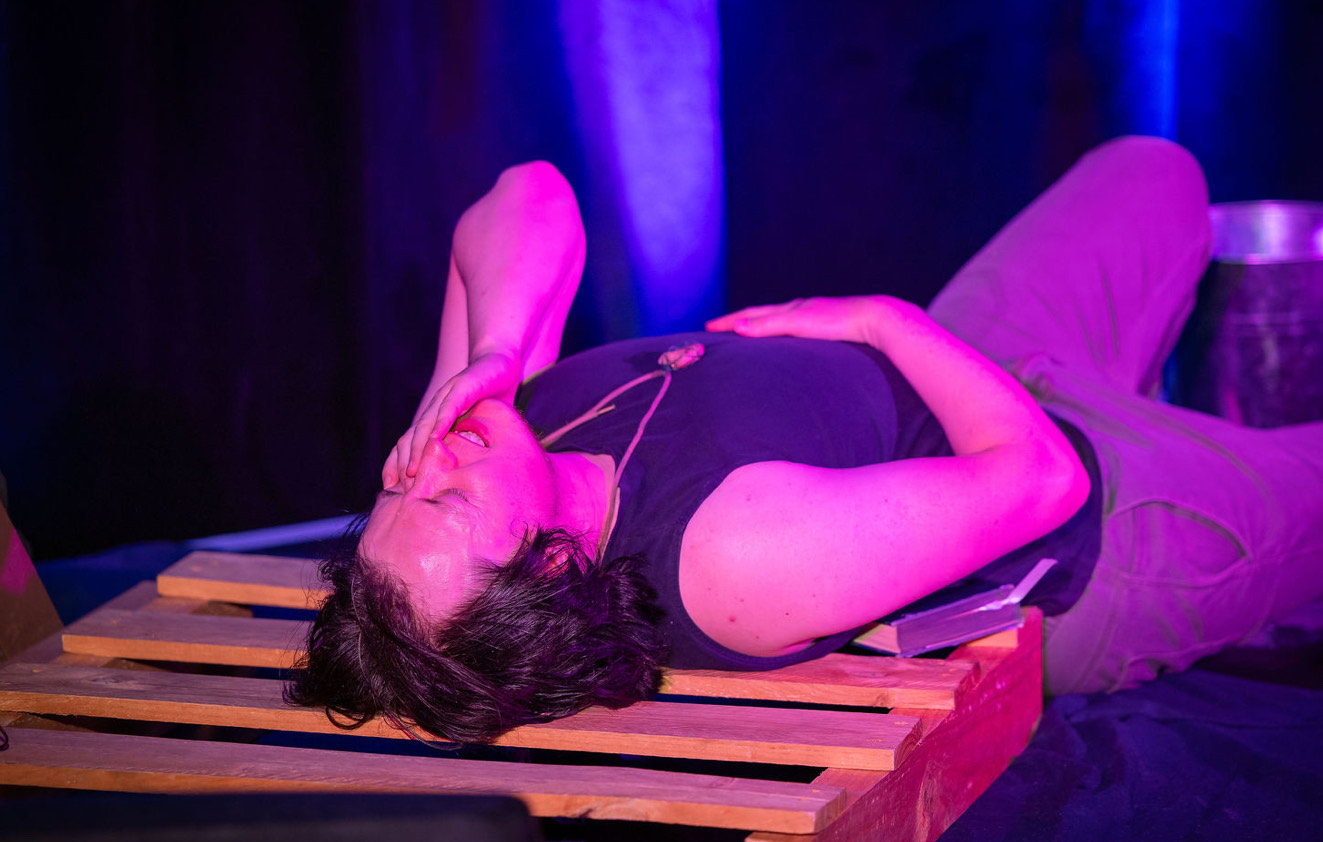
Written and performed by Tom Robins, this is a wonderful little fringe show – ambitious, evocative and magical.
The protagonist, John, tells of his maritime journey to find out what has happened to his favourite uncle, Max.
John and Max had been close, the black sheep in the family, the two individuals who didn’t fit into the small, ordered lives of the rest. Max had told John some extraordinary stories about his sea journeys. He’d asked John if he believed them – and the answer had been a resounding Yes!
Many of Max’s stories are sourced from maritime legend. In fact, Max has left, as a sort of guide, a book of such tales. In the tales told by Max to John – and by John to us – are sirens, selkies, kelpies – and the Lighthouse. Max has found the Lighthouse, and John feels he is called to follow. Like all great myths, the Lighthouse is ambiguous, inviting multiple interpretations. Is it Death? Is it the place of Enlightenment? Is it where all our many stories converge? Or is it the place from which all our stories derive?
Simply and beautifully staged, the piece is a thrilling invitation to embrace the power of story.
Its intriguing and provocative energy derives from two tensions.
Firstly, stories are everywhere. They’re the sea in which we swim; without them, we’d be as fish thrown upon the sand. Stories are this rich, life-giving medium because they forever mix, in a surging ocean of ideas. Stories inform each other. There are no entirely original tales – and that binds us all together. But – and this is the tension – each of us must find our own stories. The fish might be in the sea, it might be of the sea, but it is not the sea. To have Life is to have movement of your own, not to be at the mercy of every tide, every current. (This extended metaphor is mine, not Robins’. I hope, that by being inspired by someone else to make its own way, it exemplifies the generously wise vision his piece shares with us.)
The second tension is that between story and reality. Some people might argue that what we call reality is just one more story. But Robins’ story features a hagstone: that is, a stone with a naturally occurring hole, one which – when peered through – enables the viewer to see beyond all disguises and illusions…to reality. This tension between story and reality runs through the entire piece, just as it runs through the entirety of postmodernity. In the world in which we live, we know that any desire to reduce the human experience to mere facts is dehumanising, counter to a flourishing diversity. But at the same time, we suspect that the utter denial of facts can pave the way to atrocities, of both the figurative and literal kinds.
Robins presents John’s story in an easy, utterly watchable manner. Occasionally, I felt a clash between the character’s casual colloquialism and the grand, poetic vision of the piece – but I can’t deny that The Art of Storm-Whistling is a joyous gift.
Paul Gilchrist
The Art of Storm-Whistling by Tom Robins
Presented by Curious Roach Collective, as part of Pride Fest
At The Loading Dock, Qtopia, until 30 June
Image by Photos By Jamois

