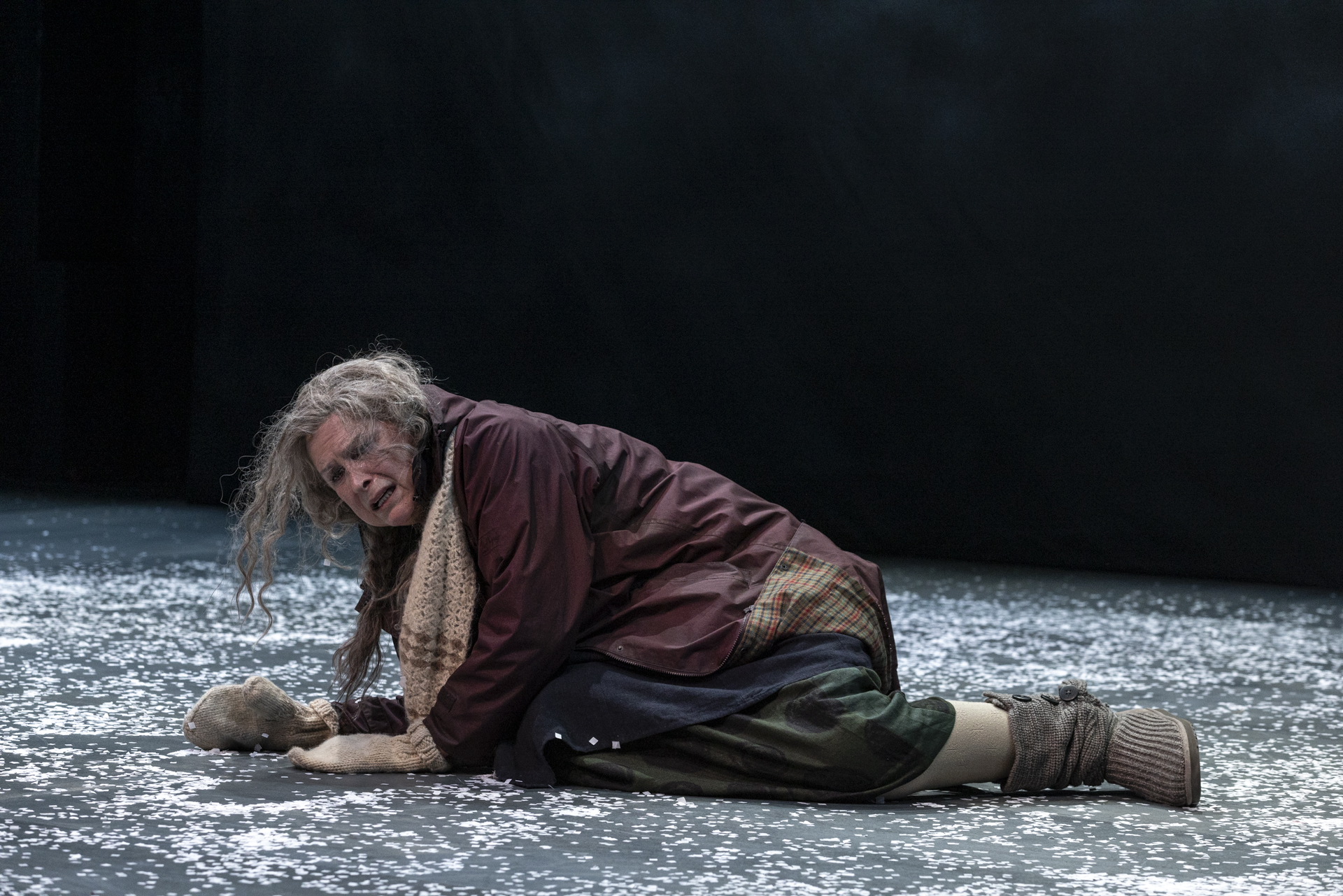
Little People caught in Big History.
Written and directed by S. Shakthidharan and Eamon Flack, The Jungle and The Sea tells of the Sri Lankan Civil War.
It’s an extraordinary piece of theatre-making.
With a simple design and an exceptional cast – Anandavalli, Prakash Belawadi, Emma Harvie, Nadie Kammallaweera, Shiv Palekar, Dushan Philips, Kalieaswari Srinivasan and Rajan Velu – The Jungle and The Sea movingly presents the impact of war on ordinary people.
The script is inspired by both eyewitness testimony and classic literature. The first of these brings an urgent truthfulness, which the second somewhat dilutes. (Allusions to The Mahabharata and Antigone risk pulling us out of what is believably wild reality into the euphemism of the constructed tale.)
A recurring motif is Fortune. And, reflecting on the events so powerfully presented in this production, ones that occurred not that far away and not that long ago, it’s difficult to see modern Australia as anything but deeply fortunate. It’s also a timely, crucial reminder to value peace and to work for its maintenance. (Hint: Seek Justice. Shun Violence. Both in equal measure.)
Another motif is the tension between Chaos and Order. There’s a provocative moment in which a defender of Order wails in frustration that Everyone can’t get what they want. Are we being invited to view this assertion as self-serving, as simply spoken by someone enjoying authority? Well, enjoying certainly seems the wrong word in this scenario – and, anyway, the painful assertion is also true. Our society’s beautiful infatuation with Justice means we desperately pursue it, without giving much consideration to what it is. Who decides the nature of Justice? Serious question. And is Justice really the paramount virtue? What of Love? One of the many glories of this piece is that it’s peopled with characters of many faiths – Hindus, Buddhists, Muslims, Christians and Atheists – and in these traditions that speak of Love there’s an awareness, that in our Fight for Justice, the Fight must not predominate.
It’s an epic piece (2 hours 50 minutes with two intervals) – and for the first two acts, the beautiful simplicity of the presentation leads us to believe we’re witnessing the dreadful Truth of civic unrest. The final act, however, feels different, as though the recording of events – and the allowing of the audience to evaluate those events – is gradually replaced by a direct evaluation by the theatre-makers themselves. Without spoilers, an example: A woman accused of treason repeatedly asserts that what she was doing was ordinary. It’s a remarkable claim, not because her actions are in any way treasonous, but because of the extreme circumstances and the life and death stakes. (In the Event of Attack: Escape, Hide, Tell.) What is perhaps understandably maddened grief is presented as a desire for justice. Like the literary allusions, this moral judgement dilutes what would be achieved by plain honesty.
Perhaps I’m being pedantic – but there’s no doubt this is a brilliant, bold piece of theatre.
Paul Gilchrist
The Jungle and The Sea by S. Shakthidharan and Eamon Flack
at Belvoir until 2 Aug
Image by Brett Boardman