And how do we stop the problem arising in the first place?
Our culture assumes there must be simple answers to questions such as these. We’re certain of the destination, so there must be a path. Perhaps this attitude is a product of our hubris, or a result of the current fashion for self-righteousness. Or maybe it’s a consequence of something closer to universal, the spell of language: if you can formulate a question, then there must be an answer.
In Duncan Macmillan’s beautifully wise play there are no simple answers.
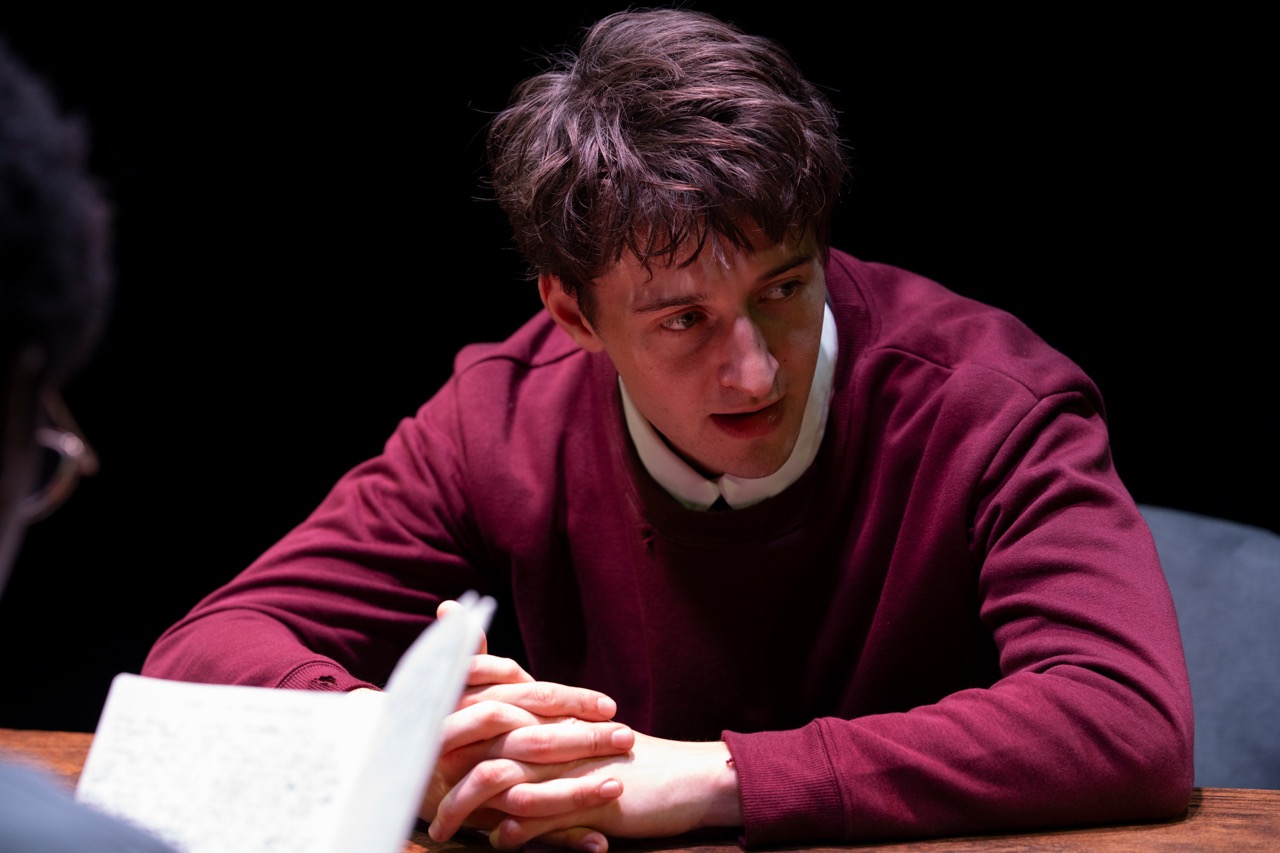
Fourteen year old Darryl is obsessed with violence. School staff member Tom doesn’t know how to help. And Rita, Darryl’s only remaining family member, desperately wants to pretend he’s just a normal teenager.
There’s a brilliant piece of dialogue between Tom and his partner, Jodi. (I’m probably paraphrasing, but this is its core)
Jodi: Who’s to blame?
Tom: No–one.
Jodi: Then what hope do we have?
Darryl also refers to this blame game.
Counter-intuitively, blame bestows hope. Blame assumes powerful dangerous forces could have been controlled, if only we’d done what was right. (As though perfection were possible in this sub-lunar world, as though we could return to Paradise after the Fall.)
Director Kim Hardwick’s production is excellent; aided by designer Victor Kalka and a splendid cast, there’s a pared back simplicity that lays bare the complexity of the human heart. (There is one simplicity – but more on that later.)
Campbell Parsons as Darryl is magnificent. Macmillan gives Darryl an incendiary idiolect – a hilarious, frightening language sourced from English working class slang and American gansta rap – and Parsons has utter command of this explosive mix. His portrayal of the troubled, piteous Darryl is an utterly fascinating and moving combination of a bouncy-youthful energy, a cynical- saddening understanding of power, and a heart-breaking innocence and self-doubt.
Having just jumped into the role a few days ago, Tony J. Black as Tom does great work, capturing the character’s struggle for patience, his bubbling frustration, and the terrifyingly all-consuming nature of the task of helping Darryl.
Romney Hamilton as Jodi gives a superb portrait of a beautifully imperfect human soul. Though creating a silly woman – one who too easily believes emotional outbursts are Truth – Hamilton still finds space to evocatively manifest the woman’s real need for companionship and security, and to express both her crushing fear and its all-too-common companion, anger.
Linda Nicholls-Gidley as Rita gives a gloriously rich performance. Confronted about Darryl, she’s defiant, even to obtusity, but also sharply loyal. And after a family loss, Rita has rediscovered her faith. It might be easy to dismiss this as mere rationalisation, and its manifestation – a fascination with angels – is cringey …. but its emphasis on Love is not. It’s the very heart of the piece. (Even Jodi, pondering the possibility that their first child might turn out another monster, asserts We will just love them more.)
So is Love the solution?
Once again, the same habit: a question expects an answer.
But, in the dark middle of the brutal wilderness that is Life, perhaps our chosen path is all the destination we can know.
Paul Gilchrist
Monster by Duncan Macmillan
presented by Tiny Dog Productions, in association with bAKEHOUSE Theatre Co,
I’m twice as old as the protagonist of this piece, but I can still relate to the story because it’s about a failed artist and I’m a reviewer.
(Incidentally, the protagonist claims that the reviewers in Sydney are dogs. The more sensitive among us might find this offensive, but fortunately no dogs were in the audience.)
But seriously, I found Gia Ophelia, written by Grace Wilson and directed by Jo Bradley, very intriguing, vastly entertaining and quite disturbing (in a good way.)
Despite obstacles possibly unjust but entirely predictable, Gia desperately wants to play the role of Ophelia.
It can be difficult to care whether someone (else) succeeds in the arts. It’s a small story, even for those who love art (or perhaps even more so for people who love art and are familiar with Stanislavski’s exhortation Love the Art, and not yourself in the Art.) And, anyway, success is what we pursue until we realise there are more important things to work for.
In Gia Ophelia, I’m not sure we’re not being gifted a portrait of a sort of madness. There are parallels to Ophelia’s famous mad scene from Shakespeare’s play, with Gia handing random audience members books just as Ophelia distributes flowers. (And, just like Laertes, it lit in me a burning desire to find out who had done this to her.)
Somewhere, I’d heard that this was a story about ageism and sexism in the arts. Such evils clearly exist – they exist throughout our society – but this story seems far too idiosyncratic to be a serious attempt to take them on. It does riff on the societal privileging of youthful looks and of motherhood. But if it does operate as an indictment of ageism, it does this most provocatively by presenting Gia as having internalised the very prejudice she rails against. And curiously, in regard to sexism, it’s Gia who reduces Shakespeare’s Gertrude to the mother. Ironically, this diminution of Gertrude is in direct contrast with Hamlet’s response, who is upset that his mother is refusing to fulfill the conventional female role. (I know Gia’s dismissal of Gertrude as the mother is also fed by the bitter irony of her own situation but, as I’ve suggested, there’s also a stimulating lack of self-awareness. More on that later.)
Rather than a social justice piece, the play most fascinatingly operates as a Saturn returns story. Characters in stories of this type often ask Is this all Life offers? Or have I settled too early? But here, Gia’s quarter life crisis is about confronting the question If this is what Life has dealt me, can I really go on pretending otherwise? Gia must cope with the closing of two of Life’s opportunities, one rather specific and small (the opportunity to play Ophelia), the other much closer to universal (a situation which Gia refers to most of the play as my secret, and concerns her fertility.)
I found Gia a difficult character to like – she’s too-cool-for-school, oddly obsessed with the Ophelia role, and dangerously dishonest. Despite the enormous dissonance between the characters’ personalities, we’re tempted to view both Ophelia and Gia as mainly sinned against. It’s a temptation to which Gia seems to succumb. But she’s also perfectly capable of doing the sinning herself – the keeping of her secret being the prime example – but Gia never seems to consider her choice problematic.
All this is not a criticism of the writing; it’s a rich, complex, very human portrait. And it’s not a criticism of the performance; actor Annie Stafford is magnificent. A droll but fierce intelligence simmers through the first two-thirds of her performance, textured beautifully by brief but very skilful embodiments of other characters. And when Gia’s exterior cool is finally broken, Stafford presents her grief with a heart-rending power.
Grief. Is this the key to the connection between Gia and Ophelia? Shakespeare’s play is often read as suggesting Ophelia goes mad with grief. Is this what has happened to Gia? But what, exactly, is she grieving? The obvious answer, one that relates to her secret, her fertility, is mooted. But Gia seems unwilling to own that plainly, to state that her other obsession is just a type of psychological smokescreen, conjured to hide a more fundamental pain. But, then again, maybe it’s not…. Thrillingly, the play resists simple answers.
Early on, I suggested I found this play disturbing (in a good way.) Here’s why.
In Shakespeare’s play, in a moment of lucidity despite her madness, Ophelia says Lord, we know what we are, but know not what we may be. In Wilson’s play, Gia could be accurately described by an inversion of this famous observation. It’s as though Gia imagines she knows all she needs to know about her future, whilst not knowing herself.
If that’s a type of madness, it’s one many of us suffer.
I find this piece thrilling and disturbing (in a good way) because it represents the incomplete messiness of very human Truths.
Paul Gilchrist
Gia Ophelia by Grace Wilson,
presented by JB Theatre Co. in association with bAKEHOUSE Theatre,
One of the many things that makes KXT an invaluable part of the Sydney theatre scene is their support of early career artists.
Directed by Monica Sayers, this is Trent Foo’s debut play. It tells the story of Heepa, who visits the underworld to enlist the aid of his ancestors to ensure his Paw Paw attends the family Christmas.
Despite this particularly Australian-Chinese setting, the piece deals with a universal theme: our relationship with those who came before us.
Heepa expresses a mix of feelings towards his grandmother: a rejection driven by his hunger for independence, a gratitude for all she’s done, and a regret that too often the first of these emotions has trumped the second. It’s a wild, heart-breaking, soul-making blend of feelings, a mix experienced by most of us, and it’s easy to imagine that the migrant experience only ramps up the intensity.
The whimsical conceit of the piece – that the protagonist speaks to his deceased ancestors – is the perfect vehicle for the exploration of what we owe family. (In contrast, the Christmas aspect of the piece is rather lightweight; the veneration of the dead taking precedence over the Christian myth. In fact, the Christian myth is given rather short shrift, reduced to the irrelevant Virgin birth and dismissed as ridiculous, no more worthy of attention than a laughable Chinese melodrama. For some audience members, however, the unspoken tension between the two spiritual traditions will be both provocative and thrilling. In contrast to the veneration of the dead, the Christian myth is about transcending our ancestors and shedding the common inheritance of selfish misery supposedly passed down from our forebears, Adam and Eve. Ultimately, it’s about new beginnings and looking forward. Add to that the conceit of the Divine choosing to enter the human world via a stable, the child of two nobodies, the birth witnessed by farm animals, and you have a tale that challenges all commonly accepted human values. Absurd simplification: you could place the two traditions, the veneration of the dead and the Christian myth, in stark contrast – one asserts the importance of connections, the other the importance of fresh starts. And a healthy spirituality requires both.)
Portraying Heepa, Foo has an easy stage presence, a charming, playful, natural manner that leans delightfully into the script’s use of the youthful vernacular. For the majority of the piece, the structure is amusingly loose, as Heepa shares anecdotes about his relationship with his Paw Paw. The finale is very moving (but the plot is dependent on the protagonist withholding information, and so the overall impact of the piece will be determined by whether you believe this reticence aligns psychologically with the way the earlier anecdotes are delivered.)
As Heepa’s Paw Paw, Tiang Lim beautifully combines comedy with dignity, playing with the grandma tropes of being overly demanding yet not openly affectionate, while at other times projecting a mature nobility, one that’s both inspiring and pathos-inducing.
Performing on traditional instruments, Jolin Jiang creates an accompaniment which is wonderfully evocative. As an actor, she creates a character of poignant mystery.
Paul Gilchrist
A Chinese Christmas by Trent Foo
Presented by FooFrame Productions in association with bAKEHOUSE Theatre Co,
Written by Simon Stephens, it’s set in Stockport in the UK over a fifteen year period, beginning in the late 1980’s. I call it intriguing because, in some ways, it’s novelistic in its ambition.
Focusing on the life of Racheal, it’s a bildungsroman (of sorts.) We watch Racheal as she moves from a young girl to a young woman. The journey is difficult. Her parents are absent or abusive or lost. Her younger brother is hyperactive to a degree that promises little peace. She makes poor decisions regarding men.
Is she growing? Or just surviving? I’m not sure.
Racheal’s story (if story is the right word) is constructed from multiple vignettes. Presented in chronological order, each is a slice of fifteen minutes or so of her life. In one, she’s eleven and she’s sheltering in the car with her mother and brother. In the next, she’s perhaps fourteen and in a hospital waiting room, as her father watches over his dying father-in-law. Etc. There are large time jumps between these vignettes and only occasionally do characters remain in the story (if story is the right word.) Of course, much has happened in between these vignettes and we have to piece together the parts.
Sometimes, what happens has little background and not much follow up. There are a lot of unanswered questions. Examples: Racheal faces constant accusations of sexual misconduct, which we assume is garden-variety misogyny, but as so much of her life is excluded from the vignettes, we’re not sure; her father is supposedly weird, but in what way, we’re not sure; in one scene she’s extremely cruel, but how she later makes peace with this behaviour, or indeed, if she ever feels the need to, we’re not sure; she finds a man with whom she clicks, but why they don’t stay together, we’re not sure.
In the midst of all this uncertainty, one certainty is that some audience members will be frustrated. Others will see it as an invigorating invitation to make lively guesses, to wonder at connections, to play armchair psychologist – exactly what we do every day when faced with the inevitable mystery of other people’s lives. (And I don’t mean just the unknown and unknowable lives of the strangers we see on our daily commute; I mean everybody. While our own life is experienced in first person, existentially, everybody else’s life is experienced from the outside, with us relegated to mere audience. This is why drama seems to capture Life, or least large aspects of it, while remaining entirely and obstinately blind to other aspects.)
In this honest presentation of mystery, its brave refusal to fill in gaps, the script achieves a thrilling level of verisimilitude. It reflects exactly how we know other people: only in patches. (Often, we try to sew those patches together, to make something whole, to make a thing of comfort – but, if we’re honest, we really only have a pile of scraps.)
The time jumps between vignettes demand substantial transitions, and director Nigel Turner-Carroll choreographs these beautifully.
And within each vignette wonderful opportunities are offered to actors, and Turner-Carroll’s first-rate ensemble makes the most of them. (Some people would could call this an actors’ play; that is, one in which the principal enjoyment comes from the appreciation of the craft done well.)
Owen Hasluck plays Billy with enormous energy, creating a character who is eminently lovable and heartrendingly vulnerable.
Megan O’Connell as Racheal’s mother gives us a terrifically believable portrait of toughness bred from circumstance.
Kyle Barrett as Racheal’s father effectively portrays the laconic working class man, intimations of brutality vying with fragility. Later, he doubles as one of Racheal’s lovers, and this characterisation fascinatingly and frighteningly develops elements of the older character.
James Collins, as another of Racheal’s lovers, splendidly portrays a gentler masculinity, and their final scene together is the play’s surprise standout moment of suspense.
But it’s Racheal’s play, and Grace Stamnas gives a performance that’s entirely engaging – astonishing in its range, yet always mysteriously, evocatively, (and appropriately) incomplete.
Paul Gilchrist
Port by Simon Stephens
Presented by December Theatre Company in association with bAKEHOUSE Theatre
In the battle between the generations, the outcome is inevitable; all that’s in question is what the victors will learn from the vanquished before their final defeat.
The Bridge by Sunny Grace, Richie Black and Clare Hennessy is a fun comedy.
But it’s also a story of generational conflict.
Alyssa is covering Medea’s Curse on Tik Tok.
Amanda, who wrote the song, is not impressed. She’s the archetypal bad girl of 90’s Aussie rock. She Gave-it-to-the-Man good and hard – and now she lives in Canley Vale with her adult son, teaching teenagers on Zoom to play Smoke on the Water.
Stories of generational conflict are as old as humanity. But our contemporaries often give two twists to this ancient tale.
The first twist – facilitated by our faith in Progress – is that the conflict is an ideological one, rather than just an unseemly scuffle for power. (Many people of a certain age will see in the self-righteousness of youth nothing more than an unconscious powerplay – and will look back at their own younger self with horror.)
The second twist – a product of a sociology infected by the disease of marketing – is that the generations are somehow monolithic, that to make generalised assertions about Boomers or Gen X is insightful rather than mere intellectual laziness.
The Bridge, though aware of these contemporary twists, sensibly delivers them light. Directed by Lucinda Gleeson, it focusses the audience not on pseudo-sociology, but on the terrific one-liners and the excellent comic performances.
Zoe Carides gives us an Amanda who is hilariously plain-speaking. Brendan Miles as her manager beautifully expresses the frustrations inevitable in the attempt to curb a force of nature. Hennessy as Alyssa is an engaging mix of exuberance, defiance and doubt. Matt Abotomey, in a range of roles, displays a thrilling comic virtuosity.
The production runs 95 mins and occasionally loses pace. I was left wondering whether the script would benefit from a trim. The story begins in the 90’s, but its heart is now. I’m not sure we really need to see any of the past. Let it be backstory and allow it to enrich the dialogue in the present (and this suggestion from someone who has too often complained about modern theatre’s obsession with backstory.)
And though the whole issue of whether these characters achieve fame or success was never going to resonate with a theatre reviewer, there remains a heartwarming comedy of the generations, and of the construction of bridges more important than any found in pop songs.
Paul Gilchrist
The Bridge by Sunny Grace, Richie Black and Clare Hennessy
Presented by CrissCross Productions in association with bAKEHOUSE Theatre
Late twenties-something Una confronts middle-aged Ray about what he did to her fifteen years ago.
To misquote Voltaire, if this play did not exist, it would be natural to assume it did. Written by David Harrower, it won the Olivier for Best New Play in 2007. And if you were a parochial Australian theatre reviewer – yes, the first two adjectives are tautologous – if you were a parochial Australian theatre reviewer, you might be inclined to view this piece as the epitome of the modern British play. It’s gritty. It presents two characters in a room in real time. It goes to a place most of us don’t want to go. It’s constructed from staccato dialogue that eventually blossoms into beautifully written monologues. It gives voice to characters who in public discourse are standardly reduced to stereotypes: either victim or villain.
As a result, it’s tempting to see it as a well-executed writing exercise or some sort of feat of dramatic ability. And there’s certainly much to admire about the skill. It would be terrific to show aspiring playwrights: What does it do?What doesn’t it do?
I’ve suggested a little about what it does, but what about what it chooses not to?
Despite Ray getting half the dialogue, we don’t really ever learn much about him. This is partly because we’re always deliberately left uncertain whether he is being honest or whether he is performing. This could engage an audience or it could tire them. The challenge is that the more realistically Ray is played, the more banality there is in his evil, the less we will see and enjoy – if enjoy is the right word – what might be a theatrical Machiavellian duplicity. But another reason we’re left not knowing much about Ray is because his faults, obvious on an ethical level, remain opaque on an ontological level. If you’re of the hopelessly hopeful school that assumes that every human fault is only the desire for some good somehow gone wrong, then it’s difficult to see, with his particular fault in this presentation, what that good ever was. I suspect twenty years ago, the play encapsulated the movement, the moment, when for the first time this particular crime and its prevalence was openly and seriously discussed. And that was sufficient.
There’s another thing the play deliberately doesn’t do. What we’re shown on stage occurs fifteen years after the original crime. Ray has tried to move on. Una can’t. We hear a lot about the past, but we don’t see it. (Would we want to? No. But then, do we want to be shown the present?) This is a play primarily about consequences rather than causes. What we are shown is how individuals – both perpetrator and victim – try to deal with the past, how they create narratives to try to make sense of their guilt, their pain. But as we haven’t been shown that past, this personal narrative building is oddly untethered, pushing us back on assumptions we held before we entered the theatre. As I’ve said, perhaps twenty years ago ….
But, in the face of those who suffer, and who continue to suffer, it’s ENTIRELY INADEQUATE to say But we’ve talked about this already. Every evil must be faced anew; the price of innocence is eternal vigilance.
Directed by Pippa Thoroughgood, this production powerfully urges that vigilance. Performances are committed and courageous. Charlotte De Wit’s Una is a pathos-inducing portrait of fracture: assertiveness battling uncertainty. Her monologue in which vulnerability predominates is delivered superbly. Phil McGrath’s Ray is aptly unsettling: mundanity blends with belligerence, despondency becomes indistinguishable from duplicity.
Paul Gilchrist
Blackbird by David Harrower
Presented by HER Productions in association with bAKEHOUSE Theatre Co.
This is a fascinating piece of theatre. The arresting title is an introduction to its key concerns. Philosophers as great as Plato, Augustine and Foreigner have all wanted to know what love is – but an even deeper tradition has long questioned the meaning of those mysterious little pronouns, the you and me of the phrase people will think you don’t love me.
What are you?What am I? To what degree do any of us have a fundamental essence? If so, what does that essence consist of? I don’t mean the particular qualities we might attribute to lovers, qualities like courage, intelligence or kindness. I mean the medium in which such characteristics exist, where they reside. (Analogy: old films were celluloid, and it was in this medium that the particular images that made up any individual film resided.) To cut to the chase, in the currently reigning philosophy of secular materialism, are we simply our physical bodies? If so, then our personal qualities must reside in those bodies. And the tantalising question raised by all this is If you donate an organ to me, do I begin to become you?
This is the basis of Joanna Erskine’s fabulous play. Michael has a diseased heart. When Rick dies in an accident, Michael is given his healthy heart. And then he changes….
Some people might dismiss the idea as simply weird, or as such a rare experience as to be of little relevance.
But what it’s doing is opening up the concept of selfhood. A couple of decades ago we had an obsession with finding ourselves. It was assumed every individual had an essence and it was the mission of each of us to find that essence and let it shine. More recently, we’ve come to define our essential self in terms of our membership in certain demographic groups. With this sociological rather than psychological focus, we’ve come to see our individuality as a space carved out by the intersection of various statistical sets. We’ve almost replaced the word individuality with identity. We no longer shine like some sort of star, but rather lie small and flat, a mere overlap in a Venn diagram.
But, as I’ve suggested, this play doesn’t so much raise the question of Who we are but What we are.
I don’t want to make the play sound heavy; it’s extremely engaging. (And I certainly don’t want to sound like the kind of pretentious fool who goes to a children’s party and sees innocents being inculcated into the competitive values of capitalism, while everyone else just sees kids playing Musical Chairs.)
But this play won the Silver Gull Award when it was run by subtlenuance, when the parameters were that eligible plays be philosophical or political. Now the award is run by New Theatre, and that phrase has wisely been removed (the average theatre-goer being insufficiently familiar with the philosophical approach to appreciate that their favourite artform is philosophy’s closest cousin. What two human activities are the Ancient Greeks most famous for gifting to Western society? Drama and philosophy.)
Good drama is good philosophy: recognisable situations, presented in accessible language, posing fundamental questions.
And the dramatic form is eminently suited to the investigation of the philosophical concept of the essential self. The creation of individual characters is one of the dramatist’s major tasks. And, as audience members, we judge the success of any particular characterisation by the success of that mysterious trick of combining consistency with unpredictability. Of any character, we want to be able to say I understand why she did that rather than being reduced to the boredom of She was obviously going to do that. And one way theatre keeps that magic mixture of consistency and unpredictability bubbling is the actor, the physical body on stage. Every writer has had an actor in a workshop or rehearsal critique their script: I don’t think my character would say that. One answer is Your character does, indeed, say that. Your physical presence on stage as you say the line is sufficient, because the character exists nowhere else.
In Erskine’s play, the interrogation of the nature of selfhood is further facilitated by the focus on romantic love. Romance is the type of relationship most based on the assumption that an individual is something particular, something special. (In most other relationships we’re honestly not that interested; we’re content to deal with people as we find them.) There’s a flashback to the night before Michael and Liz’s wedding, where he explicitly outlines why she is the woman he loves. It’s commonplace to assert that people change, and that’s why romance dies. But why are we so hopeful in the first place that the loved one will act consistently? Perhaps sexual love is like the theatrical stage; the centrality of the body somehow implies a permanency of self.
I’ll repeat again, the play is not heavy; it’s a gripping psychological drama (with a smattering of the gothic – I’d love to see more!)
And the awkwardness of the situation, that Michael’s life is only possible because of Rick’s death, provides opportunities for surprising humour. The uncomfortable pauses, the inappropriate comments, the unrecognised hints, all create a linguistic landscape of the alien and the unfamiliar, and under the direction of Jules Billington, the cast present beautifully the tentative navigation of this strange new world.
Tom Matthews as Michael has an extraordinarily challenging task – the portrayal of two characters battling it out in one body. He achieves this superbly, achieving genuine nuance (and avoiding any temptation to employ the garish strokes more suited to horror.) The duality of his inner world is reflected by the two women in his life, his wife Liz, and Tommy, the partner of Rick who donated his heart. These two characters have tremendous arcs, as they try to come to terms with the most unusual of circumstances. Ruby Maishman’s Tommy moves poignantly from suspicion and the coldness of grief to a wondrous softening as she begins to find Michael’s behaviour oddly familiar. Grace Naoum’s Liz brilliantly transforms from a daggy, uptightness to a bewildered anger, as she finds only loss where she expected victory, and knows not who to blame.
I’ve talked a lot about the philosophical provocations of the play, but its glory is that it’s still grounded in the psychological. As Michael begins to display attributes of the bolder, more brutal Rick, we’re asked to consider whether he is merely acting out his desires. Now that Michael is finally healthy, is he simply claiming a bigger life? Is the whole I-have-your-heart-now-in-my-body-and-it’s-changed-who-I-am a materialistic justification for what are actually just choices? It’s an old trick: disguise decisions as determinism. It’s beyond my control, says the man who really, really, really wants to do it.
In the most stimulating way, the play takes on some of the most dominant assumptions of our culture. It interrogates materialism in two ways, positing its natural but rather disconcerting conclusion, and by uncovering its dubious allure. And it does all this in the way drama does best: offering no answers, just an engaging story.
Paul Gilchrist
People Will Think You Don’t Love Me by Joanna Erskine
presented by Little Trojan in association with bAKEHOUSE Co
The joy of a classic is twofold: you’ve either seen it before and are fascinated by the choices made by this particular production, or you’re seeing it for the first time and are sharing in an experience that has enthralled millions before you.
This version, adapted and directed by Anthony Skuse, will thrill audiences both familiar with the play and those to whom it is entirely new.
Skuse has tightened the piece so it runs a brisk 90 minutes, a remarkable achievement as there’s not much fat to trim off Ibsen’s original, a piece that can run two hours fifteen.
Hedda has just returned from her honeymoon with her more conventional husband Jørgen Tesman. It’s clearly not a perfect match, a fact underlined by the play’s title: Hedda’s maiden name. In the drawing room of the couples’ newly acquired home is a portrait of her father, General Gabler, watching over all. And, waiting in a drawer, is the set of pistols he bequeathed his daughter.
It’s tempting to read the plays of the second half of Ibsen’s career as documenting social issues. When Nora leaves her husband at the end of A Doll’s House, it can seem like she’s slamming the door on the whole damned patriarchy. And, I guess, if you like your theatre as a type of animated slogan, a sort of cutely repeating GIF, who am I to say you shouldn’t. But I do wonder if reducing Ibsen to a message is to rob the dramatic experience of its richness. From long, hard experience, I’ve come to the conclusion that the best way to pass the time in the theatre is by paying attention to the actual play, rather than holding tight to some theory you brought pre-packed from home.
Ibsen, I suspect, is best appreciated through character rather than message. Famously, he claimed to have spoken to his characters, heard their voices, noted their choice of dress. They weren’t puppets for his particular philosophy, but people….with all the wild heaving breathing contradictions that implies.
Skuse’s version honours this gloriously Life-affirming approach, and Hedda as performed by Ella Prince is beautifully rich and complex. Prince’s Hedda is intense and bewildered, focussed and fraught, iron-strong and vapour-vulnerable. She’s both the pistol and its puff. She’s a long way from some other Heddas I’ve seen: silly middleclass housewives who are close cousins to Emma Bovary, bored with their lives and self-medicating with fantasy. Prince’s Hedda longs for something more, but in a way that’s so genuine, so potent, that it doesn’t so much indict the mediocrity of the society she’s trapped in as offer a Dionysian vision of ecstatic fecundity, of human flourishing …. of tragically lost opportunity.
With a terrific cast, Skuse surrounds Hedda with characters who are tougher and less comically inconsequential than those some directors choose to present. There’s still plenty of humour, but these characters, though not Hedda’s equal in strength, inhabit a psychological world that is neither inconceivably nor prohibitively distant from her own. Considering the notorious final line of the play, this is both ironic and deeply poignant. The use of space is brilliant, making the most of KXT’s traverse stage, and the simple conceit of having characters occasionally sit with us in the front row is a powerful reminder that Ibsen offers people, just like ourselves.
Paul Gilchrist
Hedda Gabler by Henrik Ibsen, in a version by Anthony Skuse
Presented by Secret House in association with bAKEHOUSE theatre co
The story it tells is very gentle. (I use the word story but, apparently, it’s non-fiction.)
Written by Sonal Moore, and directed by Neel Banerjee, the conceit is that the playwright has gathered her two adult children so that their grandparents can tell them about their migration to Australia from India. Interpolated between the conversations happening in something like the present are flashbacks to the 1960’s.
All the members of this family are played by actors, which might seem an incredibly odd thing to mention – except for the fact that this is a documentation of a real family history and the majority of the participants in this history are still with us. (Moore is played by Shabnam Tavakol, her two adult children by Karina Bracken & Madhullikaa Singh, and their grandparents by Taufeeq Ahmed Sheikh & Reema Gillani.)
I say the piece is surprisingly fascinating because it really shouldn’t work. After all, it doesn’t have the allure of narrative. There’s tender humour but little real tension. In literary terms, it’s a simple recount: the sort of thing listened to by polite friends or obliged family members. (The second of these being exactly who has been asked to pay attention to their grandparents in the scenes to which we are audience.)
Yes, the production could probably do with a bit more pace and sometimes the performers with a bit more vocal projection, but gradually, like the playwright’s two adult children, we’re drawn in – not by gawdy theatrics or attention seeking histrionics, but by the quiet, plain, unassuming Truth. This history, or one like it, is shared by so many Australians. We’re seduced by the piece’s mundanity, and if that sounds like a bad thing, I’d assert the world would gain enormously from learning to listen in quiet to the quiet. It’s not only how we’ll discover our shared humanity, it’s how we’ll further enrich it.
Paul Gilchrist
Ten Years to Home by Sonal Moore
Presented by Nautanki Theatre in association with bAKEHOUSE Theatre
Written by Olivia Clement and directed by Lucinda Gleeson, it’s an exemplar of the grand tradition of drama.
(Perhaps there aretwo grand traditions. One’s the Theatre of Audacity, the type that asks to be valued because it surprises, shocks and delights. It has us say of the actors I can’t believe you stood in front of people and did that! The other grand tradition is the Theatre of Authenticity, the type that asks to be valued because of its universality, veracity and honesty. It has us say of the actors You made me believe it was true.)
The Arrogance is of the second of these traditions. On the simplest level, it presents the relationship between parents and children; a relationship as close to universal as you’ll get. Amber (Whitney Richard) reflects on her relationship with her father (Alan Glover), a man she’s beginning to acknowledge verbally and physically abused her when she was little. She’s also making friends with her new neighbour (Linden Wilkinson) and learns that she too has had a problematic relationship with her child. But, true to the Janus-like visage of the human condition, as we look into the past, we must still look to the future. Amber is pregnant. That most fundamental, most fractious, of relationships is about to begin once again.
When I praise the Theatre of Authenticity, and this most marvellous example of it, what most impresses me is its unflinching gaze. It refuses to polish to unrecognizability the crooked timber of humanity: it records what’s messed up, what’s contradictory, what’s irresolvable. Philip Larkin famously wrote “They fuck you up, your mum and dad.” Adrian Mitchell replied with his playful parody “They tuck you up.” Drama of authenticity shows how both experiences can happen simultaneously.
And there’s another tension portrayed brilliantly in this piece. It’s about the contingency of judgement. We’ve all been told you shouldn’t judge people. And we’ve all been told there are times you most definitely should. Amber has to make such a judgement, but once she’s begun she has difficulty knowing when to stop. She falls into the error of lumping people together (an error endemic to our sociologically obsessed age.) There are few cries more tragic, more wrong-headed and more wrong-hearted, than You are all the same!
To suit the play’s commitment to both truth and its complexity, designer Soham Apte gives us a simple playing area, one evoking a garden, but soaked in dark hues, a place symbolic of the contradictory connotations of digging – it’s both a place to plant, and a place to bury.
Gleeson draws from her cast performances of glorious, unadorned honesty. At a mere 70 minutes, nothing is hurried, nothing forced – and truth is laid bare.


 Theatre Red