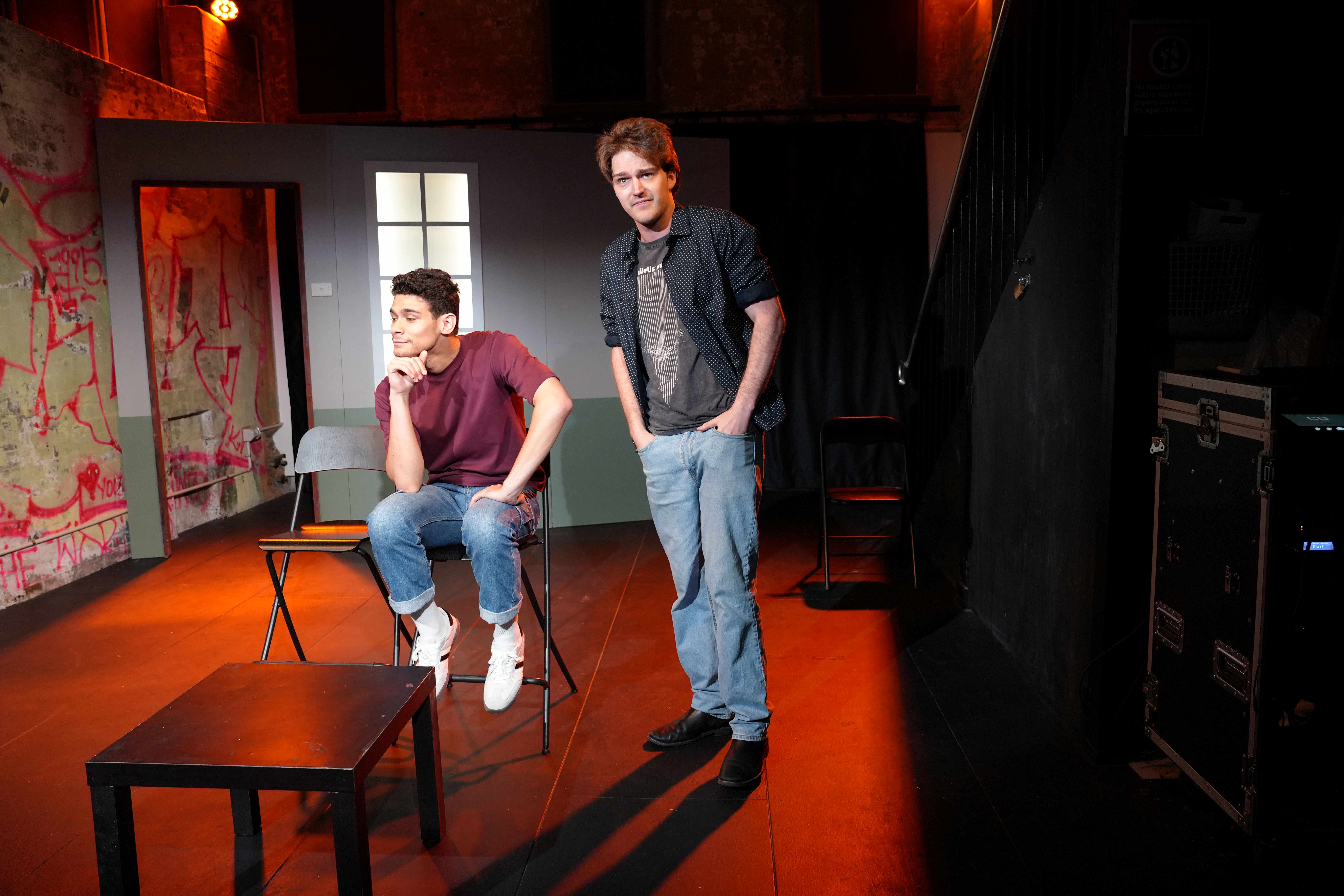
This is a simple, generous-hearted story of the friendship between a gay man and a straight man. It’s funny and engaging.
For the most part, an overly reductive binary opposition between gay and straight is avoided. Instead, directed by Les Solomon and performed by Nathaniel Savy and Tom Kelly, we get rich portraits of two likeable men.
One of the most intriguing creative choices made in Jeffrey Jay Fowler & Chris Isaacs’ script is to reject the convention of presenting a series of dramatic scenes portraying moments in the characters’ relationship. Instead, the two characters directly address the audience, not each other, taking turns to tell us their own version of the unfolding events. This juxtaposition effectively creates humour, but it also makes very apparent to the audience the isolation of the two men, and their differences.
The question is: From where do these differences derive? Because one man is gay and the other straight? Or because, regardless of sexuality, the two men have different psychologies? Or because, at the most fundamental and ontological level, two souls just won’t see the world in the same way – because they have to see it from different places?
The answer is, of course, all three. But it’s the third that’s of particular interest (to me).
Drama struggles to present the inner life of individuals; it’s far more successful in presenting relationships, the life of groups. (If this seems an unusual thing to say, that’s because the Western mind has been so soaked in the dramatic form that this particular presentation of life – life from the outside – has come to seem entirely natural.)
Though working in an artistic form that privileges the interpersonal, dramatists over the millennia have experimented with ways to represent the personal inner experience. The Elizabethans, for example, embraced the poetic soliloquy. This play, with its beautifully veracious contemporary vernacular, is a fine modern descendant of that experiment.
And so, regardless of its humble focus on the garden-variety experiences of finding romance and friendship, what an experiment like Fag/Stag does is explore one of the greatest of miracles: how we make a connection with others, despite the isolation of our rich but singular inner lives.
Paul Gilchrist
Fag/Stag by Jeffrey Jay Fowler & Chris Isaacs
Presented by Little Stormy Productions in association with Lambert House Enterprises,
Full disclosure: I come to this piece, if not an opera virgin, then certainly a novice to the artform (but still a seeker of Truth and Beauty.)
When I do what I usually do – which is write about theatre – I like to give the impression that I’m a knowledgeable expert. I get away with this because theatre audiences are used to actors pretending to be someone they’re not, and I guess it’s not too big a jump for them to continue playing this fun game when they read my reviews.
But I won’t pretend expertise here. I’ll write as someone fortunate enough to have been shown a doorway to an exciting new world.
Directed by Adam Player, Possession is what I might call a pocket opera – less than an hour, and presented in a beautiful, intimate venue. It would be a marvellous introduction to the artform. (With its simple but evocative staging, it’s also a model for how opera could be enjoyed by a greater number of people than only those who can get to the Opera House and can afford those tickets!)
Mezzo soprano Ruth Strutt, accompanied by pianist Michael Curtain, presents samples from the works of Gioachino Rossini, Gaetano Donizetti and Ethel Smyth.
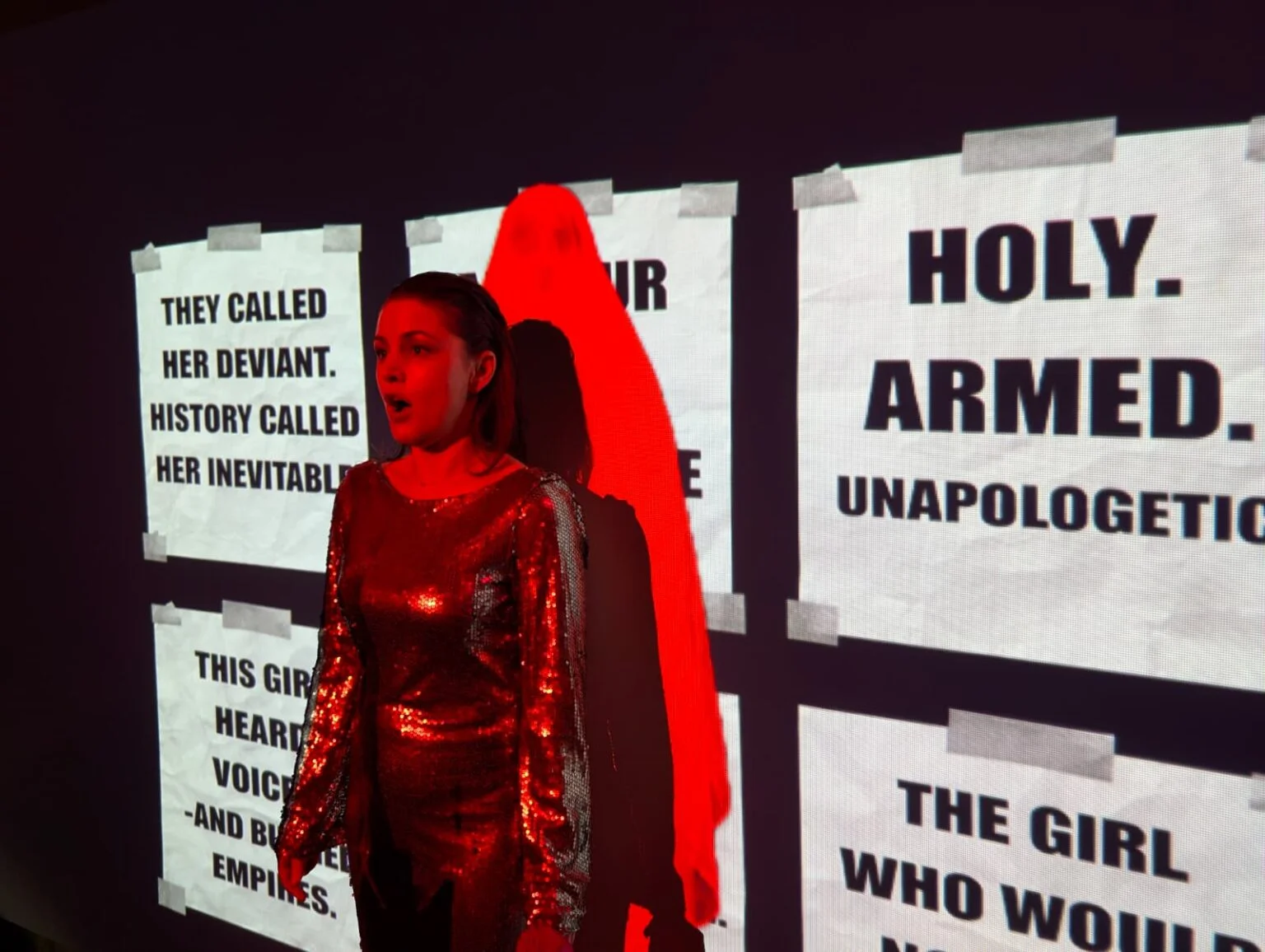
The Rossini is his Giovanna d’Arco, the solo cantata presenting Joan of Arc’s farewell to home before battle. It’s inspiring, it’s poignant and Strutt’s performance, in both voice and physicality, beautifully captures the character’s emotional range.
The Donizetti is his Saffo, which gives voice to the ancient Greek poet. Here Strutt has the opportunity to portray a character with even more vulnerability, and she embraces this with mesmerising passion. The Italian libretto is presented in English surtitles, as it was for the Joan piece, and it’s a wonderful chance for the creative team to use projection to establish setting and mood. Here Sappho’s lament for lost love is presented as though it were a series of text messages, and it’s a cheeky decision that underlines the universality of the experience, that Sappho’s 7th century BC concerns, via the medium of Donizetti’s 19th century opera, are still very much ours.
The Smyth pieces are her Nocturne and Possession. The latter is her work dedicated to suffragette Emmeline Pankhurst. Here surtitles are no longer necessary, and Smyth’s romantic influences are apparent. Performed with a luscious, welcoming warmth by Strutt, the melodies are rich and accessible.
Why Joan, Sappho and Smyth? These are voices of female resistance, but none has been flattened to mere slogan by the weight of opposition. Each is deeply human, acknowledging challenges while all the time reaching for joy.
Under the direction of Player, Curtain and Strutt give us a gem, a small piece that dazzles (for me, a jewel given at the threshold of a previously unexplored land, a promise of treasures, of Truth and Beauty.)
Paul Gilchrist
Possession, consisting of works by Rossini, Donizetti and Smyth,
This a work of non-fiction, yet it’s highly theatrical. The artist bears witness to her experience, yet her method of telling her truth eschews any mundane assertions of a flat objectivity.
Instead we’re gifted a rich, high-energy performance that serves as an invitation into her emotional and psychological world. We’re not shown a mere map; we’re given a personal tour of the landscape.
Writer/performer Claudia Shnier presents her experiences of obsessive compulsive disorder and of an abusive relationship. The latter seems to exacerbate the former. It’s a story of suffering, but also of strength and resilience.
Shnier employs multimedia to suggest intrusive voices, and her interaction with the technology is superb.
A pair of scissors, a pair of tweezers and a vacuum cleaner double both as their everyday selves and as people in her life, and the commitment to the theatrical metamorphosis of each prop is fascinating.
Shnier’s delivery moves between a fast-paced-almost-aggressive swagger, a playful humour, and a deeply-moving, bewildered vulnerability.
I’ve written previously about the oddness of autobiographical theatre. It seems strange to use the artform for personal sharing, considering the glory of theatre usually derives from its multi-voiced possibilities. And perhaps even more threatening to the autobiographical purpose is the fact that – more than most artforms – theatre seems to court a very public judgement, one as unreflective as it is immediate.
But if sharing is the goal, there are few means more direct and more powerful than standing before an audience and opening one’s heart. And considering that the sting of many a pain is worsened by the fear we bear it in isolation, the sharing of an artist such as Shnier is gloriously generous-spirited, for it assures those who suffer that they’re not alone.
This a passionate cry against the injustice of sexual assault.
But it’s the way this cry is presented that makes The Forked Tongue such an intriguing piece of theatre.
I’d like to discuss three elements of this presentation.
The first of these relates to myth.
Written by Babette Shaw and directed by Kirsty Semaan, The Forked Tongue tells the story of Medusa, but – we’re told – not the one we know. A reasonable number of people might find this an odd claim, because I suspect a reasonable number of people don’t know any story about Medusa. After all, she is a character from Ancient Greek mythology, a cultural creation of a faraway place and a long ago time.
But if you’ve wasted vast swathes of your life and have more than a passing familiarity with the culture of the classical world, you’ll be aware that Medusa, like most Ancient Greek mythical characters, is rather nebulous. A lot of classical authors mention her, but they’re short on detail, rarely agree on her story, and seem little interested in her psychology.
But to distil: Medusa is a Gorgon, a monster, the one with snakes for hair, so hideous that she turns people into stone if they meet her eye.
It’s a myth ripe for feminist subversion – and subverted it has been. This is the second piece of theatre I’ve seen this year in Sydney that employs the Medusa motif. You might argue that observation alone counters my claim that Medusa is a relative unknown in our culture. Or you might not: you might read it as evidence that storytellers are want to emphasise stories, attributing to them far more importance than the average person does. Perhaps this is indicative of the deep insight of storytellers. Or perhaps it suggests their parochialism. All the world is a stage says the playwright; All the world smells of fish says the fisherman.
Leaving aside the value of interrogating old myths, I’ll move on to the second fascinating element of the piece: the clash that results from the modern appropriation of classical culture. When Modernity tangles with Antiquity, it really is the clash of the Titans and, in the case of The Forked Tongue, leads to some rather explosive theatre.
Let me start with a trivial example. Medusa is at work at the temple of Athena. She has rushed there this morning, fearful of being late again. It is though she works in retail and can’t afford to miss the train one more time. This is the mundane detail of the bourgeois novel – and that’s not a criticism: these modern artworks display an interest in interiority and equality which is at the very heart of the contemporary social justice project, a project unknown to a classical world in which women had virtually no power and one third of the population were slaves.
Another example (but with a different conclusion.) When Medusa is confronted by the predatory Poseidon, it’s at the end of her shift at the temple. She’s closing up. She’s alone. He asks her for a drink. She politely refuses. He violently takes what he wants. We’re asked How could the experience be consensual, considering the difference in position in pecking order of the two? Poseidon is presented as the creepy boss who abuses his power. It’s a very modern take, and one that effectively indicts such behaviour. However, if there had been any Ancient Greeks in the audience (I don’t think there were) they might have responded But Poseidon is a god! In the modern world, encounters with the Divine have become so rare we’ve forgotten that the value of such encounters is that they overturn …. pretty much everything. A terrible beauty is born. All encounters with the Divine were – and are – a type of assault. Does that justify any type of actual human assault? NO. But Poseidon’s dreadful violence reminds us of the existence of a sphere of Life beyond Project-Social-Progress, a sphere of Life where individuals are confronted with the utter capriciousness of the universe, and no well-meaning-committee-endorsed-protocols can protect them.
Modernity versus Antiquity. Time has determined the victor, but a play like this poses the question (at least for me) of what we’ve gained and what we’ve lost.
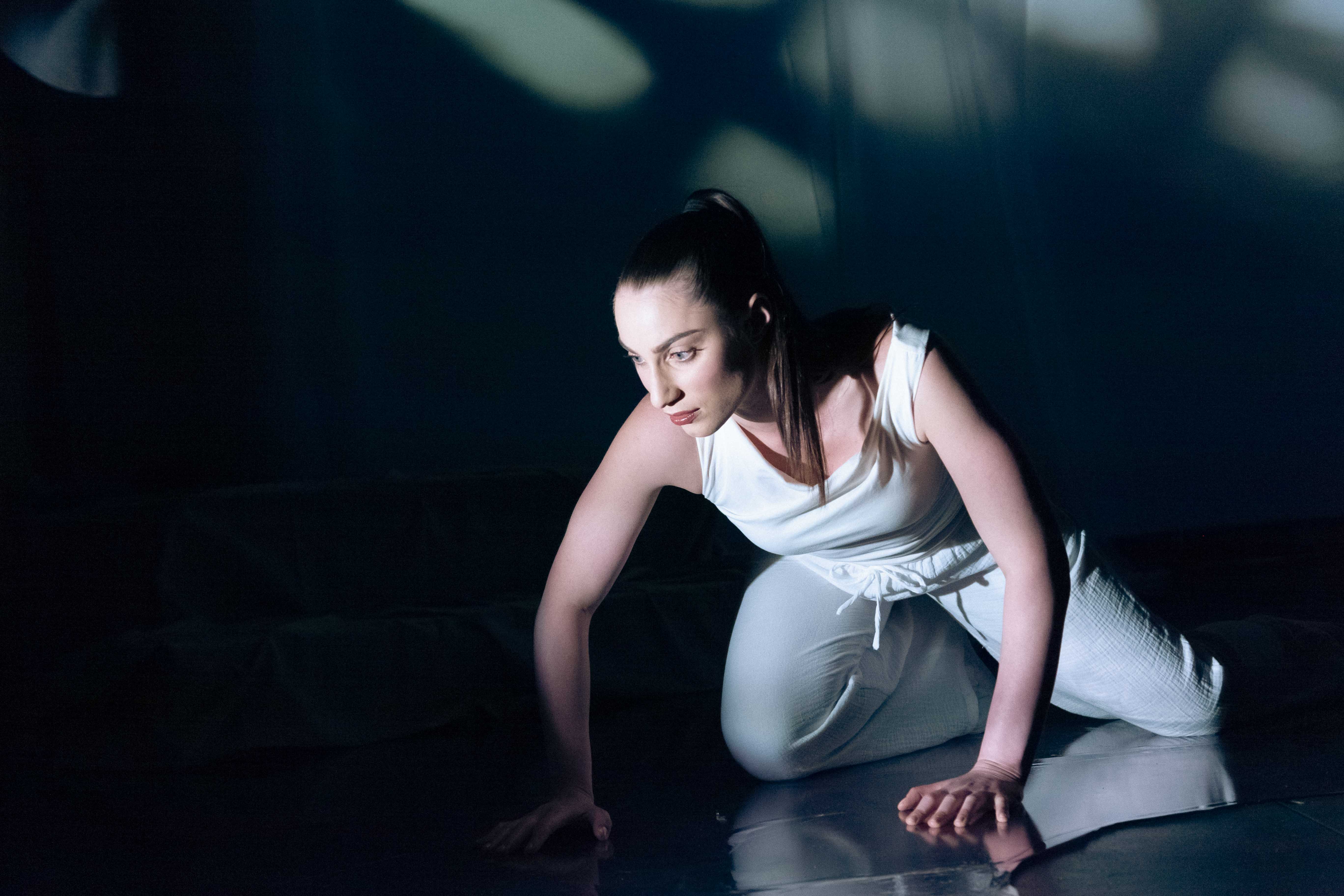
And the final creative decision making this a fascinating piece of theatre is the characterisation. It’s a one actor piece, and Emilia Kriketos is marvellous, showing enormous skill both vocally and physically. She also has the challenge of portraying three characters – Medusa, Athena, and a modern narrator – and presents these variations with aplomb.
In giving her version of Medusa’s tale, the modern narrator asserts there’s more than one side to every story. You might wonder if there’s a logical inconsistency here, or something oddly self-defeating. It’s certainly unusual for a character in drama – or, in this case, outside the drama – to make such an assertion. It’s like a used car salesman saying Trust me: at every repetition we feel a little less inclined to do so. Any commentary on the tale reminds us it’s just a tale (about a tale – which brings me back to my first question about storytellers and fishermen….)
As you can see – with its bold decisions and beating heart – this piece will spark much discussion.
On the way to the theatre, my plus one asked if we were seeing a new play. I replied Yes, that considering the title, it must’ve been written at least post-1687, the year Isaac Newton published Philosophiae Naturalis Principia Mathematica.
A joke like that doesn’t belong in Bradford Elmore’s Gravity; his play is genuinely funny.
But there’s a connection. Elmore presents characters who are intelligent – and this is the surprise for an Australian play – they can read! And they do.
Not that the piece is overly cerebral. Far from it. It’s just that the characters in Gravity have an active interest in the written word – and actually discuss it!
Christopher and Heather have a love of literature and David has a fascination with astronomy.
And all this isn’t gratuitous, a case of a playwright choosing to focus on some bizarre corner of society in order to present a gritty new angle, or an example of a dramatist claiming to give voice to some neglected minority.
The literature and astronomy operate as motifs that give the play a wonderfully rich texture. But to discuss that, I must first outline the play’s basic scenario.
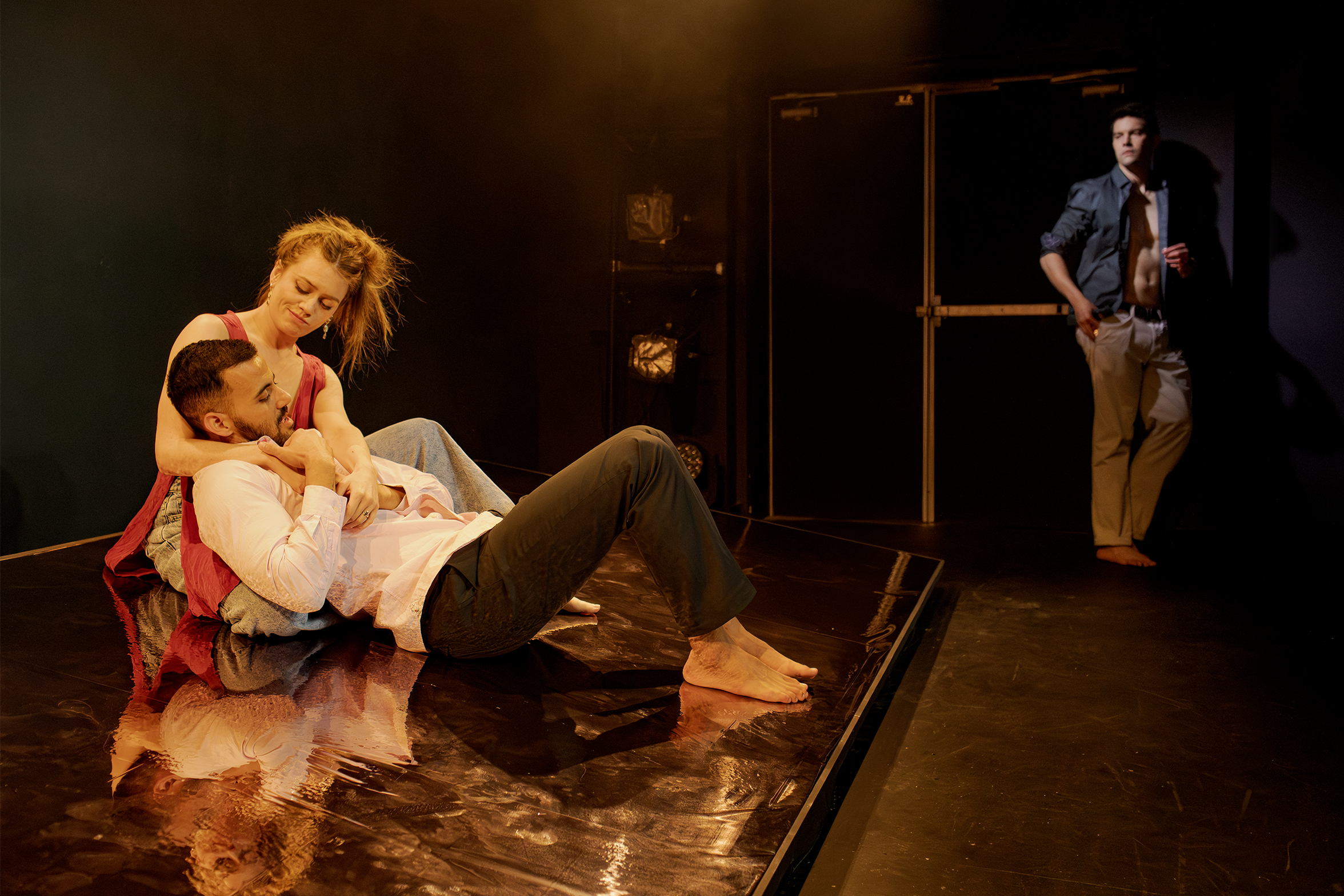
Christopher (Wesley Senna Cortes) and Heather (Annabelle Kablean) have been married for ten years, and he feels he still loves her. But he has now also fallen in love with David (Drew Wilson). How can this be resolved?
Back to the motifs.
David’s interest in astronomy allows consideration of opposing forces, of the difficulty of orbiting two bodies simultaneously, of the danger of being torn apart. But it also posits balance, the possibility of a smooth, untroubled, eternal motion (the type we imagine is enjoyed by the stars.) The relevance to the play’s scenario is beautifully thought-provoking.
Heather and Christopher’s interest in literature allows musings on narrative, and how we’ll stick to things, despite the emotional pain, because we need to know how it turns out. As a play about the challenges of fidelity, the connection is clear. Discussions of literature also facilitate some playful games about preference, of the Austen-or-Dickens, Tolstoy-or-Dostoevsky type. I’ve made up these examples, but the mischievous premise behind these sort of games – that loving one somehow excludes loving the other – is central to the play’s exploration of relationships.
Anthony Skuse directs and designs, and in this deliciously simple space there’s a gorgeous flow to the movement. Skuse also elicits fine performances from his cast, who make the humour crackle and the heart cry.
Whether you ultimately find the conclusion of the piece satisfying will probably hinge on your willingness to watch it devolve from the higher stakes of dramedy to the easy cheerfulness of rom-com. But I suspect satisfaction might also depend on your own values and emotional experience; what you consider Love, and what you consider Truthful. (Though, if your sole aim in visiting the theatre is to see a reflection of yourself, a visit to the aptly named vanity in your bathroom would suffice. Embrace doubt and surprise; they’re some of the artform’s greatest gifts.)
Foam by Harry McDonald presents the encounters of skinhead Nicky with a range of men, from those who aim to lure him into far right ideology, to those who are aroused by his brutal persona. (There is at least one man, however, whose attitude is closer to the only good fascist is a dead one.)
Patrick Phillips as Nicky appears in every scene and, under the direction of Gavin Roach, delivers a magnetic performance. The supporting cast of Timothy Springs, Joshua Merten and Chad Traupmann create a range of characters to populate the world around Nicky. Traupmann as the older fascist seeking recruits is suitably calm, confident and deeply disturbing, and as Nicky’s lover movingly portrays both concern and vulnerability. Merten as a gay photographer under Nicky’s spell is both charming and funny. Springs effectively creates characters who are far less enthralled by the protagonist’s antics.
Set in Britain in the 70’s and 80’s, each scene of Foam is separated from the others by several years, and apart from Nicky, the characters don’t appear to have a continuous arc. This makes for a fascinating guessing game as we figure out what has happened to the protagonist in the time between.
Each scene is set in a toilet (though not the same toilet.) And as almost every scene involves Nicky and a lover (or a potential lover), the toilet is a symbol powerfully suggestive of the simultaneous ubiquity and marginalisation of gay experience. (It wasn’t until uni that I learnt that some men met in public toilets for sex – and I learnt it from a book. I read that book not long after I’d read another that claimed to be the work of a reincarnated medieval heretic and, to my painfully narrow experience, the premise of both books seemed equally likely.)
The play is inspired by a true story, and I’m guessing the stimulus was the question How could a queer man get mixed up in far right politics? This seems as provocative as the question Why do bad things happen to good people? and deserves the same answer: Why not? (Perhaps I’m less naïve than I was at uni.) After all, out of the crooked timber of humanity, no straight thing was ever made. (And like Kant when he wrote those lines, I’m not playing on any connotation that invites a reductionist vision of sexuality. Or, indeed, a reductionist vision of anything.)
The script doesn’t really explore why Nicky becomes a fascist. And (probably for the best) it uses the terms nazi and fascist rather vaguely and offers only a few examples of the type of violence that usually attracts those labels.
The piece is primarily about identity. Unsurprisingly, most communities develop a vision of themselves that is positive. I suspect few billionaires are of the belief that billionaires are myopically selfish. The queer community are likely to engage in the same strategy (and for much greater reason than the insanely rich.)
This play confronts us with human complexity, and that is a glorious invitation to growth. And who outgrows that?
Written by Irish writer Eugene O’Brien, it tells the story of a middle-aged couple at a crisis point, and it does so with humour and insight.
Kate Gaul’s direction is wonderfully simple, unaffected in a way that allows the brilliance of the writing and performance to shine.
The piece is constructed from two intertwining monologues. Husband and wife Mal and Mairead attend a family wedding. The couple seem to get on well, but they’re never shown speaking to each other because each is in the process of exploring something that will challenge their relationship. Fitting the setting, that challenge is sexual.
Mairead has met an old flame, the man with whom, in her twenties, she had the best sex of her life. Mal is confronting his repressed homosexual desires.
The title? Heaven? Do they both seek a joy that will utterly transcend their merely comfortable relationship? Have both become aware that Eternity fast approaches, with its mysterious, unsatisfying promise of either oblivion or pleasures of a less certain nature?
In contrast to the metaphysical connotations of the title, both characters use very physical metaphors to express their needs and doubts, underlining that they’re far from finished with this plane of existence. She asks is this where my 50 years has lead? He wonders whether he has the courage to enter the world below, the lower dimension.
Because of my peculiar (and un-Australian) penchant for digging into metaphor, I should make clear that the play is not in any way religious (except what it has in common with all serious philosophies: an awareness of the tension between our inner lives and our outward relationships.)
This is, however, modern Ireland, and the hand of Catholicism is still heavy. Mairead tells of going to England for an abortion. Mal’s sexual fantasies are couched in the language of his desire for Jesus, effectively suggesting the complexity of his emotional situation, its guilt and its passion.
As the couple, Lucy Miller and Noel Hodda are absolutely superb.
Miller’s Mairead is gloriously tough. She doesn’t edit her speech. She’s a proud playground bully. She’s utterly disdainful of her daughter’s choice of partner. Reflecting on the death of her abusive father, she hisses that cancer sometimes takes the right ones. She’s deeply sensual and unafraid to fulfill her needs. Yet, she never speaks a word against Mal. It’s a magnificently rounded portrait, strength sparring with uncertainty, delivered with captivating power.
Hodda’s Mal is gentler, softer – desirous of the direction Mairead gives his life. Hodda plays the humour of the-dag-who-dares with consummate skill, but also marvellously portrays the internal battle between desire and doubt.
It’s a temptation with a production like this to be so taken by the skill of the makers that you forget the meaning, that (to mangle Yeats) you fall in love with the dancers, and forget the dance. But this production – an exploration of the tension between our inner and outer worlds, epitomised in its presentation of a marriage under threat – achieves the perfect marriage between artistry and Art.
Written by James Elazzi, this is new work, but it’s a historical piece, with everything occurring forty to fifty years ago.
And it’s set in Lebanon, rural Queensland, and Sydney.
This is big storytelling, and it’s terrific to see it on one of our stages (and the Loading Dock and Qtopia deserve credit for giving space to such stories.)
But Saints of Damour is also small storytelling; we’re very much focussed on Pierre, his mother, his wife and his lover. The big historical events remain in the background. (The dramatic form doesn’t make this inevitable, but very different creative decisions would’ve had to been made on the script level if a grand historical drama was to be offered.)
The title is a tease: are these characters saints?
Sure, they feel the weight of duty, especially to family, but they’re also quite prepared to behave in ways that cause serious pain to others. Migrants in a new country, they stick together, but the dust of dishonesty dirties everything. It’s a long time before Pierre’s homosexuality is acknowledge or accepted by anyone except his lover. And Pierre’s decision to not reveal his sexual orientation to his wife before their marriage – even privately – seems unnecessarily cruel.
Are we victims of our circumstances or can we rise above them? That’s the fundamental question the play posits (though I’m not sure if it posits it consciously.)
We talk a lot about theatre that makes us feel seen.
And this narrative feels as though it’s attempting to be true to some particular personal history. I say this because it sprawls, as though it’s trying to capture what actually happened to someone.
Seemingly superfluous to a story, the family spend several years in Goondiwindi. They buy land and try sheep farming, though they’ve had no previous experience. They also open a small shop in town and an ad runs in the local paper telling residents to boycott them. These challenges are not especially developed in the script, it’s as though it’s sufficient they are recorded. Witness needs to be borne. (A similar recording of what appears to be actual events happens when the family move to Sydney: an Anglo-Australian who has lived in this city his entire life, and who has the privilege of a tertiary education, says he’s never seen the Blue Mountains. It seems so unlikely that it has to be based on the truth.)
Ironically, this sense of truth being recorded is emphasised by the play’s treatment of major historical events. Big issues are, oddly, given short shrift; they’re outside the parameters of a story dedicated to documenting personal lived experience. For example, the gay lovers believe they will have more freedom in a Western country, which is probably true, but when Pierre gets to Australia no mention is made of the fact homosexuality remains illegal or that the battle to change that injustice is being fought. It’s outside this story’s scope. Similarly, the outbreak of the Lebanese Civil War is the impetus for the characters’ migration, but the complexity and tragedy of a society tearing itself apart remains curiously offstage. Ethnically, the two lovers are from opposing sides in the conflict, but little is made of this. And, when they’re in Australia, only Pierre is interested in what happens in the homeland, and seemingly only in terms of his lover. No one else seems haunted by the past, or as it is for them, the ongoing present.
It’s the sort of play where characters, when they’re concerned about who might have survived the conflict in Lebanon, say things like I’m concerned about who might have survived the conflict in Lebanon.
As a whole, the dialogue is lucid and limpid. Or direct and flat. It’s a matter of taste.
There are many quick scenes and, aided by a clean, functional design by James Smithers, director Anthony Skuse creates a beautiful sense of flow.
The cast are imminently watchable. The two lovers (Antony Makhlouf and Saro Lepejian) have a delightful, intense chemistry. Nicole Chamoun as Layla, Pierre’s wife, pitches her performance gorgeously between protest and pathos, while still finding that vital spark of joy. Max Cattana as Todd (who’s never been to the mountains) is splendidly gentle and, in other bit roles, displays a laudable versatility. As Pierre’s mother, Deborah Galanos has a glorious waspish tongue (which she also used on us before the performance, asking us to turn off our mobile phones.) At the finale, her bewildered terror, her explosive anger, is a moment in which the piece realises the dramatic form’s full potential (that is, refusing us any easy, unthinking judgement of the characters.)
Stories that make us feel seen – I suspect many audience members will feel this piece does this in spades.
But the title invites more: it’s a provocative reminder that having our challenges acknowledged does not automatically result in our actions being approved. It would be a pity for the dramatic artform if being seen was allowed to diminish into being justified.
Philosophers as great as Plato, Augustine and Foreigner have all wanted to know what love is.
So, a title like this has genuine swagger. Are we, finally, to be given a definitive answer to the greatest of questions?
No.
This is L-O-V-E is an anthology of playlets by American dramatist Allan Staples, here somewhat loosely linked together by a connecting piece written by director Kai Paynter.
The playlets are all about love (romantic love, that is) and they’re all either very funny or very touching – but, of course, no definitive answer to the question What is love? is being offered. It’s more of a shot-gun style scatter sample. Any overarching theory, if one were ever worth attempting, is up to us. (I’m not sure if the playlets were originally intended to be grouped together.)
The eleven-strong ensemble are a little uneven, especially in terms of vocal work, and the changeovers between the playlets would benefit from more pace and pizazz, but the writing is beautiful and some of the performances are magnificent.
A couple process some daunting medical news. Kate Jirelle and Kirk Hastings work brilliantly the surprising humour, and Jirelle as the woman facing the diagnosis finds a gloriously honest and deeply moving vulnerability.
Another couple suspect they may be pregnant, despite having a decidedly unserious relationship. With Georgia Britt and Dominic Di Paolo, the gags fire, but both actors also offer emotionally inspiring performances: Britt presents a poignant dignity and Di Paulo an unexpected chivalry.
Two men bump into each other at an airport. Why did their romance fail? Alex Baum and Rhett Wilks superbly portray the heady mixture of residual resentment and ongoing chemistry.
Presented by The Americas A Theatre Company, there’s an intriguing focus on the USA. During each playlet, a photo of a recent American president is projected on the upstage wall. I was unsure whether these were meant to place the playlets in time. On occasions, I could draw a connection between the concerns of the particular playlet and the policies of the pictured president, or with events during his term, but often I couldn’t. I certainly didn’t need to see a two metre tall projection of Trump’s face.
This focus on the USA is curious, because it positions us to ask if the aim of the piece is to present love as it is experienced American-style. (It’s also quite brave, because since at least the 1940’s, Australian audiences have hardly been deprived of American culture. It’s only recent political events in the northern hemisphere that have left us wondering if America was always more foreign than we assumed.)
But perhaps that’s the point: despite the recent turn in American politics, both disturbing and bewildering – its people are still people, who like us all, worship before the great mystery of love.
Paul Gilchrist
This is L-O-V-E by Allan Staples (with Kai Paynter)
Presented by BearTiger Productions in association with The Americas A Theatre Company
At the Loading Dock Theatre, Qtopia, until 15 March
Despite being a delightful device for the creation of joy, running through this piece is a melancholic sense that the scene is less welcoming of drag kings than it has been – or, more importantly, might be.
And, judging by this production, that’s a real pity.
This is a thoroughly entertaining hour, and a magical celebration of life’s richness.
Directed by Kaz Therese and written by Therese & Danica Lani in collaboration with the cast, it’s part-sharing and part-performance.
The four cast members begin by asking each other to name a world famous drag king. They come up with few contenders. (Though the suggestion of Joan of Arc is marvellous food for thought; as one cast member says, the Maid of Orleans definitely would have been a they.)
In amusing and affecting anecdotes, the cast members share personal stories of the joy of being a drag king. They also perform some of their own routines. As “Chase Cocks”, Chris McAllister delivers some terrific stand up, replete with some needle-sharp one-liners that puncture all parochiality. As “Jim Junkie”, Becks Blake performs a hilarious movement piece, playfully both burlesquing and saluting masculine swagger. Danica Lani as “Dario di Bello” presents a glorious lip-synced pop duo and dance number, in which the performer brilliantly takes both the (conventional) male and female roles. Angel Tan as “Fine China” offers a moving personal sharing, accompanied by themselves on a very evocative violin.
We’re told You can be any gender you want to be. And this is a golden reminder that life is larger than lethargy and fear might make it.
We’re told There are different masculinities (and even as a supposed straight cis-guy, that’s encouraging; I admit, as I limped home after the show with my bad back, I did try to put on a bit of a swagger.)
Though I present as a theatre critic, I identify as a philosopher – and I find the performative aspect of personal identities absolutely invigorating.
There are prejudices in our culture asserting that conscious performance is indicative of inauthenticity. However, WB Yeats (with his dramatist’s hat on) points out that performance is vital for a full life. For example, performance is the fundamental element of an ethical life. To act ethically is to act in a way different to our first, unthinking impulses. Goodness is something we perform.
But, what if you are accused of not being good? That there is something problematic about your identity? Essentialism becomes an understandable temptation: I was born this way, you respond.
No doubt true.
But like all our truths, only a partial one.
We are creatures of time; it’s the element in which we exist. And, as Catherine of Siena would say, The fish is in the sea, and the sea is in the fish. We’re not independent of time; we don’t swim through it immutable and unchanging. Not only with salt does the ocean permeate all, but with its very openness. We only ever know who we are incompletely, because who we are contains also who we might be.
And not merely who we become; that’s just a more sophisticated form of essentialism. The joy of the dance is not found only in its final step.
Embrace the play, the potential, the delicious possibilities….
Yeats (this time with his poet’s hat on) asks of essentialism How can we know the dancer from the dance? And the subtext is clear Why do we need to?
They Will Be Kings is life affirming and enriching, and wonderful fun!
Paul Gilchrist
They Will be Kingsby Kaz Therese & Danica Lani in collaboration with the cast,





 Theatre Red