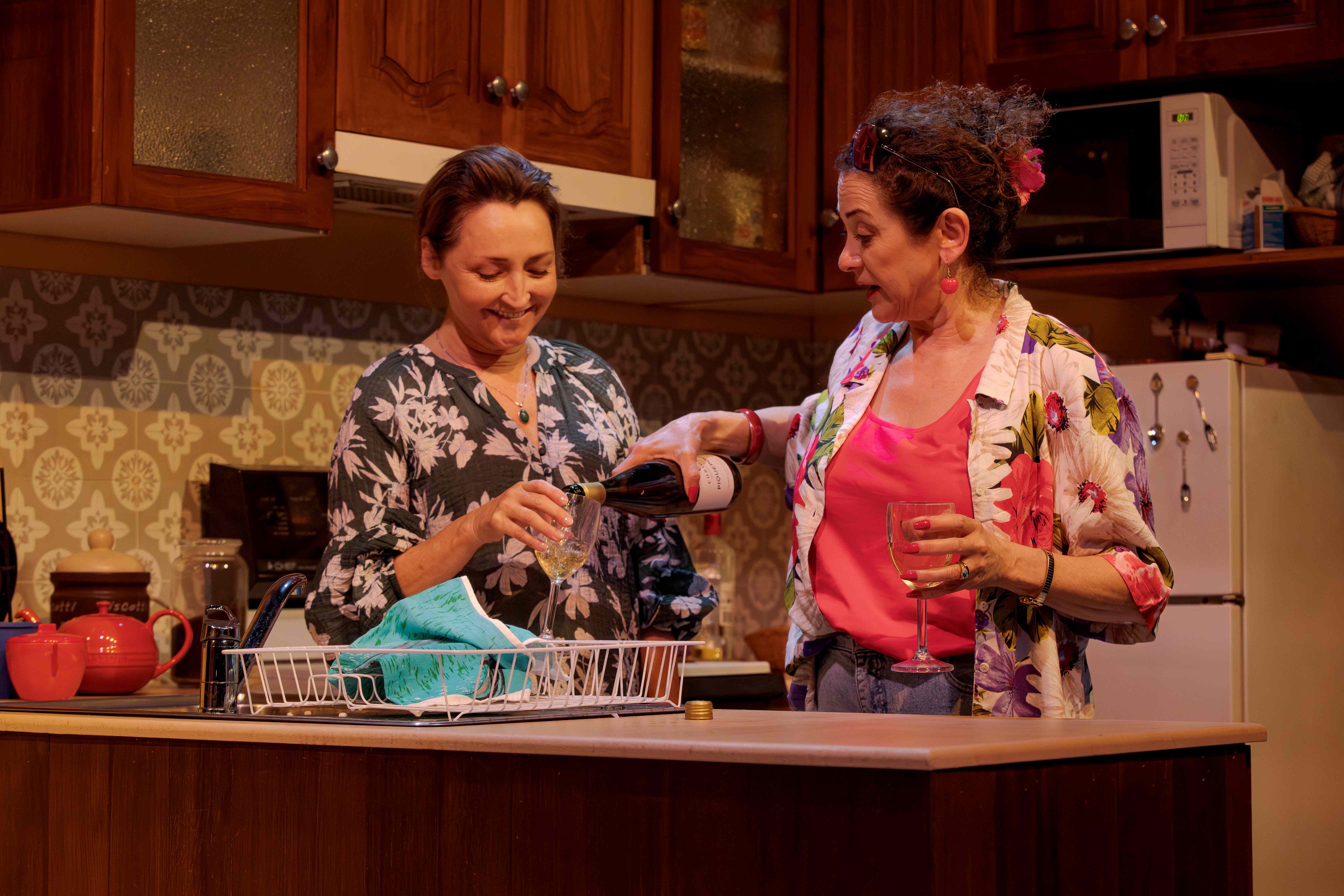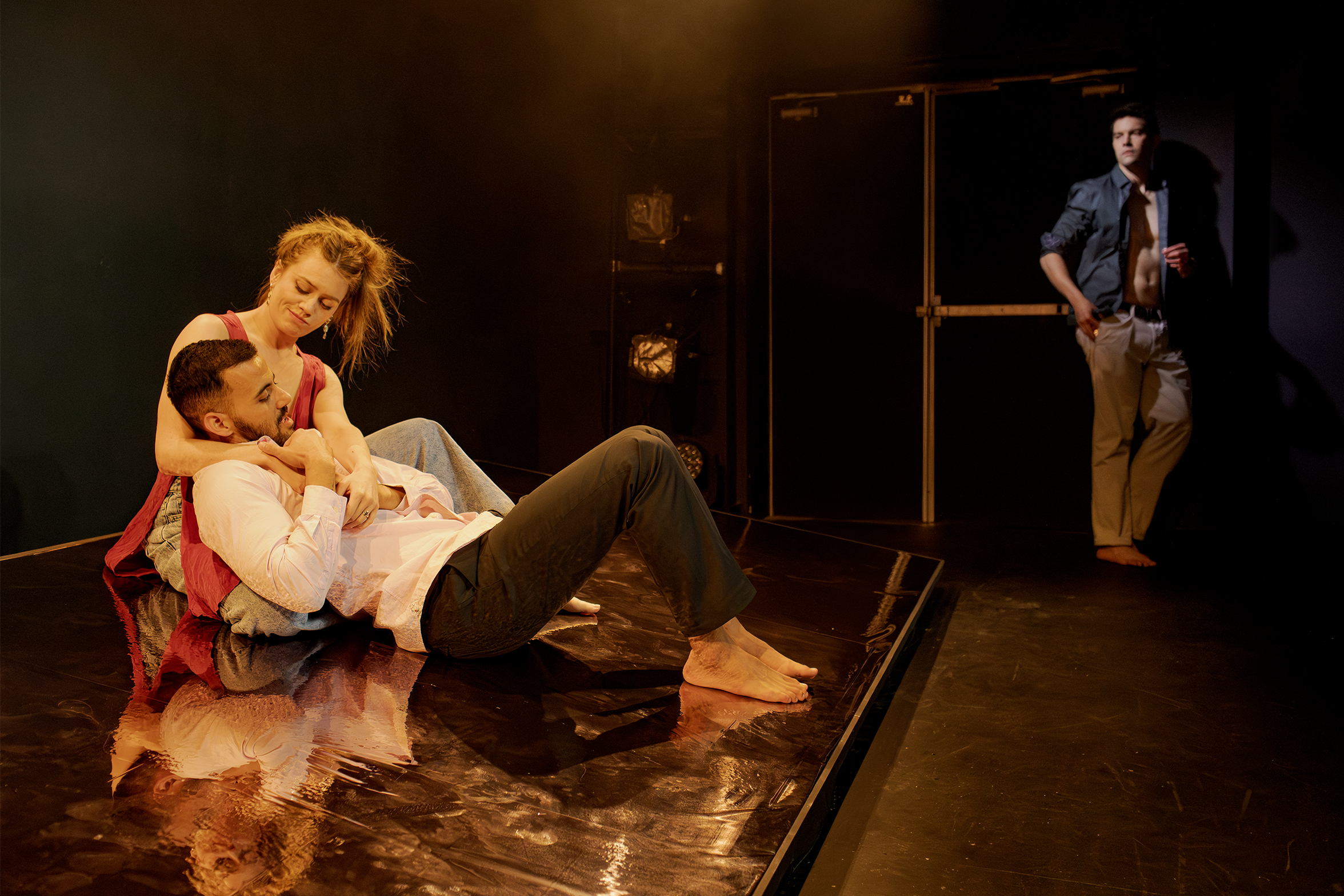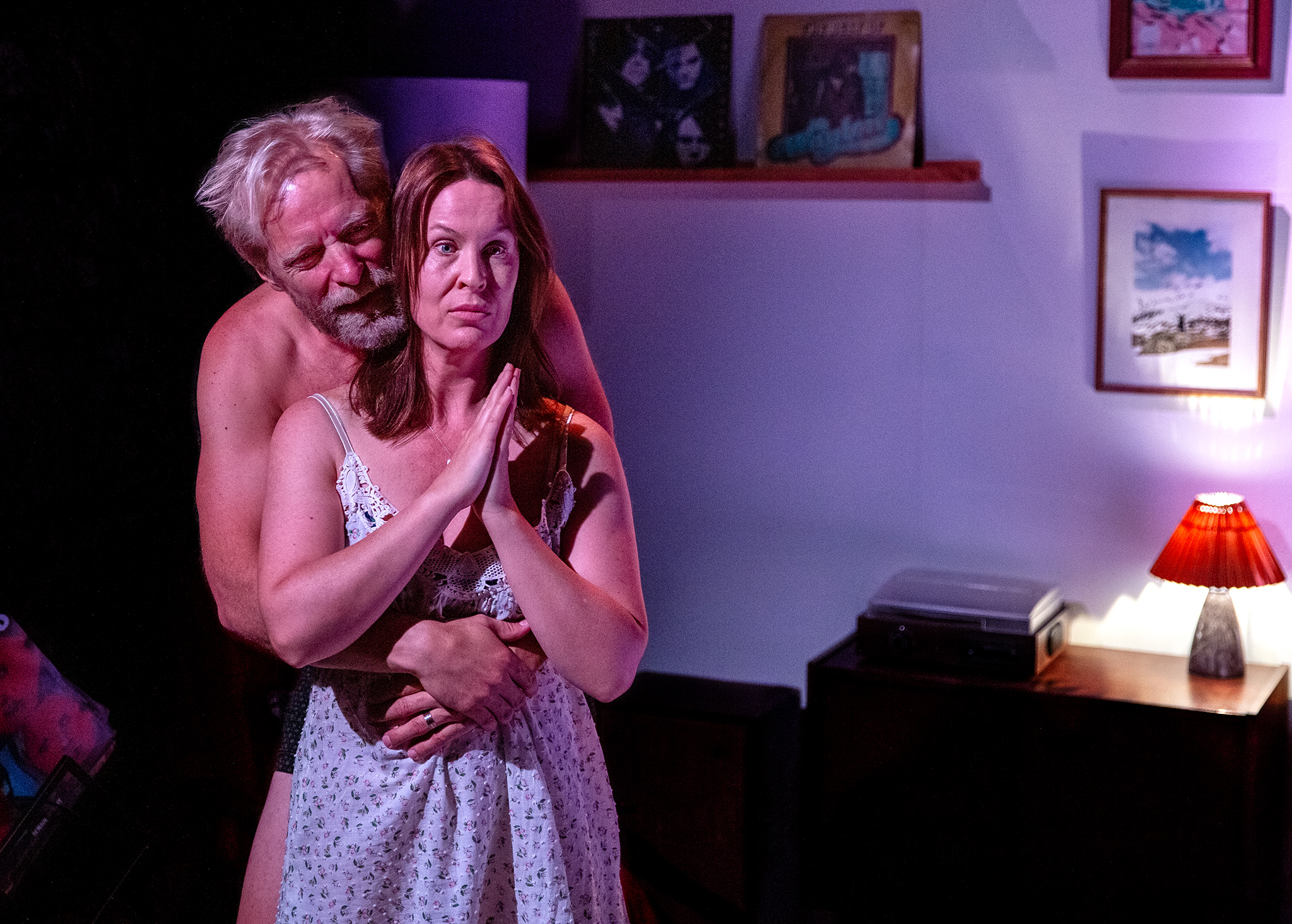
Tag Archives: review

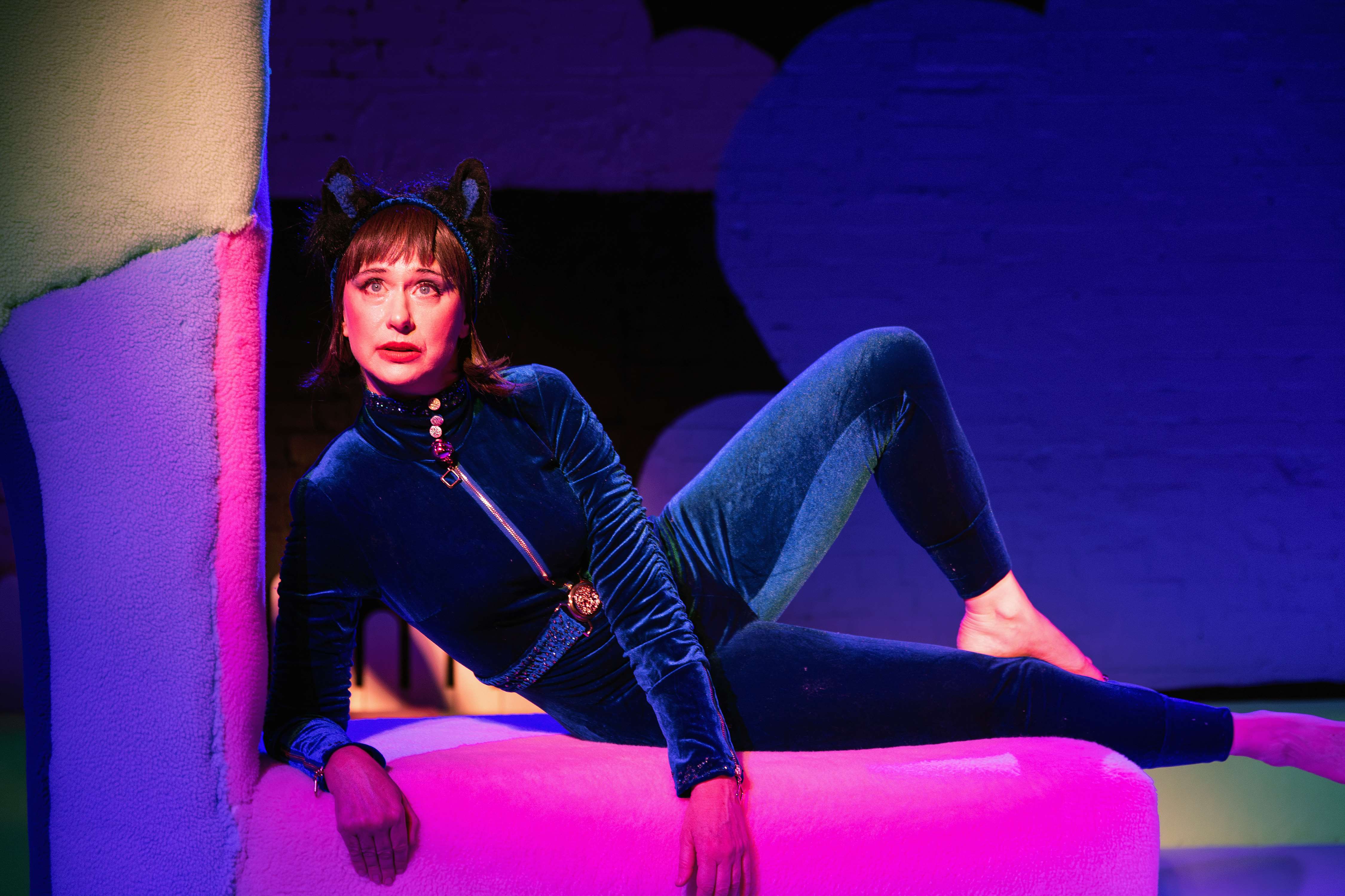
The Frogs: In Hell They Sing Show Tunes

26 Aug

Adapted by Alex Kendall Robson, after Aristophanes (about twenty-four centuries after Aristophanes.)

Robson’s adaptation follows a very similar plot to the original.

In an attempt to save the world, Dionysius visits the underworld to bring back the greatest playwright. It might seem an odd strategy, but as the God of Theatre, Dionysius might be excused for overestimating the impact of the artform.

The original play, first produced in 405 BCE, was a mixture of satire and broad humour. Robson’s adaptation is similar in tone, though with slightly more focus on the second of these comic elements.

Aristophanes included songs, though not show tunes. (The Ancient Greeks can be blamed for a lot, including theatre and philosophy, but not for the abomination that is modern American musical comedy.)

With amended lyrics, this adaptation of The Frogs includes versions of Putting on the Ritz and Singing in the Rain, as well as Wayfaring Stranger and something (I think?) from Bizet’s Carmen. The last two aren’t show tunes, but then, the manner in which all the musical numbers are presented doesn’t justify the title’s joking implication that songs such as these are the essence of the tortures of Hell. (Nor does their presentation justify my earlier cheap shot at musical comedy.) Under musical director Zachary Aleksander, the talented cast perform the songs beautifully. (Though I wonder whether amplification might have better delivered the wacky, high-spirited energy this production clearly values.)

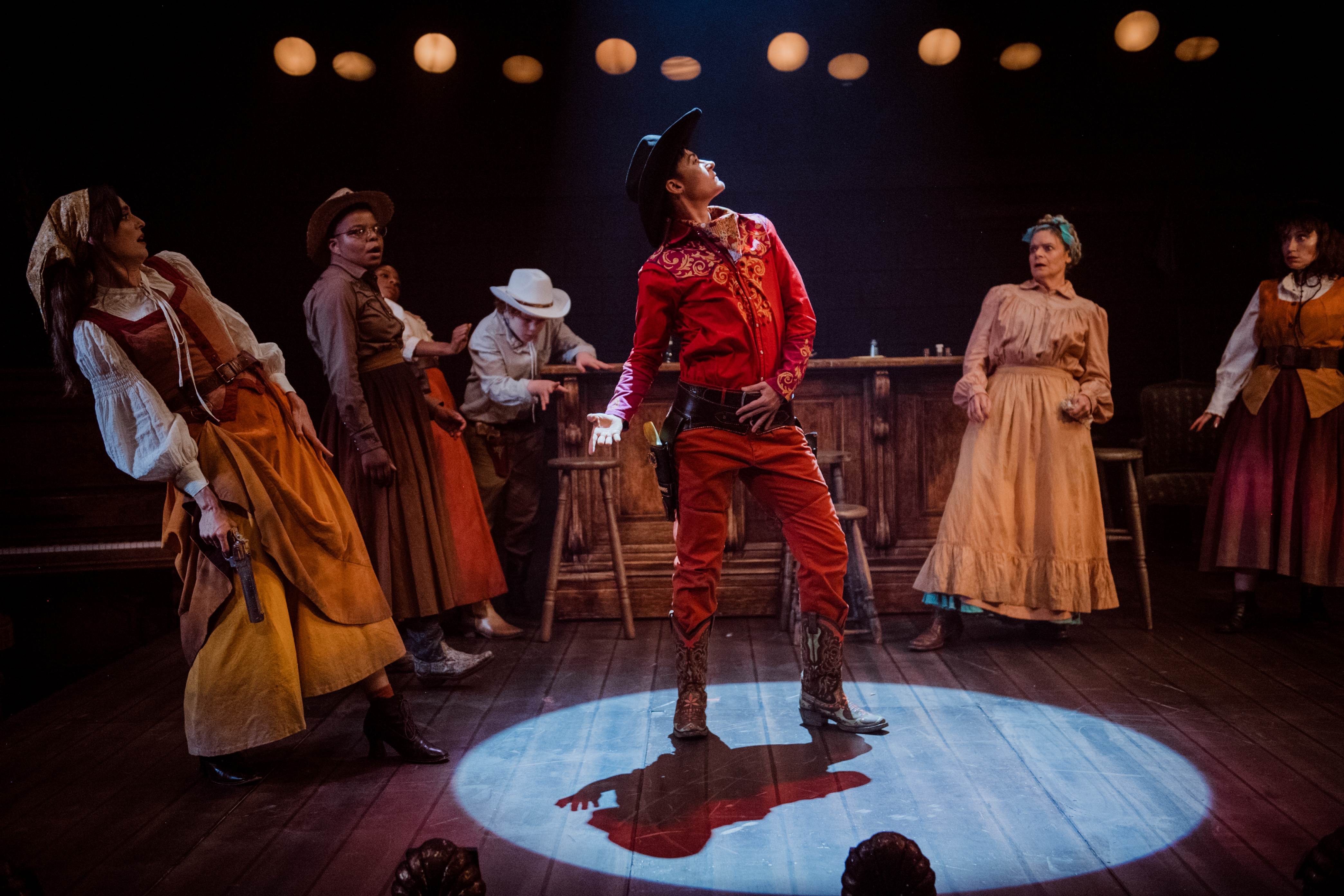
Working with Robson’s fun script, and under his direction, the comic performances are excellent. I’ll cherry pick a few. Pat Mandziy as Dionysius is a delicious blend of camp and privileged naivety. Eddy O’Leary as his underling, Xanthias, is a fine inheritor of the long tradition that the disempowered see truths to which the powerful are blind. (The script mischievously asks whether we can call this character a slave – but I’ll get back to that later). Axel Berecry as Heracles is gloriously over the top in his presentation of the stupid he-man. Larissa Turton and Meg Bennetts deliver a terrific parody of two tough-speaking old-school landladies. Bennetts also turns up as Sappho, and her portrayal of a character of gravitas, dignity and wisdom is a sensationally effective change in tone from the rest of the production’s madcap hijinks.

I’ve expressed previously that I think it’s odd that Australian theatre makers are fascinated with Ancient Greece. It’s odd because Ancient Greece is truly a foreign culture – yet we seem to see it as a sort of universal. It’s not. Example: Up to 40% of Ancient Greece’s population were slaves – yet, as this production implies, we have trouble even saying the word. And don’t get me started on the misogyny of the ancient world.

Not that audiences will have any trouble following this adaptation. Robson makes this foreign world accessible – a challenging task when you consider that the original play’s dramatis personae consists of a mixture of mythical characters and historical individuals who are hardly household names in modern Australia. Sensibly, when we get to the two historical playwrights who are contending for the title of the greatest – Euripides and Aeschylus – this adaptation slips into a musical number and a quick bawdy sight gag. It’s a smart choice, as contemporary audiences are likely to find a debate concerning the relative merits of the competing styles of Ancient Greek tragedy more soporific than stimulating.

Another change to the original is the addition of Sappho. As I’ve suggested, it’s a scene that makes for fascinating theatre. But curiously, it also functions as a criticism and rejection of Dionysius’ quest. I say curiously because – up to this point – the assertion of theatre’s ultimate value seemed to be the only serious justification for the piece. (If one was needed.)

But the Sappho scene also highlights what I’ve suggested about the Ancient Greeks being a very different culture from our own. And I know I’m close to spoiler territory here – but, when you go, note Sappho’s prayer. Who she prays to is not anachronistic, but what she asks for is. It involves a conception of human relationships which lay centuries ahead, at least in Western culture.   

By now, reading my response, you’ve probably come to the conclusion that it’s not show tunes that are the essence of Hell, but rather nit-picking, such as mine. (The devil being always in the details.)

But, by pointing out an anachronism, I’m not criticising the script. With such a deliberately playful piece that type of petty fault finding would be utterly misguided. (Especially since the piece consciously indulges in it’s fair share of impish anachronism.) And, anyway, I agree with Sappho’s imagined-though-anachronistic solution. I’m merely pointing out that the actual answer the Ancient Greeks would offer to our problems might not satisfy us (…..which is why Robson has rewritten the end of the play.)

Ultimately, this production is an exuberant celebration of love and laughter, and whether that’s a timeless panacea or not, it’s sure as hell welcome now.

Paul Gilchrist

The Frogs: In Hell They Sing Show Tunes adapted by Alex Kendall Robson, after Aristophanes

At New Theatre until 6 September

newtheatre.org.au

Image by Bob Seary

Three (Short) Plays by Tennessee Williams

11 Aug

An increasing familiarity with a writer’s body of work offers real delight.

And it’s not just the delight of the know-it-all or the systemiser, the sort of pleasure that comes from a sense of superiority or control.

It’s the joy of meeting the artist behind the work, of getting a sense of their world view, their fascinations and their fears, what they feel they can attempt and what, for whatever reason, they eschew.

Jane Austen famously described her writing as a little bit (two inches wide) of ivory on which I work with so fine a brush, as produces little effect after much labour – and if you’ve had the good fortune to read her six novels, you’ll know that even in her throw away aphorisms she was the master ironist.

But what of Tennessee Williams?

Many of us are familiar with Williams’ full length plays The Glass Menagerie, Cat on a Hot Tin Roof and A Street Car Named Desire, but we’re less familiar with his short works. This production presents three of those playlets: At Liberty, Auto-Da-Fe and This Property is Condemned.

Williams was very proud of many of his short works.

And they further the impression of the artist and his art that many audiences get from his better known plays. On a linguistic level, they’re constructed from a beautifully heightened language that never loses its connection with the genuine vernacular. On a thematic level, they’re built from the tensions between sexuality and respectability, purity and pretension, and loneliness and fulfilment. And because they’re usually performed in a Southern accent (as they are here) they seem to offer a portrait of a particular part of the USA at a particular time. (You might assert that all theatre does something like my last point; that is, depict a specific place and time, but I think that’s true to varying degrees. Williams always seems aware of Society – that demographic cultural phenomena which is the subject of study of sociology, and is posited by modernity because it recognises the ubiquity of the arbitrary. Williams is aware of this Society in a way that, say, Shakespeare is not. You could argue this is because Williams is more interested in the outsider, but Shakespeare has characters like Othello and Shylock. Williams’ outsiders, however, are not obviously outsiders: he’s the great playwright of the hidden subversive.)

Directed by Megan Sampson, this production is a wonderful opportunity to consider the exact nature of the playwright’s genius (and, if you read this before you go, offers the added pleasure of concluding that my assessment of Williams is utterly inadequate or simply absurd.)

I’ll forgo filler and refrain from a description of each playlet; with the whole evening only 50 mins long, scenarios too easily slip into spoilers. Suffice to say, each piece is a treat, and the six different roles, doubled by Helena Cielak, Will Manton and Emma Wright, are brought to life with a precise energy. Cielak portrays two different women who each in their own way balances a radiant presence with a pathos-inducing bluster. Manton creates portraits of both uptight repression and bewildered innocence. And Wright brings fitting focus to two distinct characters who represent firmness in the face of flailing volatility.

Paul Gilchrist

Three (Short) Plays by Tennessee Williams

Presented by Ground Floor Theatre Company

At the Old Fitz, as the Late Show, until 15 August

oldfitztheatre.com.au

Image by Robert Miniter

Foam

9 Aug

Every woman adores a Fascist, wrote Sylvia Plath.

And, apparently, it’s not just the women.

Foam by Harry McDonald presents the encounters of skinhead Nicky with a range of men, from those who aim to lure him into far right ideology, to those who are aroused by his brutal persona. (There is at least one man, however, whose attitude is closer to the only good fascist is a dead one.)

Patrick Phillips as Nicky appears in every scene and, under the direction of Gavin Roach, delivers a magnetic performance. The supporting cast of Timothy Springs, Joshua Merten and Chad Traupmann create a range of characters to populate the world around Nicky. Traupmann as the older fascist seeking recruits is suitably calm, confident and deeply disturbing, and as Nicky’s lover movingly portrays both concern and vulnerability. Merten as a gay photographer under Nicky’s spell is both charming and funny. Springs effectively creates characters who are far less enthralled by the protagonist’s antics.

Set in Britain in the 70’s and 80’s, each scene of Foam is separated from the others by several years, and apart from Nicky, the characters don’t appear to have a continuous arc. This makes for a fascinating guessing game as we figure out what has happened to the protagonist in the time between.

Each scene is set in a toilet (though not the same toilet.) And as almost every scene involves Nicky and a lover (or a potential lover), the toilet is a symbol powerfully suggestive of the simultaneous ubiquity and marginalisation of gay experience. (It wasn’t until uni that I learnt that some men met in public toilets for sex – and I learnt it from a book. I read that book not long after I’d read another that claimed to be the work of a reincarnated medieval heretic and, to my painfully narrow experience, the premise of both books seemed equally likely.)

The play is inspired by a true story, and I’m guessing the stimulus was the question How could a queer man get mixed up in far right politics? This seems as provocative as the question Why do bad things happen to good people? and deserves the same answer: Why not? (Perhaps I’m less naïve than I was at uni.) After all, out of the crooked timber of humanity, no straight thing was ever made. (And like Kant when he wrote those lines, I’m not playing on any connotation that invites a reductionist vision of sexuality. Or, indeed, a reductionist vision of anything.)

The script doesn’t really explore why Nicky becomes a fascist. And (probably for the best) it uses the terms nazi and fascist rather vaguely and offers only a few examples of the type of violence that usually attracts those labels.

The piece is primarily about identity. Unsurprisingly, most communities develop a vision of themselves that is positive. I suspect few billionaires are of the belief that billionaires are myopically selfish. The queer community are likely to engage in the same strategy (and for much greater reason than the insanely rich.)

This play confronts us with human complexity, and that is a glorious invitation to growth. And who outgrows that?

Paul Gilchrist

Foam by Harry McDonald

presented by Gavin Roach

at the Substation, Qtopia, until 23 August

qtopiasydney.com.au

Image by Robert Catto

Fewer Emergencies

28 Jul

This one resists an easy reductive reading – and that makes for thrilling theatre.  

In Martin Crimp’s Fewer Emergencies, four characters appear to be constructing a narrative. The narrative they tell each other is a story (or stories) of a couple who marry and raise a child. The four characters (one of whom may be the actual child) add to each other’s ideas for the narrative. They echo suggestions they like and challenge those they don’t. They toss up various motives for the actions of the characters, and insist – sometimes successfully – on consistency.

It’s oddly reminiscent of a TV writers’ room – but it’s most certainly not. The narrative building that Crimp is exploring is far less specific than that. It’s the narrative building that is the common inheritance of humanity.

Crimp’s script is an absolute delight – funny, horrifying, invigorating.

The narrative his four characters construct is part-cliché and part-inspiration. And that’s true of the narratives we build of our own lives: the cliché aligns us with a community, the inspiration grants us individuality.

Crimp plays with linguistic clichés: That only makes it worse; Don’t help me; Things are getting better.

But he also undercuts these clichés with a glorious poetry of the vernacular, making music from its rhythms and repetitions.

There’s also some startling imagery: In a drawer, awaits the island of Manhattan; Dangling over the suffering child is a dazzling key (a tantalisingly ambiguous symbol of varieties of opening – to reality’s wildness, or of the understanding.)

Crimp also has fun with clichés of the narrative kind: The troubled marriage that results in a troubled child; The formula for happiness being money plus property plus family plus shopping; And GOOD shopping – not just the usual big brands.

But these narrative clichés are also mischievously disrupted: With intimations of frightening mental illness; With scenes of appalling violence; With magical realism.

It would be easy to do this sort of theatre really badly. (I can certainly imagine botching it. My inner nightmare narrative, in common with everyone’s, consists of cliché tempered with terrifyingly unique personal disasters.)

But director Harry Reid pulls it off brilliantly, creating an extraordinarily engaging 60 minutes of theatre. Aided by a clever lighting design by Izzy Morrissey, Reid uses the space magnificently, presenting a piece as visually exciting as it is linguistically. He also elicits from his cast (Clay Crighton, Olivia Hall-Smith, Bayley Prendergast and Monica Sayers) wonderful performances. Without the usual safety net of dramatic realism – the verisimilitude to recognisable individuals – the cast display virtuoso skill, captivating us with both voice and movement. Crighton’s physicality, powerfully suggesting determination’s battle with fear, and confusion’s with certainty, is a highlight.

Paul Gilchrist

Fewer Emergencies by Martin Crimp,

presented by The Company Theatre,

at The Old Fitz, as a Late Show, until 3 August.

oldfitztheatre.com.au

Image by Robert Miniter.

Othello

26 Jul

There’s currently another company in Sydney producing another play by Shakespeare – and they’re employing the slogan All Bard, No Bull.

In contrast, the marketing for this production of Othello led me to expect something somewhat closer to the bull end of that imagined spectrum.

And, yes, bold choices are made – but, at heart, what we’re given is an engaging presentation of Shakespeare’s classic script.

As for most modern productions, that script has been slightly abbreviated. I’ll admit, some of my favourite lines and speeches are missing, but all the key elements of the story remain.

The cast is all female. Some might think this an usual choice, but it’s worth noting that each of the characters retains the gender Shakespeare originally gave them.

Casting is also colour blind. Some might think this an even more unusual choice, as a common reading of the play is that Othello is susceptible to Iago’s deceit and manipulation because of his outsider status. (There’s plenty of textual evidence to suggest Iago takes advantage of Othello’s potential vulnerability as the only black man in a white society.)

The marketing states the production has a “movement-based performance style”, but don’t fear, Shakespeare’s incomparable poetry is not sacrificed to an undue focus on physicality. Director Diana Paola Alvarado’s interest in movement mainly manifests itself in the rearrangement of the set between and within scenes. Designed by Jason Lowe and Leandro Sanchez, and consisting of four industrial-style pillars, the set is moved by the performers with a beautifully fluent choreography, and complemented by Theo Carroll’s wonderfully evocative haze-tinted chiaroscuro lighting design, as the play moves to its climax, the mood becomes increasingly and disturbingly claustrophobic. This perfectly captures the tragedy of Othello and Desdemona: a man who has been through so much, whose life story of “most disastrous chances, of moving accidents … of hair-breadth scape(s)” has elicited from Desdemona “a world of sighs”; a tale that “in faith, ’twas strange, ’twas passing strange; ’Twas pitiful, ’twas wondrous pitiful” is what wins her love – and the ultimate pity of the play is that the lives of two such great souls as these should end in a horror of pettiness.

Sometimes the performers deliver the verse at too great a pace, but intriguing choices are made regarding characterisation. Cassio, played with suitable sophistication and charm by Chloe Schwank, may seem recognisable to audiences, as will be Lucinda Jurd’s delightfully foolish Roderigo, but other choices are less expected. Doubling, Jurd’s Emilia is less earthy than usual, Lisa Hanssens’ Iago is less hail-fellow-well-met in his duplicity than usual, Sedem Banini’s Desdemona is less refined and demure, and Natasha Cheng’s Othello, in the play’s initial acts, less calmly commanding. I’ve deliberately phrased my descriptions of these performances to highlight what they don’t do – and I’m sure that’s frustrating –  but I’d rather not spoil the surprising freshness of the choices.   

Paul Gilchrist

Othello by William Shakespeare

Presented by La Fábrica de Microbios and Gente Perdida

At Flight Path Theatre until August 9

flightpaththeatre.org

Image by Felipe Godoy

Emerald City

24 Jul

David Williamson is a legend of Australian theatre and Emerald City is one of his best known plays.

First produced in 1987, it tells the story of screenwriter Colin who brings his family to Sydney to further his career.

True to traditional satirical structure, the play is constructed from dichotomies: Sydney versus Melbourne; the Eastern Suburbs versus the Rest of our Sprawling Metropolis; Private Schools versus State Schools; America versus Australia; Entertainment versus Art; Ambition versus Acceptance; Hypocrisy versus Integrity.

Each of these dichotomies evoke the more fundamental binary division of Evil versus Good.

The game we’re asked to play is to consider whether these dichotomies are overly simplistic or just plain false. We’re encouraged to do this by intriguing character arcs and piercingly funny one-liners.

As a screenwriter, Colin gives the advice that something always has to be at stake – but it’s not reasonable to assume a theatre reviewer will relate to a story in which characters seek glamour and success. (Some might even suggest that ambition is not a particularly interesting subject – unless it leads you to kill the king of Scotland and afterwards deliver some hauntingly desperate soliloquys.)

Inoculated by hard experience, two-bit reviewers might be immune to the siren song of Success – but that immunity is hardly universal. Many conversations about Art do sound like demarcation disputes, or performance reviews, or quality control panels, or price negotiations. But only one conversation is vital. And it happens in the desert, when the artist battles with the devil – alone, naked and true – and in that battle forfeits her ego to win her soul. And tired but free, she returns to the city, and scratched in the dirt if necessary, she offers a vision of the kingdom of heaven.

This play attempts no such a vision – but it does effectively make the primrose path to hell appear a little less rosy.  

Mark Kilmurry’s production is a fascinating opportunity to observe the challenges of the actors’ craft. Satirical roles can be surprisingly tricky, especially when the characters themselves are granted an aptitude for mocking comic observation. It’s fun to watch Tom O’Sullivan as Colin and Rachel Gordon as his wife Kate navigate the slippery duality of being both declaimers of foibles and figures of ridicule themselves. Juxtaposed with these two is the more straightforward characterisation of the hustler Mike, who is transparently duplicitous, a gloriously self-seeking philistine – and Matt Minto embraces the role with a wonderful physicality and a mirth-inducing energy.

Paul Gilchrist

Emerald City by David Williamson

At Ensemble Theatre until 23 Aug

ensemble.com.au

Image by Phil Erbacher

Betrayal

23 Jul

I know a lot of us justify the fact we’re yet to win a Nobel Prize in Literature by telling ourselves that it’s really just about who you know.

However, Betrayal by Nobel laureate Harold Pinter raises the disturbing spectre that the prize might also be awarded to those of genuine genius.

Several years ago, and for quite some time, Jerry had an affair with Emma, the wife of Robert, his best friend. Pinter tells most of the story through a reverse chronology, ultimately ending at the beginning.

The impact of reversing the tale’s chronology is twofold.

Firstly, it facilitates dramatic irony. Lies become more apparent, like shards of glass in sunlight. The audience delights in discovering the ways the characters have not been open and honest about the past.

But Pinter’s unconventional structure is not about giving the characters some sort of back history that explains or justifies their infidelity. (I’ve never been a fan of plays that use flashback to explain the present, feeling the question What happens next? is always more interesting than Why did that happen?) What Pinter does is more akin to what a craft-person working in the plastic arts might do. He crafts an object from the concept of betrayal, leaving us as unconcerned with narrative as we would be with, say, a small glass ornament. Instead, the concept is held up to the light, and we’re given glimpses from different angles, to marvel at the way the Truth is tainted.

This leads me to the other stroke of genius displayed in this unconventional structure: it weakens the sense of the passing of Time, as though whatever it is that is being betrayed is beyond Time – which, of course, it is. Every committed relationship we have is an attempt to transcend Time, to deny its inevitabilities, to say This Always, despite all Life’s vagaries.

And this hope filled fantasy of permanence aligns with how we usually think about ourselves as individuals. We imagine we’re like some solid object somehow caught in the current of Time. It’s as though we’ve accidentally fallen into that mysterious river and our natural element is elsewhere. Yes, we acknowledge the current will ultimately beat and batter us till destruction – that’s just a matter of Time – but we don’t see ourselves as fundamentally a part of the world that does that, but somehow outside and opposed to it. The soul-expanding thrill of Pinter’s play about deception is that the characters are continually shocked to discover that their secrets were always known, that their belief in their separation from the wider world was an illusion all along.

Cristabel Sved directs a wonderful production of this superb play. The staging is suitably and deliciously simple. Performances are excellent, offered in a gorgeous understatement that both highlights the glib naivety of those who deny realities greater than themselves, and which creates all the more poignancy when genuine vulnerability and passion are revealed.

Let me highlight a few moments of utter dramatic magic: the deeply human fragility of Ella Scott Lynch as Emma when she is simultaneously known to be unfaithful and aware the affair is over; Andrew Cutcliffe as Robert at a restaurant, cutlery in hand, barely containing his anger towards his supposed best friend; and Matt Hardie and Lynch as the two lovers, in the scene where their affair begins, so wanting to see life-affirming magic in what’s just a garden-variety curse; and Diego Retamales in a terrific comic cameo.

Paul Gilchrist

Betrayal by Harold Pinter

presented by Sport for Jove

until 10 Aug at the Old Fitz

oldfitztheatre.com.au

Image by Kate Williams

Conscience

19 Jul

This is a fine piece of provocative political theatre.

Written by Joe DiPietro and first produced in 2020, Conscience tells the story of American Republican Senator Margaret Chase Smith in her battle against McCarthyism. 

The Greek Theatre can be a challenging stage on which to play, but director Madeleine Stedman uses the space superbly, giving the production a beautiful flow (the type seen in quality performances of Shakespearean drama.) Stedman also elicits some excellent performances from her cast. Alison Chambers as Margaret Chase Smith gives us the iconic symbol of moral integrity, but richly shades that symbol with the warmth of human weakness. As Smith’s assistant, Matthew Abotomey offers a brilliant portrait of determination and fierce intelligence when they’re pitifully tainted with (undeserved) shame. Ben Dewstow as Joe McCarthy plays the buffoon splendidly, presenting both the self-interest and the sleaze that makes this variety of clownish laughability so politically dangerous. McCarthy’s assistant, Jean Kerr, has probably the largest character arc, and Jordan Thompson’s performance is mesmerising, a heart-rending journey of seduction and corruption. 

The play raises some fascinating questions.

Firstly, there are questions concerning the nature of historical drama. Directors are often asked Why this play now? And playwrights are asked Why this story now? Why tell a tale that’s set 70 years ago? To answer, Relevance is usually trotted out – as if Truth and Beauty were insufficient justification for a work of art. (It’s the equivalent of choosing a minor hobgoblin to defend Two of the Persons of the Divine Trinity.) The script of Conscience has a firm sense of its own relevance, with McCarthy portrayed as a type of Trump. History does not repeat, as Mark Twain may have said, but it does rhyme. However, as every part-time poet knows, chase the rhyme and you lose the sense. There are times this script left me wanting to know more about the historical McCarthy and less about the implied similarity to Trump. I refer to Relevance as a hobgoblin because, when many commentators say a play is relevant, they only mean that it’s telling whatever story is currently being told by the media. And when that story is Trump, you might feel you don’t need to hear it again.  (To misquote a critic greater than, I asked for bread and you gave me stones.)

The second set of questions raised by the play concerns politics. The play left me thinking about the word conscience in relation to what might be called the political sphere of life. The title pulls no punches. Margaret Chase Smith followed her conscience in opposing McCarthy and the play portrays this as admirable. The play suggests many other people did not follow their consciences and that was reprehensible. But what impact did Smith’s actions ultimately have? How did her following of her conscience impact 1950’s America? The spoiler rule means I can’t unpack this line of thought further – but see the play, and ask yourself the same question.

It’s a common trope to assert, when someone chooses political actions different to our own, that they have silenced their conscience. It’s also a convenient trope – because it neglects to consider whether that other person ever really shared our values in the first place. Conscience is a private thing, and (talk to any priest who has heard confession) a rather complex and varied thing. What one person considers shameless compromise another embraces as unavoidable pragmatism. I’m making no comment about the historical individuals who didn’t stand up to McCarthy or about Smith’s attitude to them; it’s just that the play left me wondering whether the word conscience is really at home in the political sphere of life. Maybe home is where it belongs, keeping us from sleep in the small hours of the morning, as we stand solitary judge on our own souls. Only I know my own conscience. Everyone else can only guess at it – and why they should bother when there’s a better world to build is beyond me.

It’s through these invitations to thought that I feel the play achieves Relevance (and not because of that media-mimicking minor demon.) It’s relevant because it asks us to consider the Third Person of my imagined Divine Trinity – Goodness.

How do we personally manifest Goodness? And how can we encourage Goodness in others? Do people become Good by being told they are Bad? Are people only Good when they align with our vision of Goodness? How is individual Goodness related to a Good society?

As you can see, the play invites some awfully good questions.

Paul Gilchrist

Conscience by Joe DiPietro

Presented by Joining the Dots Theatre

At The Greek Theatre, Marrickville until July 26

joiningthedotstheatre.com.au

Image by Iain Cox Photography

Mr Red Light

11 Jul

A group of innocent people are held hostage for an hour and a half, which is coincidentally also the story being told on stage. (Thus would I seriously begin my review, if I were to accept my role in the grand tradition of theatre criticism, a role that posits my superiority to the storytellers. But I won’t – for reasons that will become apparent by the end of my response.)

After a failed attempted to rob a bank, Mr Red Light ends up in the Joker’s Pies store next door.

Despite a gun being waved around for the entirety of the show, the vision is comic and the key word wacky. There’s fun wordplay, set-based visual gags and very committed slapstick humour.

Written by Carl Bland (with Peter Bland and Peta Rutter) the play is absurdist or surrealist in intent, with the incredible scenario serving to invite thought about the human condition.

Dramatists love the trick of offering their characters no possibility of escape (and audiences go along with it because – as I’ve suggested – it often mirrors their own experience of being in a theatre.) But it’s a trick that demands careful consideration of the physicality of the performances; it’s inevitable that close proximity will have to reflect both intimacy and antipathy, and in so far as this genre is a distant cousin of naturalism, there’s enormous pressure to get the pacing right to make this all appear, if not believable, then at least somehow related to reality.

This production is certainly a giggle generator, but it suffers from an imprecision in the physical humour which is matched by a lack of rigour in the linguistic performances. And though the set by Andrew Foster impresses, some of the visual puns seem gratuitous. 

The plot plays out in real time, but texture is created by breaks into flashbacks, imagined scenarios and surprising perspectives.

This suggests the aspect of the human condition being explored is our ability to tell stories. Stories are shelter one character says. But not when they’re merely ever-repeated internal monologues: that sort of unexamined private narrative only prevents us experiencing Life’s fullness. Two of the characters have succumbed to the habit of telling themselves the story that they’re perpetually unlucky. (Always hitting red lights.) Another tells herself a constant narrative of guilt. We are storytelling creatures, but it’s only when we share those stories that their magic becomes apparent. It’s only when we sit around the fire and share with others the journey we’ve survived that stories perform their miracle: the transformation of disparate individuals into a close-knit community.

The unlikely conclusion of this piece is a hyperbolic assertion of this magical ability of stories. And though I feel this production struggles to cast that spell, it’s indubitably a joyful celebration of why theatre matters.

Paul Gilchrist

Mr Red Light by Carl Bland (with Peter Bland and Peta Rutter)

Presented by Nightsong

At Riverside Theatres until 12 July

riversideparramatta.com.au

Image supplied

Blackbird

30 Jun

This one’s probably not for date night.

Late twenties-something Una confronts middle-aged Ray about what he did to her fifteen years ago.

To misquote Voltaire, if this play did not exist, it would be natural to assume it did. Written by David Harrower, it won the Olivier for Best New Play in 2007. And if you were a parochial Australian theatre reviewer – yes, the first two adjectives are tautologous – if you were a parochial Australian theatre reviewer, you might be inclined to view this piece as the epitome of the modern British play. It’s gritty. It presents two characters in a room in real time. It goes to a place most of us don’t want to go. It’s constructed from staccato dialogue that eventually blossoms into beautifully written monologues. It gives voice to characters who in public discourse are standardly reduced to stereotypes: either victim or villain.

As a result, it’s tempting to see it as a well-executed writing exercise or some sort of feat of dramatic ability. And there’s certainly much to admire about the skill. It would be terrific to show aspiring playwrights: What does it do? What doesn’t it do?

I’ve suggested a little about what it does, but what about what it chooses not to?

Despite Ray getting half the dialogue, we don’t really ever learn much about him. This is partly because we’re always deliberately left uncertain whether he is being honest or whether he is performing. This could engage an audience or it could tire them. The challenge is that the more realistically Ray is played, the more banality there is in his evil, the less we will see and enjoy – if enjoy is the right word –  what might be a theatrical Machiavellian duplicity. But another reason we’re left not knowing much about Ray is because his faults, obvious on an ethical level, remain opaque on an ontological level. If you’re of the hopelessly hopeful school that assumes that every human fault is only the desire for some good somehow gone wrong, then it’s difficult to see, with his particular fault in this presentation, what that good ever was. I suspect twenty years ago, the play encapsulated the movement, the moment, when for the first time this particular crime and its prevalence was openly and seriously discussed. And that was sufficient.

There’s another thing the play deliberately doesn’t do. What we’re shown on stage occurs fifteen years after the original crime. Ray has tried to move on. Una can’t. We hear a lot about the past, but we don’t see it. (Would we want to? No. But then, do we want to be shown the present?) This is a play primarily about consequences rather than causes. What we are shown is how individuals – both perpetrator and victim – try to deal with the past, how they create narratives to try to make sense of their guilt, their pain. But as we haven’t been shown that past, this personal narrative building is oddly untethered, pushing us back on assumptions we held before we entered the theatre. As I’ve said, perhaps twenty years ago ….

But, in the face of those who suffer, and who continue to suffer, it’s ENTIRELY INADEQUATE to say But we’ve talked about this already. Every evil must be faced anew; the price of innocence is eternal vigilance.

Directed by Pippa Thoroughgood, this production powerfully urges that vigilance. Performances are committed and courageous. Charlotte De Wit’s Una is a pathos-inducing portrait of fracture: assertiveness battling uncertainty. Her monologue in which vulnerability predominates is delivered superbly. Phil McGrath’s Ray is aptly unsettling: mundanity blends with belligerence, despondency becomes indistinguishable from duplicity.

Paul Gilchrist

Blackbird by David Harrower

Presented by HER Productions in association with bAKEHOUSE Theatre Co.

At KXT until 5 July

kingsxtheatre.com

Image by Ravina Jassani