Tag Archives: Downstairs Belvoir

Afterglow

13 Jul

It’s been a while since I’ve been invited to a Griffin show. Perhaps I’d been banned. Perhaps I’d been banned because I spoke Truth to Power. See how I’m creating a story, one in which I’m some sort of cultural hero. But that’s a story no-one needs (least of all me.)

We do need a story like the one told in Afterglow.

But need doesn’t quite express what I mean – but that’s something I’ll come back to.

Sheanna Parker Russon and Lillian M. Hearne’s Afterglow is a glorious celebration of sexual and gender diversity.

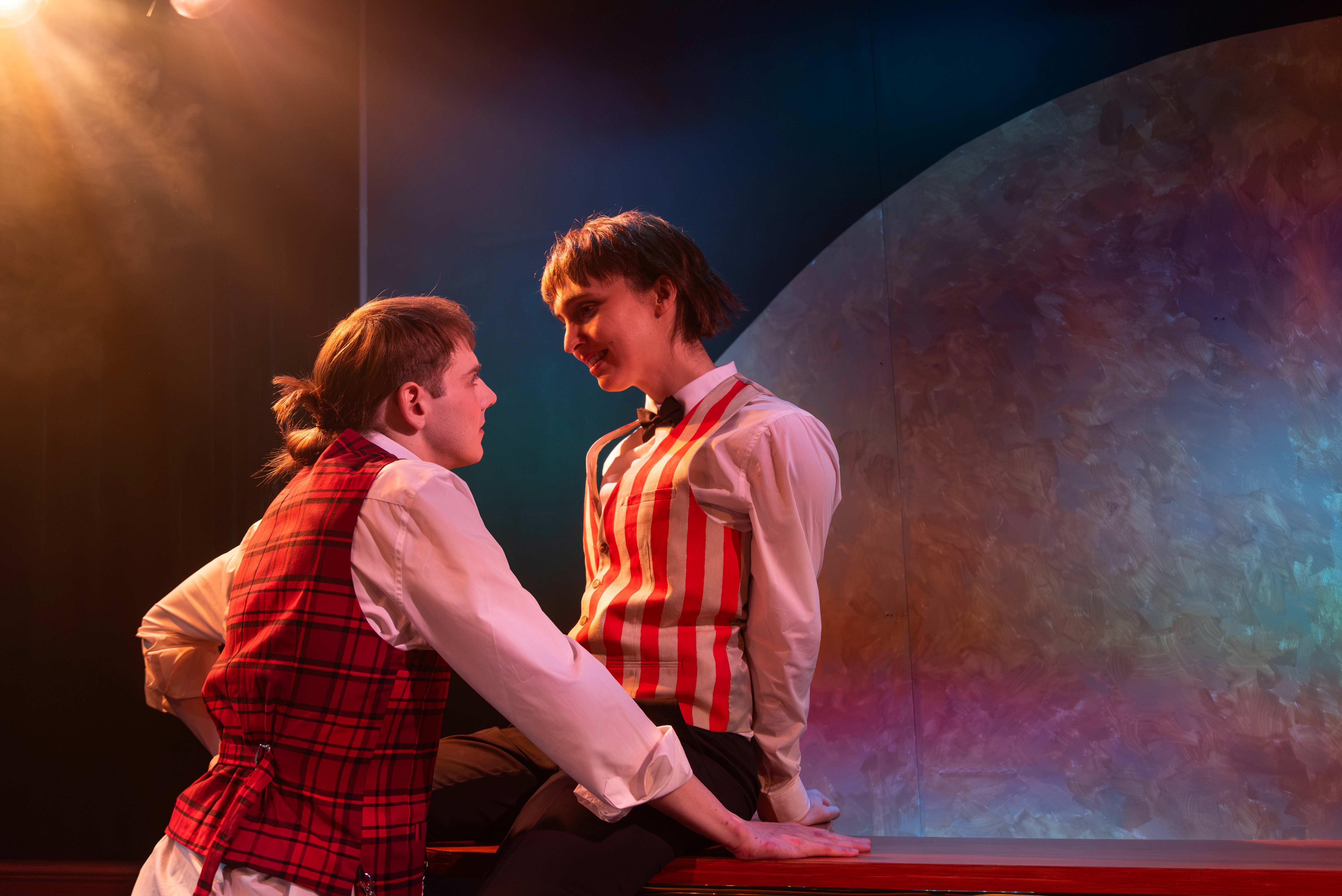
It’s a thoroughly enchanting rom-com with songs. The songs are in the style of barbershop quartet and contemporary music theatre. The barbershop is, of course, sung acapella and the contemporary is accompanied by Hearne on piano. The performance of both styles is an absolute delight.

Michael loves singing in a barbershop quartet, but he’s not quite sure who he is, and there’s good reason to believe that those who partake in the quaint artform may not be too accepting of where his journey of self-discovery may take him.

Afterglow shares with Strictly Ballroom the playful presentation of a rather antiquated artform to parody parochial insistence on conformity.

Performances are comic gold. Directors Cassie Hamilton and Lily Hayman know the sort of piece they have and make it sing. Clever lighting choices by Tyler Fitzpatrick add to the merriment.

The script hilariously targets the narrowness of some of the quartet. Playing characters who are bigoted and bumbling, Nat Jobe and Lincoln Elliott are excellent. Rarely have such bores been such fun.

The potential lovers are utter magic. Hamilton offers a superb portrait of a charming, confused vulnerability and Nic Prior gifts us a moving presentation of confidence and courage.

The script is not without provocations.

Can straight people really be reduced to middle class conventionality, to the kids, the house, the lawn? (It’s a reduction that presupposes the existence of some sort of contrasting cultural heroes. And I’ve told you already what I think about that.)

Does a cis heterosexual male really need to define his own moral growth using someone else’s language?

And there’s that word – need. As we leave behind a smaller, suffocating world, how prescriptive will we be? Can we only break old norms by introducing new ones? Or is there a wider vision of flourishing?

The absolute joy of this piece suggests the latter.

Paul Gilchrist

Afterglow by Sheanna Parker Russon & Lillian M. Hearne

presented by Griffin Theatre Company and Purple Tape Productions

at Downstairs Theatre, Belvoir, until 25 July

griffintheatre.com.au

Image by Lucy Parakhina

Life is a Dream

9 Sep

This is a fascinating piece of theatre.

It’s a contemporary adaptation of Pedro Calderón de la Barca’s original play, a classic of the Spanish Golden Era.

In both versions, Segismundo is imprisoned at birth because of an omen suggesting he will be a threat to the royal family.

In this version, by Australian writer Claudia Osborne, the story is streamlined and the focus becomes the dreadful impact of marginalisation (which is somewhat different from the original – but more on that later.)

This version begins with a long sequence in which Segismundo is imprisoned in his cell. To justify his imprisonment, his warder, Clotaldo, repeatedly tells him He is dangerous and destructive, but not in this room. We watch Segismundo both deal with boredom and guess at the nature of the outside world he can only know through home videos, books and conversation. For quite some time, we’re not told why Segismundo has to live this existence, and the suspense of this sequence and its hint of allegory seems informed not only by the 17th century original but also by 20th century absurdism. Directed by Solomon Thomas and Osborne, the humour and pathos are beautifully rendered. Thomas Campbell is terrific in his portrayal of Clotaldo, his complicity in an injustice and his love for his prisoner fighting a silent, heart-wrenching battle. Ariyan Sharma as Segismundo gives a brilliant performance, skilfully presenting the physical comedy, while still portraying the character’s innocence and wide-eyed vulnerability.

Then, suddenly, on the king’s birthday, Segismundo is allowed to meet his family for the first time. The sequence that follows is a thrilling tonal change. From the gentle evocative pace of the imprisonment scenes, it now feels as though we’ve been thrown into the living-room-cum-board-room of a hyper-privileged family, where tensions are entirely explicit (partly because of the repetition of refrains like This is fucked up!) Mark Lee as the king, Essie Randles as his daughter, Shiv Palekar as his eldest son, and Ariadne Sgouros as his daughter-in-law bring to this sequence a fierce energy (though I wish the script had allotted more space to the exploration of their characters and motivations.)

But that isn’t the piece’s focus. The focus is the experience of the marginalised, or more precisely, the demonised. And, yes, I’m getting awfully close to spoiler territory, so I’ll tread carefully – but what the piece offers is a powerful warning about the tendency of prophecies to be self-fulfilling. Expect evil, and you encourage it. This is a timely reminder in our current political climate, one in which we increasingly fall into the temptation of deciding that those who are different to us, or who disagree with us, are irredeemable enemies. Our certainty of their evil will prove us correct – and that may well be our only satisfaction.

But it’s not only what this piece does that makes it fascinating, but also what it doesn’t do. Osborne has created a version of Life is a Dream for our era, with our desire for social justice and our condemnation of the misuse of power. Written for a very different era, Calderón’s version ends very differently. And in the original, the title evoked more than the exclusion of the marginalised from what the hegemony might call reality. It also suggested something of Life’s grand mystery, something of the wonder of existence expressed by so many writers in Spain’s Golden Era (and which, incongruously, I’ll exemplify by a quote from the ancient Chinese philosopher Zhuangzi: Am I a man dreaming I am a butterfly or a butterfly dreaming I am a man?)

Awareness of the difference between the two texts invites some rather confronting questions. In our journey to modernity, what we have gained and what we have lost? No one can argue with a culture that’s cured small pox and condemns slavery. But still, one might regret a certain diminishment, a shrinking of the soul, a soul that now knows only answers, and knows not wonder.

But awareness of the difference between the texts, or indeed any knowledge of the original, is unnecessary for the enjoyment of this piece.

It’s surprising and vibrant, fun and thought-provoking.

Paul Gilchrist

Life is a Dream by Claudia Osborne, after Pedro Calderón de la Barca

Presented by Fervour

At Downstairs Belvoir, as part of 25A, until Sept 21

belvoir.com.au

Image by Phil Erbacher