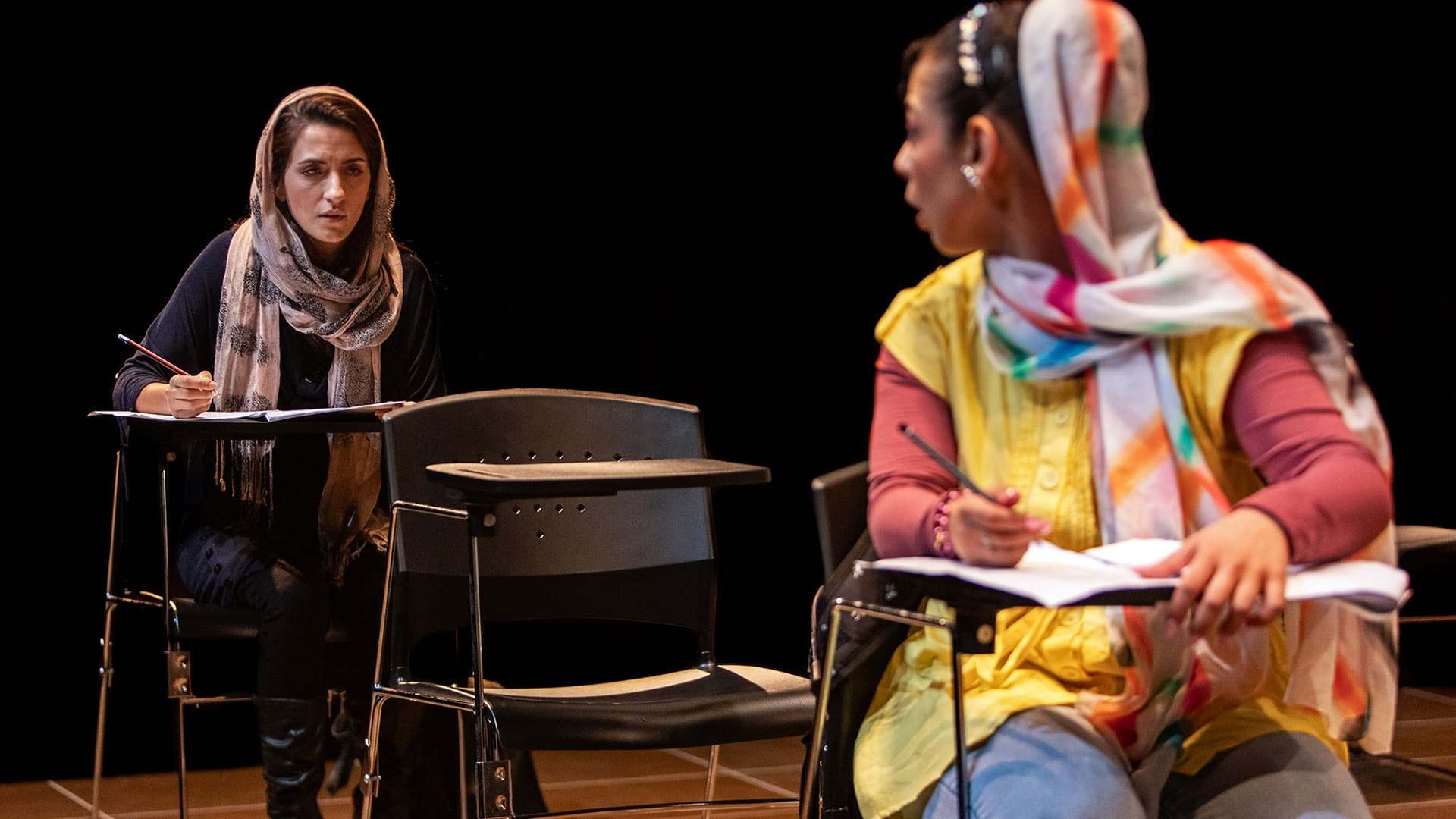
This is a beautiful production of a truly beautiful play.
It’s set in Iran, in a classroom in which English is taught as a foreign language.
The script won Sanaz Toossi the 2023 Pulitzer Prize for Drama, and by presenting it, and doing so brilliantly under the direction of Craig Baldwin, Outhouse confirms itself as one of our most exciting and stimulating theatre companies.
Marjan insists her students speak only English in class. Pedagogically, this is probably a sensible decision – but it brings to the fore the challenges of learning a new language.
When not attempting English, the characters are imagined to speak in their native Farsi. For the purposes of the play, Farsi is represented by the actors’ natural spoken English, while the language they are attempting to learn is represented by English spoken with an Iranian accent. Dialect coach Linda Nicholls-Gidley deserves congratulations for the cast’s successful navigation of this neat trick. And neat trick it is – because it effectively highlights that behind every accent you might find clumsy, or difficult, or amusing, is a person of equal dignity to you: equally intelligent, equally articulate, equally human.
(Digression: Farsi is what native speakers call their language. For a long time, English speakers called it Persian. There are some Farsi speakers who would prefer that English speakers returned to using the word Persian – because it would make clear to them that the language referred to is a continuation of that used in one of the great literary cultures of the world. Think Hafez, Omar Khayyam, Rumi. In what follows, I’m going to quote Rumi several times, but that’s my pomposity, not the play’s. The play derives its authority not from pretentious claims to erudition, but from the more difficult commitment to honesty, and to the hilarious and oh-so-skilful use of the vernacular.)
By an accident of geopolitics, a fluke of technological disparity, and the evil of man, the majority of the world’s people now speak, as their native tongue, a language they’re told is of secondary value. The play explores this phenomenon with exceptional humour, poignancy and insight.
Eighteen year old Goli hopes English will allow her to reinvent herself, and Minerva Khodabande is splendid in the role, capturing with comic excellence the awkwardness and optimism of youth.
Speak a new language so that the world will be a new world. – Rumi
As the unexpectedly competent English speaker Omid, a charming Pedram Biazar presents the psychological challenges of being caught between two cultures, and the quiet presentation of this oh-so-common predicament fosters the air of truthfulness that pervades the entire production.
Neveen Hanna as Roya powerfully evokes the ache of grief as a language difference divides her from her son. In one of the play’s many tear-inducing moments, she cries Why couldn’t you have given my granddaughter a name I could pronounce?
All language is a longing for home. – Rumi
Elham muses how different the world might have been if Cyrus the Great’s empire had survived and Farsi, instead of English, had become the lingua franca. Setareh Naghoni’s portrayal of Elham is marvellous: prickly, frustrated, resentful, but courageous in her determination to be loyal to who she is.
Nicole Chamoun as Marjan offers another wonderfully complex portrayal. She presents superbly the character’s pride in her bilingual ability and her commitment to sharing it, but threads through these qualities a strand of self-doubt, thin but thorny.
The scenes between Elham and Marjan are magic, and their gentle but firm refusal to tell us which character is correct is expressive of the sheer dramatic brilliance of this work.
Perhaps it’s through language we become who we are… or become anyone at all.
Or perhaps not. The play says nothing directly about the ineffable, the world beyond what can be spoken. But what work of literature can?
This is how it always is when I finish a poem. A great silence overcomes me and I wonder why I ever thought to use language. – Rumi
And, regarding the play’s conclusion, the spoiler rule also sanctions silence. It must suffice to say that it’s extraordinary. It will be experienced in different ways by different audience members, but it left monolingual me, once again, thinking of Rumi.
Not the ones speaking the same language, but the ones sharing the same feeling understand each other.
And this play is a glorious invitation to empathy.
Paul Gilchrist
English by Sanaz Toossi
presented by Outhouse Theatre Co. & Seymour Centre,
at the Seymour Centre, until 2 May
Image by Richard Farland

