Tag Archives: Seymour Centre

Cowbois

25 Nov

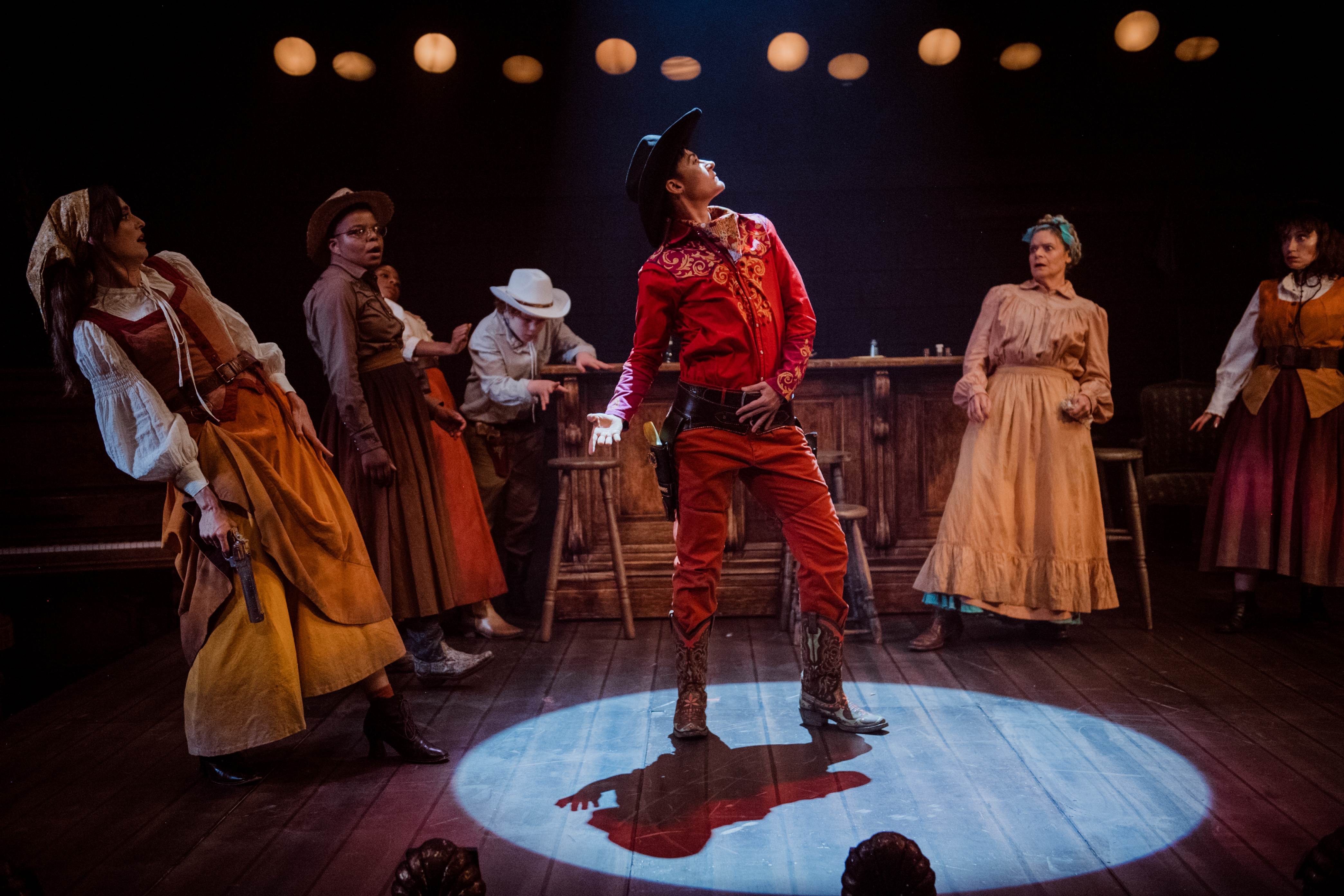
Siren Theatre’s production of Cowbois by Charlie Josephine is an absolute visual delight, a whole lot of fun, and a poignant cry from the heart.

We’re in a small Wild West town, but all the men have gone off to find gold. Left to themselves, the women begin to wonder about possibilities, and with the arrival of charismatic outlaw Jack Cannon, they find gold of a very different sort.

There’s an exhilarating blend of genres: Western meets Magical Realism.

The Wild West is the ideal setting to interrogate assumptions about gender. (The West being a literary myth in which men are men, women are women…..and women are invariably either school teachers or show girls.) It’s a myth that begs explosion – and it gets it here. Jack is a trans man, and he offers a vision of gender identity radically different from what the towns people have previously known. It’s joyous and liberating, and Magical Realism helps represent his life-changing impact.

It’s a case of guns, glitter, and glorious growth.

Director Kate Gaul creates visual magic. The use of space is wonderful and the tableaux alone are spellbinding. Lighting design by Brockman and sound design by Aisling Bermingham add to the enchantment. Clay Crighton’s original songs complete the charm.

There are superb performances. Jules Billington as Jack is the embodiment of charisma, tempered with moments of confronting rawness, of searing emotional honesty. (Wait for when the words “cruel” and “fight” are uttered.) Matthew Abotomey as the drunken sheriff gives a performance of virtuosic range and marvellous physicality. Amie McKenna gives a terrific turn as a smart-mouthed school teacher, displaying brilliant comic timing. Emily Cascarino as the saloon keeper radiates intelligence, wonder and determination. Crighton’s cameo as a laughing trouble-maker is show-stopping.

Being a Western, at the finale there’s a shoot-out. This is handled with comic aplomb by the team. However, the subtext of this shoot-out is not to my peculiar political taste. I find dissatisfying the assumptions that the pursuit of a fair, full life is best described as a fight, that harmony is dependent on having common enemies, and that those enemies are expendable. But my political taste or not, there’s no doubt that what we’re given is a genuine expression of what it feels to experience this particularly cruel form of injustice, one that heartlessly denies who you are, and who you might become.

Paul Gilchrist

Cowbois by Charlie Josephine

Presented by Seymour Centre and Siren Theatre Company

At Seymour Centre until 13 Dec

seymourcentre.com

Image by Alex Vaughan

The Face of Jizo

27 Aug

What people do to other people.

So says Mitsue’s perplexed father.

Mitsue is a survivor of the bombing of Hiroshima. She now works in a library. She’s also a member of a club that collects folktales. She insists they be handed down as they were traditionally told. During story week, she shares them with the local children.

A young physicist, and a potential suitor, has arrived in the city. He’s collecting mishappen objects that illustrate the ferocity of the nuclear explosion that was unleashed only three years ago.

Mitsue’s father suggests ways that these objects could be incorporated in her stories. She’s reluctant. She says no art can be made from what happened to the people of Hiroshima.

This play by Hisashi Inoue proves Mitsue wrong. A story of Little People caught in Big History, it’s both beautiful and profoundly moving. It does what theatre can do so well; it makes concrete what otherwise is lost in abstraction. We all know what happened at Hiroshima 80 years ago, but bewildered by the sheer numbers, the human face of the horror is hidden.

Directed by Shingo Usami and David Lynch, this production is extraordinarily powerful. Mayu Iwasaki as Mitsue and Usami as her father deliver magnificently poignant performances. It’s the gentleness, the restraint, the unforced nature of these performances that have such an effect. “Dripping water hollows out stone” wrote Ovid. Plotwise, we know what’s happened to Mitsue, and we soon guess what’s happened to her father, but over the show’s 70 minutes, which is sprinkled with humour and infused with the warmth of the love between father and daughter, we come to feel their true humanity, in all its wondrous fragility.

In our mad world, the plenitude of pain can petrify us, can turn our hearts to stone. But stone can soften, and by arousing such deep sympathy for those who suffer, The Face of Jizo revitalises hearts that have become too heavy.

Paul Gilchrist

The Face of Jizo by Hisashi Inoue (translated by Roger Pulvers)

Presented by Seymour Centre and Omusubi Productions

At Seymour Centre until 7 September

seymourcentre.com

Image by Philip Erbacher

Eureka Day

5 Jun

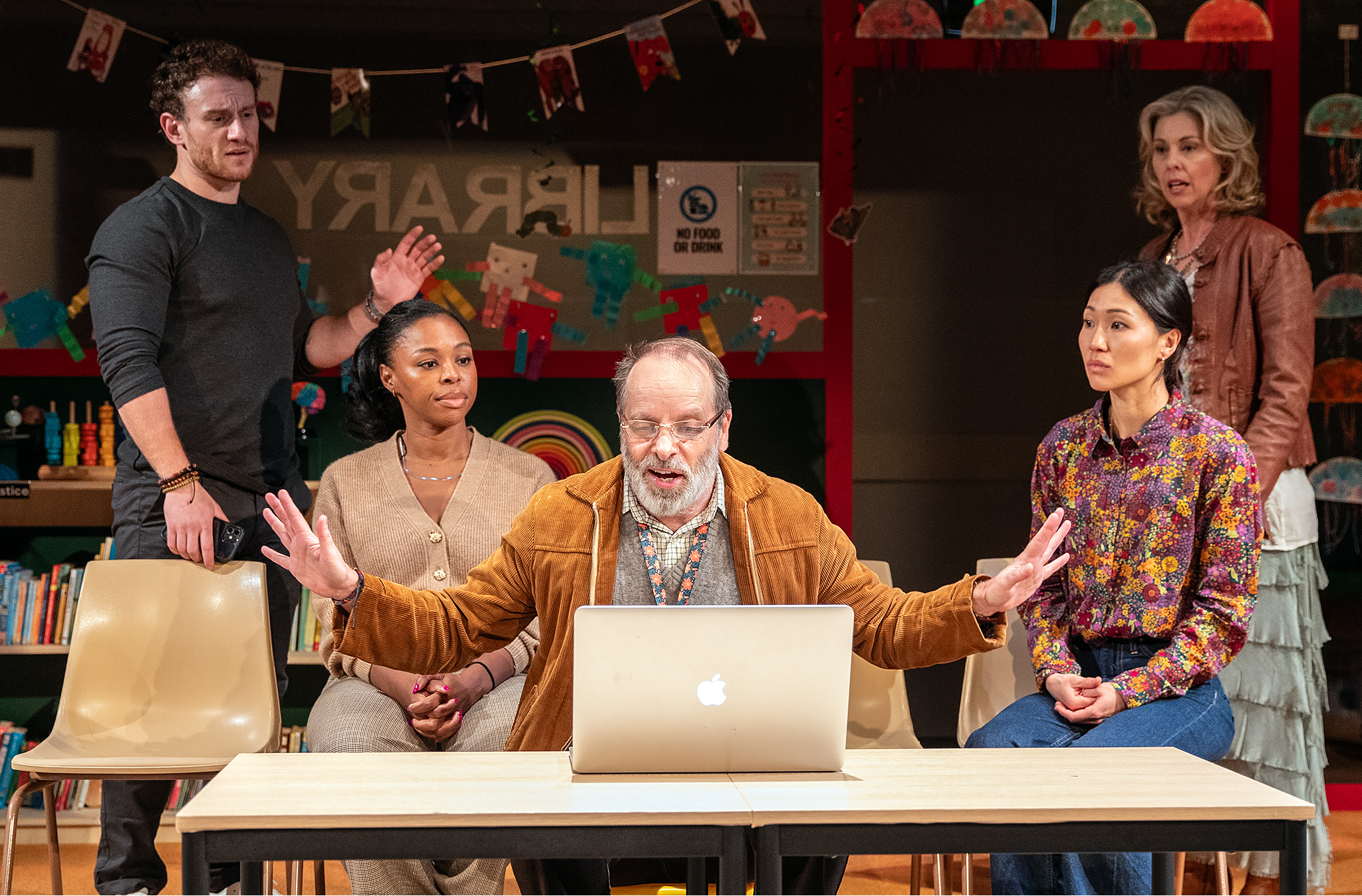
Set almost entirely in the P&C meetings of a primary school, you might assume this is a fun satire of contemporary society.

And you’d be right. Eureka Day by American writer Jonathan Spector is extraordinarily funny. But it doesn’t just make fun, it confronts one of the biggest rifts in our culture.

Eureka Day Elementary is a school built on social justice and inclusivity: a place where everyone feels seen and heard; a place where decisions are reached by consensus; a place where all points of view are valid.

The last of these is the issue. (And possibly the second last.)

Eureka, of course, means I have found it! – and there’s a sense that’s what the P&C believe: that their place is special, that it encapsulates, somehow, the perfect way forward.

But, for all their good intentions, it doesn’t.

Watching their meetings – bursting with thoughtless condescension, moral pedantry and obsession with policy, yet empty of soul-felt kindness, honest humility and genuine openness – is utterly painful. Yes, it’s hilarious, but it’s also excruciating. Earlier, I called the piece satire, but that genre usually employs hyperbole to make its point. But there’s no exaggeration here; it’s just the reality of our present day.

(A reality that feels like one of the rings of punishment in Dante’s Divine Comedy, one in which we’re condemned to an endless repetition of what seem to be absurdities but are actually perverted echoes of our true sins. However, I do think it’s a ring of Purgatory we’re stuck in, rather than Hell; we are purging ourselves; things will improve; there’s no need to abandon hope.)

There are beautiful moments in the piece where our societal problem is artfully diagnosed. One parent jokes that her daughter was very smart but also good-natured, so they knew she would become a benevolent dictator. Another compliments the work of a mime artist, for his subtlety and, we can only imagine, for his rare ability to just remain silent. Another parent says it straight out: she’s sick of the hubris.

This hubris, the belief that they’ve found the correct way, is tested by an outbreak of mumps at the school. Can all decisions be made by consensus? Are all points of view really valid?

As a society, we’ve fallen in love with policy and forgotten politics. And by politics, I mean the sphere of life in which we have to work with other people (as against just shout at them over and over that they are wrong or evil.) The fact that this play centres on meetings where adults must come together and solve problems makes it essential viewing.

(Though I must admit, I’m a little uncertain about the play’s exploration of vaccination. This hot button issue threatens to overwhelm everything else, burying from common view the representation of the political sphere that I so value. But, yes, I know, I know, the dramatic form must deal in the concrete…)

Directed by Craig Baldwin, the production bubbles away at just the right pace, evoking the awful enervating reality we currently endure, yet still assuring us the dramatic boil-over is imminent.

Performances are excellent.

Jamie Oxenbould as Don, a school official, is perfectly, perpetually, and pathetically polite and patient.

Katrina Retallick as Suzanne is both wonderfully comic and deeply poignant, offering a rich portrait of an individual traumatised by the universe’s chaotic cruelty and who overcompensates with a commitment to control.

Christian Charisiou’s Eli is brilliant as the epitome of overtalking privilege, the misguided good that knows not when to stop.

Branden Christine as the newcomer to the school community is magnificent, presenting a fascinating study in intelligence encountering its nemesis: the holding back, the bitten tongue, the seductive whisperings of despair as we wait to speak the Truth.

Deborah An as May has a gloriously warm energy. Her character’s journey is perhaps the biggest of the play, and she pitches it superbly. Her speech in which she posits what she wants for her kids is a highlight, and represents the best of what the play has to offer: the petty hobgoblin of certainty dispelled by a courageous vision of hope.

With this production, Outhouse Theatre shows once again why they are a vital part of the Sydney scene, presenting work that dares to walk our societal fault lines, and keeps its balance with honesty and humour.

Paul Gilchrist

Eureka Day by Jonathan Spector

Presented by Seymour Centre & Outhouse Theatre Co

At Seymour Centre until 21 June

seymourcentre.com

Image by Richard Farland

Seventeen

10 Oct

It’s a neat trick that blossoms into a fascinating night of theatre.

Seventeen by Matthew Whittet is a piece for mature actors but asks them to play teenagers. School has just finished – forever – and they’ve gather in the local park to celebrate. It’s an ensemble piece, and we watch these six young people drink, dance and greet the dawn.

The title implies we’ll be offered a representation of a particular demographic, and like all pieces with an aim this broad, it has to fail.

What it does achieve is sentimentality, in the most wonderfully humane way. (Sentimentality, not nostalgia; the play’s set here and now, not in the past of the actors’ youth.)

Sentimentality could be defined as being overly emotional and safely enjoying the feeling – which is often exactly what we want from a visit to the theatre, and this play delivers.

It’s a top cast, and under the direction of Mary-Anne Gifford, it’s a joy to see them do their magic. Peter Kowitz nails Mike, the annoyingly alpha male with some serious growing up to do. Di Adams as Sue, his girlfriend, offers a beautiful portrait of a gentle-hearted young woman who knows Life offers more. Noel Hodda’s Tom is a captivating mix of youthful suggestibility and soul-deep maturity. Katrina Foster’s Edwina is a delightfully funny presentation of a young woman already looking to the future, dismissing teenage foolishness but still naïve enough to be caught by its allures. Di Smith is Lizzie, Mike’s younger sister, and it’s a terrific portrayal of childish pester power, impish mischief and sibling affection. Colin Moody’s Ronnie is deeply affecting, powerfully capturing the awkward vulnerability of the outsider.

Apart from the sheer talent of this brilliant ensemble, the piece is also irresistible because it brings to the fore the paradox of performance. The usual way the game of theatre works is that the audience is invited to forget that the actors are actually acting. We’ll often judge a piece successful if this illusion is so persuasive that it’s only broken at the curtain call. Yet, in this production, the discrepancy between the age of the actors and that of the characters means we’re constantly being reminded they are, indeed, acting. If in these most unusual circumstances we still forget, it’s testament to the performers’ extraordinary skill. But I wonder whether the more likely impact is that we’re made more conscious of the actors’ active empathetic role-playing, more appreciative of their creative decisions.

And that brings me to the second paradox of performance highlighted by this play. In every production, each actor brings to each role their life experience, even though it’s not their life they’re being asked to portray. Their knowledge and wisdom will inform the character but not determine the character – the play itself does that. On one level, this particular play asks its actors to forget everything they might have learnt from a lifetime of adulthood. (For some of us, though not all, that’s a hell of a lot of forgetting.) Watching Seventeen, we know the actors are doing this forgetting, this erasing. We know they know more than the characters. (If dramatic irony is defined as those occasions when we know more than the character, then all actors present all characters with dramatic irony – only in this production, they do it explicitly.)

And irony is close cousin to pity. If only you knew…..

In witnessing actors in the deliberate process of forgetting, or erasing, the fundamental emotion aroused is pity. We pity the teenager characters their myopia, their naivety, their inexperience. Perhaps we even pity their innocence.

If only you knew…..

In the play, Tom reads a letter he wrote as a child to his future self. This play is a letter written to our past selves – a wistful, funny, forgiving, love letter.

Paul Gilchrist

Seventeen by Matthew Whittet

At Seymour Centre until 19 Oct

seymourcentre.com

Image by Carlita Sari

A Case for the Existence of God

2 May

This is a magnificent piece of theatre.

However, I suspect the title might put off an Australian audience.

Australians like to believe we’re less literal than our American cousins. Case in point: we often joke that they don’t get irony. But, ironically, when it comes to religious language, we’re the ones reluctant to use it in any way other than literally. In many other cultures, writers comfortably evoke God without fear that it automatically commits them to the theological tenets of some religion. Religious language is employed to suggest or symbolise the grand, the awe inspiring, the universal. Sometimes, it can feel like the only discourse big enough for these things. An honorary American, Albert Einstein, was famous for using religious language in this way. His oft quoted comment, expressing his objection to quantum theory, that God does not play dice, was simply an assertion that mere chance could not be fundamental to the fabric of the universe. He was saying nothing that we unsophisticated Australians would interpret as religious.

The title of Samuel D. Hunter’s play uses religious language in a similarly evocative way. In this superbly crafted two hander, no one says a word about religion. Not a word. The two male characters discuss money, work and most of all, their children. They build an unlikely friendship. The title simply implies hope, that despite problems, things might work out OK. (I know I’m getting awfully close to spoiler territory here, but the final scene, which is a theatrical surprise and an utter delight, reminds me of the conclusion of Thornton Wilder’s Our Town, only more secular. Wilder himself borrowed the idea from Dante, that towering poet who spoke of the human heart via religious language – because only it had the grandeur to do justice to his topic.)

Director Craig Baldwin’s production is wisely pared back so that the focus is on the two splendid performances by Elijah Williams and Anthony Gooley.

Keith is an educated musicologist, working as a mortgage broker. As a single gay man, his dream of adoption is proving difficult, so he fosters a new born in the hope that the relationship might be allowed to become more permanent. Surviving a divorce, working class Ryan seeks a mortgage to help give his baby daughter a real home. Out of a similar sadness, the friendship between the men grows.

Williams’ Keith is brilliant: prickly, vulnerable, articulate and lightning fast. Gooley’s Ryan is marvellous: slow, awkward and inarticulate. Both characters are beautifully generous-hearted. It was pure pleasure to spend ninety minutes in their company.  

A case for the existence of God? Amongst other things, it’s their friendship that suggests the possibility. (See above. God is love is not marketing hyperbole; it will reward deep reflection in a way that Coke is It cannot.)

In a play jam-packed with scorchingly truthful moments, one of my favourites is when the two men, sharing a bottle of scotch, begin to discuss the history of Western music (as you do.) Keith mentions the invention of polyphony, a term which is, of course, meaningless to Ryan. And then the penny drops: harmony! Ryan can’t believe there was a time before harmony. The symbolism is not overplayed, the scene does what drama excels at: concrete moments played so honestly they intimate something universal.

Paul Gilchrist

A Case for the Existence of God by Samuel D. Hunter

At Seymour Centre until 4 May

www.seymourcentre.com/event/a-case-for-the-existence-of-god/

Image by Phil Erbacher

Pride in Prejudice: the Wharf Revue

13 Nov

Satire has street cred. It sticks it to the Man.

Written by Jonathan Biggins, Drew Forsythe and Phillip Scott, and performed by Mandy Bishop, David Whitney, Andrew Warboys, Biggins and Forsythe, what gives this production countless giggles is its clever caricatures of well-known people. Standouts are mischievous portraits of Anthony Albanese, Jacqui Lambie, Caroline Kennedy, Joe Biden and Peter Dutton.  

It’s a satire aimed at the famous and the supposedly powerful (though I don’t believe any of the above mentioned people were in the audience on opening night. It must be admitted, however, I do avoid all chit chat in the foyer.)

Satire always faces one huge dilemma: directly address your audience, make their lives your target, and you offend them. And, alas, the offended stop listening, and what’s worse, they don’t tell their offendable friends to buy tickets. So satire, despite good intentions, is often reduced to little more than the shadows in Plato’s cave; something that distracts us from reality, or secures us in our illusions.

One such illusion is that people who act on a political level are flawed. But isn’t that the Truth? Indubitably, but a lot of things are true that no one delights in repeating. This particular truism has the advantage that it justifies political passivity: I care, but engagement entails compromise at best, or corruption at worse, so I’ll merely watch. And, if this is my choice, then being informed must be valorised, and the consumption of media products must be conflated with genuine political engagement.  

Two skits seem to me to particularly suggest this disdain for authentic engagement. One is a series of video projections of Lidia Thorpe. I don’t admire Thorpe’s politics, and the sight of her in a “No” t-shirt filled me, once again, with dismay – but an attack on her that consisted of merely a rhyming ditty left me with a previously unexperienced empathy for the woman. Similarly, a skit in which three French people are lampooned for rioting for seemingly trivial political objectives left me reflecting that at least they weren’t sitting comfortably on their couches watching the ABC.

Another way satire gains street cred is by its flirtation with bad taste. This show has its share of such naughtiness: an animation of the Titanic mini-sub accident; an operatic assassination of Putin; and a passing reference to the current horrors in Gaza with the suggestion the problems are perennial. I’m not certain if this type of naughtiness is a challenge to conventions or a suspension of empathy.  

Subject matter aside, there are also challenges of a creative nature in a work like this. Video projection, though facilitating costume changes, might leave an audience wondering why they left home (especially an audience that it seems to be assumed watches a whole lot of TV.) Sung ditties, which made up a fair percentage of the evening, can be an inefficient and ineffectual way of making a satirical point; their critique being more rhyme than reason. And, if you perform a well loved song with altered, satirical lyrics, the prime victim is often the song.

And finally, a structural point: satire can be sharp like a scalpel, or detailed like the T & C’s for online banking, and anywhere in between risks losing either the bite or the complexity. The concluding skit, a terrific appropriation of South Pacific that explores Australian, American and Chinese diplomatic relations, gets the mix hilariously right.

Paul Gilchrist

The Wharf Revue: Pride in Prejudice by Jonathan Biggins, Drew Forsythe and Phillip Scott

At Seymour Centre until Dec 17

www.seymourcentre.com

Image by Vishal Pandey

Venus and Adonis

6 Oct

Written and directed by Damien Ryan, this is big, bold, and delightfully ambitious. It’s also very entertaining (but more on that later.)

It is not a dramatization of Shakespeare’s poem but rather follows a growing tradition of fictionalising aspects of the poet’s life.

It’s not a surprising tradition; Shakespeare’s influence on the language and theatre is overarching (and I will admit somewhere in the first act, for just a moment, I understood why some people call for the total erasure of everything to do with the Bard so we could all just start again.)

Several Elizabethan stories are layered together here: the death of Shakespeare’s son Hamnet; the possibility that poet Aemilia Lanier was the Dark Lady of the sonnets; the performance by Shakespeare’s company of Venus and Adonis before the monarch herself (which I guess is completely fictional??)

The play is a musing on love, and love may be a many splendored thing, but it’s certainly a thing of enormous semantic diversity. Sparked by the poem Venus and Adonis we are offered love as desire, but the play also explores sexual love beyond physicality, and friendship and familial love. In one provoking moment, lust is juxtaposed with grief, the little death lying side by side with its stronger sibling.

Though moving and provocative, the production forefronts entertainment. There’s excellent physical humour aplenty, theatre jokes abound, and there are constant allusions to Shakespeare’s work (which might be either diverting or distracting, depending on whether you buy into the theory Shakespeare was less a creator of enormous vitality and more of a sponge absorbing nutrients from the ocean of language in which he swam.)

Performances are magical. Anthony Gooley as Will is both poignant in his pain and funny in his frustrations, a very human take on a man we have diminished by raising to an icon. Aemilia Lanier is Will’s lover and one of the earliest published female poets, and possibly the first explicitly feminist one. Adele Querol is glorious in the role: fire and strength; at one moment a lightning bolt falling mercilessly on the earthly patriarchy, and at the next, that even more miraculous phenomena, a bolt shot back heavenwards, lighting the way to a brighter future. Jerome Meyer as Nathaniel Field, who plays Adonis to Amelia’s Venus, is brilliantly comic as he navigates some truly teasing tensions: in Shakespeare’s company he plays the women, but before the Queen he is asked to play a man, a gorgeous man, who as the target of Venus’ unrelenting desire might feel somewhat reduced to passivity…. like that projected on women by the male gaze. Belinda Giblin as Queen Elizabeth is magnificent, perfectly regal and (as the script demands) unexpectedly sage. Perhaps the character operates as a coda. Certainly she is a deus ex machina, arriving from the beyond and offering …. But perhaps all fictional histories function as such, offering a solution, of a certain type, to our problems: assuring us they are eternal.

Paul Gilchrist

Venus and Adonis by Damien Ryan

at Seymour Centre until 21st October

www.seymourcentre.com/event/venus-and-adonis/

Image by Kate Williams

The Turn of the Screw

29 Jul

Ghost stories are not about ghosts; they’re about fear. They ask what makes us frightened and what type of safety we crave. They also ask when is fear natural and beneficial, and when is it irrational and dangerous.

Richard Hilliar’s adaptation of Henry James’ classic novella is funny, fascinating, frightening, and entirely engaging.

Ostensibly, it’s a ghost story and, as director, Hilliar works multiple theatrical elements to create a deeply creepy atmosphere. Set, sound, lighting, costume and performance all combine together brilliantly to establish this mood. (Set designer Hamish Eliot deserves special mention: the creation of the late 19th century house and its surrounds is extraordinarily rich.)

Adaptation is a tricky business. The audience will always slot into two distinct categories: those familiar with the original text and those who are not. Though there have been dramatizations before, I would think James’ novella stubbornly resists the form, being so dependent on the subjective psychological experience of the protagonist. The original novella is in first person and the protagonist is the archetypal unreliable narrator. (Here she is played by Lucy Lock with affecting horrified bewilderment.) The achievement of the original text relies on silences, both deliberate and contextually determined. James’ narrator doesn’t tell us certain things, either out of self-interest or from lack of self-knowledge. And James himself, working at the end of the Victorian era, was presumably reluctant to spell out the more confronting possibilities latent in his tale. Hilliar’s version is much more explicit.

It could be argued that James’ novella is the culmination of the gothic, a tale in which the external supernatural and the internal psychological collapse into one. After The Turn of the Screw, modern horror developed because the genre had nowhere else to go.

But Hilliar creates a play and a production that engages in a fascinating conversation with the original, as well as being a deeply intriguing work in its own right.

Paul Gilchrist

The Turn of the Screw by Richard Hilliar (after Henry James)

presented by Tooth and Sinew and Seymour Centre

at Seymour Centre until Aug 12

www.seymourcentre.com/event/the-turn-of-the-screw/

Image by Phil Erbacher

Consent

10 Jun

This is a marvellous play presented by an extraordinary team.

As the title suggests, it’s based on crimes of sexuality, both what is illegal and what is too little or too large for legislation. (The law is a net we drag through the ocean of reality; the small slips through the mesh, the large tears it asunder.)

Nina Raine’s Consent is built on serious conflict. Not the type of conflict where two characters fight for the same thing, whatever that random thing is: the farm, the man, or dominance. No, it’s conflict born of those unfathomable fissures in the human condition. Sometimes, when we’re particularly brave or clear-eyed, we acknowledge that our deepest held values might be at odds with each other; that it might not all fit together. (It’s sort of the Gödel’s Theorem of values.) It’s what Hegel expressed in the line “Genuine tragedies in the world are not conflicts between right and wrong. They are conflicts between two rights.” In its reference to the great Greek tragedies, Consent makes explicit this type of tension.

But this is a contemporary play set in modern London. It contrasts the need for a legal system with the unavoidable limitations of a legal system. And, in asking which way justice, the play presents the battle between empathy and logic.

It interrogates empathy’s disturbing whole-heartedness. Sure, we must listen to the victim, but as is said in the play (I paraphrase) If you’re hurt enough, you become stupid.

Also explored is the troubling relationship between the valorisation of empathy and the desire to make others suffer the same pain we have felt. Empathy and revenge are perhaps closer cousins than one might imagine.

But rationality won’t necessarily save us either. The conflict between the letter of the law and its spirit is age-old, and legal logic can be especially pedantic. As one character points out, if you were to come across that sort of pedantry outside a courtroom, you’d naturally assume the speaker was disingenuous.   

The play also asks us to consider the difference between I’m sorry and I apologise, and to compare repentance with forgiveness. This isn’t semantics, it’s a genuine gift for the soul.

The play’s construction emphasises the inevitability of conflicting perspectives, with the stage sometimes split into two parallel and contrasting scenes. Likewise, the characterisation asserts complexity. Characters we initially despise will shine with unexpected goodness, and vice versa.

And under Craig Baldwin’s direction, the absolutely terrific ensemble present beautifully rich performances. Anna Samson’s Kitty is magnificent, offering both real heart and a glimpse into its darkest chambers. Nic English, playing her husband Edward, gives a superb portrait of cold intellectual arrogance and the emotional confusion it hides. Jeremy Waters’ Jake is wonderfully narcissistic, until he is gloriously, and so truthfully, not. Jennifer Rani, playing his wife Rachel, portrays magnificently that type of justified resentment that arrests moral growth. Anna Skellern’s Zara positively floats with exuberance until it’s punctured by betrayal. Sam O’Sullivan’s Tim is an eminently watchable combination of uncertainty and strength, a performance that captures the physicality of doubt and the verbal virtuosity of conviction. Jessica Bell as Gayle is a splendid working class counterpoint to all these privileged professionals, But Gayle is also a victim of rape, and Bell encapsulates perfectly both her incandescent rage and aching vulnerability.

Life is hard. Life is complex. Maybe we can’t make it all fit together. But we’re in it together. Consent is a deeply humane play, brilliantly presented.

Paul Gilchrist

Consent by Nina Raine

At Seymour Centre until 24 June

presented by Outhouse Theater Co

seymourcentre.com

On a Clear Day You Can See Forever

23 Mar

Reincarnation is an alluring belief, and may even be true.

The depth of our emotions, especially for others, can lead us to feel that one life is not enough. Perhaps, somehow, there will be other lives in which our love can continue.

The problem – for those of us with a modern sensibility – is proof.

But none is needed. A belief (or faith or hope) in reincarnation requires no verification; its value is expressive. One might as well ask for proof that my favourite colour is blue.

In Alan Jay Lerner and Burton Lane’s musical, Dr Mark Bruckner hypnotises Daisy Gamble, in an attempt to understand her apparent Extra Sensory Perception. Exploring her memories, he discovers Melinda Wells, an English woman who passed over a century ago.

Perhaps my philosophical pretensions make the subject matter sound heavy, or just plain weird, but it’s not – it’s light, breezy, and beautiful; a glorious expression of our dearest desires.

The play has a history of revisions, and Jay James-Moody (who also directs and performs) has adapted and updated the original story. In this version, following a 2011 Broadway revision, Daisy is a gay man, David, and as Mark falls for Melinda, he must ask what are his feelings for the man in whom she resides. It’s all about…. fluidity.

James-Moody’s production is visually delightful, musically superb, and very funny. As David, James-Moody is both movingly vulnerable and deliciously comic. His timing is spot on. Melinda is played by Madeleine Jones with a mesmerizing pizazz. Blake Bowden’s Mark wonderfully captures both the psychologist’s obsessive drive for knowledge and the man’s desperate need for love.

The vocal performances are terrific, with highlights including “When we are 65” sung by James Haxby and James-Moody, “Don’t Tamper With My Sister” sung by Jones, “Come Back to Me” sung by Bowden, and the title song, performed by James-Moody, Jones and the company. Natalya Aynsley’s orchestra is brilliant. Choreography by Leslie Bell is cheeky and playful, perfectly suiting the gorgeously non-conventional relationships portrayed, and the cast perform it with aplomb.

On A Clear Day You Can See Forever is an exuberant reminder to look beyond the mundane and be open to the surprise of joy.

Paul Gilchrist

On a Clear Day You Can See Forever by Alan Jay Lerner and Burton Lane, revised and adapted by Jay James-Moody

presented by Squabbalogic and Seymour Centre

until 15 April

seymourcentre.com

Image by David Hooley