Tag Archives: Theatre Review

People Will Think You Don’t Love Me

22 Nov

This is a fascinating piece of theatre. The arresting title is an introduction to its key concerns. Philosophers as great as Plato, Augustine and Foreigner have all wanted to know what love is – but an even deeper tradition has long questioned the meaning of those mysterious little pronouns, the you and me of the phrase people will think you don’t love me.

What are you? What am I? To what degree do any of us have a fundamental essence? If so, what does that essence consist of? I don’t mean the particular qualities we might attribute to lovers, qualities like courage, intelligence or kindness. I mean the medium in which such characteristics exist, where they reside. (Analogy: old films were celluloid, and it was in this medium that the particular images that made up any individual film resided.) To cut to the chase, in the currently reigning philosophy of secular materialism, are we simply our physical bodies? If so, then our personal qualities must reside in those bodies. And the tantalising question raised by all this is If you donate an organ to me, do I begin to become you? 

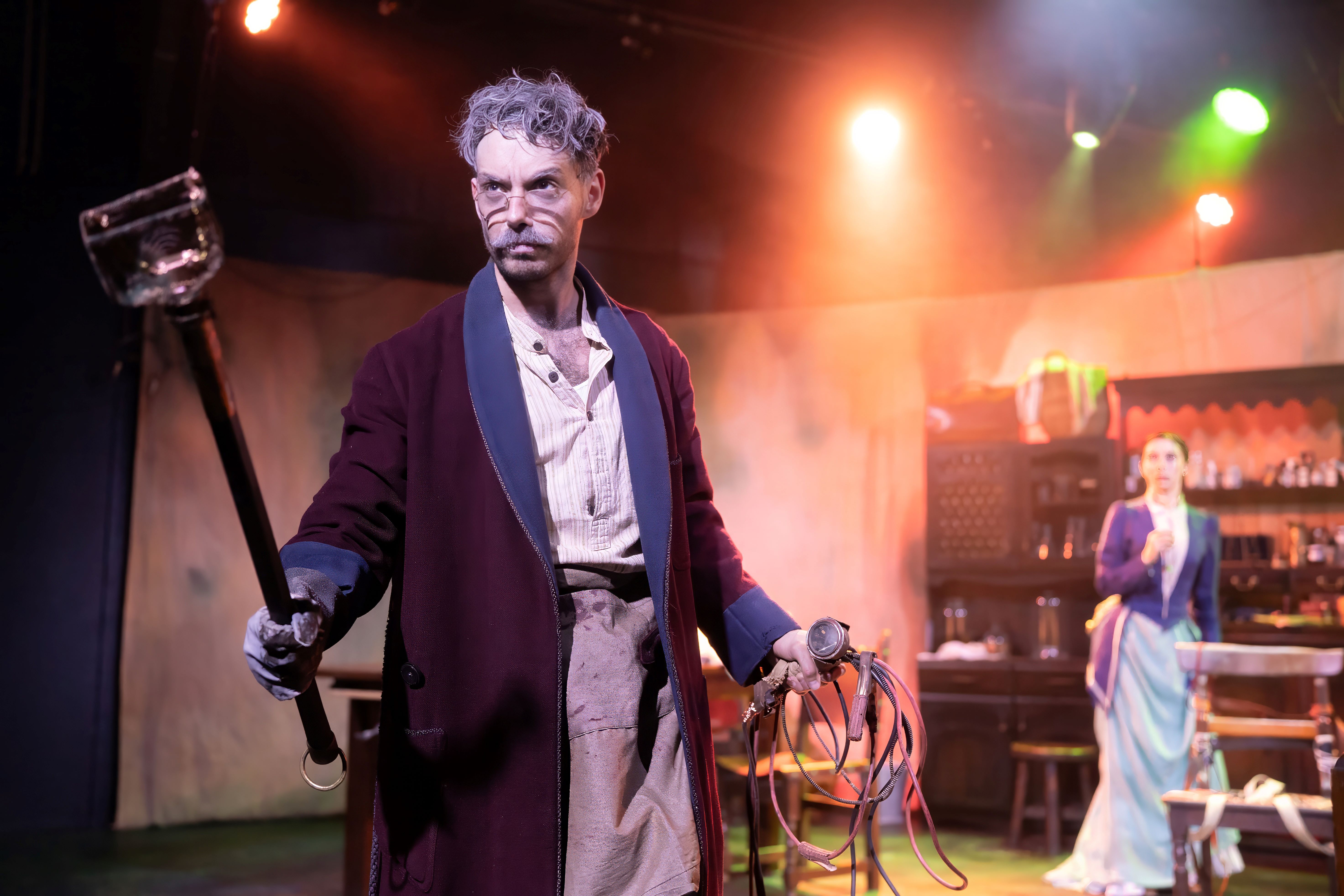
This is the basis of Joanna Erskine’s fabulous play. Michael has a diseased heart. When Rick dies in an accident, Michael is given his healthy heart. And then he changes….

Some people might dismiss the idea as simply weird, or as such a rare experience as to be of little relevance.

But what it’s doing is opening up the concept of selfhood. A couple of decades ago we had an obsession with finding ourselves. It was assumed every individual had an essence and it was the mission of each of us to find that essence and let it shine. More recently, we’ve come to define our essential self in terms of our membership in certain demographic groups. With this sociological rather than psychological focus, we’ve come to see our individuality as a space carved out by the intersection of various statistical sets. We’ve almost replaced the word individuality with identity. We no longer shine like some sort of star, but rather lie small and flat, a mere overlap in a Venn diagram.

But, as I’ve suggested, this play doesn’t so much raise the question of Who we are but What we are.

I don’t want to make the play sound heavy; it’s extremely engaging. (And I certainly don’t want to sound like the kind of pretentious fool who goes to a children’s party and sees innocents being inculcated into the competitive values of capitalism, while everyone else just sees kids playing Musical Chairs.)

But this play won the Silver Gull Award when it was run by subtlenuance, when the parameters were that eligible plays be philosophical or political. Now the award is run by New Theatre, and that phrase has wisely been removed (the average theatre-goer being insufficiently familiar with the philosophical approach to appreciate that their favourite artform is philosophy’s closest cousin. What two human activities are the Ancient Greeks most famous for gifting to Western society? Drama and philosophy.)

Good drama is good philosophy: recognisable situations, presented in accessible language, posing fundamental questions.

And the dramatic form is eminently suited to the investigation of the philosophical concept of the essential self. The creation of individual characters is one of the dramatist’s major tasks. And, as audience members, we judge the success of any particular characterisation by the success of that mysterious trick of combining consistency with unpredictability. Of any character, we want to be able to say I understand why she did that rather than being reduced to the boredom of She was obviously going to do that. And one way theatre keeps that magic mixture of consistency and unpredictability bubbling is the actor, the physical body on stage. Every writer has had an actor in a workshop or rehearsal critique their script: I don’t think my character would say that. One answer is Your character does, indeed, say that. Your physical presence on stage as you say the line is sufficient, because the character exists nowhere else.   

In Erskine’s play, the interrogation of the nature of selfhood is further facilitated by the focus on romantic love. Romance is the type of relationship most based on the assumption that an individual is something particular, something special. (In most other relationships we’re honestly not that interested; we’re content to deal with people as we find them.) There’s a flashback to the night before Michael and Liz’s wedding, where he explicitly outlines why she is the woman he loves. It’s commonplace to assert that people change, and that’s why romance dies. But why are we so hopeful in the first place that the loved one will act consistently? Perhaps sexual love is like the theatrical stage; the centrality of the body somehow implies a permanency of self.

I’ll repeat again, the play is not heavy; it’s a gripping psychological drama (with a smattering of the gothic – I’d love to see more!)

And the awkwardness of the situation, that Michael’s life is only possible because of Rick’s death, provides opportunities for surprising humour. The uncomfortable pauses, the inappropriate comments, the unrecognised hints, all create a linguistic landscape of the alien and the unfamiliar, and under the direction of Jules Billington, the cast present beautifully the tentative navigation of this strange new world. 

Tom Matthews as Michael has an extraordinarily challenging task – the portrayal of two characters battling it out in one body. He achieves this superbly, achieving genuine nuance (and avoiding any temptation to employ the garish strokes more suited to horror.) The duality of his inner world is reflected by the two women in his life, his wife Liz, and Tommy, the partner of Rick who donated his heart. These two characters have tremendous arcs, as they try to come to terms with the most unusual of circumstances. Ruby Maishman’s Tommy moves poignantly from suspicion and the coldness of grief to a wondrous softening as she begins to find Michael’s behaviour oddly familiar. Grace Naoum’s Liz brilliantly transforms from a daggy, uptightness to a bewildered anger, as she finds only loss where she expected victory, and knows not who to blame.

I’ve talked a lot about the philosophical provocations of the play, but its glory is that it’s still grounded in the psychological. As Michael begins to display attributes of the bolder, more brutal Rick, we’re asked to consider whether he is merely acting out his desires. Now that Michael is finally healthy, is he simply claiming a bigger life? Is the whole I-have-your-heart-now-in-my-body-and-it’s-changed-who-I-am a materialistic justification for what are actually just choices? It’s an old trick: disguise decisions as determinism. It’s beyond my control, says the man who really, really, really wants to do it.

In the most stimulating way, the play takes on some of the most dominant assumptions of our culture. It interrogates materialism in two ways, positing its natural but rather disconcerting conclusion, and by uncovering its dubious allure. And it does all this in the way drama does best: offering no answers, just an engaging story.

Paul Gilchrist

People Will Think You Don’t Love Me by Joanna Erskine

presented by Little Trojan in association with bAKEHOUSE Co

at KXT until 30 Nov

kingsxtheatre.com

Image by Phil Erbacher

The House of Bernarda Alba

11 Nov

This is a terrific production of a fascinating play.

Written in the mid-1930’s, the last work by the great Spanish playwright Federico García Lorca, it features only female characters.

After her husband dies, Bernarda, matriarch of the family, insists her five unmarried daughters mourn in the ultra-traditional way. Prohibited from engaging with the wider world, prisoners of patriarchal standards, the household of women live an overwrought, claustrophobic existence.

But eldest daughter Angustias is still permitted to speak to her suitor, Pepe, a man whom we never see or hear. The problem is that she is not the only member of the household with feelings for Pepe.

Previously, I’ve expressed doubts about the efficacy of plays that purport to indict injustice but show only the victims. I know and support what drives this creative fashion, but the resultant work often feels lopsided, unintentionally granting the perpetrators a moral leave pass.

Despite being set in a patriarchy but presenting only women, Lorca’s play avoids these pitfalls. He was an extraordinary playwright, but I suspect freedom from the later theoretical apparatus of second wave feminism might have helped. This type of theory serves a necessary purpose, but not always one useful in the theatre. Sometimes, we can be so soaked in the simplicity of theory – as against the dreadful messiness of human reality – that we represent injustice as though it was merely the result of a few poor or selfish decisions at the last staff meeting. The value of the dramatic form is that it can acknowledge that problems are deep and painfully complex.

In Lorca’s play, women are presented as finding men irresistibly attractive, despite – or perhaps even because of – their brutish behaviour. It evokes for me God’s punishment of Eve in Genesis: “Your longing will be for your husband, and he will dominate you.”   

And, in Lorca’s play, it’s the matriarch who’s the main enforcer of oppression. Now, the idea that individual women will betray the sisterhood to further their own power is not unheard of, but is this what Bernarda is doing? Does she really perceive any alternative?

One of her daughters cries To be born a woman is the worst punishment in the world. She doesn’t offer any corollary. She doesn’t suggest that being a woman is a punishment in this particular time and place, but if only we were to raise our children differently, or if only we were to spend more money on public awareness campaigns, or if only we were to adopt a gender quota in the entertainment sector… No, it’s a cry of eternal despair. And, in the play, this sense of terrible inevitability is further emphasised by the fate of one woman who breaks the seemingly everlasting laws governing female behaviour: no human being discovers and reveals her crime, but rather the dogs of the street. It is as though the blind forces of the universe itself will punish transgressions.

But all this doesn’t mean female oppression is inevitable. What a play represents and what a play invites are not the same thing. It’s one of the weaknesses of our current theatre culture to conflate the two. We’ve come to feel that theatre should represent a situation, tell us what to think about it, and then tell us what to do about it. The churches are all empty, because everyone who wants to preach is in theatre. But theatre that imitates a sermon, or can be reduced to a slogan, is not worth either the time or the ticket price.

It might seem odd to suggest a play with such a bleak vision is invigorating, but a deeply affecting portrait of the human experience like this production is an inspirational invitation to make the world better – and this is the rub – because we’re not being told to do so. Give the audience something to do, and they will love you for it. Less is more.

Director Kim Hardwick’s approach to the whole production follows this maxim, and the result is theatrical brilliance. Set and lighting are minimal, but the use of the space is majestic, a place for a script and a cast that are both superb to shine. An utterly mesmerising languidness, effectively expressing the enervation of oppression, provides the perfect detonation zone for the explosions of tension that come.    

Sarah Chadwick as Bernarda is magnificent, a frightening portrait of a cold heart and an iron will. Linda Nicholls-Gidley as Poncia, her housekeeper, offers a gloriously complex depiction: resentful in servitude, exulting in the little power she has, gleeful in her expression of earthy desire, and fearful in her awareness of the trouble ahead. Romney Hamilton as Angustias wonderfully captures the petulance and insecurity of privilege in a world where it is so very scarce. Teodora Matović is marvellous as the sister pushed from weary despair to sudden and dangerous desperation. Estelle Davis as youngest sister Adela portrays youthful passion and defiance in all its tragic poignancy.

Paul Gilchrist

The House of Bernarda Alba by Federico García Lorca, in a translation by Barry Nielsen.

Presented by Frantic Muse.

At Flow Studios until 17 November

franticmuse.com.au

Image by Holly Mae Steane Price

Draw Two

8 Nov

Fiction is an act of fact shaming. Invented narrative has a magic that can embarrass mere recount. I begin my response to Draw Two this way because it’s a one actor play, and there’s been a disappointing trend recently to reduce this genre to confessional theatre.

Now there can be great confessional theatre, but it has its place (and often that place is in a support group or a prayer meeting.)

Draw Two by Meg Goodfellow is a superbly crafted piece of dramatic fiction, an inheritor of the grand tradition of storytelling. Something has happened to Riley’s twin sister Mia, and she must return to her hometown to collect her little nephew. Goodfellow follows the sage advice of make them laugh, make them cry, make them wait. And though the show’s only 70 minutes (which seems to slip by much faster) the audience is offered a journey that’s both funny and deeply moving.

It’s a story of loss, regret and moving forward. And, perhaps unsurprisingly, considering it’s told by one of a pair of twins, it’s about identity. Commandeered by contemporary political discourse, identity is a word in danger of petrifying into a stone tool we use to beat each other. But Goodfellow’s beautiful script playfully acknowledges the concept’s limitations, reminding us that love dissolves all the barriers that corral identity into isolation.

I began by unfavourably comparing recount to narrative, and Goodfellow makes the most of the narrative form’s potential, moving back and forth through time in a perpetually intriguing manner. She also avoids narrative’s great temptation: the end that resolves all problems; the end, that by slamming shut, leaves us feeling we’ve enjoyed a mere fantasy that belongs back in its box, rather than a fiction that will continue to reverberate through our reality. 

Director Lauren Bennett textures the piece magnificently. The use of projection, built from visual art by Laura Hayley, is gently and gorgeously evocative, and one of the most effective uses of the technology I’ve seen in theatre.

But Bennett’s master stroke is casting. Georgia McGinness as Riley is phenomenal. Goodfellow’s use of the vernacular is brilliant and McGinness inhabits it flawlessly. McGuiness works without props, her splendid control of movement creating the world of the play. She also creates each of the characters who surround Riley – her mother, her lover, an old flame of her sister’s, a tradesman, her nephew – all through subtle changes in voice and nuanced movement. It’s an extraordinary performance.

Paul Gilchrist

Draw Two by Meg Goodfellow

At old Fitz until 17 Nov, as the Late Show

oldfitztheatre.com.au

Image by Georgia Brogan

The Female of the Species

8 Nov

The dramatist is the natural enemy of the theorist. Whereas the dramatist delights in the presentation of multiple voices, the theorist subsumes all voices to their singular vision of the world.

In The Female of the Species, Joanna Murray-Smith gives us Margot Mason, a provocateur feminist in the tradition of, say, Germaine Greer or Clementine Ford. To simultaneously poke and praise this type of personality has been in the literary zeitgeist since at least John Irving’s novel The World According to Garp in the late 70’s. But the dramatic form is perfect for reminding us of the vitality of complexity in the face of soul-shrinking reductionism. And, by choosing the particular genre of farce, Murray-Smith gives us something quite special.

Farce is one of the most difficult of genres to perform, especially a piece like this – one which invites high energy physicality but also requires close attention to the witty, erudite dialogue. With a terrific cast directed by Erica Lovell, this production pulls it off, giving us a hilarious, thought-provoking evening of theatre.

Murray-Smith’s protagonist is a superb creation, an incendiary combination of social warrior and self-interest. She’s played brilliantly by Lucy Miller, who gives the character gravitas, scorn and passion (the last of these transcending the temptation to present intellectuals as mere pedants, obsessed with verbal precision.) 

Margot proudly owns the moniker provocateur. She’s certainly provoked Molly, a young student who turns up uninvited to her country house. Jade Fuda is wonderful as Molly, positioning her beautifully between vulnerability and determination. Molly points out that Margot’s published works contradict each other, that she’s just seeking attention. The celebrity writer is unfazed. Her books are not commandments for Life, they’re invitations to thought. (This is despite her deep contempt for her daughter’s more conventional life choices. Lib Campbell plays the utterly exhausted young mother of three in suitable, gorgeous hyperbole.)    

But back to the play’s interrogation of the provocateur. One of the great questions of the intellectual life is Should you only write the Truth? Anyone with any intellectual humility appreciates that a truly serious commitment to Truth might condemn you to silence. But what would that gain? So you compromise. You tell yourself you’ll write the Truth as it appears to you, limited and flawed though that will inevitably be. It’s what you have to offer to the conversation, another stick among many thrown onto the communal fire. But if it’s the conversation, the fire, that’s important, what does it matter what you throw into the mix? After all, the deliberately inflammatory might just shake things up, make the fire burn that bit more fiercely, push back the darkness a little further, hold back the cold a little longer…

Which leads me to another great tension in the intellectual life, that between followers and leaders. We’re in awe of those who can express things neatly, who can tie up the world’s loose ends with some all-encompassing theory. But to mistake what they say for Truth is to confuse the small solidity of the stick with the dangerous vitality of the fire. Hold on too tightly to that dried out old piece of wood and watch the desiccated hollowness spread up your arm and wither your whole life.

Murray-Smith gives Margot a chain of books with curious catchy titles. Her most famous is The Cerebral Vagina, but listen closely for her most recent title. She’s toying with The Female of the Species, but in the play’s closing moments she comes up with another title, one that is gloriously provocative.

I started by suggesting farce is extremely difficult. It’s difficult because it makes so little effort at truthfulness. Instead, it asks us to revel in its very artificiality. And it’s this delightful artificiality that makes farce an ideal vehicle for the examination of the artificiality of our grand narratives. We enjoy them so, but they’re not Life.  

Paul Gilchrist

The Female of the Species by Joanna Murray-Smith

Presented by Rogue Projects

At Old Fitz until 23 November

oldfitztheatre.com.au

Image by Noni Carroll