It’s probably the most abridged version of this play you’ll see outside a school incursion.
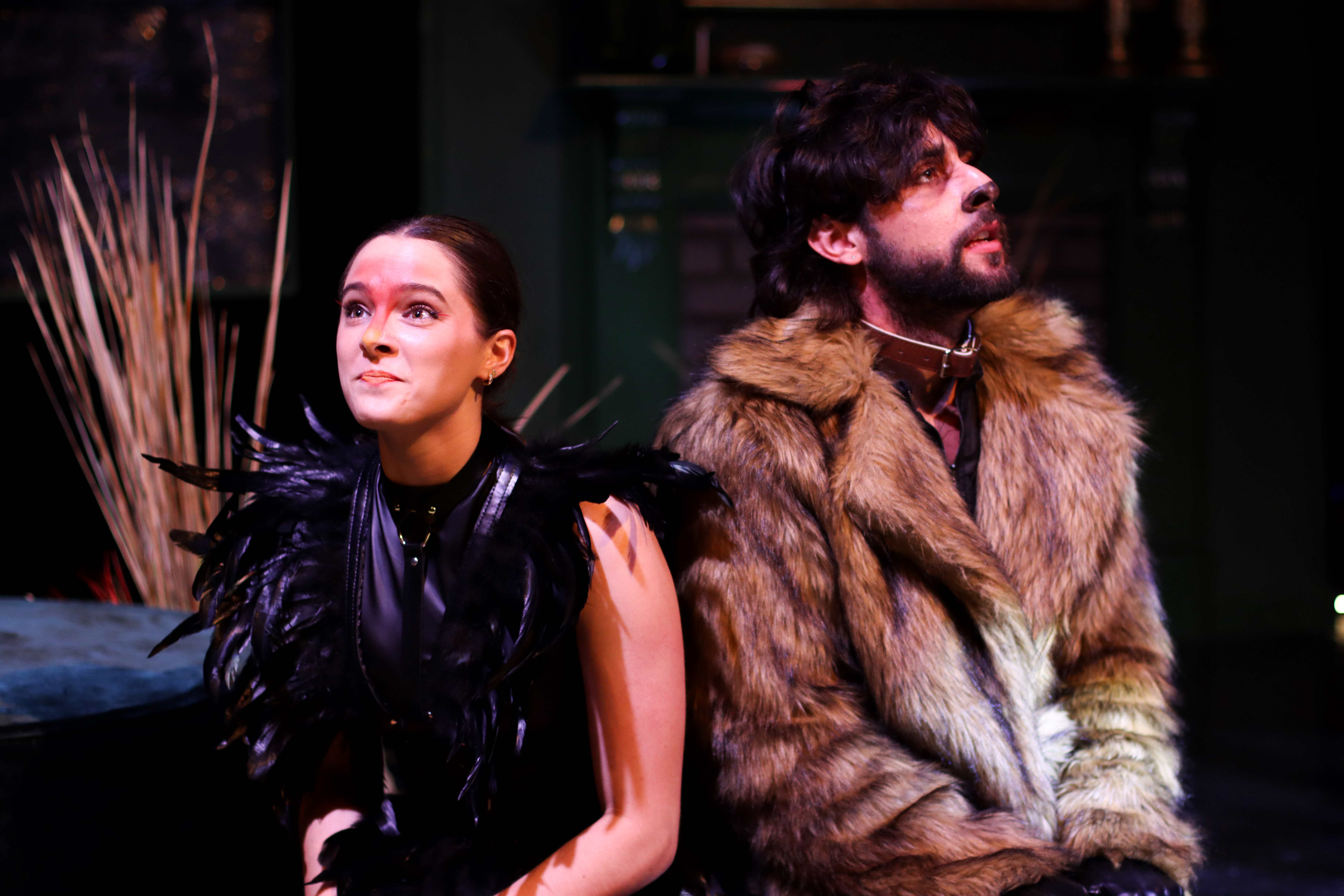
It’s all performed by three actors: Charles Mayer as Antony, Jo Bloom as Cleopatra, and Charley Allanah as everybody else (or at least everybody else who isn’t cut.) Performances are bold and spirited. For reasons that will become more apparent later in my response, design focuses on costume, and these by Letitia Hodgkinson are beautifully lavish.
There’s also a narrator or guide, a role taken by Nathan Meola. He almost gets as much stage time as Shakespeare, though far fewer words. He appears to be adlibbing. He speaks very slowly and quietly, as though he’s speaking to the guests at a spiritual retreat. We’re thanked for the journey each of us has made to get to the theatre, and it’s acknowledged that the journey may have been difficult. (There’s even talk of snow.) We’re asked several times if we feel safe, and at each repetition I feel a little less so. His speaking style is a curious mix of condescension and coercion, made all the more disconcerting by the very convincing illusion that it’s not a created dramatic character being performed. He asserts that we humans are not immune to stories and, for a moment, I question my own humanity – until I recall that he’s ignoring a rather vital point: the power of a story depends on how well it’s told. This narrator recaps what we’ve seen and tells us what we’re about to see – which may seem superfluous, even to those unfamiliar with the play. He also assumes we’re deeply affected by the performance. (In our current theatre scene, in which there’s far too much of telling audiences what to think, it’s refreshing to be told what to feel.)
The marketing describes the production as immersive – which can mean a lot of different things, but here means you may not get a seat. We’re needlessly shuffled back and forth between the foyer (where there aren’t enough seats) and the theatre (where there are plenty.) These changes of location, and the narrator, have a slowing effect, but the whole thing is only 90 mins, including interval.
Shakespeare’s play is reduced to the story of two people going through a dark night of the soul to find eternal love, or divine love, or some such thing. (At least that’s what the narrator tells us is happening.) The political tensions and the grand clash of civilizations are given little space. This reduction enhances the sense the play is being used as a vehicle for a certain New Age philosophy.
So is it “Shakespeare”?
That’s an absurdly conservative question, based on some disturbing essentialist assumptions. But I’ll answer it anyway.
On one level – a particularly academic one – the answer is No. Shakespeare and his contemporaries dragged theatre away from being what was almost a religious ritual, with narratives dominated by religious perspectives. They moved the artform away from the traditional Mystery play. These Elizabethans still acknowledged that spiritual experiences existed (in a way that, say, Jane Austen seemingly does not) – but they viewed those experiences as part of the wider human experience, not necessarily as its key. To be essentialist, they were humanists.
But, soaked in Renaissance humanism, Shakespeare was not an essentialist. He looked at the world with humility and wonder, and I suspect he wouldn’t dismiss a production like this, but would ever so gently chastise those who might. After all, as his most famous creation says, “There are more things in heaven and earth than dreamt of in your philosophy… “
This is terrific fun. It’s also a very clever use of both the dramatic and theatrical forms.
Written by James Fritz and first produced in 2023, it’s inspired by the 1889 Cleveland Street scandal, in which it was claimed that gentlemen, high ranking members of British society, were frequenting a male brothel. (The accusation is obviously absurd, akin to suggesting that there are women who engage in homosexual activity.*)
One aristocratic visitor to this house of ill repute was Prince Edward, grandson of Queen Victoria, and second in line to the throne. Or so the scuttlebutt goes, and scuttlebutt it most certainly was – because the men who worked in this brothel were from a much, much, much lower class of society. Telegram boys, apparently, from the General Post Office. As if a gentleman would employ a telegram boy for anything other than the quick delivery of something urgent and rigidly to the point.
So, The Flea is an exploration of class and discrimination. Its title highlights one of the ways we try to avoid acknowledging the impact of these forces. How did these particular men end up working at a brothel, and why did it end for them the way it did? The play’s title implies that it was all just a case of bad luck, an unfortunate chain of causation beginning with an event as random and insignificant as a bite from a tiny insect. But that, of course, is dramatic irony. The play shows us something quite different; it powerfully presents the dreadful machinations of privilege and prejudice.
The Flea is beautifully written, fast paced and very funny, yet with deep emotional impact. It even manages that most difficult of achievements, what is the pinnacle of the dramatic artform: it engages us emotionally with both sides of the conflict. One way it does this is by building on motifs of intimidation; the intimidator in one scene becomes the intimidated in the next. It’s both amusing and disconcerting (like that nightmarish nursery rhyme There was an Old Lady who Swallowed a Fly.)
Director Patrick Kennedy creates an environment of theatrical playfulness while skilfully maintaining the strong narrative drive. His cast is brilliant, delivering great comic performances and embracing the script’s wild doubling. Sofie Divall is magnificent as the Queen and as Emily Swinscow, a no-nonsense working class mother, garnering wonderful laughs from both roles, and drawing tears with the latter. Similarly, Samuel Ireland doubles as the Prince of Wales and Emily’s son Charlie, and he’s delightfully entertaining as the first and heartrendingly poignant as the second. Jack Elliot Mitchell is marvellously versatile, playing Lord Euston, suave aristocratic man about town, in glorious contrast to Hanks, a super conscientious constable. James Collins achieves an equally laudable elasticity, jumping neatly between swaggering working class telegram boy and frightened upper class seeker of illicit love. Mark Salvestro balances portrayals of pimp and policeman, ingeniously highlighting the expected differences and the surprising similarities.
Kennedy also designs, and all is gorgeously exuberant. The set, with its red and white colour scheme, its subversion of conventional lines and its inversion of traditional curves, evokes John Tenniel’s illustrations for Alice in Wonderland. And that’s appropriate – the production presents as an enchanting madcap cartoon, but it’s also a portrait of a disturbing world, one in which innocence finds no safety.
Paul Gilchrist
The Flea by James Fritz
At New Theatre until March 8, as part of Mardi Gras
* Unlike male homosexual acts, female homosexual acts were not illegal in Britain; it doesn’t seem to have occurred to the establishment that they were possible.
Director Victor Kalka has gathered a talented ensemble, and they give riveting performances.
There’s a fascinating tension between a simple truthfulness and the theatricality of created humour. (Though I’m not sure that a certain curtain-call gag doesn’t give too sharp a pull to one end of that tense tightrope.)
Kalka adapts Chekhov’s play. A few minor characters are cut and some of the subtleties of the plot are made more apparent, but the key alteration is the transference of the action to the present. (Though the word action takes on a different, deeper meaning when applied to a play by Chekhov.)
You could be critical of the decision to modernise the setting, arguing that many of the characters’ problems – Why can’t I be with who I love?Why must I live here? – would simply evaporate in a society in which change has become so easy that it’s expected, normalised and, in an if-you-can’t-stop-it-you-may-as-well-embrace-it sort of desperation, even lauded.
But what Kalka’s adaptation does is ensure the play is not read solely as a portrait of one particular decadent society.
It’s natural for us to read Chekhov through a sociological lens. After all, just sixteen years after Three Sisters was first produced came the epoch changing Revolution, sweeping into the dust bin of History the privileged lethargy of the old regime. And then, dominating the 20th Century, came the tension between that new Russia and the so-called free world.
But Chekhov didn’t know all that. Perhaps he saw the writing on the wall … but a solely historical, sociological approach to his work discounts the miracle that occurs on stage. The play itself is a revolution. It takes the inherently undramatic experiences of boredom and enervation – and turns them into an utterly watchable piece of theatre.*
Is lethargy being indicted? Perhaps. More importantly, it’s being acknowledged. A brilliant light is being shone down into the shadowy grey recesses of the human condition. Our current zeitgeist glibly pounces on inaction, equating it with complicity, and with a cavalier disregard for complexity, even conflates silence with violence. (If I were Satan, I’d be proud to have invented that slogan.) But Chekhov’s play reminds us, that sometimes, a mysterious, invisible weight holds an individual down; that for some inexpressible reason what we would do inexplicably remains undone. It’s a compassionate vision, reminding us that all those who don’t act or speak as we wish might be something other than enemies.
Modernising the setting – placing the characters in a world in which their problems should be more easily overcome but for some reason still aren’t – invites us to look beyond easy externals and shallow judgements. Kalka’s adaptation of Three Sisters draws to the fore the revolutionary aspect of Chekhov’s deeply humane art and, with rich poignancy, the excellent cast portray that eternal dance desire has with disappointment.
Paul Gilchrist
Three Sisters by Anton Chekhov, in a new version by Victor Kalka
presented by Virginia Plain
performed by Matthew Abotomey, Meg Bennetts, Alex Bryant-Smith, Nicola Denton, Barry French, Sarah Greenwood, Jessie Lancaster, Alice Livingstone, Ciaran O’Riordan, Mason Phoumirath, and Joseph Tanti
This is a rom-com. Yes, I know Shakespeare made this sort of thing work, with his poetry and multiple storylines, but it’s a genre I don’t usually enjoy, and one I don’t think particularly suited to theatre.
But, written by Dax Carnay with Aleks Vujicic, Chasing Dick is utterly charming.
A father (Jason Jefferies) and a son (Chris Colley) have both fallen for Dick (Carnay), a trans woman.
Directed by James Lau and Carnay, the performance style is a sort of naïve naturalism, and the characters created are warm and very likeable. Carnay, in particular, is a gifted comic actor.
The result is a show that’s cute, funny, and wonderfully effervescent.
But it’s not just bubbles; there’s some invigorating tensions that give the piece a glorious richness.
Firstly, there’s a fascinating dual narrative in regard to Dick’s backstory. At one point, her Filipino culture is described as conservatively intolerant of her identity, retrograde in comparison to a more open Australia. In another telling, her original culture appears warmly accepting. Is the character indulging in revisionism? If so, it’s a penetrating portrait of the psychological complexity of migration. Or, are the competing narratives indicative of the inescapable contrast between our anxieties and reality? She feared coming out, but was then happily surprised? If so, it’s an insight into abuse’s inevitable and insidious ability to warp our world view; a single snarl erases a thousand smiles, and can hold us back from so many more.
Secondly, there’s a moving interrogation of the trope of the Manic Pixie Dream Girl (MPDG). The MPDG is a female character who sometimes pops up in romantic comedy, a woman of transgressive energy but no apparent interiority, a woman whose sole purpose appears to be aiding the male characters’ growth. Both father and son fall under Dick’s vivacious spell, but she complains You see me, but you haven’t listened to me! She refuses to be reduced to a fetish; she demands to be recognised as a full human being. But, at the same time as rejecting the dehumanising elements of the MPDG, the positive aspects of the trope are retained. Dick does encourage the men to mature. A cynic might reject the lessons these characters are asked to learn as mere psychobabble – of the Tennyson-inspired Better to have loved and lost variety. However, romance might be the silliest of the serious things, but in a world in which the silliest people seem to have gained control of the most serious things, lessons of acceptance, openness and the importance of genuine love have definitely not lost their vitality.
Thirdly, the play offers a transformative exploration of reductive thinking. Confronted by his unexpected feelings for Dick, the elder of her devotees wants to know What am I now? It’s a powerful poke at conservativism. (I, for one, wanted to scream from my seat Why do you NEED a label?) And yet, in a play that positions us to question the oversimplification of labels, Dick says very clearly I am a woman.
And it’s a truly beautiful moment.
The current fashion in our theatre is to be overtly political, to be direct, didactic – and dull. We like to tell our audience what to think. One way we do this is by loudly asserting the rights of marginalised peoples. Jeremy Bentham famously suggested that any talk of rights was nothing more than nonsense on stilts, meaning it was just airy-fairy fancifulness, rights ultimately being guaranteed nowhere and underwritten by nothing. Inadvertently (perhaps) Bentham’s dismissive metaphor highlights the appeal of the language of rights – after all, everyone does stop to watch a person walking on stilts – though he was correct in suggesting it’s not usually a sight that has a life-altering emotional impact.
But when Carnay as Dick asserts I am a woman, she is not speaking the language of rights, she is not furthering an agenda, she is not repeating the party line. She’s being far more radical than that – she is being honest.
I’m not completely dismissing theatre with political attitude, but a piece like this is an invaluable reminder of how we might best connect with our audiences. It is openness that breeds openness, and I suspect many more hearts are melted by sincerity than ever are by slogans. If justice is to stand, it will stand strongest when built on the knowledge of our shared humanity.
Loss shakes us out of the complacency of the Present, like a sudden change of speed on a train reminds us that we’ve been in motion all the while.
Rainbow Chan’s song cycle tells us of the bridal laments of the women of the Weitou people – an artistic ritual that has now passed, as have the arranged marriages that inspired them.
For Weitou women, the leaving of the house of their girlhood and the marriage to a man they did not know seemed like a type of death. (The husband-to-be was referred to as the King of Hell.) Chan sings these traditional laments in their original language, Weitouhua, and does so with extraordinary poignancy and beauty. Subtitles invite us into their evocative imagery, a world in which connections with nature were strong, and where vulnerability and ephemerality are granted meaning by being attributes of universals that transcend any individual life.
Chan guides us through the rituals of the bride-to-be, but intersperses her tour of the past with anecdotes of her own personal history as a child migrant to Australia, with particular focus on her mother, a Weitou women.
Juxtaposed with the historical laments are (what I take to be) Chan’s own wonderful compositions, contemporary songs with beguiling electro-pop and traditional influences. They give voice to the experience of a modern woman, one facing challenges both different and similar to those of her ancestors.
Directed by Tessa Leong, this is all effectively bound together by some very lush lighting and projected video graphics, creating a theatrical experience that is spellbinding.
(On rare moments, it felt a little over-produced: the traditional music, the original compositions and the visuals all propelled into an excess of richness by the need to cohere. The singularly most wondrous moment of the performance is when Chan sings a cappella a lament she has written herself, inspired by the traditional pieces. Stripped back, the sorrow is even more heart-rending. But, of course, this emotive impact was a consequence of the sudden contrast, and so only made possible by the creative decisions I’ve just questioned.)
Remarkably absent from the piece is a bland criticism of the custom of the arranged marriage, the sort of denunciation of the past that does little but feed the contemporary desire for definitive moral superiority. But neither are the arranged marriages romanticised; they’re presented, as they were probably experienced, as a brute force, as inexorable as Death.
The Bridal Lament is a fascinating piece of theatre; Chan effectively combines a personal sharing with a wider exploration of her cultural heritage, in a way that attains to universality.
Ultimately the piece is about grief and its natural place in the human condition. The traditional bridal laments themselves are stylised grief and that, in addition to their intrinsic beauty, is their value. That grief can be stylised tells us we are not alone in feeling it. This is the solace the laments offer, union with all who mourn.
Chan suggests that when she sings the traditional laments she feels at one with all the women before her. And when she visited Lung Yeuk Tau village, as an Australian who didn’t speak the language, the old grandmothers placed a villager’s hat on her head and claimed her as one of their own.
Time takes much from us, but it gifts us the Past. We can’t live there, but it’s from what we make our Dreams – and they fuel our Future.
Paul Gilchrist
The Bridal Lament by Rainbow Chan
Presented by Riverside Theatres and Contemporary Asian Australian Performance
Written by Declan Furber Gillick and directed by Mark Wilson, it’s the story of an indigenous man navigating between (what might be called, in the broadest sense) black and white cultures. But it’s also a deeply humane exploration of the concept of identity, and a magnificent example of the richness of the dramatic form.
Jacky lives in the city, far away from his family, and from his country. He rents a one bedroom place, but he’s making good money, and hopes soon to buy. He’s good-hearted and well-liked.
Because of some mischief at home, little brother Keith comes to couch surf. The contrast between the brothers is wonderfully, and hilariously, realised: Jacky the epitome of mature, common-sense responsibility, and Keith all youthful, high-spirited indolence. When pushed to finally find a job – the sort you’re expected to turn up to every day – Keith says wouldn’t the old fellas laugh at us. True that may be, but a longing for the pre-colonial way of life at this point in the play seems merely a risible excuse for lazy self-indulgence.
But Keith’s presence alerts us to how little Jacky knows about what’s actually going on back at home. What sort of life is he making for himself in town?
Follow the money. One source of income for Jacky is a traineeship he has with employment agency Segue. They want him on the books because, being black, he helps them maintain funding. His other source of income is as a rent boy. Even here, his identity is a selling point.
He’s a black man prostituting himself to white society. But it’s not a heavy-handed metaphor; rather, it’s a set-up that positions Jacky’s story as ideal for telling in the dramatic form.
But before I unpack that, let me talk about the performances. Guy Simon as Jacky is electrifying, perfectly embodying a gentleness that is suggestive of the many sources of that complex behaviour: confidence and intelligence, fear and despair. Danny Howard as Keith is brilliant: high-energy, fast-paced vocals coupled with a physical lethargy creates a tremendous portrait of the tension between youthful hopes and uncertainties. Mandy McElhinney’s Linda is pleasingly soft-spoken, reasonable, generous – and sublimely unaware of (or unconcerned with) the knottiness of Jacky’s position. It’s a stealthy and unsettling portrait of the white ally. Greg Stone as Glenn, one of Jacky’s clients who’s exploring some rather disturbing sexual fantasies, offers a powerful and utterly truthful mix of awkwardness, shame and brutality. It’s very funny, until it’s shockingly not.
Back to my comments about the use of the dramatic form. Presented in concrete, believable situations, and in deliciously natural dialogue, the resonances, echoes and parallels in the script are gloriously evocative: Jacky focusses on Keith’s supposed uncleanliness in a way that disturbingly echoes a client’s racist abuse; potential supporters of the employment agency seem overly interested in the gender of the Indigenous participants, recalling the sexual interest of Jacky’s late night customers; both Linda and Jacky compromise themselves for property, while other (offstage) indigenous characters are concerned with the integrity of country; Linda thanks Jacky for playing along, while Glenn thanks him for his role-playing in the bedroom; and, perhaps most perturbingly for a majority white audience, this particular racist client has a fascination with the art created by marginalised peoples.
Parallels and resonances aside, the fundamental tension driving the piece is that everybody wants Jacky to embrace his identity – just in different ways, and for very different reasons. One of the most painful and poignant moments in the play is when a fellow indigenous person tells him to get back in your box, Jacky. The reprimand he receives is completely deserved, and though my phrase isn’t the one used, it hints at an aspect of identity often overlooked.
What is identity? A case could be made that it’s a response of our psychological immune system. When we’re endangered, we make an identity. It’s a strength in times of trouble, but redundant in times of calm. (One of the things that binds Jacky’s family together is a shared love of Country and Western music. And, as Glenn says, that’s crying music.) Perhaps the fostering of identity is a type of honourable strategic withdrawal? (I’m not suggesting Furber Gillick’s script asserts this, but as a splendidly sophisticated piece of writing, it got me thinking. The final line of the play was a particular stimulus to this train of thought. Due to the spoiler rule, I can’t repeat that line, but it was the sort of declaration of defiance one makes most often in retreat. Accordingly, it was simultaneously inspiring and saddening.)
Jacky is an outstanding piece of theatre, composed with humour that entertains, honesty that engages, and sorrow that humanises.
Paul Gilchrist
Jacky by Declan Furber Gillick
Produced by Melbourne Theatre Company
At Belvoir as part of the Sydney Festival until Feb 2
This is a fun night of theatre, one we’re privileged to share with three contemporary legends as they muse on the dramatic form.
It’s also a tantalising potpourri.
It begins with Toby Schmitz, Brendan Cowell and Ewen Leslie each performing a self-written monologue. Schmitz’s monologue is about an actor currently working in a second-hand book store in Newtown; still a purveyor of art, but in rather reduced circumstances: tale teller now retailer. Cowell’s monologue explores how the actor’s life of perpetual rootlessness impacts their relationship with material objects. Leslie’s presents the journey of an out-of-his-depth child TV actor to maturity as a lover of the craft. Each monologue is richly poetic and very funny.
Are they autobiographical? Sort of. I guess. I don’t know. Truth is certainly tempered by poetic licence and the hyperbolic needs of humour. I did take away the sense that the character being presented in each piece was a moderately successful actor. What a disparate, contradictory, explosive mix of words that is! It also operates as a suitable tonal introduction to the madcap comedy that follows.
That’s because – after Claudia Haines-Cappeau’s beautifully evocative dance as Ophelia – there comes the title piece, an extended skit in which three actors who’ve played Hamlet are now going through rehab. It’s written by Schmitz, Cowell and Leslie, three actors who’ve played Hamlet and are now…
If the monologues might be autobiographical, the skit certainly isn’t – at least not if read as realism. It is, however, a puckish peep into the weirdly overwhelming experience that playing the Dane apparently is. As suggested, the play’s the thing.
Or can rehab help them realise that it’s just a thing? One thing among many.
The skit is terrifically amusing, a wonderful opportunity for three great comic actors to strut their stuff. It sparkles with insights into what it is to be a performer. (There are plenty of in-jokes about particular past productions, and these are marvellously mischievous, but they don’t dominate.) Frustration is expressed at directors and their determination to own a play by imposing some bizarre idiosyncratic vision. As one recovering Hamlet says, I’d love a director to say ‘Let’s just do the play.’ Also grumbled about are reviewers. Cowell’s character is disturbed that one reviewer described his Hamlet as mercurial. This observation hints at the sensitivity of performers, but it also left me wondering if the greatest tragedy in theatre is not Hamlet, but that reviews are taken seriously.
Another provocative observation is that we romanticise Hamlet, which I took to mean we overvalue both the character and the performance of that character. One of the sessions at the rehab centre is entitled Offstage Women. It seems to refer to the play’s representation of women and how Hamlet himself mistreats them. It also refers, I think, to how male actors lost in the role mistreat the women in their own lives. I make no comment about the impact playing the famous protagonist might have on an actor’s personal relationships, but I find fascinating the suggestion that audiences are asked to admire Hamlet. Perhaps an actor needs to find that connection, but as an audience member I’m more than happy to dislike a protagonist or, more precisely, to hold such a personal response to a character in abeyance. (Perhaps, like the suspension of disbelief, it’s the key to a mature appreciation of fiction.) Take Macbeth and, to a lesser degree, Lear: the achievement of these tragedies is that we’re presented a monster yet, beneath all, we still see their humanity. (I admit this probably doesn’t accurately describe what’s happening in, say, Othello or Romeo & Juliet – so perhaps there are audience members out there who do actually like Hamlet as a person.)
That’s the joy of Hamlet Camp, it’s a deliciously playful invitation to thought.
Paul Gilchrist
Hamlet Camp by Brendan Cowell, Ewen Leslie and Toby Schmitz
JB Priestley’s classic play is a subversion of crime fiction. It initially presents as typical detective fare – and then we realise it’s doing something far bigger, more important, and much more thrilling.
The Birlings are celebrating the engagement of daughter Sheila to Gerald. They’re respectable people. When the ladies retire after dinner, and the men remain for a glass of port or two, Mr Birling takes the opportunity to share his wisdom. Every man need only look after himself and his own, the successful businessman pronounces to the younger men. Do that, and all will be right with the world.
And then an inspector calls.
Disrupting this privileged party, the inspector informs them of the recent suicide of a desperate young woman and, through an utterly enthralling chain of questions, asks them to consider their possible culpability.
I call the play a subversion because crime fiction usually asserts that it’s the detective’s commitment to rationality that will restore order to a fracture world. But this piece places its hope not in logic but in the human heart. If only we’d listen to the still small voice within, we’d realise that it’s not every man for himself, that we’re all in this together and, if the world is fractured, it’s we who might make it whole again.
It’s a beautifully rich piece and, under the direction of Ali Bendall and Mark Bull, this production is both thought-provoking and very entertaining. (That’s no small achievement. Drawing room dramas are notoriously difficult, their seemingly static world can appear to restrict creative choice. And, as a historical piece, set in a distant past even when Priestley first wrote it, Truth could all too easily atrophy into lifeless stereotype.)
The cast handle the challenging material well. David M Bond as Mr Birling is delightfully pompous, and Annabel Cotton as Mrs Birling is deliciously all prickle and pride. The younger generation, newer to the tired old ways of the world, are perhaps a little more shaken. Simon Pearce as Gerald presents moments of touching vulnerability. Rebecca Liquorish as Sheila effectively juxtaposes a frantic fear with the wondrous relief of honesty. Harry Charlesworth as younger brother Eric, the impulsive child who only Shame might mature, offers a moving portrait of moral growing pains.
And Vincent Andriano as the inspector is wonderful, a subtle physical awkwardness that underlines his outsider status contrasting brilliantly with a gloriously authoritative voice that clearly speaks command and consequence.
This is the Genesian Theatre Company’s first production in their new Rozelle home. Fans of the Kent Street proscenium arch will be pleased to see that house preference retained, and fans of engaging theatre will hope this show is an accurate portent of many things to come.
Tomorrow, Linda marries Dave. But tonight is the stags and hens’ parties.
Willy Russell’s play was first produced in 1978 and the action occurs in a dump of a disco in Liverpool in England.
Though it’s nearly fifty years old and set in a foreign country, it’s terrific to see this play on a contemporary Sydney stage. (Though, I must admit, it took a while for my ear to become accustomed to the accents.)
Firstly, it’s very funny. And under the direction of Johann Walraven, the cast commit fully to the comedy. The entire ensemble is brilliantly hilarious.
On the night I saw the show, some members of the audience gasped at some of Russell’s one-liners. Perhaps they thought them politically incorrect? But the awful things some of the characters say, especially the men, are key to Russell’s satire. He’s targeting working class brutality, its fatalism and its seeming inability to tolerate individuality.
But despite the satire, it’s a sympathetic portrait. There’s a heart-rending sense of missed opportunity, and this is enhanced by the casts’ skill in making the characters likeable, imbuing them with tremendous energy, which has the impact of highlighting how that energy is ultimately either misdirected or thwarted. Chester Lenihan as Robbie, the would-be lady’s man, presents a gloriously funny mix of cockiness and self-doubt. Kirra Jones as Maureen, the drunken cry-baby who just wants a fella, is both very amusing and powerfully poignant.
And when the play shifts gear, and comedy cozies up to its close-cousin tragedy, the cast are once again up for the script’s demands. Ava McClean as Linda, the bride-to-be, is enormously affecting in her shocked realisation of brutality’s ubiquity. Cameron Sutton as Eddy, the alpha male who lords over his herd but is terrified of change, is a gutsy, confronting portrait of dangerous fragility.
The play is well-named; despite the impending marriage, the focus is not on the personal relationship at the heart of the sacrament, but rather on the dehumanising potential of group dynamics. How do the stags maintain a group identity? How do the hens? And how do the two groups relate?
Maintaining a group identity necessitates policing. Both sexes speak a lot about mateship, but that never seems to go so far as granting each other genuine autonomy or individuality. Instead, there’s an insistence on conformity. It’s a very binary world: you’re either a ‘lad’ or a ‘tart’; you’re either with us or against us. This world of indubitable division is emphasised by the set; scenes mostly happen either in the Gents or in the Ladies.
With our current questioning of binary assumptions, it’s tempting to think we’ve transcended all such narrowness. But, understandably, marginalised people will always seek a greater share of power, and a group identity has long been perceived as one way this might be achieved. In fact, a focus on group identity is presently the height of political fashion and so – by drawing attention to the brutish enforcement that the maintenance of such identities can entail – this production firmly places a troubling, teasing, tickling finger on our societal pulse.
Paul Gilchrist
Stags and Hens by Willy Russell
Presented by Blank Slate Productions
Directed by Johann Walraven
Featuring Grace Easterby, Jonah Elias, Benjamin Itaba, Kirra Jones, Chester Lenihan, Jonathan Serafino, Ellen Peebles, Ava McClean, Cameron Sutton, Hunter Taylor & Madeleine Zinner
This is a fascinating piece of theatre. The arresting title is an introduction to its key concerns. Philosophers as great as Plato, Augustine and Foreigner have all wanted to know what love is – but an even deeper tradition has long questioned the meaning of those mysterious little pronouns, the you and me of the phrase people will think you don’t love me.
What are you?What am I? To what degree do any of us have a fundamental essence? If so, what does that essence consist of? I don’t mean the particular qualities we might attribute to lovers, qualities like courage, intelligence or kindness. I mean the medium in which such characteristics exist, where they reside. (Analogy: old films were celluloid, and it was in this medium that the particular images that made up any individual film resided.) To cut to the chase, in the currently reigning philosophy of secular materialism, are we simply our physical bodies? If so, then our personal qualities must reside in those bodies. And the tantalising question raised by all this is If you donate an organ to me, do I begin to become you?
This is the basis of Joanna Erskine’s fabulous play. Michael has a diseased heart. When Rick dies in an accident, Michael is given his healthy heart. And then he changes….
Some people might dismiss the idea as simply weird, or as such a rare experience as to be of little relevance.
But what it’s doing is opening up the concept of selfhood. A couple of decades ago we had an obsession with finding ourselves. It was assumed every individual had an essence and it was the mission of each of us to find that essence and let it shine. More recently, we’ve come to define our essential self in terms of our membership in certain demographic groups. With this sociological rather than psychological focus, we’ve come to see our individuality as a space carved out by the intersection of various statistical sets. We’ve almost replaced the word individuality with identity. We no longer shine like some sort of star, but rather lie small and flat, a mere overlap in a Venn diagram.
But, as I’ve suggested, this play doesn’t so much raise the question of Who we are but What we are.
I don’t want to make the play sound heavy; it’s extremely engaging. (And I certainly don’t want to sound like the kind of pretentious fool who goes to a children’s party and sees innocents being inculcated into the competitive values of capitalism, while everyone else just sees kids playing Musical Chairs.)
But this play won the Silver Gull Award when it was run by subtlenuance, when the parameters were that eligible plays be philosophical or political. Now the award is run by New Theatre, and that phrase has wisely been removed (the average theatre-goer being insufficiently familiar with the philosophical approach to appreciate that their favourite artform is philosophy’s closest cousin. What two human activities are the Ancient Greeks most famous for gifting to Western society? Drama and philosophy.)
Good drama is good philosophy: recognisable situations, presented in accessible language, posing fundamental questions.
And the dramatic form is eminently suited to the investigation of the philosophical concept of the essential self. The creation of individual characters is one of the dramatist’s major tasks. And, as audience members, we judge the success of any particular characterisation by the success of that mysterious trick of combining consistency with unpredictability. Of any character, we want to be able to say I understand why she did that rather than being reduced to the boredom of She was obviously going to do that. And one way theatre keeps that magic mixture of consistency and unpredictability bubbling is the actor, the physical body on stage. Every writer has had an actor in a workshop or rehearsal critique their script: I don’t think my character would say that. One answer is Your character does, indeed, say that. Your physical presence on stage as you say the line is sufficient, because the character exists nowhere else.
In Erskine’s play, the interrogation of the nature of selfhood is further facilitated by the focus on romantic love. Romance is the type of relationship most based on the assumption that an individual is something particular, something special. (In most other relationships we’re honestly not that interested; we’re content to deal with people as we find them.) There’s a flashback to the night before Michael and Liz’s wedding, where he explicitly outlines why she is the woman he loves. It’s commonplace to assert that people change, and that’s why romance dies. But why are we so hopeful in the first place that the loved one will act consistently? Perhaps sexual love is like the theatrical stage; the centrality of the body somehow implies a permanency of self.
I’ll repeat again, the play is not heavy; it’s a gripping psychological drama (with a smattering of the gothic – I’d love to see more!)
And the awkwardness of the situation, that Michael’s life is only possible because of Rick’s death, provides opportunities for surprising humour. The uncomfortable pauses, the inappropriate comments, the unrecognised hints, all create a linguistic landscape of the alien and the unfamiliar, and under the direction of Jules Billington, the cast present beautifully the tentative navigation of this strange new world.
Tom Matthews as Michael has an extraordinarily challenging task – the portrayal of two characters battling it out in one body. He achieves this superbly, achieving genuine nuance (and avoiding any temptation to employ the garish strokes more suited to horror.) The duality of his inner world is reflected by the two women in his life, his wife Liz, and Tommy, the partner of Rick who donated his heart. These two characters have tremendous arcs, as they try to come to terms with the most unusual of circumstances. Ruby Maishman’s Tommy moves poignantly from suspicion and the coldness of grief to a wondrous softening as she begins to find Michael’s behaviour oddly familiar. Grace Naoum’s Liz brilliantly transforms from a daggy, uptightness to a bewildered anger, as she finds only loss where she expected victory, and knows not who to blame.
I’ve talked a lot about the philosophical provocations of the play, but its glory is that it’s still grounded in the psychological. As Michael begins to display attributes of the bolder, more brutal Rick, we’re asked to consider whether he is merely acting out his desires. Now that Michael is finally healthy, is he simply claiming a bigger life? Is the whole I-have-your-heart-now-in-my-body-and-it’s-changed-who-I-am a materialistic justification for what are actually just choices? It’s an old trick: disguise decisions as determinism. It’s beyond my control, says the man who really, really, really wants to do it.
In the most stimulating way, the play takes on some of the most dominant assumptions of our culture. It interrogates materialism in two ways, positing its natural but rather disconcerting conclusion, and by uncovering its dubious allure. And it does all this in the way drama does best: offering no answers, just an engaging story.
Paul Gilchrist
People Will Think You Don’t Love Me by Joanna Erskine
presented by Little Trojan in association with bAKEHOUSE Co