Archive | April, 2025

Silent Sky

26 Apr

This is an engaging production of an extraordinarily beautiful play.

Written in 2011 by American playwright Lauren Gunderson, Silent Sky tells the story of astronomer Henrietta Swan Leavitt. Despite the patriarchal prejudices of the early 20th Century, Leavitt made paradigm-shifting discoveries in her field.

Her work was crucial in determining the distance to faraway stars and has helped us appreciate that our Milky Way is merely one galaxy among many. Thanks to her, and those who developed her insights, we’ve been offered intimations of the true majesty of the universe.

Though obviously critical of misogyny, Gunderson does not reduce Leavitt to a woman solely defined by this challenge. The play is an enchanting exploration of vital ideas, ones that offer liberation beyond the passing evil of patriarchy. For simplicity, I’ll reduce these ideas to two, what I’ll call the two ‘P’s’.

The first of these ‘P’s’ is patterns. Like all scientists, Leavitt worked on the assumption that if the universe is to be comprehensible, we must find its patterns. The trick is to find the right pattern. Or, perhaps more importantly, not to commit to the wrong pattern. (Patriarchal prejudices are a perfect example of commitment to the wrong pattern, exacerbated by the fact that this misplaced conviction is ultimately self-fulfilling. If women have not proved great scientists, any assertion that they can’t be is indubitably one of the reasons they haven’t been.) True wisdom consists in being able to see patterns, but also in being able to see more than patterns. In philosophy, it’s the perennial battle between the systemisers and the existentialists, between those who are committed to a grand theory that explains all existence and those who are constantly startled into an invigorating awareness by existence’s inexplicability.

The other ‘P’ is perspective. Leavitt’s insight that helped calculate the distance to the stars was one of perspective: Does a star appear bright because it’s close? Or does it appear close because it’s bright? I won’t spend time explaining the science with which Leavitt solved this problem – but the playwright does it with a splendid lightness of touch that leaves her tale utterly accessible to all. And the motif of perspective is threaded cleverly through the entire work. Einstein’s theory of relativity – at the time new, fresh and controversial – reminds both the characters and the audience that no perspective can be automatically privileged. Perspective is about being maturely aware that you will inevitably suffer from bias, an unavoidable consequence of seeing the world from a particular place. And Gunderson uses the gentle friction between Leavitt and her sister to highlight the concept of perspective in a slightly different way. Margaret says You would think a world war would make the stars seem trivial only to be answered with You would think the stars would make a world war seem trivial. At another moment, Leavitt asserts Life is about being appropriately upset. Perspective is not just the awareness that there are competing points of view; it’s also about keeping one’s own multifarious experiences in mature relation to each other (what is commonly referred to as keeping things in perspective.)      

But I don’t want to give the impression the script is heavy – it’s not at all, it’s gloriously rich. Gunderson’s brilliance in telling this tale of magical wonder is that her touch is gentle, humorous and heart-warming, as soft as starlight.

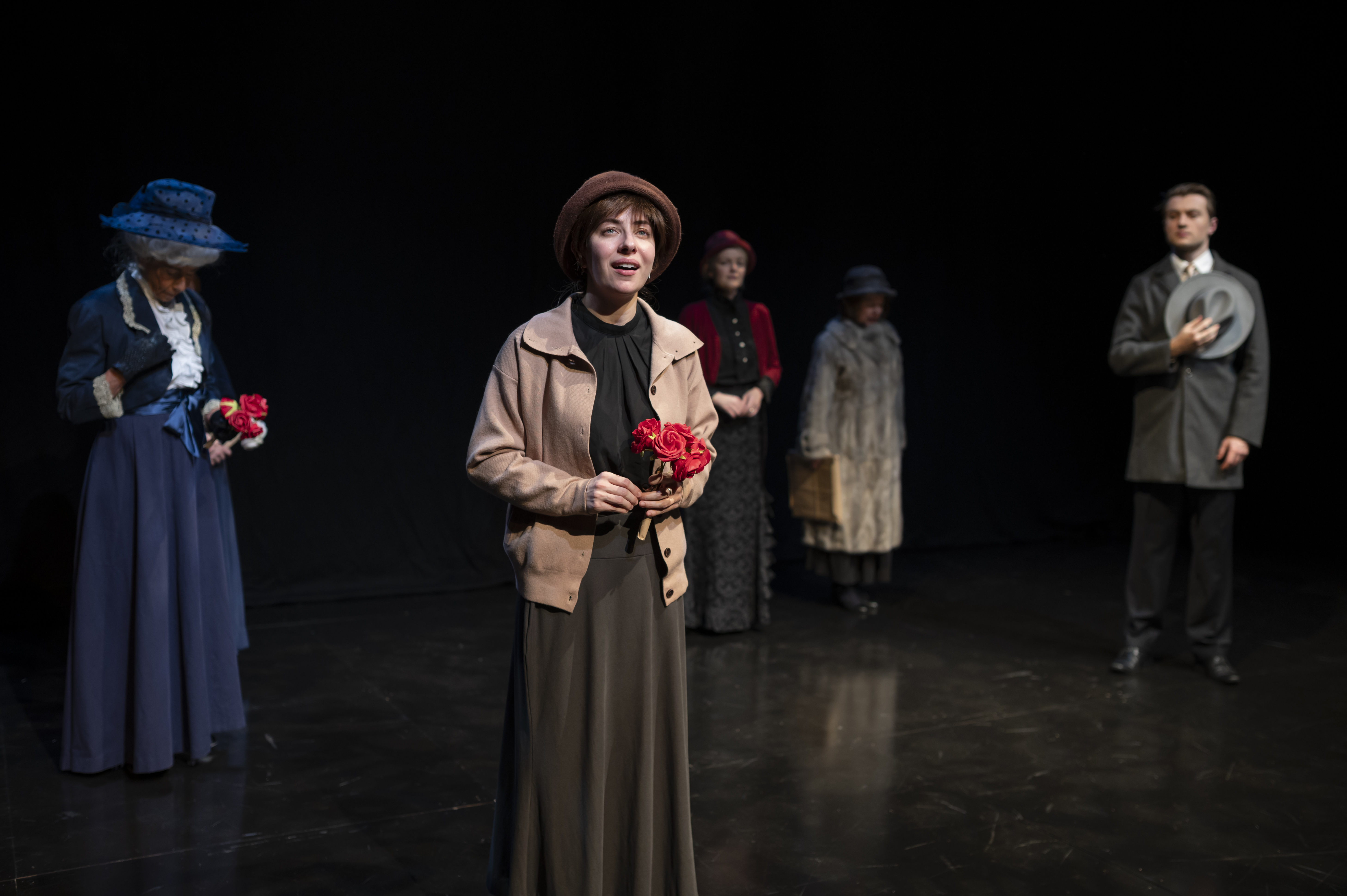
Except for a couple of hiccups that can be put down to opening night gremlins, director Tracey Okeby Lucan’s production is captivating. The Theatre on Chester is a proscenium arch, but the limitations of this type of theatre are turned by Okeby Lucan into opportunities. The depth of the stage facilitates an appropriate sense of vastness, aided by deft lighting by Mike Brew and Milo McDermird and evocative design by Michael Arvithis and Okeby Lucan.

The cast do some great work. Angela Pezzano captures magnificently Leavitt’s determination and wonder. The scenes with her sister, played by Tida Dhanommitrapap, are sweet. As Peter, David Eisenhauer navigates the journey from nemesis to admirer and beyond with likeable humour. As Leavitt’s two colleagues, Annie and Williamina, Julie Moore and Anna Desjardins are excellent: Moore creating a gravitas inclusive of tenderness, and Desjardins a delightful, mischievous playfulness.

Paul Gilchrist

Silent Sky by Lauren Gunderson

At the Theatre on Chester until 17 May

theatreonchester.com.au

Image by Carla Moore

The Amazing Lucas Girls

25 Apr

This is set in Ballarat during the First World War and its direct aftermath.

The Lucas Girls are the women who work in E. Lucas & Co, a clothing and corsetry factory.

They’re Amazing because of their response to the war. Losing husbands, lovers, brothers and fathers to the conflict, they work to give solace to those who grieve, and they fight against the introduction of conscription to ensure no other lives are unnecessarily sacrificed.

Writer and director Cate Whittaker tells this tale through a focus on two sisters, Tilly and Clara. The tensions and affections between the siblings are well presented by Joanne Booth and Amy Joyce. The sisters work in sales and management, and so are not the working class factory hands. In the main, these women are left off stage, represented only by Casey Martin, who portrays a wonderfully cheeky Mavis.

Martin also briefly plays Vida Goldstein, a character whose mere mention drew applause from the audience. This underlined one of the play’s unmistakable goals: to recognise the efforts of the women who have made our society more humane.

As an opportunity to present possibly forgotten historical facts, the play ticks the boxes, but Whittaker also works hard to give us an engaging character-driven story. Though both purposes are laudable, sometimes they seem at loggerheads. On some occasions, characters give slightly unnatural speeches of historical exposition. On all occasions, I was left uncertain whether these particular people once lived or whether they’re simply fictional creations. (The Lucas Girls are undeniably real, but I’m not so sure about these specific characters.)

Such are the perennial challenges of historical drama.

But I have to admit, I love the genre.

In contemporary theatre we often talk of sharing our stories and giving voice to particular communities, phraseology that creates the impression that theatre is merely a type of reportage.

But historical drama is clearly not reportage: when a play is set in a distant historical period the creating artists were simply not there. No matter how much research has been done, we know things are being made up, that we’re being thrown back onto fiction, and that’s a delightful thing. Rather than merely informing the audience, fiction is a glorious invitation to engage, to enjoy, to flourish.

It’s right to recognise and honour those who came before us. And from them we can take inspiration, whether they were made of flesh and blood, or of the stuff of dreams.  

I saw the first night of this run, and production values will hopefully improve. The play has a large number of scenes, which means a large number of exits and entrances – and these could do with more pace and pizazz. Similarly, on this first night, operation of the lighting was patchy, including at least one occasion when the house lights were raised mid-action. (I’ve never felt more seen by a piece of theatre.)

But, seriously, who is seen by this piece of theatre? Everyone who works to make the world a better place.

Paul Gilchrist

The Amazing Lucas Girls by Cate Whittaker

presented as part of the HERStory Arts Festival

at Wharf 2 until 26 April

herstoryfestival.com

Image supplied

Abigail Williams

24 Apr

Written and directed by Rebecca McNamee, and performed by Ebony Tucker, this is a beautiful production of a fascinating script.

Tucker is brilliant, presenting a character who is at turns playful, powerful and poignant.

McNamee’s use of the space is magnificent. With the aid of evocative lighting by Chris Milburn, haunting sound design by Keelan Ellis, and clever design by Angelina Daniel, the large black box that is Wharf 2 becomes a captivating arena of humour, horror and humanity.

I want to dig a little deeper into this 50 minute monologue’s deliciously thought-provoking script.

Like Arthur Miller, McNamee gives us a fictional Abigail Williams

Both this monologue and The Crucible posit Abigail as 17 year old girl who has a sexual relationship with John Proctor, a man in his thirties.

In Miller’s version, Abigail’s desire to continue her relationship with Proctor fuels the accusations of witchcraft which tear 17th century Salem apart.

But there was a real Abigail Williams. The historical Abigail was only 11 or 12 years old, and there’s no record she met Proctor before the trials.

So, here, we’re being given a story about a story. But stories are powerful (as storytellers are fond of telling us.)

This Abigail begins by quoting several critics who have viewed her as a villain. The quotes aren’t from the most reputable of sources – Spark Notes, Cliff Notes, Shmoop. But, as they’re indubitably the most commonly read analyses of the character, in an exploration of the impact of stories they’re entirely pertinent. Abigail asserts there’s more to her than their misogynistic judgements.

We’re then presented a prequel to the events of Miller’s play, from Abigail’s perspective. She’s positioned as a reliable narrator. In some ways, the monologue simply fills gaps in Miller’s text, portraying Abigail’s life at the Proctor’s farm while Elizabeth, the matriarch of the family, is unwell.

However, in what might be a surprise to the writers of Cliff Notes, Abigail is presented as enjoying being a homemaker and as devoted to the Proctor’s newborn child. And, in what might be a surprise to most people, Elizabeth is presented as suffering not only from (what we assume is) post-natal depression but also from fantasies of infanticide.

The affair between Proctor and Abigail is presented as consensual, but the monologue ensures we feel the older man has done more than break the Seventh Commandment. Abigail steps out of the historical world of the piece to discuss a modern case of what appears to be statuary rape. The salient point is that the defence team in this contemporary case claimed the teenage accuser was motivated by revenge.

This is where the purpose of the monologue becomes a little blurry. Are this fictional Abigail and the real victim so similar? It would appear that the sexual relationship between the younger woman and the older man in both situations was “consensual”. But both this monologue and the prosecuting lawyers in the contemporary case assert that such a relationship is, in fact, an abuse of power.

This seems inarguable. (Even Miller’s Abigail complains bitterly that she was taken advantage of in her youth– “I look for John Proctor that took me from my sleep and put knowledge in my heart. I never knew what pretense Salem was, I never knew the lying lessons I was taught by all these Christian women and their covenanted men!”)

But there are real differences between the modern day court case and this piece of fiction. The Australian woman sought justice. The fictional Abigail behaves in a way that leads to the deaths of at least seven people. What degree of victimhood permits you to be a murderer? (Having said that, I have to clarify that this monologue does not get as far as the witch trials – so perhaps we’re being invited to imagine a far less ruthless Abigail.)  

Dismissing the popular critics mentioned above, does Miller himself present Abigail as a villain? (Like this monologue, I’ll ignore the criticism he has received for his manipulation of the historical record and focus on his fiction.)

Miller certainly does not present Abigail as acting morally. But he does give comprehensible reasons as to why a disempowered, traumatised young woman in a restrictive patriarchal society might be tempted to act the way she does. I’m not sure a dramatist owes their characters anything more. (As Miller says in his authorial notes to the play ‘one can only pity them all, just as we shall be pitied some day.’)

Declaring Abigail a villain is what’s done by some audience members, including critics – those who enjoy fiction as a kind of a moral holiday, one where you leave your humanity at the door and indulge in absurdly simplistic judgements. (If only that desire were gratified solely in our response to fiction!)  

This Abigail claims Miller thinks he’s sufficiently outlined her character when he describes her as a “strikingly beautiful young woman” – but that’s just a cheap shot. A dramatist’s description of a character resides not in a casting note but in the play in its entirety.

This monologue is so very valuable because it presents the Abigail discovered by committed theatre-makers. (The type of theatre-makers who know how to shake audiences out of conventionality and complacency.) Any capable actor playing the part, or any serious director mounting the production, should delve into the character’s background and find a human being, not a monster.

Abigail doesn’t need to be justified. (Do any of us?)

Abigail can be deeply flawed. (Aren’t we all?)

She deserves pity. (Who doesn’t?)

Paul Gilchrist

Abigail Williams by Rebecca McNamee

Presented at Wharf 2, as part of the Her Story Arts Festival

www.herstoryfestival.com/program25

Image by Robert Miniter

Snakeface

15 Apr

The marketing gave me the impression this piece would interrogate the experience of queer black women in white Australia via ancient Greek myths. This struck me as inauspicious, the equivalent of attempting to explain quantum mechanics using hieroglyphics.

But, as they say in Jurassic Park, “Theatre finds a way” (or they say something like that; I couldn’t really hear over the roar of all those dinosaurs.)

As it turns out, this piece does not claim to represent the queer black experience. Nothing in the monologue implies anything so outrageously reductive.

And the use of Greek myth is beautifully subtle and intensely powerful.

I will admit, however, that for a while, I feared this one had defeated me. The 90 minute monologue was a challenge, both because of its confronting subject matter and because of the difficulty I had following its narrative.

But, ultimately, it offers a rich, raw and deeply humane insight into love and vulnerability.

Written and performed by Aliyah Knight, and directed by Bernadette Fam, Snakeface presents a fictional character who seeks love and suffers brutality. Knight has a wonderfully warm, engaging stage presence, generating immense sympathy for the character.

Knight’s language is stunningly poetic. Its ruling motif is physicality; it’s visceral, sensual, violent. There’s much talk of bodily fluids and organs. There’s the suggestion that Truth is found only in the rag and bone shop of existence: one lover is judged honest or genuine because of the animal-like noises he makes in the bedroom.

Knight’s own physicality, a hypnotising balance of rhythm and writhe, emphasises the primacy of the body.

The set by Keerthi Subramanyam is dominated by a huge slab of clay, reflecting the character’s interest in sculpture and the plastic arts. But also, via its biblical and classical connotations, it suggests vulnerability. Are we made of mere clay? Will we be reduced to stone? (It also hints at the hopefulness of creation, but more on that later.)

Back to the Greek myths. The Medusa motif effectively expresses the seemingly overwhelming desire to destroy those who have hurt us. And the character has been seriously mistreated, a victim of at least one sexual assault. And though rage is presented as an utterly natural response to brutality, the inspiring maturity of the piece is that it’s not valorised. Rage is an attribute of a monster, one wrought by cruelty. Rage is no resting place.

And a resting place is finally offered, a new creation is possible, one that embraces the physical, but also knows a calm that transcends it.

Paul Gilchrist

Snakeface by Aliyah Knight

Presented by Fruit Box Theatre, as part of 25A

At Downstairs Belvoir until 27 April

belvoir.com.au

Image by Abraham de Souza 

Big Girls Don’t Cry

14 Apr

There’s something thrilling about historical drama, a sense of being transported to another time and place.

Big Girls Don’t Cry, written by Dalara Williams and directed by Ian Michael, is set 1966 in Redfern. The fundamental question – how far have we come in sixty years? – is clear. The answer is less clear (for reasons I’ll return to later.)

The piece feels more like a slice of life than a narrative. Not that things don’t happen, but the purpose seems more the capturing of indigenous experience than the weaving of a story.

Queenie (Megan Wilding), Lulu (Stephanie Somerville) and Cheryl (Williams) are preparing for their debut. It’s the first one being held for indigenous women. Trouble is, Cheryl’s man Michael (Matthew Cooper) is overseas, fighting in Vietnam, and the other two women seem to be having difficulty finding a partner. Ernie (Guy Simon) has just returned from the Freedom Rides, with a vision of a better world, and with a friend, Milo (Nic English), who’s interested in Cheryl….

It’s a snap shot of a time and place, brimming with heart and humour.

The scene in which Ernie and Queenie work out their differences – or work out what’s at the heart of the differences – is comic gold.

But the piece is not merely light-hearted fluff. Within the first few minutes, we hear our first story of racial injustice. And this builds, until the end of the first act. By the time we’re confronted with a scene depicting racist brutality, we’ve heard several speeches complaining about its (incontestable) ubiquity, and afterwards we hear more. A play of this length – 2 hours 50 minutes with interval – would benefit from a greater trust in showing rather than telling.

As a historical drama, it’s oddly dissatisfying, partly stuck in the present while at other times lost in the past.

Sometimes, there’s a whiff of anachronism. Perhaps this is inevitable; we chose to tell a story set in the past but our purpose is still to speak to the present. I’ll begin with something really small (which might simply be an example that underlines my ignorance). The characters speak of living in the colony and ask others whether they’re allies to the indigenous cause. This language feels very 21st century, but perhaps it has taken sixty years for these usages to move beyond the indigenous community to the non-indigenous community.

Another potential anachronism is the presentation of the 1967 referendum. The play’s action occurs in the build up to this historical event and the referendum is referred to – but generally negatively, with responses like It won’t do enough and Who are they to make decisions about us? No doubt, this was part of the indigenous response. But, because of the iconic status of the referendum in the history of the civil rights movement, if it was so displeasing to indigenous people I would have loved to have had this displeasure more fully explored, especially in relationship to the hope manifest in movements like the Freedom Rides. But I suspect what we we’re getting is not a response to the 1967 referendum, but rather a response to the more recent, failed, one.

Yet, despite these examples suggesting the play speaks more of now than then, in other ways it’s firmly located in the past – and one that seems a foreign country.

Events lead up to the inaugural Sydney Indigenous debutante ball of 1966, but we’re left with tantalising gaps. How did the ball happen? Why did it happen? Considering a debutante ball is the epitome of privileged white upper middle class aspirational culture, and that Ernie uses the term assimilation in a totally understandably scathing way, I wanted to know more about how and why these women navigated this extraordinarily weird experience. (I know I’m probably being unreasonable, wanting more sociological analysis than a play like this – one sourced, at least partly, from personal testimony – can offer.)

How far have we come in sixty years? It’s difficult tell.

But there’s no doubt we’ve further to go.

Paul Gilchrist

Big Girls Don’t Cry by Dalara Williams

At Belvoir until 27 April

belvoir.com.au

Image by Stephen Wilson Barker

We Have Stolen Our Bodies From God

11 Apr

In so many ways, I’m not the person to write about this show. I routinely refuse invitations to musical performances with the excuse It’s outside my area of expertise. No doubt this leaves publicists shaking their heads, thinking Expertise? You’re a theatre critic for God’s sake, not a brain surgeon! Just whack some stars on it, and go and guzzle more free champagne at your next show!

Matthew Forbes has composed a series of musical pieces. It’s described in the notes as a song cycle or live concept album. The pieces are marvellously eclectic in style, indicative of Forbes’ extraordinary talent. Forbes plays guitar and synthesiser, and he’s put together a super tight band. Particularly impressive (to a non-musician such as myself) were the vocal performances of Olivia Tajer and Felix Staas.

The 40 minute show shines with musical gems.

The space itself, the Upstairs Studio at Shopfront, is beautiful. Softly and warmly lit, it has a magical ambience, one promising the stuff of dreams.

And now I have to describe what the piece is about.

The title is wonderfully rich, evocative and provocative. (But I’m not quite sure of its intended meaning, or whether it’s deliberately – and beguilingly – ambiguous.)

Is the piece conventional in its presentation of religion?

It seems to source the Abrahamic traditions: there’s talk of a creator God, and there’s a sense that we’ve been left as custodians of this fragile planet.

But there’s also talk of space and of visitors. One track samples a small child saying something like God is someone who rules the world  … (and then something about) Outer Space. (It’s a quote I really should be able to remember, as it’s repeated numerous times, with increasing poignancy.)

Excepting blasphemy, Australians are generally very literal in their use of religious language. In many other cultures, writers comfortably evoke God without fear that it automatically commits them to the theological tenets of some religion. Religious language is employed to suggest or symbolise the grand, the awe inspiring, the universal. Sometimes, it can feel like the only language big enough for these things. Albert Einstein was famous for using religious language in this way. His oft quoted comment, expressing his objection to quantum theory, that God does not play dice, was simply an assertion that mere chance couldn’t be fundamental to the fabric of the universe. He was saying nothing that we unsophisticated Australians would interpret as religious.

With this piece, I’m uncertain whether Forbes is doing an Einstein, or whether he is genuinely discussing theological ideas. I wasn’t even sure if there was a narrative.

Live performance of original music always has the risk that your audience won’t follow the lyrics. (Indeed, anyone who’s written a straight play exploring anything other than cookie cutter conventional themes knows the danger that the audience won’t keep up. It’s enough to leave a writer questioning whether live performance is, after all, the best form in which to present her art.)

The production values of this show are first rate, so it’s not a technical problem. (Of course, it could be just a me problem; remember how I began this review.)

It might just be the nature of this gloriously rich piece that it asks to be listened to multiple times, and then it will reward its audience a hundred fold.

Still, the 40 minutes I spent last night with Forbes and his team were reward enough.

Paul Gilchrist

We Have Stolen Our Bodies From God by Matthew Forbes

Forbes was mentored by Jack Prest, and the piece is presented as part of ArtsLab: Reverb, a program from Shopfront Arts that showcases the talents of emerging artists.

Until 12 April at Shopfront

shopfront.org.au (for tix and full program)

Mummy, I’m Scared

11 Apr

This is a work of craziness and true comic commitment.

Set in the late nineteenth century, it tells the story of a family of women intent on summoning a spirit via a séance.

I call it a story – and for the show’s 50 minute duration, the plot works very effectively – but it’s really just a fast moving vehicle for some humorous hijinks.

It’s a three hander, written by Fia Morrison, and performed by Morrison, and her co-collaborators Alison Cooper and Georgia Condon.

There’s a lot of doubling, and this adds to the show’s enormous verve.

All three performers display great physicality, and Morrison herself excels in the type of magical facial expression that’s gloriously hyperbolic and glowing with mischievous energy. (Rather than the Theatre of Authenticity, this is the Theatre of Audacity, inviting an audience response of I can’t believe you’re actually doing that!)

All three performers have thrilling, distinctive vocal styles, and use these to mine and shine the comic nuance of Morrison’s lively script. Cooper is particularly adept at the throwaway gag. (Admittedly, at times, I lost lines from all three actors, but in a show like this, that’s always a risk courted for the sake of sheer exuberance.)

The historical setting makes sense of the focus on seances and the supernatural. The world weariness of fin de siècle society, with its rejection of traditional religion and its growing awareness of the inadequacy of any substitutes, encouraged the most audacious of spiritual experiments.

But the setting also facilitates key aspects of the show’s humour and impact.

Somewhere in the last hundred years or so, the acting fraternity has developed a way of portraying (faux) late Victorian and Edwardian historical characters, one epitomised by a thoroughly declarative vocal style. (It’s one of the styles employed in this production.) Where does it come from? Perhaps it’s our shared response to amateur theatre’s penchant for quaint old drawing-room dramas. Or perhaps, more broadly, it’s modernism’s response to the era that preceded it. Virginia Woolf famously quipped “on or about December 1910, human character changed”. But from wherever the trope derives, the declarative style we routinely give to historical characters is a delightful and deliberate denial of their inner life. And in this consciously comic erasure of psychological complexity, the performers themselves gift us a playfully subversive reminder of genuine human vitality.

Paul Gilchrist

Mummy, I’m Scared by Fia Morrison

Morrison was mentored by Mish Grigor, and the piece is presented as part of ArtsLab: Reverb, a program from Shopfront Arts that showcases the talents of emerging artists.

Until 12 April at Shopfront

shopfront.org.au (for tix and full program)

These Youths Be Protesting

10 Apr

Aye, they do be protesting.

I’m not sure why the title of this one is in Pirate. The rest of the play is not, and that’s probably a wise decision, as it’s set in contemporary Australia, me hearties. (Yes, I’ve got to admit, I’ve been fighting the temptation to write my response entirely in the language of the buccaneer. After all, in a flat, consumerist society such as our own, what is any serious theatre review but some quaint, seemingly old-fashioned, musty document … but one that shows the way to hidden treasure?)

And this play, written and directed by Izabella Louk, certainly has its treasures.

I’m guessing it’s inspired by the student climate crisis protests of a few years ago, where young people quite understandably answered criticism that they should be in school with the assertion they’d like to be, if only the adults would do their job and protect the planet.

All the characters in this play are fifteen and, surprisingly, that’s the source of its strength.

Louk and her talented cast nail the high energy of youth, and the piece is fast-paced and very funny. Karrine Kanaan as the bossy would-be school captain offers a terrific satirical portrait of the obsession with self-advancement. Rachel Thomas’ Georgie is hilariously prim, and her journey to independence fascinating. Hamish Alexander’s Jimbo is slow-witted and good-hearted, great fun and greatly inspiring. Mây Tran’s Mandi is the serious heart of the play, and her impassioned speech about the challenges and necessities of political engagement is deeply affecting. But the script also gives Mandi plenty of scathing sarcasm, and Tran delivers it with delicious bite.

In these four characterisations, there’s a real sense of the dreams and doubts of youth.

But in making all the characters fifteen, doesn’t the play risk being about being fifteen? Is it a creative decision that threatens to overwhelm the more pressing issue of climate change?

Perhaps. Louk’s script reveals a maturity of political vision that belies its dramatis personae. The challenges of political action are candidly presented: How do you deal with those who support your cause but do so for selfish or stupid reasons? How do you work with people who claim to have the same goal as you but demand a different strategy? How do you not hate those who oppose your cause or, even more provokingly, seem entirely oblivious to it? How do you cope with the hate directed at you?

These challenges are not presented to dissuade us from political action, but to clarify what it is. Despite the current rhetoric, everything is not political. There are the things we can only do alone and there are the things we can only do together. The second of these clauses describes the political sphere of life, and its key word is together. Learning how to do things with other people is the key to political action.

This might seem naïve and simplistic, but this recognition of the true nature of politics is invaluable. The play may portray children, but many adult Australians appear to believe they’re being politically engaged when they’re merely spouting opinions. By representing the political sphere of life as it is first encountered by a group of teenagers – as they first learn to work together – the adults in the audience are gently, and surreptitiously, given a lesson in political maturity. (It’s a trick Harper Lee uses to great effect in To Kill A Mockingbird.)

On an even plainer level, the play’s exclusive representation of youth has an irresistible emotional impact. In regard to that most critical of issues, climate change, reason alone should prompt action, but the sight of fear in the eyes of a child is a powerful motivator.

Paul Gilchrist

These Youths Be Protesting by Izabella Louk

Presented by Blinking Light Theatre, in association with bAKEHOUSE Theatre

At KXT until 19 April

kingsxtheatre.com

Image by Karla Elbourne

Rex

8 Apr

Jasper Lee-Lindsay’s one actor show is a 40 minute abbreviated version of Sophocles’ Theban plays.

Well, that was the plan.

What we get instead, as recompense, is a PowerPoint outlining the show he was going to write, if he’d finished it.

It’s a terrific conceit, allowing for brilliant humour and yet, surprisingly, still capturing the essence of the Ancient Greek tragedies.

Initially, the projector screen isn’t in place, and Lee-Lindsay’s mumbling, bumbling incompetence is juxtaposed to great effect with the quick action of the stage manager.

As Lee-Lindsay outlines the show that was to be, his comic timing is excellent. This is self-effacing, self-depreciating humour, beautifully delivered.

It’s not stand up, it’s a character piece. There’s whiff of Bob Newhart about it all (which shows my age, unless of course Newhart ages as well as Sophocles, and then I won’t be old, but erudite.)

Why Sophocles’ tragedies? Lee-Lindsay suggests the plague and crisis that hit Thebes resonate with the last few years in world affairs. And the title is a pun. Everything is wrecked.

Not that Lee-Lindsay articulates it, but there’s also the train wreck of this show. As I suggested earlier, it mischievously manifests the Ancient Greek tragic spirit: it’s fated that things will go terribly wrong; despite all our hopes, the universe is fundamentally, and incomprehensibly, hostile.

And there’s also the hint of what we call Shakespearean tragedy. Does the persona that Lee-Lindsay creates have a flaw which plays a part in that persona’s demise? Is that flaw ADHD? (That’s if a mental disorder can even be a flaw, in the way that, say, ambition is for Macbeth.) The possibility is aired but then, just as quickly, buried by fear. Hasn’t he read somewhere that the disorder might not even be real? It’s both a hilarious and moving portrait of debilitating doubt.

The world is big and we are small – and born of that eternal yawning disparity is bewilderment and pathos and pity and resignation and compassion and mercy and acceptance and … recognition. (Oh, and humour. Lots of that.)

Lee-Lindsay was mentored by Zoe Coombs-Marr, and the piece is presented as part of ArtsLab: Reverb, a program from Shopfront Arts that showcases the talents of emerging artists.

ShopFront proves once again to be an invaluable part of our arts scene.

Paul Gilchrist

Rex written and performed by Jasper Lee-Lindsay

presented as part of ArtsLab at Shopfront until 12 April

shopfront.org.au (for tix and full festival program)

Dear Elena Sergeevna

4 Apr

This is an absolute cracker of a play.

Written by Lyudmila Razumovskay in the 1980’s in the Soviet Union, it’s a masterclass in building tension.

Four senior high school students arrive at the home of their teacher on her birthday. She is surprised. The students bear gifts, and one dubious request.

This is a classic battle-of-the-generations tale. Elena stands for an idealism which the students think is quaint and naïve. Elena thinks the younger generation are cynical materialists. We are your children, they tell her.

What makes this exploration of intergenerational conflict so rich is that Razumovskay makes it obvious that it’s not simply a matter of conflicting intellectual fashions. She recognises it’s also about power. The younger generation are fighting, not just for a new vision of the world, but for ownership of it. (It’s been suggested elsewhere that one reason Stalin’s purges didn’t lead to the total collapse of Communist Russia, despite their seeming irrationality and their certain brutality, is that there were sufficient young people who knew they would benefit. The murdered fill unmarked graves, but leave vacant more coveted positions.)

In this case, the young people want what they want, and one weapon they use to get it is to suggest Elena’s ethics are old fashioned, out of touch with hard reality. Anyone of a certain age is familiar with this strategy, only now the trick has been updated so that the younger generation’s claim is that they are more moral than their elders.

But it’s really about power. Volodya, the student ringleader, says it explicitly.

Volodya is a terrific portrait of a talented, dangerous young man. Once again, in tribute to the richness of the play, Volodya’s suggestion that his generation are the inheritors and natural development of Communism has sufficient a ring of Truth to make it perfect material for drama. (Out of the crooked timber of humanity….) With the collapse of the traditional religious consensus in Europe in the nineteenth century, the cry Everything is Permitted was heard in the winds that urged change. No longer was Communism, or any other political philosophy, to be restricted by old parochial moralities. If you had to crack a few eggs to make an omelette, you had to crack a few eggs. But it proved only a small step from Everything is Permitted to Everything is Possible. With the right planning, the right organisation, anything could be achieved. Hannah Arendt has observed this is a core belief of totalitarian movements. And Volodya has learnt from the masters. He comes to Elena’s apartment determined to make her give into their will. His friends will gain materially if she submits, but for him it’s just the thrill of dominance. (Those familiar with 1984 will see a whiff of the villain O’Brien about him.)

This production, directed by Clara Voda, makes some bold, thrilling decisions. Fitting the societal interrogation which is the play’s purpose, Voda goes for an ultra-realistic style of performance. This means the talented cast achieve an impressive level of authenticity (especially considering they all play characters substantially different in age to themselves.) Faisal Hamza as Volodya is particularly frightening, exuding the type of allure usually reserved for rattle snakes. Madeline Li as Lyalya captures the pathos-inducing, innocent arrogance of youth. As Pasha, Toby Carey nails that quiet sense of entitlement that screams ignorance – and its usual attendant, moral myopia. Harry Gilchrist as the group goof is likeable when required and threatening when not. Teodora Matović as Elena portrays a spiritual strength in the face of rising panic.

The ultra-realism of the production does have drawbacks. Sight lines are sometimes obstructed, and vocal delivery, while aiming for verisimilitude, occasionally slips into inaudibility.    

Paul Gilchrist

Dear Elena Sergeevna by Lyudmila Razumovskaya

produced by Last Waltz Productions

at the Old Fitz until 11 April

oldfitztheatre.com.au

Image by Noah David Perry