Archive | Responses to Plays RSS feed for this section

Jane Austen is Dead

22 Sep

It is a truth universally acknowledged that a critic reviewing a play alluding to Jane Austen will assert their authority by appropriating an obvious famous quotation.

But I’m not a reviewer. I’m what I call a responder.

Any authority I have regarding Austen comes from a course I did at uni. For six months I surrendered myself to six great novels about love. Disappointing – the class consisted of ninety nine women and one gay male couple. It wasn’t only Austen’s prose that awakened my sense of irony.

jane media image SQ 350px

But Mel Dodge’s Jane Austen is Dead isn’t just for Austen aficionados and it certainly isn’t gender specific. An exploration of the modern dating and mating game, it’s terrific fun. Dodge’s performance is absolutely brilliant. She plays multiple characters, treating the audience to a heap of hilarious insights and a good sprinkling of poignant moments.

Dodge’s main character is Sophie, who is battling the influence of fiction in her life. Where can Mr Darcy be found?

We need stories. And we need to escape them.

They help us look to the stars. But they don’t get us there.

Or to offer another analogy: when the heart goes a hunting, we shouldn’t treat stories as maps. They don’t actually tell us what’s out there.

Perhaps stories are more like gun sights, helping us zero in on what we want. Violent imagery, I know, but they’re powerful, dangerous things.

Love stories, but never ever trust them.

Veronica Kaye


Jane Austen is Dead

New Theatre

One more show in Sydney – Mon 23 Sept

http://2013.sydneyfringe.com/event/theatre/jane-austen-dead

Penelope

19 Sep

United we stand. Divided we stand – in an empty swimming pool, waiting to be butchered by a legend.

That’s the scenario of Enda Walsh’s play Penelope. Four men have unsuccessfully vied for the affections of Penelope and soon her long absent husband, Odysseus, will return. There will be consequences.

Walsh’s play is rich and playful. It sets competition against co-operation. Are we really capable of the latter?

Director Kate Gaul’s production is superb. The cast is top class, and they bring to life Walsh’s snappy word play.

Thomas Campbell as Burns. Photo by Kathy Luu

Thomas Campbell as Burns. Photo by Kathy Luu

There are some extraordinarily powerful speeches, which provide an effective foil to  the lighter raillery. The monologues by Nicholas Hope and Thomas Campbell alone will get me back a second time.

Gaul and designer Tom Bannerman have magically transformed the space. We are in the pool. Or is it the gladiator’s amphitheatre?

But they’re a sorry lot of gladiators. Perhaps collaboration is their only hope.

Dramatists have a vested interest in seeing hostility at the heart of human nature. It’s their ideology. With out this belief it’s hard to spin stories.

But is it true? News reports provide easy confirming evidence. But journalists are the close cousins of dramatists, and share their needs.

This play puts it out there; competition or co-operation?

It’s a fascinating question. With no answer.  Except, of course, the one we make with our own lives.

Veronica Kaye


Penelope

TAP Gallery til Oct 6th

http://www.sirentheatreco.com/

Decadence

11 Sep

This is all class. Class war, that is. And a great night of theatre.

It’s fun, physical and bitingly satirical.

The performances by Katherine Shearer and Rowan McDonald are tremendous. They play two couples, one upper class and one lower. And these twin characterisations are superbly playful.

decadence_fringe_program

Steven Berkoff’s script, written in punchy verse, is naughty and rude, sharp and clever. It’s a glorious collection of both repartee and comic monologues, ranging over topics like sex, excess and casual violence.

Set in Thatcher’s England, it hasn’t lost its relevance. Only those whom it would serve to do so might think it had.

And that’s one of the joys of the piece, not just the mocking of the decadence of the privileged, but the skewering of what Marxist theorists call ideology.

Ideology refers to the views we hold that perpetuate our position in the economic hierarchy.

It’s a sobering concept. That our vision of the Truth is not honest, but either self serving or self sabotaging.

And it’s a concept that should drive us to ask ourselves a curly question:

What I call Truth, what does it Do?

Veronica Kaye


Decadence

TAP Gallery until Sun 15 Sept

http://2013.sydneyfringe.com/event/theatre/decadence

Any Womb Will Do

11 Sep

I understand the desire that makes children.

I don’t understand the desire to have them.

Of course, I simply mean I’ve experienced one desire and not the other. I don’t actually understand any of it.

I’ve watched friends tie themselves in knots with the desire to have the baby that never comes.

And I’ve watched friends shocked and dismayed to find themselves expecting.

AWWD Main

Any Womb Will Do is about a single gay man’s desire to have a child. Written and performed by Gavin Roach, it’s heartbreakingly honest.  Roach is a consummate performer, and he is both utterly in control and entirely open. Funny and moving, the piece is a wonderfully generous and genuine sharing.

This is what I want.  But what are we to do with our desires?

Attempt to fulfill them?

Or attempt to transcend them?

It’s a choice we must make with each of them.

At least a billion people on our planet believe desire should be transcended. All of it.

In the West, we find this a challenging notion, almost life denying. Unless we feel there’s something morally wrong with our desires, we try to satisfy them. Only when we find that a desire can’t be achieved do we ask for the strength to rise above it.

To pursue, or to let go?

In terms of desire, I don’t know what I want.

Veronica Kaye


Any Womb Will Do

King Street Theatre

Sun and Mon til Sept 23

http://2013.sydneyfringe.com/event/theatre/any-womb-will-do


Who Do You See?

11 Sep

We call them audiences. Not spectators.  Listening matters in the theatre.

Who Do You See? further privileges sound by eliminating pretty much everything else. The whole play is performed in the dark.  There’s a subtle scentscape (coffee, lotion) but the focus becomes almost entirely on what you can hear.

Writer Gavin Roach has cleverly crafted five interlocking contemporary stories. Director Sarah Vickery elicits engaging vocal performances from her actors – David Griffiths, Emma Jones, Suz Mawer, Jack Michel, and Christian O’Connor.

Who Do You See

Who Do You See? is an intriguing title. The implication is that we’ll attempt to imagine the unseen individuals telling the tales.

But the experience actually opens up to something more fascinating and thought provoking.

The stories are simple and gentle, and span only a brief period in the character’s lives. Roach wonderfully captures the minutiae. Life under a microscope.

Ever put a piece of yourself under a microscope? What you see is no longer you. Self hood is an optical illusion, created by distance. Too close, or too far, and we disappear.

Roach’s intriguingly precise observation creates an effect that is somewhat existential rather than essential. It is as though we’re exploring Being; the space in which we experience being human, as against something particular and personal. This effect is further enhanced by Roach’s decision to have the actors tell the character’s stories in third person.

Self as illusion?

Our self – the individual who of our existence – is also like our shadow. It’s entirely forgotten at our best moments; becoming invisible when we look to the light. It also ceases to exist when we’re plunged into total darkness.

At other times, it shrinks and it grows. But it is never us.

Veronica Kaye

Who Do You See?

King Street Theatre Sun and Mon til 23 Sept

http://2013.sydneyfringe.com/event/theatre/who-do-you-see

Empire: Terror on the High Seas

7 Sep

I love genre studies. I love asserting which features define a particular genre. I love explaining the popularity of a particular genre. Basically, I love making ridiculous generalizations.

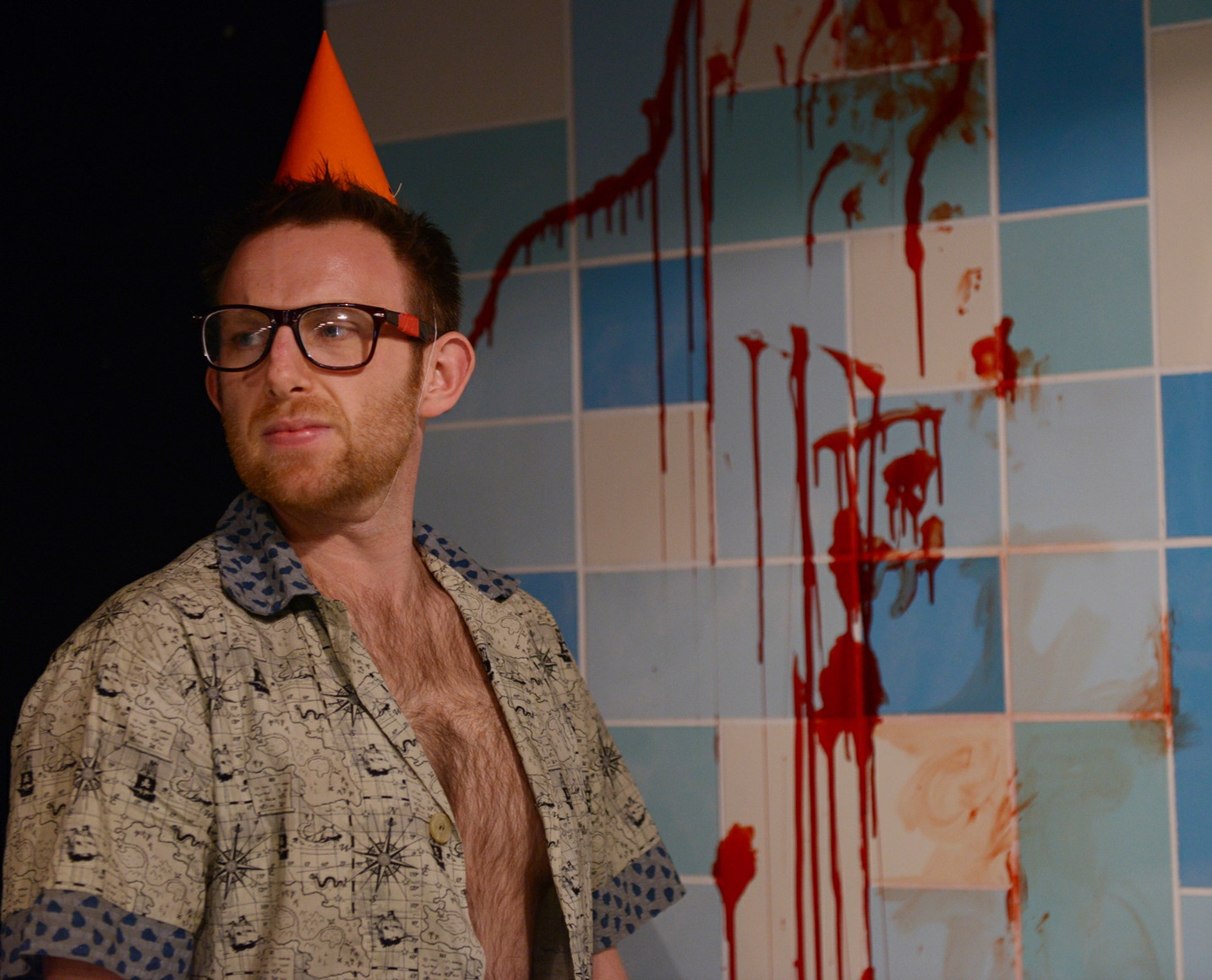
Empire: Terror on the High Seas by Toby Schmitz is part whodunit part slasher.

It’s also flamboyant and fun. And intelligent; wonderfully rich in playful historical allusion.

Empire

Set on a liner crossing the Atlantic in 1925, director Leland Kean’s cast have a ball with the larger-than-life characters. (Ella Scott Lynch and Nathan Lovejoy have particular fun with an RP accent and the beautiful comic juxtapositions it allows.)

Someone is killing the passengers and crew, and we don’t know who. So we try to guess. A whodunnit.

Whodunnits are popular because they suggest, despite the initial chaos, that order will be restored. The investigator, using reason, will bring the criminal to justice.

The slasher genre has no such faith in reason. It luxuriates in the physical; the sexual and, of course, the violent.

The whodunnit builds. The slasher genre tears down.

All philosophy could be described as the struggle between these two approaches; between the systematizers and the wreckers. They probably need each other.

And, in this play, the two have an interesting impact. Schmitz draws attention to certain values and asks us to question them.

Whodunnits, for example, rely on the power of reason, but what’s deemed reasonable is determined by the values shared by the investigator and the audience. ( Yes, Sherlock Holmes reasoning is so logical, but the whole point of that character was that he was an extreme. And, anyway, the audience can’t do the scientific stuff. ) As the audience guesses at the killer, they’re ‘proven’ to be reasonable people when their prejudices match those of the investigator. Except when  the investigator struggles to identify the killer. Then these prejudices are challenged.

The slasher strand is rather more obvious. Kill ‘em all, it says. As far as an indictment of values goes, it doesn’t get much more damning.

And what are the values questioned? In Empire: Terror on the High Seas they are a smug superiority, a privileged complacency, a casual racism.

And though the play is set in 1925, I fear the sun is still rising on that empire.

Veronica Kaye


Empire: Terror on the High Seas

Bondi Pavilion 28 Sept

http://rocksurfers.org/


Spur of the Moment

3 Sep

Spur of the Moment by Anya Reiss has a sparkling opening scene. Twelve year old Delilah is in her bedroom with three friends.  They’re young girls doing their stuff. They’re singing to High School Musical. They’re filming themselves on their phones. They’re talking about how the young man who boards in Delilah’s house is HOT.

Spur of the Moment is a simple tale, beautifully told.

I want to avoid spoilers, but suffice to say this play captures being twelve; the tweeness of it. Delilah is so obviously still a child, but …….

You’re in such a hurry to get older, her mother tells her, but when you are, you won’t want it.

The young girls are played brilliantly. Holly Fraser as Delilah gives an astounding performance. She’s innocent and vulnerable, but hungry to grow, and with that comfortable confidence intelligent children often have before the trauma of teenage years.

And Delilah’s world is changing, and the emotions and situations she must face are new, and raw.

Her parents aren’t much help. They’re lost too. Zoe Carides and Felix Williamson give wonderful performances, balanced perfectly between humour and pathos.

This play is about loving, and mostly about that overwhelming need to be loved. Do we ever shed it? Should we?

Is maturity when you realize that to love, as against be loved, is the most important thing? That’s the grand insight of many religious traditions – but it’s only made possible by the attendant belief that no matter what the world throws at you, you’re loved anyway.

But what twelve year old has got that far?

Holly Fraser

What am I saying? Who ever gets that far? We try. We try to forget ourselves. Or we try to define ourselves in ever widening circles. We try to teach ourselves to love.

But in childhood, being loved is crucial. Usually our parents do the job. Usually. But as we grow, we begin to feel their love is insufficient, and we realize the love we now crave is far, far less assured. We enter exciting but disturbingly uncertain terrain.

Director Fraser Corfield has done a marvelous job with this deeply engaging, deeply affecting play.

It comes to a climax on the morning of Delilah’s thirteenth birthday. Happy birthday? Oh, Delilah. The final image is heartbreaking.

Veronica Kaye


Spur of the Moment

ATYP Under the Wharf til 14 Sept

http://www.atyp.com.au/whats-on/productions/spur-the-moment

Brad Checks In and Summer of Blood

1 Sep

Now, why do they call them “plays”?

Could it be that they’re “play”ful?

Because they take “play” seriously?

Creation is God playing Hide and Seek with Herself. The more serious the game, the harder She is to find. And, perhaps, the less serious the game, the more She shines through.

That’s why silliness can be such a blessing.

And these two plays are a lot of fun.

Brad Checks In, written by Paula Noble and directed by Steven Tait, plays with the adult dating scene. Built on the standard sitcom conceit that adults are just big kids, this entertains with snappy dialogue and high energy performances. Chris Miller as Brad gives an endearing portrayal of a real goof.

Romance is the silliest of the serious things. And even though its comedy, this play got me thinking about gender stereotyping, and the fact that one of the greatest threats to the modern democratic project of universal equality is sexuality. (Ok, pretty heavy, I know, but I did begin this response to a couple of screwball comedies by talking about God.)

BRAD all cast 01

Summer of Blood, written by Robert Armstrong and directed by Stephen Carnell, plays with slasher films. Once again, there’s plenty of quick fire quips, and this time, a reel of film insider jokes. Carnell elicits from his actors the wonderfully appropriate larger-than-life performances that make this sort of silliness sing. Katie Shearer has a ball with the role of the ambitious starlet.

It’s a play about film.

Now, why do they call them “films”?

Could it be because they’re

(Oh, hang on. That’s not going to go anywhere.)

Veronica Kaye


Spring Comedy Double Bill

Brad Checks In and Summer of Blood

at TAP Gallery until 7 Sept

http://www.tapgallery.org.au/2013/08/spring-comedy-double-bill-tuesday-27-august-saturday-7-september-6-30pm-8-15pm/

Jerusalem

31 Aug

I don’t write reviews. But I always include a bit of evaluation. (People seem to like it. I guess it’s a way of looking back at the production, instead of forward to how the production could inform your life.)

I’ll get it out of the way to begin with:

Helen Tonkin’s production of Jez Butterworth’s play Jerusalem is superb theatre. It’s brilliantly acted. Nicholas Eadie, as Rooster, gives a mesmerizing performance, and he’s supported by a top cast.

The play is very funny – and deeply thought provoking.

Photo by Matthias Engesser

Photo by Matthias Engesser

And my last comment might also help explain the popularity of evaluation. It’s easier to write.

Jerusalem is a very rich play. It’s one I find difficult to come to terms with.

(And so what follows is probably rather shallow. In my defense, I direct readers to my article ‘Why being a reviewer is tough’ – https://theatrered.wordpress.com/2012/07/08/why-being-a-reviewer-is-tough/ )

Jerusalem is very English; not in the sense that it’s somehow typical of English plays, but because it explores English-ness. I suspect it’s part of that foreign country’s culture wars.

But I don’t mean it’s not relevant here.

Jerusalem is an exploration of reaction. And that happens everywhere.

Threatened with eviction by representatives of the local council, Rooster refuses to budge. He’s told the law requires him to vacate, the English law. But it’s not his law, because it’s not his England.

Rooster connects with a deeper, older tradition. It’s as though he believes merry old England has been lost. And to underline the point, the play is set on St George’s Day, the day of the local fair, with its May Queen and its Morris dancing, and other pathetic corruptions of a distant past.

Rooster is reminiscent of Falstaff and, like Shakespeare’s creation, he has a semi-loyal entourage. One of them, Lee (played with engaging vulnerability by Brynn Loosemore), is off to Australia. The decision has been made, but it’s troubling. Another of Rooster’s followers, Davey, asserts he’ll never leave England. With perfectly pitched cockiness, Alex Norton as Davey says, ‘Travel to Land’s End, and you’re eff’n close to France. And then after that it’s just country after country. What’s that about?’*

And the play evokes a deeper tradition still. There’s talk of fairies, and giants, and druids, and Stonehenge.

Rooster is a lovable and entertaining raconteur, but he’s not an answer to the challenges of modernity. He avoids dealing with the State by dealing drugs. And despite the threat looming throughout the play he does nothing to try to avert it. He’s a victim rather than a champion.

Jerusalem is an exploration of reaction. Reactionary attitudes are those that say the present is troubling and the past was better.

And, of course, the past is better.

Regardless of whether we share its values, it can no longer trouble us with the need for present action.

Veronica Kaye


Jerusalem by Jez Butterworth

New Theatre til 14 Sept

http://www.newtheatre.org.au


* If my memory has failed me, apologies to Jez Butterworth.

Devdas the Musical

26 Aug

Romantic love is the perfect subject for the dramatic form. It’s particular – this soul adores only this soul. It’s deeply personal, yet it speaks to us all. For many people, this is theatre par excellence – where the concrete leads to the universal.

Devdas is the story of a man loved by two women. He can’t have one and does not love the other.

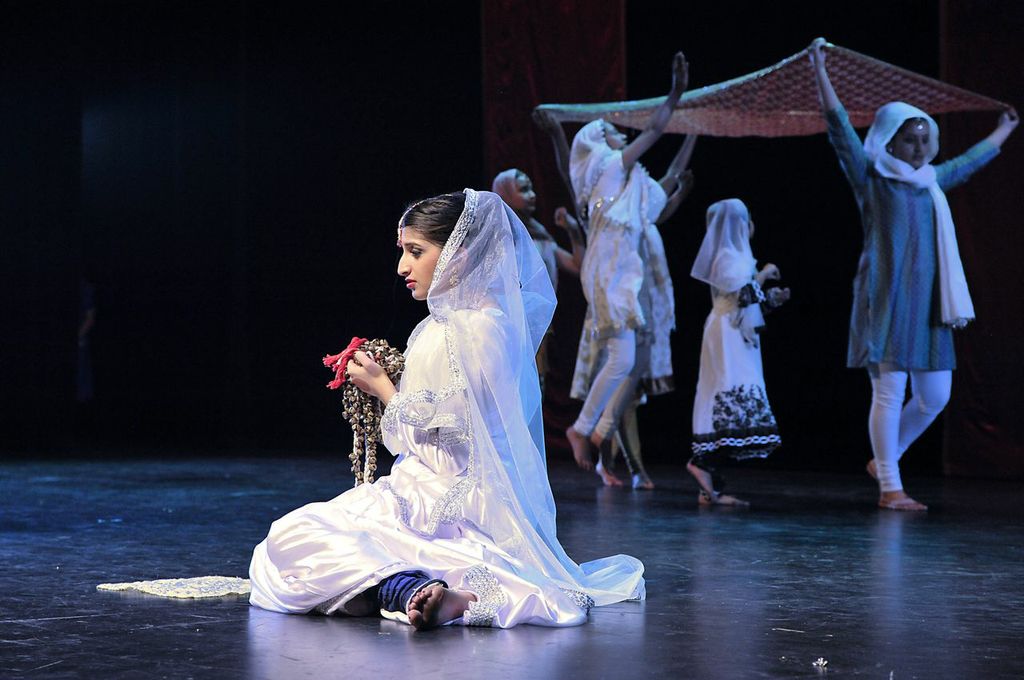
Devdas the Musical is a spectacle, an explosion of colour and sound. The audience is treated to a banquet of musical styles, provided with great virtuosity by composer/performer Aparna Nagashayana.

Visually the piece is a delight as well, with gorgeous costumes, and beautiful dancing choreographed by Ruchi Sanghi.

Director Viral Hathi does a wonderful job of both marshalling a huge cast and painting precise and poignant moments.

Despite their universality, or perhaps because of it, love stories can sometimes seem one dimensional. But not in this case – the novel on which this (and the many movie versions) is based sources a richer tradition.

Photo by Dusk Devi Vision

Photo by Dusk Devi Vision

One of the great gifts of Hinduism to the world is the insight that sexual love can be an evocative symbol of our longing for the divine. Radha longs for her Krishna.

It’s been said that young poets write of sexuality in the language of spirituality, while old poets write of the spirit in the language of sex. And some would assert that spirituality is merely sublimated sexuality.

But perhaps sexuality is sublimated spirituality.

Whatever the case, Devdas is a story of devotion and the consequences of failing in it. It’s a reminder of the power of love.

Photo by Dusk Devi Vision

Photo by Dusk Devi Vision

In the West, discourse about spirituality has been high jacked by the success of the scientific revolution. (It’s difficult to underestimate the allure of a technological culture that has doubled our life spans in the virtual blink of an eye.)

But the way of knowledge is only one path. Love and devotion are another. Termed bhakti in Hinduism, it’s a path that finds expression in most religious traditions.

To look plainly and honestly at the world is an ability we rightly admire.

But it’s not the same as loving the world.

Veronica Kaye

Devdas the Musical

NIDA Parade Theatre 24 August

http://www.devdasthemusical.com/index.html