Phaedra

22 Jul

This is a brilliant production.

I’ve made no bones about the fact I don’t like the Greeks. (Not the current ones. The ones who died about 2,500 years ago.  And, no, the bones comment wasn’t an intentional pun.)

The great Greek dramatists explored ‘universals’, or at least that’s what we’re tempted to think. Distance has lent them a grandeur. But they wrote in a society every bit as fractured and filled with contention as ours, and much of what we have raised to the status of classics were in their day part of a hard fought cultural war.

In Greek society one of the great divides was that between the philosophy of rationality and the theatre of fate and deep dark forces. Socrates and Euripides were contemporaries.

When I see current productions of the ancient Greeks, I ask ‘Why are we interested in their myths?’

From a purely personal perspective, I’m suspicious of any view that sees the world as ruled by fate and irrationality. It seems like just one more way of disempowering ourselves, of trying to mask the fact that we enjoy lives of extraordinary privilege, and hence of unprecedented responsibility. If the Furies were to drag me off today and I was to die horribly, blind and in exile, it would not override the fact that up until this point I’ve lived 49 years without ever being hungry except through choice.

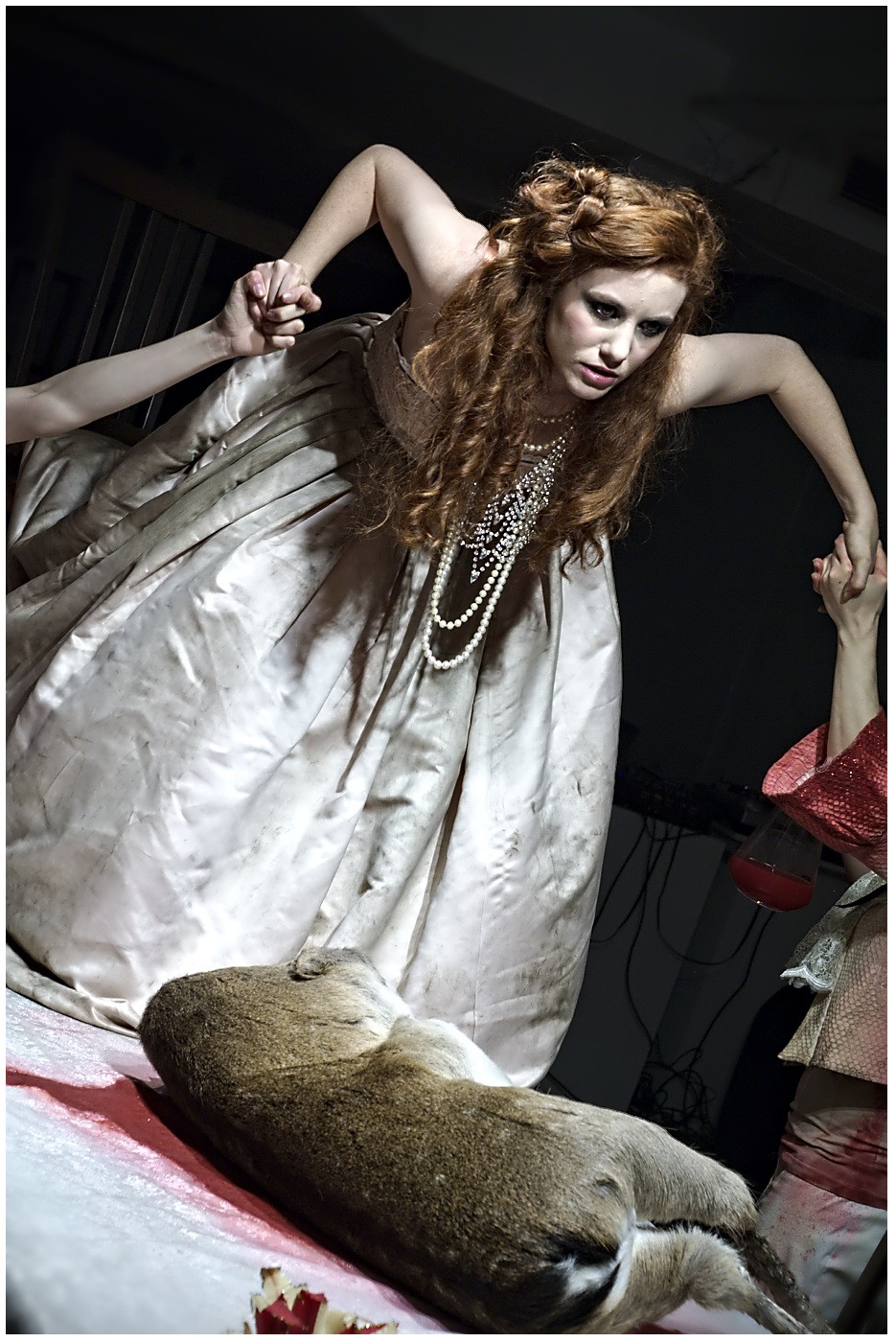
Photo by Sasha Cohen

Photo by Sasha Cohen

But I started by suggesting that Michael Dean’s production of Euripides’ play is brilliant. And it is. It’s extraordinarily inventive and a visual treat. The cast are marvellous. The individualised characters (Danielle Baynes as Phaedra, Melissa Brownlow as the Nurse, Richard Hilliar as Hippolytus and Katrina Rautenberg as Theseus) are played with a beautiful strength, which powerfully highlights the tragedy of the conclusion. The Chorus (Sinead Curry, Cheyne Fynn, Nathaniel Scotcher and Jennifer White) is wonderfully mischievous, both fun and foreboding. The use of pop music is frighteningly effective, suggesting the hidden menace lying behind our seemingly harmless daydreams and fantasies.

Phaedra is a reworking of Euripides’ Hippolytus. It’s a myth of the power of sexual desire. In the ancient Greek world, humans are the playthings of the gods. Phaedra’s passion is a divine punishment.

So what’s our modern myth of sexuality? A sort of flat biological reductionism. The consequence of our decidedly anti-existential myth is that sexuality is robbed of both its magic and danger. And where did our dull unhelpful myth come from? From the victory of the rational viewpoint. So perhaps the Greeks are worth a revisit.

Veronica Kaye


Phaedra (based on Hippolytus by Euripides)

TAP Gallery til 26th July

http://www.liesliesandpropaganda.com/


Book of Days

16 Jul

There’s a powerful set piece in the first act of Book of Days. I won’t spoil it, but suffice to say it deals with the way the announcement of a death is received. Beautifully staged and cleverly written, it perfectly presents the predominant theme of the play – hypocrisy.

Langford Wilson’s play is sort of Thornton Wilder’s Our Town, but with murder. (It’s not an appropriation. It’s definitely a subversion.)

Both plays are set in small Midwest towns.

Photograph © Bob Seary

Photograph © Bob Seary

Ultimately, Our Town presents small town life through the lens of the eternal; its mocking of the parochial is gentle to the extreme, and the play firmly asserts the value of the everyday, and of every life.

Book of Days offers a vision far less comforting. There are some seriously bad people in this play – and they’re respected members of the community.

Some audience members might find the second act unusual, undecided about the way the play becomes somewhat smaller, folding down to a whodunit.

But I think that’s the play’s purpose. It’s part of the American culture wars. It’s saying ‘What’s wrong with our simple dream?’ And it finds guilty parties.

Elsie Edgerton-Till’s production is terrific and her use of the space is magical. The performances are sensational. Kate Fraser creates a brilliantly engaging Ruth Hoch, the salt of the earth no-nonsense truth teller. The conceit of this play is that Ruth is playing Joan of Arc in George Bernard Shaw’s play. And like Joan, Ruth fights both Church and State. I’d further draw the contrasts and comparisons between Ruth and Joan, but I’d be guilty of dreadful spoilers.

In this play, there are characters guilty of far worse: Kyle Walmsley gives a chilling portrait of the intelligent, urbane and frighteningly calculating Reverend Bobby Graves. Simon Davey creates a marvelous portrait of a manipulative snake of a politician.

And a final word on Georgia Hopkins set design: a beautifully space to play, clean and pure, punctuated by only a single tree. The Garden of Eden? The Tree of Knowledge? The Fall from Paradise?

Veronica Kaye

Book of Days by Lanford Wilson

til 9 August

http://newtheatre.org.au/


Every Second

9 Jul

There are a lot of angry and envious people in this play.

Ok, there are only four characters, but they’re all in the same situation; they desperately want children.

I’m the worst possible audience for this.

I don’t understand the basic motivation of the characters. I want a child about as much as I want a rhinoceros.

Photo by Louis Dillon-Savage

Photo by Louis Dillon-Savage

So, on one level, I found the whole thing rather frustrating. There’s a grand secret but I wasn’t let in on it. The only explanation offered for the character’s desires was that everyone else had children – which, of course, wasn’t meant as an explanation at all.

The characters are middle class Australians. In one sequence, Georgina Symes’ character says she can control everything except her own uterus, which is a statement of staggering self delusion. It’s a pity this incredible power is not being used to slow climate change or solve third world poverty.

Vanessa Bates’ play is cleverly constructed with plenty of good laugh lines. Shannon Murphy elicits from her cast strong performances. But I couldn’t like any of the characters. (Yes, I’m a bad person – the weirdo who doesn’t want children.)

The set by Andy McDonell is intriguing. It suggests the lake in the park. It suggests a woman’s reproductive organs. It suggests a vortex, dragging the characters down.  This is not a play about finding, or sharing, joy.

Veronica Kaye


Every Second by Vanessa Bates

Eternity Playhouse until 27 July

http://www.darlinghursttheatre.com/


La Ronde

6 Jul

Written in the late nineteenth century, the question any current production of this play asks is its relevance.

This production contemporises costume and place names.  It’s happening now.

Foucault threw out an extraordinary challenge when he published The History of Sexuality.  Excluding the deep time of evolution, what history can sex possibly have? Isn’t sexuality just biological, not cultural? Isn’t it a timeless universal?

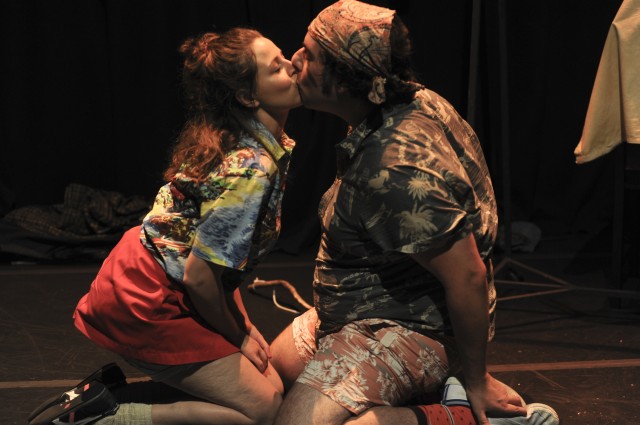
This production of Arthur Schnitzler’s play is fascinating because it makes an audience question whether a clear-eyed look at a supposed universal can, in fact, be historically specific. Forward looking in its time, is the play backward looking now? (It’s worth noting that the play is decidedly heterosexual. And, one would hope, the dynamic of class has changed.)

laronde-05

But the play is certainly about sex. Each of the scenes has a similar structure: pre-coital discussion, blackout for the act, then post-coital discussion. (The fact we don’t see the act itself is a powerful comment about its ineffable nature.)

The other aspect of the structure that’s intriguing is the suggestion of frequent infidelity. Perhaps not every one of the ten characters is actually being unfaithful, but each appears in two scenes, with a different lover. This highlights the strangeness of sexuality, so personal yet so ubiquitous.

The performances are good, both touching and funny (an achievement considering the tricky acoustics of the venue). Brendon Taylor as the Writer, Amanda Maple-Brown as the Actress and Emilia Stubbs Grigoriou as the Sweet Girl are particularly engaging.

Steven Hopley’s direction is simple and highly effective. He presents the play in the round and this evokes the dance of the title, and intensifies the oddity I referred to earlier: we watch beautiful young couples navigate the most private of moments and at the same time are aware of the social gaze of other audience members.

Is sex the place where the particular and the universal collide? (Or perhaps more accurately, rub up against each other?) And, if so, is this why sex is so crucial to both our sense of identity and our sense of connection?

Veronica Kaye


La Ronde by Arthur Schnitzler

til July 12

Coronation Hall, 95 Lennox St Newtown

Performances – July 9, 11, 12 – 8pm

Book Now at www.stickytickets.com.au/enigma

The Mercy Seat

30 Jun

Two mean spirited people with American accents remain in a room and argue about their relationship for 100 mins (including a 15 minute interval).

For many people, this would be the archetypal modern play. Which is why they stay at home.

But, in this case, context is all.  Our couple are arguing about their future while the rest of America, and much of the world, is in shock.

It is New York. It is September 12, 2001.

What to many was an unfathomable tragedy is to our couple an opportunity. They’re having an affair. He is married with children. Perhaps yesterday morning he was in one of the towers when the planes struck, instead of at his mistress’ place having his penis sucked. Is it their chance to just disappear and start again?

photo by Katy Green Loughrey

photo by Katy Green Loughrey

This production of Neil LaBute’s play is both funny and confronting. The performances by Rebecca Martin and Patrick Magee are powerful and intriguing.

Are we meant to take the characters as real people? Is this play gritty naturalism? If it is, it’s a vision of humanity so bleak that it approaches the immoral. (There’s a school of theatre that equates negativity with truthfulness. It’s the philosophy of those who wish to grant themselves moral holidays. If it’s just human nature to act dreadfully, how can my behaviour be at fault?)

The challenge of this play is the context. Presumably none of us have been in the situation represented.

Or have we?

Many of us are tempted to think the world is screwed, that it’s a chaotic mess, and that we’re all going to hell in a hand cart. I call it a temptation because it allows us to believe that it’s justifiable to be entirely self seeking. After all, in extremis, the call goes out “Every man for himself”.

The Mercy Seat is an intelligent and thought provoking production, a timely reminder that we must not use the magnitude of our society’s problems as an excuse to grant ourselves moral holidays.

Veronica Kaye


The Mercy Seat by Neil LaBute

Old Fitzroy Theatre til 5 July

http://www.sitco.net.au/

My Name is Truda Vitz

27 Jun

My Name is Truda Vitz, written and performed by Olivia Satchell, and directed by Pierce Wilcox, is a moving exploration of personal ties and the power of imagination. With stunning visual images and Satchell’s performance on the cello, it’s also a treat for the senses.

Satchell tells the story of three generations; herself, her father Paul, and her grandmother Truda. She slips between the characters with an unadorned simplicity. She forces nothing. These characters – these people – are granted dignity.

The most fascinating aspect of this personal history is that Satchell never met her grandmother. The closest she will ever get to her is in this play, she says.

Her grandmother’s personal history is therefore imagined. There are ‘facts’: the date Truda fled Vienna as a seventeen year old in order to escape persecution as a Jew; the date she was married; the date she was finally accepted as a British citizen after years of being an ‘illegal alien’. But the majority of Truda’s story is invented. As Satchell says, even if it didn’t happen to Truda, it probably happened to someone.

TRUDA7

One of the greatest tensions in life, and one that fuels the dramatic impulse, is that between otherness and empathy.

I sometimes suspect that every dramatist is a solipsist in denial. After all, how can we really know other people? I can never see through someone else’s eyes or walk around in their body. In fact, one of the most important gifts we can give someone else is an acknowledgement of our own limitations. I don’t know you. I can’t predict your behaviour. You can surprise me. I accept your otherness.

The other side of the coin is that we must make assumptions about people. If we don’t, our ethical systems falter. I have to be able to predict what causes you pain or gives you joy. And since I can’t know these things infallibly, or even contingently, it’s up to my imagination to make the human connection.

Ignorance and imagination. I don’t know you but I’ll try to guess.

It’s this gentle, warm balance that makes My Name is Truda Vitz such a beautiful piece of theatre.

Veronica Kaye


My Name is Truda Vitz by Olivia Satchell

Somersault Theatre Company

at TAP Gallery til July 6

http://somersaulttheatre.com/my-name-is-truda-vitz/

The Violent Outburst That Drew Me To You

25 Jun

Why do people keep telling me what to do with my life?

Finegan Kruckemeyer’s play is an intriguing exploration of teenage anger, positing both causes and solutions.

And Kate Gaul’s production of The Violent Outburst That Drew Me To You is extremely engaging theatre.

It’s visually exciting, with snappy dialogue and high energy performances (yes, I’m obviously holding down the cliché key on my keyboard).

Kruckemeyer’s script is a brilliant blend of both imitation and parody of teenage language – which is exactly what teenagers do. (How many adults parody their own language use?* Or, indeed, themselves?) And the cast do great work with Kruckemeyer’s words, finding their zing and mining their spirited humour.

 PHOTO BY HEIDRUN LOHAR


PHOTO BY HEIDRUN LOHAR

Michael Cutrupi is terrific as Connor, the angry teen.

Connor has difficulties at both home and school. Emily Ayoub and Anthony Weir give top portraits of dull-but-caring parents. Renee Heys produces a wonderfully vibrant school girl. Natalia Ladyko’s endlessly patient but smart-mouthed teacher is superb.

In an attempt to solve his difficulties, Connor is sent ‘into the woods’ to find himself. (Which is a little different from the way most teenage boys find themselves.) There he meets Lotte, another teenager with anger issues. She’s played by the three female members of the cast and it’s a device which effectively suggests the personality shattering effect of anger. It also helps push this sequence of the play into a sort of magical realism, and prevents the play’s conclusion from feeling too neat.

For our vision of the world is coloured by our emotions, and it is in our teenage years that this frightening and thrilling discovery is made.

Veronica Kaye

*The exception, of course, is theatre reviewers.


The Violent Outburst That Drew Me To You by Finegan Kruckemeyer

SBW Stables Theatre (Griffin) til 12 July

http://www.griffintheatre.com.au/


What is wrong with Australian Theatre?

18 Jun


.

Why Torture is Wrong, and the People Who Love Them

10 Jun

Firstly, Why Torture is Wrong, and The People who Love Them is  ‘good’ theatre.

Now a digression:

A while back, standing in a crowded foyer, a friend of a friend shocked me by saying “Bad theatre is like being tortured”.

My heart went out to her.

I felt awful. I had thought she was just another complacent, comfortable, middle-class theatre goer.

But no. Perhaps, I thought, she’s a recovering victim of some deranged sociopath. Or, possibly, she’s an escaped dissident from a brutally repressive regime.

Or most likely, like myself, she was just another complacent comfortable middle class theatre goer who enjoyed indulging in absurdly hyperbolic language simply because her life of unparalleled privilege supplied her with everything she needed – except the occasional jolt of excitement to remind her she was alive.

This might be wild speculation, but I suspect sitting through an hour or so of less-than-engaging theatre bears very little resemblance to having electrodes attached to your genitals.

But if you choose to dumbly divide the entirety of existence into the simple categories of the good and the bad, with everything either on one side or the other of that enormous world-dominating watershed, then I guess torture and ‘bad’ theatre might sit on the same side, the very same side as suffering a terminal illness and having dandruff.

Digression over.

Photographs © Bob Seary

Photographs © Bob Seary

Why Torture is Wrong, and the People Who Love Them is a very funny and fabulously performed satire.

Director Melita Rowston does a fantastic job with Christopher Durang’s script. The performances are joyfully hyperbolic.

Terry Karabelas and Peter Astridge present perfectly pitched in-your-face alpha males.

The female characters are fascinating responses to the male absurdity. Ainslie McGlynn gives us a wonderfully flighty small ‘l’ liberal. Romy Bartz gives us Hildegarde, painfully and hilariously in love with a right wing lunatic. (What’s Sylvia Plath’s line about every woman adoring a fascist?*) And Luella is my comic favourite, played brilliantly by Alice Livingstone. Luella retreats from her domineering husband, and reality in general, through an obsession with theatre. (Yes, lets worry about theatre. There’s nothing else important going on in the world. Like torture.)

And while having terrific fun with these over-the-top characters, the final scene is thought-provoking, and an acknowledgement that satire is not the solution to the great world-dominating watershed between left and right.

It’s a brave move, laying down your greatest weapon, but it’s probably the way forward.

Veronica Kaye

* The line is “Every woman adores a Fascist”.


Why Torture is Wrong, and the People Who Love Them By Christopher Durang

at New Theatre til 28 June

http://newtheatre.org.au/


It’s Dark Outside

28 May

I don’t read the program before a show. Or after.

So I sat down in the theatre knowing nothing about It’s Dark Outside. What I experienced was bewildering, beautiful and sad.

Afterwards I broke my rule and had a peek. According to the program, dementia was the starting idea of the artists’ process – in particular, a phenomena called Sundowning Syndrome, which is a “confusion and restlessness” experienced by some patients.

Phot by Richard Jefferson

Photo by Richard Jefferson

So that’s what I saw. I could blame my lack of awareness on my own parochial nature, but I prefer to blame society. This disease affects so many, but we often ignore it.

Creators Arielle Gray, Chris Isaacs and Tim Watts have produced some magical melancholy.  Built fundamentally from puppetry and projection, it’s visually stunning. Wordless, its power comes from the brilliant performances of the creators and the evocative musical composition of Rachael Dease.

An old man is being chased. Or is he doing the chasing?

Pursuing or being pursued; these are fundamental aspects of the human experience. They’re a direct function of the dimension of space. Unfortunately, they’re not a function of that other dimension we live in – time. It allows movement in only one direction. And that’s the sorrow.

Veronica Kaye


It’s Dark Outside by Arielle Gray, Chris Isaacs and Tim Watts

Riverside Theatre til 29 May

http://riversideparramatta.com.au/show/its-dark-outside/

It’s Dark Outside is currently on a national tour.

http://www.perththeatre.com.au/show/its-dark-outside/