Reading Reviews

17 Oct

Every artist knows there’s an art to reading reviews.

(Or maybe not an art. Maybe there’s a wine list. Or should be.)

But as a writer about theatre, I have a confession: I enjoy reading reviews of plays after I’ve seen them.

I know this makes nonsense of the idea that reviews are consumer advice. (My attending of theatre is rather like drinking from some random bottle I find under the sink – and then reading the label.)

I avoid reviews before seeing the play because everything feels like a spoiler.

I like to sit down to Hamlet and be surprised. “Oh, it’s in Swahili this time.”

I like to read reviews after I’ve seen the play because I don’t particularly want to know about the play. (I’ve seen it.) I want to know about the reviewer.

Or more precisely, I want to know about another person. I want to know what they value.

Because we do value different things. In aesthetics. In morality. In politics.

There is a danger to living in a pluralistic society that openly acknowledges this: we can forget to be truly amazed at how varied is the human experience. We can reduce the idea we value different things into a mere truism. But each one of us gazes through a different window. To……….. where?  I want a peek.

Reviewers say ‘Have a look through this window.’ And I want to thank them for that.

And to mix imagery, and to return to artists, let me conclude with this:

Putting on a production is like firing up a particle accelerator.  You get a small number of very excited particles and send them hurtling at a larger, more inert mass. Then, after the collision, you know more about the universe.

Veronica Kaye

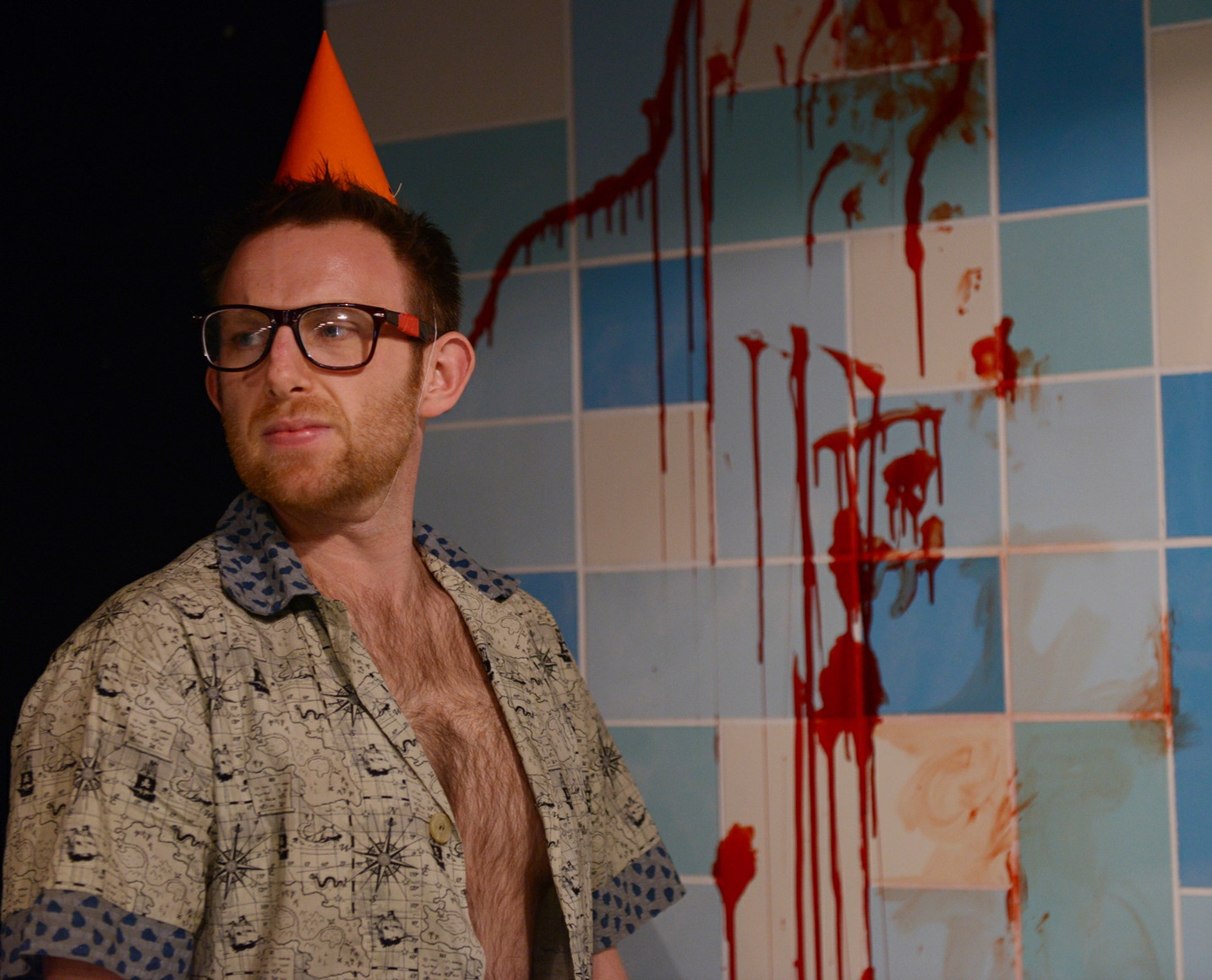
Note: The image is Paul Gilchrist reading a review to an interested friend.

The Good, The Bad and The Lawyer

16 Oct

The centre of this play is Henry Crowley, played by Mark McCann. A comfortable lawyer, his world is rocked when his wife (Tricia Youlden) decides to sponsor an asylum seeker (Geoff Sirmai). And to add to Henry’s discomfort, his very working class cousin (Marc Kay) drops in. It’s not good timing; all Henry wants is to present the image of successful stability to a journalist from the Financial Review (Brigid O’Sullivan).

There’s some good laughs in Tony Laumberg’s script and director Richard Cotter elicits big fun comedic performances from his whole team.

GBL 37 - Mark+Tricia

The character traits satirized are self importance and narrow mindedness.

The power of theatre is its concrete nature. No airy abstractions here, not when there are flesh and blood characters so close we could almost touch them.

This is also theatre’s weakness. Henry Crowley in all his glory – parochial and devoid of generosity of spirit – is a particular man.

That man.

Not me.

How many people have sat in a theatre and tried to find comfort in that belief?

Veronica Kaye

The Good, The Bad and The Lawyer

TAP Gallery until 27 Oct

http://www.tapgallery.org.au/2013/09/the-good-the-bad-the-lawyer-starts-october-10-early-bird-offers-2/

Roberto Zucco

7 Oct

With my no doubt frustrating tendency to write philosophy instead of theatre criticism, it might be expected I’d take this play about a serial killer and use it as a launch pad to discuss that old chestnut – “the nature of evil”.

But I won’t. Instead, I’ll use it as an excuse to write about conventionality.

Zucco’s violence, and the responses to it, are symbolic. This is not a blood thirsty play. It’s an amusing and engaging exploration of rebellion.

It begins with the murderer escaping a supposedly inescapable prison. The prison guards are conventional, in the sense they don’t see it coming, and conventional in that they’re characters virtually out of commedia. Played with a wonderful sense of fun by Neil Modra and Sam Dugmore, they return later in the proceedings as gloriously keystone-like cops.

Zucco, played with marvelous energy by Tim Cole, baffles those around him because he is so unexpected. We follow his extraordinary journey.

Photography by Katy Green Loughrey

Photography by Katy Green Loughrey

He has a whirlwind romance with a young girl. Played with a fascinating balance between naivety and dissent by Gemma Scoble, she longs to escape the expectations placed upon her by her family. Their only concern is that she’s marriageable material and can follow the conventional path.

In a powerfully tense scene, Zucco talks to an old gentleman who is lost in the subway. He’s taken a wrong turn, and is confused and vulnerable. Adrian Barnes plays this brilliantly, capturing the deep doubt of one who suddenly finds the world larger than he had ever imagined.

Later, Zucco kidnaps an “elegant lady”. She is more than willing. This is her chance to escape from her stultifying middle class world. Kirsty Jordan, harmonizing humour and dignity, creates a character whose authority and strength drive her to challenge the very milieu that originally empowered her.

Director Anna Jahjah has drawn from her entire cast engaging performances. I particularily loved Lyn Pierse’s joyfully larger than life characterisations.

Martin Crimp’s translation of Bernard-Marie Koltes’ play is rich and intriguing. There are some delectable speeches.

This play is part of a European tradition. Think Jean Genet. Criminality as rebellion.

It’s a risky symbol. And no justification is offered for Zucco.

It just throws it out there the idea that conventionality is problematic. It offers no alternative.

But what alternative can there be?

To live Life fully – and this play reminds us Life can be over much sooner than we imagined! – to live Life fully, we cannot pretend to know it in advance.

Veronica Kaye


Roberto Zucco 

Old Fitzroy until 19 Oct

http://www.sitco.net.au/


Singled Out

4 Oct

I had a friend, who desperately needing to get somewhere, stole a car. I don’t know where it was he was so keen to go, but unless his desired destination was Goulburn Correctional Facility, his decision proved an unwise one.

When he was released, I asked what it had been like. Apparently, apart from the obvious fact he couldn’t leave, the experience wasn’t so bad. Free food. Free accommodation. The only problem? The company. “I had to spend a whole year of my life with a bunch of criminals,” he said.

Other people.

They’re a challenge.

And increasing numbers of us are choosing to live alone.

Why we are choosing this, and what are its consequences, is the subject matter of Augusta Supple’s Singled Out.

Josipa Draisma in Grace De Morgan's "Ikea". Photo by Marnya Rothe

Josipa Draisma in Grace De Morgan’s “Ikea”.
Photo by Marnya Rothe

Supple has pulled together a brilliant team of writers and actors. In a series of playlets, this team explores the phenomena from multiple angles. It makes for a fascinating night of theatre. There’s powerfully delivered monologues, cute puppetry and some good laughs.

I don’t write reviews. I write about what theatre makes me think about.

This production made me think about solipsism – the belief that other people don’t really exist.

It made me think this because the choice to live alone smacks strongly of a desire to avoid others. I make no moral judgement. In fact, I’m going to argue the opposite of what you might suppose.

Solipsism, or the question of whether other people actually exist, is a fascinating philosophical issue. I don’t mean it’s interesting in the sort of silly way, that as an undergraduate student, I cut my teeth on arguments about whether the chair I was sitting on was actually there. It’s interesting because it asks me to question how seriously I take the proposition that other people are independent of me and hence equal to me.

The acceptance of the actual existence of others is the great ethical challenge.

A clever monologue begins Singled Out. Performed by Roland Baker and written by Luke Carson, it cheekily asks what are the economic ramifications of the trend to single living. People are reduced to dollars.

It’s only too easy to reduce those around us, both locally and globally, to something less than human. Other people become extras in our private movie, tin soldiers in our conflicts, annoying randoms in the crowd. We don’t take them, or their needs, seriously.

Accepting that other people are independent of us (that is, real) doesn’t mean we’re isolated from them. In fact, the contrary is the case. Acceptance of true otherness is how a relationship begins. Otherwise it’s just exploitation. Or neglect. I can only understand someone else’s needs when I actually listen to them and not merely play games with the toy version of them I have in my head.

The decision to live alone is an assertion of independence. It’s also a potent symbol for an authentic life, the beginning point where both ourselves and others are given the space to be acknowledged and appreciated as individuals.

It was an exciting theatrical decision for Augusta Supple to explore the concept of living alone, and with an engaging and no doubt deliberate irony, the result is stimulating examination of our relationship with others.

Veronica Kaye

Singled Out

Seymour Centre til 12 Oct

http://www.seymourcentre.com/events/event/singled-out/

Writers: Vanessa Bates, Wayne Blair, Sarah Carradine, Luke Carson, Emma Magenta, Grace De Morgan, Tim Spencer, Alli Sebastian Wolf

Performers: Amanda Stephens Lee, Bali Padda, Rosie Lourde, Josipa Draisma, Leofric Kingsford -Smith, Amber McMahon, Roland Baker, Eloise Snape, Richard Cox, Alex Bryant-Smith, Paul Armstrong and Kate Fitzpatrick

Theatre and Judgement

2 Oct

We have a predilection to judgement. It’s a good thing. It powers our moral life. Only the most naive think that a predetermined set of  rules can guide you through the complexities we face. We constantly have to judge the best course of action.

However, our faculty of judgement is often corrupted. An example of this is when we judge the person not the behaviour.

Is it also possible that it’s a corruption of our faculty of judgement when we apply it to art? I appreciate this is a radical suggestion.

Imagine you were on a panel to determine which theatre maker might receive a $1 million grant. (I’m obviously assuming you have a healthy imagination.) Unless you’re going to pull a name out of a hat, your decision must be based on something. Perhaps you will suggest the grant be given to the artist whose work would most benefit society. (This, of course, would be difficult to determine, but that’s why judgement is a serious matter.) If you choose to give the money in this way you would be making a moral judgement.

However, if you merely attend an evening of theatre and afterwards make a judgement, what is the moral component? I’m not arguing there isn’t one. Perhaps you’ll judge the production to be promoting racism or sexism. Or joy and acceptance. Or you might simply decide it’s presenting an unnecessarily narrow vision of life.

But if you judge the acting to be poor, or the costumes to be garish, what exactly is the moral component?

Well, it might be you who is promoting an unnecessarily narrow vision of life.

Of course, you could counter that I’m ignoring the category of aesthetic judgement altogether, or unfairly collapsing it into a minor subset of ethics.

Perhaps I am.

And perhaps my qualms about the passion sometimes displayed in our aesthetic judgements are indeed misplaced, and we should shout and scream about what happens on our stages, and in our stories, while somewhere else children quietly starve.

Veronica Kaye.

Fully Committed

27 Sep

The customer is always right.

Are there five words that better encapsulate our absurdly mercantile and materialistic society?

Sam, played by Nick Curnow, is the one of the team who takes the reservations for a super trendy Upper Eastside restaurant. It’s the sort of place that’s booked out months in advance, or ‘fully committed’, as the celebrity chef insists. Sam struggles to deal with the demands of both employers and customers.

nick-curnow-233209

Fully Committed is a one man show designed to show off an actor’s virtuosity. And it does. Nick Curnow is superb, creating thirty eight characters in fifty minutes.

Sam is Curnow’s primary character, but he launches into the others with breathtaking energy. Curnow’s ability to delineate such an enormous cast of characters is awe inspiring. The laughs come thick and fast. His vocal work is nothing short of extraordinary.

The script, by American Becky Mode, is witty and wonderfully structured. Director Alexander Butt has facilitated a lively night of fun, and thought.

The customer is always right. The slogan is well known because employers ask their employees to abide by it simply because it encourages return business. But customers parrot it, as though it was a moral truth. ‘I am paying, so I must be right.’ But aren’t both parties entering into the transaction in good faith? You give me this, I’ll give you that. Why should one party be privileged?

There are few more injurious attitudes to a democratic society than this false sense of entitlement.

And one of the funniest and sharpest moments is when Sam’s agent (he is, of course, a struggling actor) tells him how he could do better at castings. He must develop an aura of self-entitlement. This is silver service satire.

Veronica Kaye


Fully Committed

New Theatre

Two shows remaining Fri 27 Sept and Sat 28th Sept

http://2013.sydneyfringe.com/event/theatre/fully-committed-becky-mode

Titus Andronicus

26 Sep

And so I went to a blood bath in a lounge room.

Titus Andronicus is a classic revenge story. It was a huge hit in Elizabethan times. And it works now, especially with smart choices.

It’s also intriguing because of what it suggests about Shakespeare’s practice.

Is the scheming Aaron the Moor a test run for Iago? (And, if so, note the reversal of the ethnicity of the characters in Othello. Did Shakespeare go on to develop a conscience regarding his presentation of particular races? Is it simply that he realised there was more dramatic potential in making a member of a minority group the central character in a tragedy?)

Is Titus a trial run for Hamlet? (In both plays there’s a much put upon hero who feigns madness until the time is right. Or wrong, as is the case in tragedy.)

titus_print

This production’s all female cast is a fascinating decision. Playing against expectation, it energizes and challenges. Director Caitlin Scarr has elicited terrific performances from the entire team. Jacki Mison as Titus is brilliant. Lauren Orrell as Tamora is captivating, and appropriately threatening.

Leah Winterton’s performance as Lavina is particularly moving. The violence done to her is horrific. Shakespeare’s decision to show us the consequences is one of the most confronting moments in his whole body of work.

And here it is in a lounge room.

Well, not really. But the Glebe Café Church Space is warm and comfortable, replete with couches and soft lighting.

And so, for me, this production poses a vital question, and puts it out there bravely:

How tolerant are we of violence?

Veronica Kaye

Titus Andronicus

Glebe Café Church Space

Two performances remaining: Fri 27 Sept and Sat 28 Sept

http://2013.sydneyfringe.com/event/theatre/william-shakespeares-titus-andronicus

Skazka, Told by Night

24 Sep

And they were happy.

Appearing at the end of a tale this line seems simplistic.

Anywhere else it is ominous.

Happiness will be disrupted. The power of the folk tale, despite its exotic and anti-naturalistic setting, is its assertion that we want peace, but it shall be denied us.

This is their insight: not the denial, but the desire.

skazka1

Told By Night is a series of adapted Eastern European folk tales. They are deeply moving tales of family and death.

Beautifully written by Jonathan Dunk, Finn Davis and Jem Rowe, their strength comes from their simplicity.

They are presented somewhere closer to a telling than a dramatization. Directed by Dunk, the performances are absolutely captivating, with both voice and movement seemingly balanced between improvisation and choreography.

This creates a spellbinding immediacy which enhances one of the most fascinating aspects of this piece. These tales were told to the audience, but also to (and with) those present on stage. We hear and see the tales. We hear and see the responses to them.

Stories don’t represent reality. (Especially not folk tales.) They are not truthful. They play us.

The wind chime doesn’t ask if the wind is true.

Veronica Kaye


Skazka, Told by Night

New Theatre

2 shows left Wed 25 Sept and Sat 28 Sept

http://2013.sydneyfringe.com/event/theatre/told-night

Jane Austen is Dead

22 Sep

It is a truth universally acknowledged that a critic reviewing a play alluding to Jane Austen will assert their authority by appropriating an obvious famous quotation.

But I’m not a reviewer. I’m what I call a responder.

Any authority I have regarding Austen comes from a course I did at uni. For six months I surrendered myself to six great novels about love. Disappointing – the class consisted of ninety nine women and one gay male couple. It wasn’t only Austen’s prose that awakened my sense of irony.

jane media image SQ 350px

But Mel Dodge’s Jane Austen is Dead isn’t just for Austen aficionados and it certainly isn’t gender specific. An exploration of the modern dating and mating game, it’s terrific fun. Dodge’s performance is absolutely brilliant. She plays multiple characters, treating the audience to a heap of hilarious insights and a good sprinkling of poignant moments.

Dodge’s main character is Sophie, who is battling the influence of fiction in her life. Where can Mr Darcy be found?

We need stories. And we need to escape them.

They help us look to the stars. But they don’t get us there.

Or to offer another analogy: when the heart goes a hunting, we shouldn’t treat stories as maps. They don’t actually tell us what’s out there.

Perhaps stories are more like gun sights, helping us zero in on what we want. Violent imagery, I know, but they’re powerful, dangerous things.

Love stories, but never ever trust them.

Veronica Kaye


Jane Austen is Dead

New Theatre

One more show in Sydney – Mon 23 Sept

http://2013.sydneyfringe.com/event/theatre/jane-austen-dead

Penelope

19 Sep

United we stand. Divided we stand – in an empty swimming pool, waiting to be butchered by a legend.

That’s the scenario of Enda Walsh’s play Penelope. Four men have unsuccessfully vied for the affections of Penelope and soon her long absent husband, Odysseus, will return. There will be consequences.

Walsh’s play is rich and playful. It sets competition against co-operation. Are we really capable of the latter?

Director Kate Gaul’s production is superb. The cast is top class, and they bring to life Walsh’s snappy word play.

Thomas Campbell as Burns. Photo by Kathy Luu

Thomas Campbell as Burns. Photo by Kathy Luu

There are some extraordinarily powerful speeches, which provide an effective foil to  the lighter raillery. The monologues by Nicholas Hope and Thomas Campbell alone will get me back a second time.

Gaul and designer Tom Bannerman have magically transformed the space. We are in the pool. Or is it the gladiator’s amphitheatre?

But they’re a sorry lot of gladiators. Perhaps collaboration is their only hope.

Dramatists have a vested interest in seeing hostility at the heart of human nature. It’s their ideology. With out this belief it’s hard to spin stories.

But is it true? News reports provide easy confirming evidence. But journalists are the close cousins of dramatists, and share their needs.

This play puts it out there; competition or co-operation?

It’s a fascinating question. With no answer.  Except, of course, the one we make with our own lives.

Veronica Kaye


Penelope

TAP Gallery til Oct 6th

http://www.sirentheatreco.com/