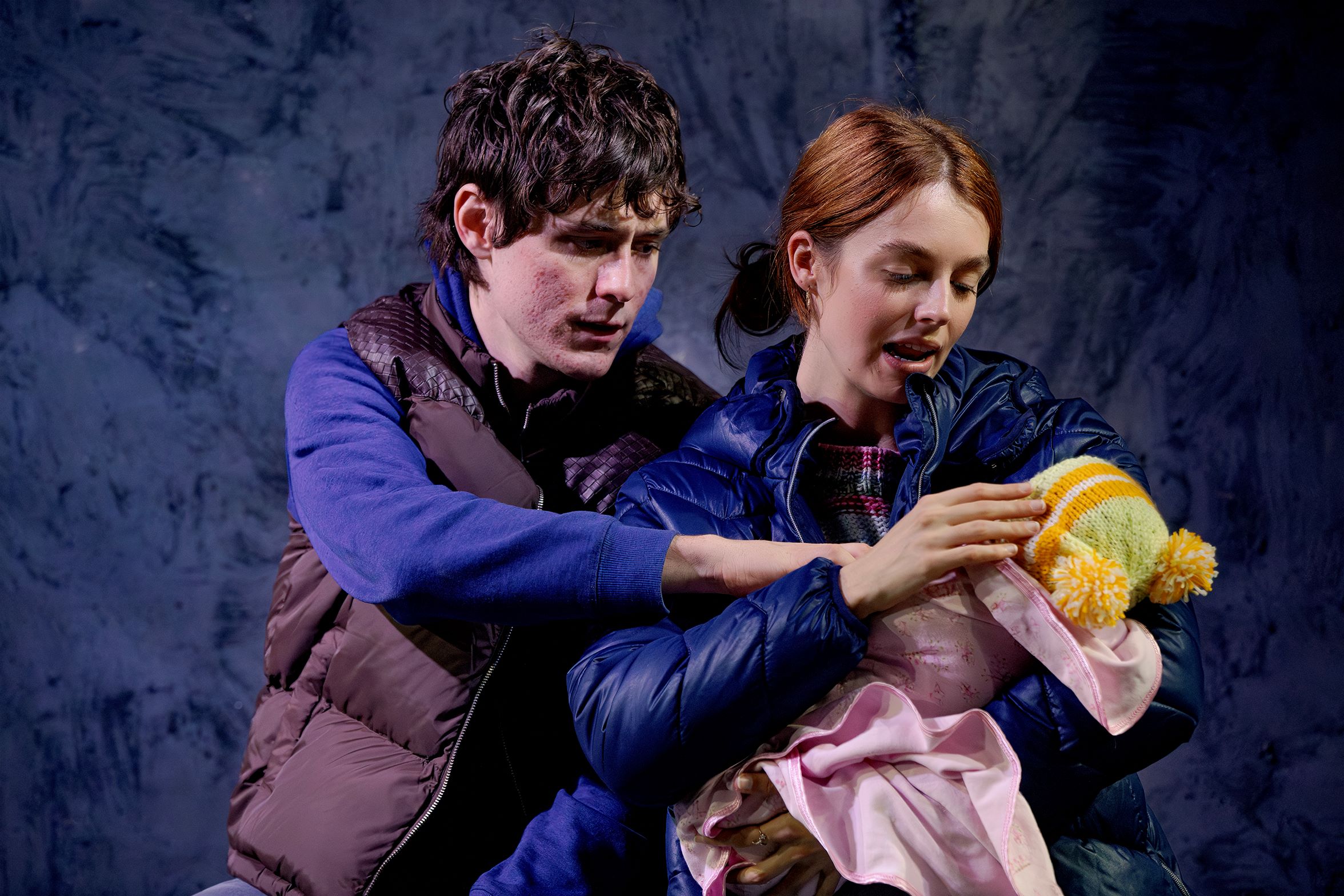
This is a very funny and extraordinarily heart-warming love story.
Of course, the title tells us it will be some sort of love story. (Though no one in the play comments on the uncanny similarity between the characters’ names and those of their iconic forebears.)
Shakespeare’s play is a tale of star-crossed lovers (though it’s rarely described as ‘very funny and extraordinarily heart-warming.’) In what way are the two lovers in Gary Owen’s play star-crossed?
Well, Julie is academically gifted and from a upper-working class family.
Romeo is academically challenged and is an eighteen year old single dad with an alcoholic mother.
Julie will probably get into Cambridge and study physics.
Romeo didn’t finish school and can barely read.
Estelle Davis as Julie and Alex Kirwan as Romeo are absolutely superb. Both the attraction and the tension between the couple is evoked gently and with such attention to detail that their relationship feels utterly real. (And that verisimilitude is quite an achievement – because true love has always been where flat reality loses its recognisable solidity and evaporates into ethereality, taking flight as fairy dust.)
As Julie’s mother and father, Linda Nicholls-Gidley and Christopher Stollery are terrific, revealing the multifarious manifestations of parental devotion. Nicholls-Gidley perfectly encapsulates a spiky concern. Stollery offers a moving portrait of love as seemingly soft as water and, ultimately, just as unrelenting.
Claudia Barrie excels as both director and performer. As Romeo’s mother, she finds playful humour in the character, while still projecting the self-protecting hardness of the wounded soul.
It’s unlike me to have said so little about the script so far. Usually that’s a sign I didn’t like it much; my policy always being, if you can’t say something nice, say something about French Existentialism.
But Owen’s script is beautifully structured and his dialogue sparkles with truth.
And there are two motifs I’d like to consider.
The first is the Theory of Everything that Julie hopes to discover when she is a physicist. A Theory of Everything would be one that reconciles relativity with quantum mechanics, a theory that harmonises what works with the big with what works for the small. But, as one of the characters asserts, the small can be the big. In a play about parenthood, can there be a better description of that awesome, aching responsibility?
The other motif is class consciousness. The class difference between the lovers and their respective families certainly exists, but there’s a greater divide. There’s the world all these characters inhabit and then there’s the world of the wealthy and those who go to Oxbridge. Owen’s treatment of this divide at the end of the play is especially provocative. I suspect some audience members may choose the offered option of a feel good sentimentality. But, in this story of aspiration, something else is offered as well, something far less comforting: some stinging questions about the source of our values and the strength of our loyalties.
Paul Gilchrist
Romeo and Julie by Gary Owen
presented by Mad March Hare Theatre Company, in association with bAKEHOUSE Theatre Company,
at KXT on Broadway until 23 May
Image by Phil Erbacher

