Tag Archives: Old Fitzroy Theatre

Betrayal

23 Jul

I know a lot of us justify the fact we’re yet to win a Nobel Prize in Literature by telling ourselves that it’s really just about who you know.

However, Betrayal by Nobel laureate Harold Pinter raises the disturbing spectre that the prize might also be awarded to those of genuine genius.

Several years ago, and for quite some time, Jerry had an affair with Emma, the wife of Robert, his best friend. Pinter tells most of the story through a reverse chronology, ultimately ending at the beginning.

The impact of reversing the tale’s chronology is twofold.

Firstly, it facilitates dramatic irony. Lies become more apparent, like shards of glass in sunlight. The audience delights in discovering the ways the characters have not been open and honest about the past.

But Pinter’s unconventional structure is not about giving the characters some sort of back history that explains or justifies their infidelity. (I’ve never been a fan of plays that use flashback to explain the present, feeling the question What happens next? is always more interesting than Why did that happen?) What Pinter does is more akin to what a craft-person working in the plastic arts might do. He crafts an object from the concept of betrayal, leaving us as unconcerned with narrative as we would be with, say, a small glass ornament. Instead, the concept is held up to the light, and we’re given glimpses from different angles, to marvel at the way the Truth is tainted.

This leads me to the other stroke of genius displayed in this unconventional structure: it weakens the sense of the passing of Time, as though whatever it is that is being betrayed is beyond Time – which, of course, it is. Every committed relationship we have is an attempt to transcend Time, to deny its inevitabilities, to say This Always, despite all Life’s vagaries.

And this hope filled fantasy of permanence aligns with how we usually think about ourselves as individuals. We imagine we’re like some solid object somehow caught in the current of Time. It’s as though we’ve accidentally fallen into that mysterious river and our natural element is elsewhere. Yes, we acknowledge the current will ultimately beat and batter us till destruction – that’s just a matter of Time – but we don’t see ourselves as fundamentally a part of the world that does that, but somehow outside and opposed to it. The soul-expanding thrill of Pinter’s play about deception is that the characters are continually shocked to discover that their secrets were always known, that their belief in their separation from the wider world was an illusion all along.

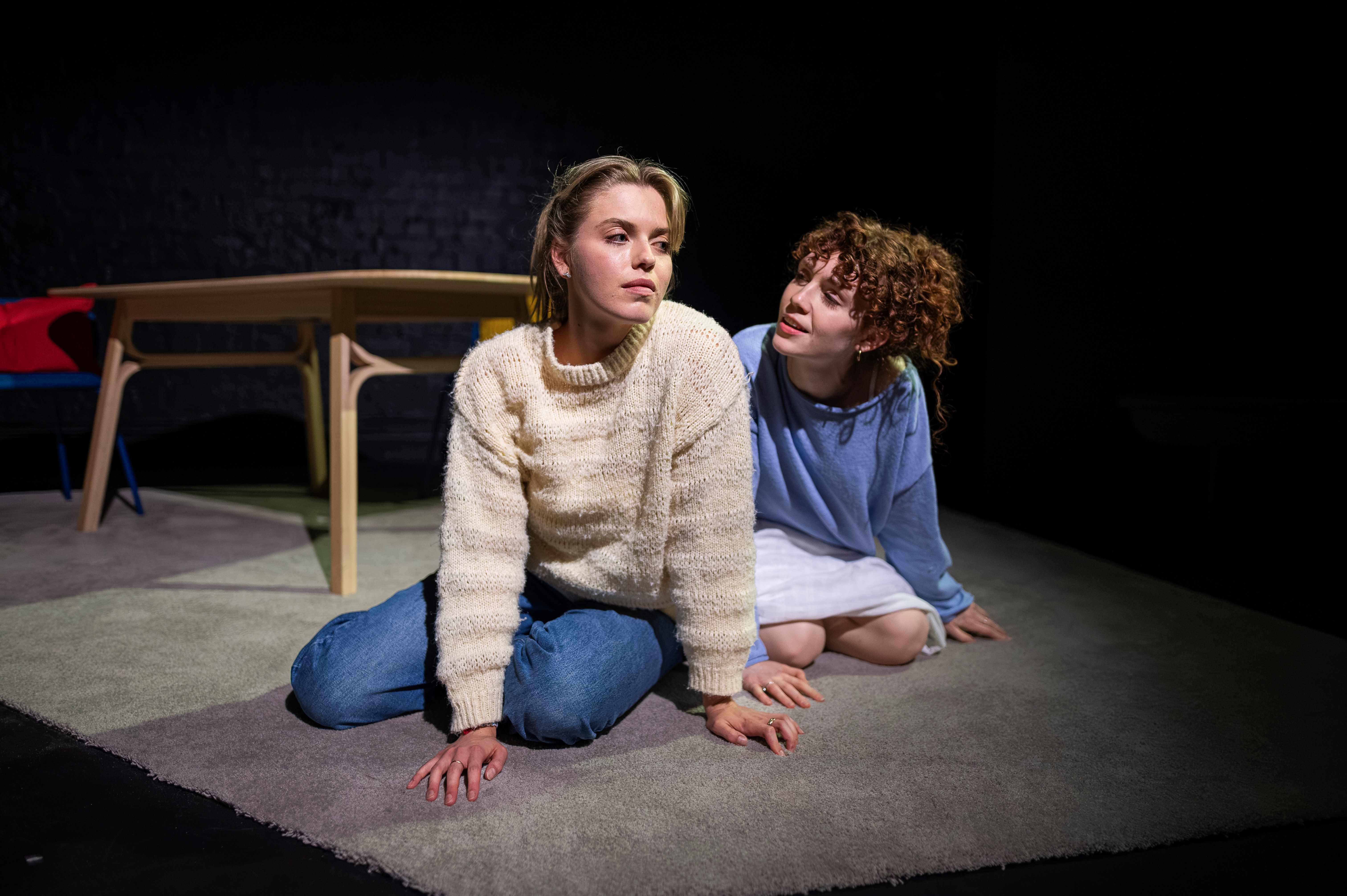
Cristabel Sved directs a wonderful production of this superb play. The staging is suitably and deliciously simple. Performances are excellent, offered in a gorgeous understatement that both highlights the glib naivety of those who deny realities greater than themselves, and which creates all the more poignancy when genuine vulnerability and passion are revealed.

Let me highlight a few moments of utter dramatic magic: the deeply human fragility of Ella Scott Lynch as Emma when she is simultaneously known to be unfaithful and aware the affair is over; Andrew Cutcliffe as Robert at a restaurant, cutlery in hand, barely containing his anger towards his supposed best friend; and Matt Hardie and Lynch as the two lovers, in the scene where their affair begins, so wanting to see life-affirming magic in what’s just a garden-variety curse; and Diego Retamales in a terrific comic cameo.

Paul Gilchrist

Betrayal by Harold Pinter

presented by Sport for Jove

until 10 Aug at the Old Fitz

oldfitztheatre.com.au

Image by Kate Williams

Dear Elena Sergeevna

4 Apr

This is an absolute cracker of a play.

Written by Lyudmila Razumovskay in the 1980’s in the Soviet Union, it’s a masterclass in building tension.

Four senior high school students arrive at the home of their teacher on her birthday. She is surprised. The students bear gifts, and one dubious request.

This is a classic battle-of-the-generations tale. Elena stands for an idealism which the students think is quaint and naïve. Elena thinks the younger generation are cynical materialists. We are your children, they tell her.

What makes this exploration of intergenerational conflict so rich is that Razumovskay makes it obvious that it’s not simply a matter of conflicting intellectual fashions. She recognises it’s also about power. The younger generation are fighting, not just for a new vision of the world, but for ownership of it. (It’s been suggested elsewhere that one reason Stalin’s purges didn’t lead to the total collapse of Communist Russia, despite their seeming irrationality and their certain brutality, is that there were sufficient young people who knew they would benefit. The murdered fill unmarked graves, but leave vacant more coveted positions.)

In this case, the young people want what they want, and one weapon they use to get it is to suggest Elena’s ethics are old fashioned, out of touch with hard reality. Anyone of a certain age is familiar with this strategy, only now the trick has been updated so that the younger generation’s claim is that they are more moral than their elders.

But it’s really about power. Volodya, the student ringleader, says it explicitly.

Volodya is a terrific portrait of a talented, dangerous young man. Once again, in tribute to the richness of the play, Volodya’s suggestion that his generation are the inheritors and natural development of Communism has sufficient a ring of Truth to make it perfect material for drama. (Out of the crooked timber of humanity….) With the collapse of the traditional religious consensus in Europe in the nineteenth century, the cry Everything is Permitted was heard in the winds that urged change. No longer was Communism, or any other political philosophy, to be restricted by old parochial moralities. If you had to crack a few eggs to make an omelette, you had to crack a few eggs. But it proved only a small step from Everything is Permitted to Everything is Possible. With the right planning, the right organisation, anything could be achieved. Hannah Arendt has observed this is a core belief of totalitarian movements. And Volodya has learnt from the masters. He comes to Elena’s apartment determined to make her give into their will. His friends will gain materially if she submits, but for him it’s just the thrill of dominance. (Those familiar with 1984 will see a whiff of the villain O’Brien about him.)

This production, directed by Clara Voda, makes some bold, thrilling decisions. Fitting the societal interrogation which is the play’s purpose, Voda goes for an ultra-realistic style of performance. This means the talented cast achieve an impressive level of authenticity (especially considering they all play characters substantially different in age to themselves.) Faisal Hamza as Volodya is particularly frightening, exuding the type of allure usually reserved for rattle snakes. Madeline Li as Lyalya captures the pathos-inducing, innocent arrogance of youth. As Pasha, Toby Carey nails that quiet sense of entitlement that screams ignorance – and its usual attendant, moral myopia. Harry Gilchrist as the group goof is likeable when required and threatening when not. Teodora Matović as Elena portrays a spiritual strength in the face of rising panic.

The ultra-realism of the production does have drawbacks. Sight lines are sometimes obstructed, and vocal delivery, while aiming for verisimilitude, occasionally slips into inaudibility.    

Paul Gilchrist

Dear Elena Sergeevna by Lyudmila Razumovskaya

produced by Last Waltz Productions

at the Old Fitz until 11 April

oldfitztheatre.com.au

Image by Noah David Perry

Amber

2 Apr

This is a consciously cartoon-candy confection.

It’s both deliciously sweet and deceptively sophisticated.

Ostensibly, it tells the story of a young woman seeking the One.

Amber openly acknowledges that this relationship-focussed worldview derives from the rom-coms of Nora Ephron and Richard Curtis, the sit-com Friends, the Twilight series and Peter Pan.

Her journey to secure love is presented with terrific humour and true heart.

This is not new territory; it’s standard fare of fringe shows around the world. But this piece gloriously transcends that genre, offering something as provocative as it is playful.

Firstly (and because of my reference to fringe, I should make this clear) the production values are excellent. Director Mehhma Malhi understands the gem of a show she has and allows it to shine. The set by Hailley Hunt is suitably puckish, replete with panels that slide to reveal mischievous surprises. The lighting by Isobel Morrissey is dominated by hues of pink and mauve, wonderfully suggestive of the girlish dreams of the protagonist, but it’s also constructed from a plethora of states that reflect and enhance the bubbly bounce of her narrative.

Secondly, writer and performer Nikita Waldron is brilliant. With a vibrant charm, she breaks the fourth wall, and with self-deprecating humour expresses Amber’s dismay when reality doesn’t align with her chosen narrative. In her scenes with the other characters – the men in her life and her best friend – she creates an Amber who is a superb portrait of the bewilderment of youth, certain and insecure, outward looking but still mesmerised by the miracle of self.

The supporting cast are splendid. As the men, Harry Stacey, Ashan Kumar and Kurt Ramjan all move between characters with impressive versatility, and Esha Jessy as Amber’s best friend, Gabby, is an engaging mix of support and sarcasm.

If you’ve read this far, you might still be wondering what lifts this piece above rom-com. Waldron’s script, for all its seeming fluffy fun, takes on some extraordinarily large concepts. (And, no, I don’t mean socio-political ones. So much new work by early playwrights purports to do this, but these plays are rarely constructed in a way that allows more than the airing of slogans and so, despite aspiring to transgression, remain wholly conventional. Not that Waldron ignores the socio-political. Amber asks in the first scene Am I a bad feminist? and then moves on to bigger game. Race gets similar treatment; in a later scene, at a late-night kebab shop, there’s a hysterical pun, and then we’re off again.)

The big game the show hunts is narrative itself. Amber is clearly trying to make her life fit a story, but the play addresses this all-too-human habit on levels far beyond what the packaging might suggest.

Let me mention just a few instances.

Amber is Catholic. And she talks to God. (He retains his usual reticence.) But, she asks, and – in a way – receives. Several people in her life question her faith, people she deeply loves, and she openly admires their atheism. She doubts her faith herself. But she’s loathe to let it go. Let a story go and you have to replace it, and this one she knows. (Quite understandably, Catholicism has got a bad rap recently. But for all its institutional crimes, and for all its focus on guilt, there’s a song of joy tucked away in there – as there is in so many religious traditions – and it’s owned eternally, not by the hierarchy, but by souls like Amber. Without in anyway being overtly or conventionally religious, this play and this production sing with that joy.)

We’re not being asked to agree with Amber’s religious choices, but we’re shown a character entirely conscious that she’s navigating a grand narrative. (It’s one of the dullest and most disappointing of modern phenomena that educated individuals will reject some grand narrative or other and then tell themselves they’re now realists – which is just another story, one still unconscious of itself. A digression: Catherine of Siena, or one of the other medieval mystics, was once asked whether her visions appeared in the real world or in her imagination? With soul-expanding sanity, she responded, In my imagination, of course. The real world is only known through story.)

The play’s focus on narrative is emphasised by the choice to make Amber, and one of her most important male friends, career storytellers. She’s a novelist, he’s a film-maker. Narrative is something to take seriously.

And the final instance highlighting that the play is, in fact, a profound and rewarding exploration of the phenomenon of narrative is the plot turn that takes it beyond standard rom-com territory: the experience of grief.

We construct narratives to make some sense of the living, to create some stability that might survive their incorrigible dynamism, that perpetual becoming that is the hallmark of the Other. But when they are gone, our narratives are no longer challenged. And so we forget that they are constructed fictions, and they diminish into mere illusion.

Faced with grief, Amber must learn this. And as she does, we’re offered a deeply affecting reminder of the power, pleasure and purpose of story.

Paul Gilchrist

Amber by Nikita Waldron

presented by essential workers,

at Old Fitz until 11 April

oldfitztheatre.com.au

Image by Phil Erbacher

Love

14 Mar

This is a fine production of a brilliant script. First performed in 2005, Love by Patricia Cornelius presents a love triangle between Annie, Tanya and Lorenzo.

Annie is a sex worker. Tanya and Lorenzo live off her earnings and, in exchange, give her what she needs. They give her affection, and protection. The only thing Tanya and Lorenzo seem to have in common, apart from a desire for Annie, is the demand that she continues to work and bring in the cash. Between Annie’s two lovers, we’re tempted to trust Tanya more, but we don’t automatically assume she’s morally superior to Lorenzo – and that’s indicative of the wonderful richness of the script.

Cornelius has a wonderful ear for the vernacular. These down-and-out characters speak in the highly-modal, subtlety-free assertions, repetitions and retractions which are the linguistic province of society’s rejects. In particular, Lorenzo’s ethical statements display the binary certainty of one only too familiar with perpetual reprimand. Cornelius offers the poetry of the underclass, of the inarticulate, and in its unflinching truthfulness, these characters are granted the dignity we too often deny their real life counterparts.

Director Megan Sampson elicits admirable performances from the cast.

Izzy Williams as Annie is poignantly vulnerable and naive, but tempers these qualities with a hunger for life that enhances the pathos of her situation.

Georgia-Paige Theodos as Tanya powerfully evokes the toughness and isolation of a woman marginalised for being who she is.

Rhys Johnson as Lorenzo is gloriously high energy, part puppy, part crocodile.

We’re presented a nuanced psychological portrait of each character, and an evocation of the fraught world in which they inhabit. It’s one of brutality, sometimes unthinking, sometimes not. The characters show little awareness of wider sociological or political issues; their marginalisation is so complete that they seem almost incapable of viewing themselves as victims. Only rarely is the myopia of their narrow world transcended: once, in Lorenzo’s cruel taunting of Tanya that society has a place for him, but refuses one to her; and in the final moments of the play, when Annie tries to make sense of what they are, in imagery that’s as surprising as it is sad.

Paul Gilchrist

Love by Patricia Cornelius

presented by New Ghosts Theatre Company,

at the Old Fitz until 21 March

oldfitztheatre.com.au

Image by Patrick Phillips

Iphigenia in Splott

14 Mar

Apparently, this is based on an “enduring” Greek myth, but whatever that myth is, it hasn’t endured in my myopic world.

But, unquestionably, Iphigenia in Splott is one of those gritty, working class British plays that Australian theatre loves. Effie has a drinking problem. And she’s aggressive, in the way those who have substance abuse problems, or are marginalised, sometimes are. She tells us about a couple of months in her life, and challenges us to see her as a someone of value.

In this colossal monologue, directed beautifully by Lucy Clements, Meg Clarke plays Effie, and does so wonderfully, finding the humour and sharing the heartbreak.

On the most obvious level, the piece is a powerful plea for empathy, a passionate and engaging reminder that the person you might want to avoid on the street is a person all the same. Effie acknowledges that this can be difficult, joking that she’s sometimes herself uncertain about her boyfriend’s claim to full humanity.

The piece also floats the idea that Effie’s problems are societal, that she is somehow representative of those who have suffered because of political mismanagement.

Written by Welsh playwright Gary Owen, it was first produced in Britain a decade ago, and perhaps it’s outgrown its origin. This is not a criticism of the piece per se, but a reminder, that like Greek myths, stories belong to their context. Effie talks a lot about “cuts”, and I can guess at the sort of policies she means, but the piece doesn’t give the background to assess whether these “cuts” are the result of hardhearted corruption, or were simply unavoidable. No doubt, it would’ve been far clearer to an audience in Cardiff in 2015.

Ultimately, Effie gives the impression that someone else is to blame for her situation, and that’s why she’s angry. But we’re also shown her making poor choices, and she herself criticises her boyfriend for complaining about all the shit on the street, turds he hasn’t picked up after his own dog.

It can be a mistake with a piece like this to assume the sole character is a truth-teller, some sort of Greek oracle. Drama works on the dynamic that no character has such a monopoly; that’s the form’s deeply humane vision. Only in the shallowest of drama is one character wholly right and the others wholly wrong. Monologue is no different. We’re not being asked if what Effie says is the Truth, but why it might be the Truth for her – that’s how we grant her the personhood she demands, and so deserves. (And, no, I’m not saying we don’t have a responsibility to help the marginalised, but am suggesting we shouldn’t confuse political engagement with simplistic readings of the dramatic form.)

Some audience members might thrill to Effie’s final dark, threatening statement, but it’s not some clarion call to action, but rather an expression of who she is, in all her pained bewilderment. If she is an oracle at all, she is in the way oracles enduringly are: their predictions will come to pass, but in ways far more disturbing and tragic than we can imagine.

Paul Gilchrist

Iphigenia in Splott by Gary Owen

Presented by New Ghosts Theatre Company

At Old Fitz Theatre until 22 March

http://oldfitztheatre.com.au

Image by Phil Erbacher   

The Children’s Hour

17 Feb

This is a superb production of a magnificent play.

First written and produced in 1934, Lillian Hellman’s The Children’s Hour still has the power to thrill an audience.

Karen and Martha run a boarding school for girls. A disgruntled student makes accusations regarding the nature of the relationship between the two teachers.

The play is a masterclass in construction, powerfully building tension and suspense. (I’m not the first person to suggest Arthur Miller must have been a student at Hellman’s feet.)

And Kim Hardwick, the director of this production, handles the material brilliantly. Her entire cast is splendid. Jess Bell’s Martha is excellent, tough and purposeful, fraught and vulnerable, understanding the dangers more clearly than she understands herself. Romney Hamilton dazzles as Karen, displaying an extraordinary range, contented confidence giving way to dismayed fear, genuine warmth striving with helpless resignation. The presentation of the women’s relationship is gloriously honest, beautiful in its unaffected vision of two individuals sharing the walk through time, invigoratingly ambiguous in its prolonged refusal to reduce to any moral pigeonhole.

Mike Booth, as Karen’s fiancé, delivers a terrific portrait of intelligent, good-hearted determination doing its best to brush off the ubiquitous spider webs of rumour and doubt. Deborah Jones’ Aunt Lily, a down-on-her-luck thespian, creates hilarity through her self-importance, and deep poignancy through the heartbreaking imbalance between her insight and her courage. Kim Clifton as Mary Tilford, the accusing student, gives an utterly mesmerising portrait of manipulation and self-interest. Sarah Ballantyne as Rosalie, one of the students who suffers from Mary’s bullying, movingly portrays the descent from resistance to terror. Annie Byron as Mary’s grandmother effectively combines dignified concern with its bastard half-sister, self-righteousness.

Disrupting heteronormative assumptions, the play met both praise and derision on its first outings. One of the charms of this current production is that it evokes so strongly the theatrical (and filmic) style of the mid-thirties. This is achieved through performance choices, but also through set design by Emelia Simcox and costume design by Hannah Yardley. A translucent backdrop, painted scenery – a supposedly static world we know to be a façade, one that hides competing visions, and one that facilitates the pretence of the privileged to Truth.

On the simplest level, contemporary audiences will read the play as a passionate plea for open-mindedness (not a message that’ll get stale any time soon.) But produced in 2025, the play raises other questions of particular relevance.

In frustration at a system we fear doesn’t guarantee justice, we now often assert Believe the victim. But that’s a tragic (though understandable) begging of the question. And it so readily slips into that perilous territory Miller warned of in The Crucible: “Is the accuser always holy now?” Hellman’s characterisation of Mary Tilford is a forthright challenge to any hope that justice comes easily.

But the play’s killer blow to moral naivety comes in the portrait of Mrs Tilford. Karen asserts that granddaughter and grandmother are of the same stock, and she means not biology, but the close kinship between self-interested deceit and self-righteousness. Both are revealed as expressions of the lust for control. In The Children’s Hour, Truth maybe fragile, but Goodness is fatally flawed. (Or, at least, Goodness with a capital G.) It’s a radical indictment of assumptions of moral superiority, and a gentle endorsement of humility and kindness. (And one of particular value in our current era in which many of us are tempted to Goodness, to that oversimplification whereby we confidently cast ourselves as warriors against evil, positing enemies where there are just people, people with the very same access to Truth as ourselves.)   

The Children’s Hour is an absolutely gripping tale, and a deeply humane encouragement to moral maturity.

Paul Gilchrist

The Children’s Hour by Lillian Hellman

Presented by Tiny Dog Productions and Dead Fly Productions

at the Old Fitz until March 1

oldfitztheatre.com.au

Image by Phil Erbacher

Draw Two

8 Nov

Fiction is an act of fact shaming. Invented narrative has a magic that can embarrass mere recount. I begin my response to Draw Two this way because it’s a one actor play, and there’s been a disappointing trend recently to reduce this genre to confessional theatre.

Now there can be great confessional theatre, but it has its place (and often that place is in a support group or a prayer meeting.)

Draw Two by Meg Goodfellow is a superbly crafted piece of dramatic fiction, an inheritor of the grand tradition of storytelling. Something has happened to Riley’s twin sister Mia, and she must return to her hometown to collect her little nephew. Goodfellow follows the sage advice of make them laugh, make them cry, make them wait. And though the show’s only 70 minutes (which seems to slip by much faster) the audience is offered a journey that’s both funny and deeply moving.

It’s a story of loss, regret and moving forward. And, perhaps unsurprisingly, considering it’s told by one of a pair of twins, it’s about identity. Commandeered by contemporary political discourse, identity is a word in danger of petrifying into a stone tool we use to beat each other. But Goodfellow’s beautiful script playfully acknowledges the concept’s limitations, reminding us that love dissolves all the barriers that corral identity into isolation.

I began by unfavourably comparing recount to narrative, and Goodfellow makes the most of the narrative form’s potential, moving back and forth through time in a perpetually intriguing manner. She also avoids narrative’s great temptation: the end that resolves all problems; the end, that by slamming shut, leaves us feeling we’ve enjoyed a mere fantasy that belongs back in its box, rather than a fiction that will continue to reverberate through our reality. 

Director Lauren Bennett textures the piece magnificently. The use of projection, built from visual art by Laura Hayley, is gently and gorgeously evocative, and one of the most effective uses of the technology I’ve seen in theatre.

But Bennett’s master stroke is casting. Georgia McGinness as Riley is phenomenal. Goodfellow’s use of the vernacular is brilliant and McGinness inhabits it flawlessly. McGuiness works without props, her splendid control of movement creating the world of the play. She also creates each of the characters who surround Riley – her mother, her lover, an old flame of her sister’s, a tradesman, her nephew – all through subtle changes in voice and nuanced movement. It’s an extraordinary performance.

Paul Gilchrist

Draw Two by Meg Goodfellow

At old Fitz until 17 Nov, as the Late Show

oldfitztheatre.com.au

Image by Georgia Brogan

The Female of the Species

8 Nov

The dramatist is the natural enemy of the theorist. Whereas the dramatist delights in the presentation of multiple voices, the theorist subsumes all voices to their singular vision of the world.

In The Female of the Species, Joanna Murray-Smith gives us Margot Mason, a provocateur feminist in the tradition of, say, Germaine Greer or Clementine Ford. To simultaneously poke and praise this type of personality has been in the literary zeitgeist since at least John Irving’s novel The World According to Garp in the late 70’s. But the dramatic form is perfect for reminding us of the vitality of complexity in the face of soul-shrinking reductionism. And, by choosing the particular genre of farce, Murray-Smith gives us something quite special.

Farce is one of the most difficult of genres to perform, especially a piece like this – one which invites high energy physicality but also requires close attention to the witty, erudite dialogue. With a terrific cast directed by Erica Lovell, this production pulls it off, giving us a hilarious, thought-provoking evening of theatre.

Murray-Smith’s protagonist is a superb creation, an incendiary combination of social warrior and self-interest. She’s played brilliantly by Lucy Miller, who gives the character gravitas, scorn and passion (the last of these transcending the temptation to present intellectuals as mere pedants, obsessed with verbal precision.) 

Margot proudly owns the moniker provocateur. She’s certainly provoked Molly, a young student who turns up uninvited to her country house. Jade Fuda is wonderful as Molly, positioning her beautifully between vulnerability and determination. Molly points out that Margot’s published works contradict each other, that she’s just seeking attention. The celebrity writer is unfazed. Her books are not commandments for Life, they’re invitations to thought. (This is despite her deep contempt for her daughter’s more conventional life choices. Lib Campbell plays the utterly exhausted young mother of three in suitable, gorgeous hyperbole.)    

But back to the play’s interrogation of the provocateur. One of the great questions of the intellectual life is Should you only write the Truth? Anyone with any intellectual humility appreciates that a truly serious commitment to Truth might condemn you to silence. But what would that gain? So you compromise. You tell yourself you’ll write the Truth as it appears to you, limited and flawed though that will inevitably be. It’s what you have to offer to the conversation, another stick among many thrown onto the communal fire. But if it’s the conversation, the fire, that’s important, what does it matter what you throw into the mix? After all, the deliberately inflammatory might just shake things up, make the fire burn that bit more fiercely, push back the darkness a little further, hold back the cold a little longer…

Which leads me to another great tension in the intellectual life, that between followers and leaders. We’re in awe of those who can express things neatly, who can tie up the world’s loose ends with some all-encompassing theory. But to mistake what they say for Truth is to confuse the small solidity of the stick with the dangerous vitality of the fire. Hold on too tightly to that dried out old piece of wood and watch the desiccated hollowness spread up your arm and wither your whole life.

Murray-Smith gives Margot a chain of books with curious catchy titles. Her most famous is The Cerebral Vagina, but listen closely for her most recent title. She’s toying with The Female of the Species, but in the play’s closing moments she comes up with another title, one that is gloriously provocative.

I started by suggesting farce is extremely difficult. It’s difficult because it makes so little effort at truthfulness. Instead, it asks us to revel in its very artificiality. And it’s this delightful artificiality that makes farce an ideal vehicle for the examination of the artificiality of our grand narratives. We enjoy them so, but they’re not Life.  

Paul Gilchrist

The Female of the Species by Joanna Murray-Smith

Presented by Rogue Projects

At Old Fitz until 23 November

oldfitztheatre.com.au

Image by Noni Carroll

Champions

18 Oct

Four young visual artists have been shortlisted for a prestigious prize. They’re given adjacent studios and several months to create something original. The  artwork judged the best will win $50 000 and, allegedly, bestow the status that will guarantee the artist a successful career.

Written by Isabella McDermott and directed by Bali Padda, Champions operates as an allegory for our competition-based society, one in which individuals are isolated and pitted against each other.

This reading is encouraged by the play’s form: four interwoven monologues. There is no dialogue between characters; each character simply shares with the audience their experience of the competition. One of the major benefits of this creative choice is that it facilitates dramatic irony. Characters make assertions about each other, but then we swap to a new speaker and these assertions are immediately undercut. These people know little about each other, they struggle to help each other, and nothing in the world they live in suggests they should even try.

More narrowly, you could read the piece as an interrogation of competition within the arts. (Let’s face it, that sort of competition is often like the Hoof to Hook competition at the Royal Easter Show; sure, it encourages the nurturing of healthy beef cattle, but we know what happens to the contestants. Or, as I’ve suggested elsewhere, competition and art are an odd marriage: vital art rarely follows or fulfills criteria, it’s too busy questioning and challenging them.)

This piece certainly floats the idea that competition might be counter-productive to creativity, but it also invites us to care which of the four artists ultimately wins the prize. This is a sophisticated use of the dramatic form, refusing us a pat response.

However, the piece also throws out an interesting challenge. These artist characters talk a lot about themselves. And when they’re not, they’re often talking about other artists – in order to compare those artists to themselves. Is the play really tempting us with the tired old prejudice that artists are self-obsessed?  

The piece certainly reveals a fascination with personality, an interest in what particular individuals supposedly are (as against what they do or say or think or feel.) For example, two characters are initially described as charismatic (or a synonym), and they’re admired or disliked for that, the other two characters comparing their own personalities to those of their more bold competitors. This focus on a concrete personality is a sort of essentialism, one that contrasts provocatively with the dramatic form, an artform which is almost always predicated on the representation of change. In drama, any assertion like I am This or You are That can end up seeming little more than words written in the ever-shifting sands of Time.

But this essentialism is an insightful piece of characterisation. In a society in love with competition and consumerism, individuals will commodify themselves. That’s how to be valued in the marketplace. But validation is dependent on the whim of the outside world, on what others think. Several of the characters desperately want the outside world to say to them You are good. It’s a portrait of pathos-inducing powerlessness, one I suspect that resonates all too deeply in so many contemporary artistic communities.

Many people reading this review might be frustrated by my obtuse approach, my refusal to plainly give this show, say, 4 stars and move on. (Or, to expand my earlier Easter Show analogy, award a blue ribbon and then head off to the bar, oblivious to what follows.)

If this review does elicit exasperation, the reason is simple: to support the competition necessitated by capitalism, it’s expected writers about theatre will focus on evaluating performers and productions, as against discussing ideas. And so the prevailing economic structure influences everything, even trivialities like theatre criticism.   

So, to avoid being superfluous as well as trivial, l’ll add this:

Padda has gathered a terrific ensemble. Bayley Prendergast’s Fraser is hilariously and pitifully arrogant. Talitha Parker’s Emmy oozes confidence until her sense of self is threatened in a most frightening way. Lincoln Vickery’s Howie is a fish-out-of-water delight, an appealing mix of certainty and bewilderment. Cat Dominguez’s Claudia is a powerful portrait of a woman seeking the strength to claim her place in the world while not abandoning the good that might be found in her complex, troubled inner life. 

McDermott’s stimulating creatives choices make for an intriguing, engaging play, one with the potential to surreptitiously tease us out of a complacent acceptance of some of society’s more pernicious assumptions.

Paul Gilchrist

Champions by Isabella McDermott

At Old Fitz until 26 Oct

oldfitztheatre.com.au

Image by Patrick Phillips

sitting, screaming

3 Oct

This is a fine piece of theatre; it’s beautifully written and superbly presented.

Written by Madelaine Nunn and directed by Lucy Clements, it’s the story of Sam, a teenage school girl navigating what is (hopefully) the worse moments of her life. Dad has cancer and so mum has forgotten her. Her friendship circle has proven fragile. Sam is fraught and alone. Then a teacher, Mr David, begins to pay attention.

Nunn’s script is brilliantly crafted. Danger is hinted at gradually. Animal imagery lurks ominously amongst the everyday. Near Sam’s house, the ocean looms in the dark – loud, enormous, unceasing.

Sam’s teenage vernacular is pitch perfect. She has the glorious energy of youth and it’s frightening naivete.

It’s an one-actor show and performer Clare Hughes is absolutely extraordinary. Her Sam is utterly real, a spellbinding balance of brashness and vulnerability. Hughes (or is it Sam?) also evokes all the other characters; with a slight change of voice, a subtle physicality, she becomes each of the people in this young woman’s troubled world: her mother, the school counsellor, her best friend, her sick father, a gaggle of teenage girls, the loud mouth school boy – and Mr David. It’s a virtuoso performance.

Elsewhere I’ve written about the silencing of male voices in stories that indict misogyny. It’s an understandable response to the seemingly endless bellow of the patriarchy, but sometimes it can leave the female characters in a theatrical world in which their suffering seems oddly nebulous and ungrounded. By inadvertently questioning their grievances, it’s a creative decision that ironically can gaslight the very characters it aims to truthfully represent.

Nunn’s script is a thrillingly inventive response to this dilemma. Because Sam voices everyone in her world, it evokes her dreadful isolation but it also emphasises her power.  Mr David and the dickhead schoolboy are heard, their brutality is noted, but this is Sam’s story, and in its telling she embodies the courage that can slay the beast.

And, in having Sam voice everyone, the piece also magically positions her for a life-altering shock. Characters she gently mocks, who elicit parody and perpetual eyerolling, burst into unexpected fullness as she discovers genuine solidarity and sisterhood. It’s deeply moving and intensely inspiring.  

Paul Gilchrist

sitting, screaming by Madelaine Nunn

presented by New Ghosts Theatre Company

at Old Fitzroy Theatre until Oct 5

oldfitztheatre.com.au

Image by Phil Erbacher