Archive | Responses to Plays RSS feed for this section

Two Hearts

20 Mar

Romance is such a garden variety human experience that we often forget its potentially wondrous result.

(Or, to slightly misquote Chesterfield, the pleasure is momentary, the position ridiculous, and the consequence damnable.)

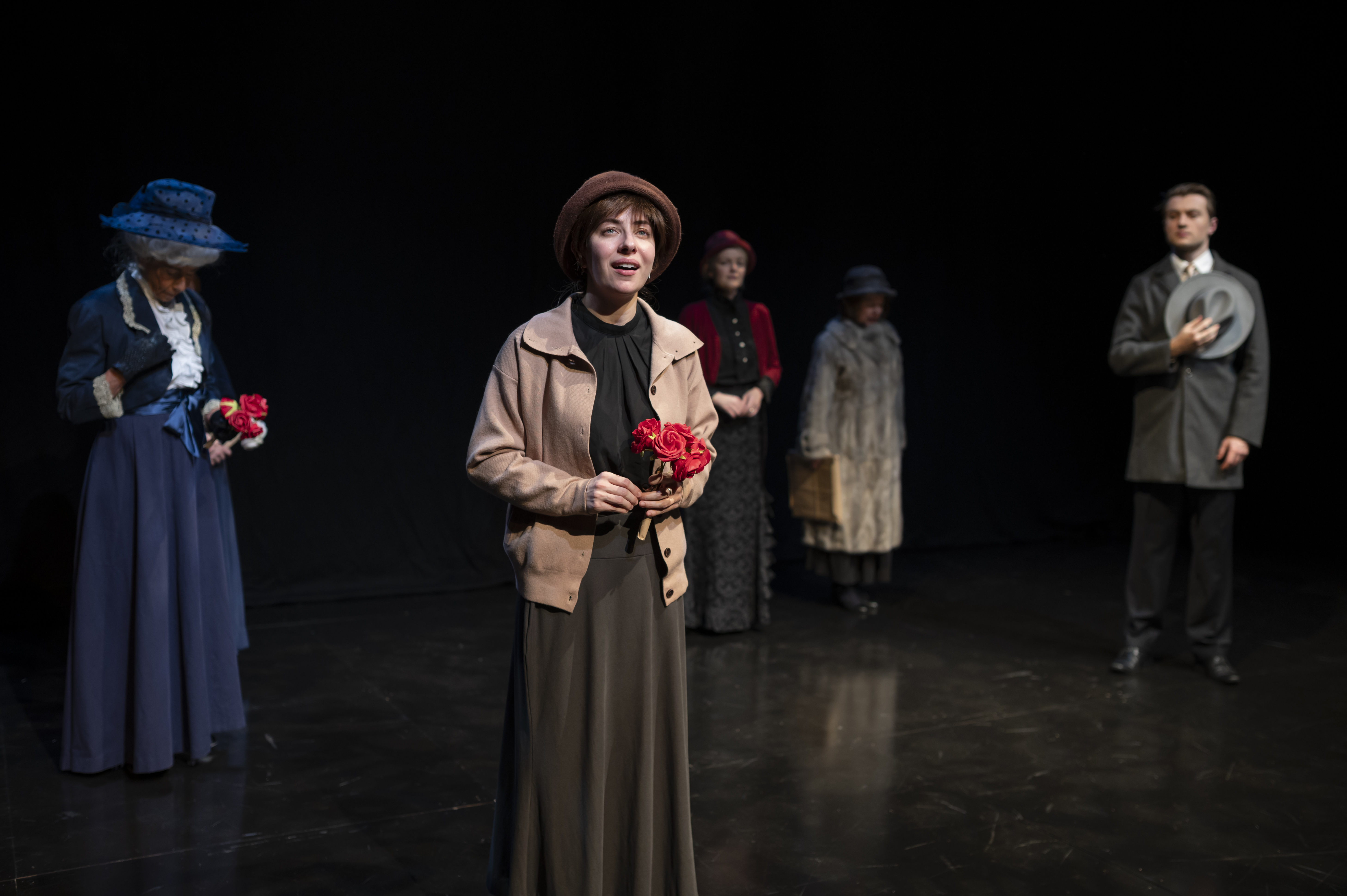
Written by Laura Lethlean and directed by Kirsty Semaan, Two Hearts tells the story of Him (Yarno Rohling) meeting Her (Danette Potgieter), and of what follows.

Throughout, the couple are shadowed by It (Lisa Hanssens).

For a while, it’s a guessing game as to what (or who) It is. I suspect some audience members might find this frustrating or dissatisfying, but not as frustrating or dissatisfying as when they realise the answer. You could suggest that the answer to the question of who is It? begs the fundamental question of the play.  (I’m attempting to avoid breaking the spoiler rule, so forgive me for being so vague. When a play risks so much on one dramatic trick, it seems poor form to reveal the nature of that trick in a review; a bit like revealing who did it in a whodunnit.)

But, perhaps the fundamental question of the play lies elsewhere (away from the issue I’m not naming, the issue that’s both very current and also universal, the issue I suspect many audience members will have very decided attitudes regarding, attitudes which will remain unchanged by this play.)

Perhaps, rather, the fundamental question is how do we navigate memory and regret, how do we construct a narrative of our lives? Though some scenes between the couple are played in naturalistic dialogue, many are played in a manner that suggest both the woman and the man are recalling events and trying to determine the truth of that moment. Sometimes the characters will play out the actions of the scene while seemingly remaining in their own internal worlds, trying to recall (or assert) how it all actually occurred. For example, the couple sit down and He says something like We were sitting next to each other and this is juxtaposed with Her reflection (rather than Her response), something like We sat far apart. This motif of reflection on the past is furthered by scenes in which It asks the man and woman, separately, about decisions made during the relationship. Combined with a sometimes heightened poetic language, and a muted but expressive lighting design (Jasmin Borsovsky), and a movingly melancholic sound design (Charlotte Leamon), we get the sense of two individuals grappling with a great mystery, the passing of Time and all the loss that entails.

Potgieter and Rohling as the young couple are wonderfully believable, both in their initial excitement as the romance blossoms, and in their growing frustration as it threatens to fade. The differences between the two lovers are subtly portrayed in both script and performance.

The character She is gently performative – I want people to like me – and perhaps a little more selfish – a friend has said to her You are the happiest person I know, because you are the most selfish. Both despite these flaws, and through them, Potgieter beautifully creates a character who we like and who we pity (which is probably the most suitable response we can have to any other person.)

In contrast to Her, He is more genuine, perhaps a little simpler. He dreams of being a musician but is self-deprecating enough to realise it is unlikely to happen. Rohling’s presentation of the character brims with warmth, and as things begin to go wrong in the relationship, his portrayal of a sad, anguished bewilderment is superb.

As It, Hanssens has the oddest of roles – but pulls it off with aplomb. With both movement and voice, she effectively evokes something passionless yet present, something uncomplicated yet curious, something without skin in the game, but that watches eternally. (There’s an infinite pathos in a figure who stands always at the bank, as the river of Time slides endlessly by.) To use the body in a way that suggests the soul is a remarkable achievement.

Two Hearts is a piece that is as gently disconcerting as it is softly beautiful.

Paul Gilchrist

Two Hearts by Laura Lethlean

presented by Space Jump Theatre

at Flight Path Theatre until March 29

http://flightpaththeatre.org

Image by Philip Erbacher

No Love Songs

17 Mar

This is a micro-musical: two performers, accompanied by a musician on key board – whole thing 80 minutes long.

Apparently, it’s inspired by the life experiences of song writer, Kyle Falconer, and one of the writers of the book, Laura Wilde. (The other writer is Johnny McKnight, and the piece is directed by Andrew Panton and Tashi Gore.)

As the title suggests, it’s a relationship story, but not your conventional one. This is no romance ending with And Reader, I married him. A baby is born in the third scene.

How do Lana and Jess navigate this new arrival?

Hint: it’s not a baby bliss story.

Firstly, I’ll be shallow and sharp.

Neither character is particularly charming. They’re incredibly judgemental, criticising her mother, the women at play group, and even a guy who wears socks (or doesn’t wear socks?) with a particular type of shoe. A lot of things are shite. A lot of emotions are punctuated with fuck. And we hear about her vag, her tits, and the need to shit while giving birth.

Despite referring to themselves as the Dream Team, Lana and Jess never seem particularly close, and this is emphasised by the structure of the piece, in which each often sings alone, or talks directly to the audience about the other.

And they constantly refer to the baby as the Little Man, suggesting they haven’t really got their heads around the fact he’s a child, and the enormity of their new responsibilities. (And it left me wondering if they would’ve referred to a female child as the Little Woman.)  

They’re really just oversized adolescents who need to grow up.

But, as I suggested, I’m being sharp and shallow.

To respond in this manner to dramatic characters is to deny the sophistication of the dramatic form.  

Let me dig deeper.

There’s hints of a troubled prehistory. One of the early songs, musing on their future as parents, expresses the hope they don’t become monsters. This begs a backstory we’re never told, this pathos-inducing hope betraying unacknowledged darknesses in their own pasts, and effectively establishing how self-unaware these characters are.

But I’m still sticking to the surface, the spoiler rule holding me back – but the need for content warning, and a more genuine assessment are pushing me forward.

It’s story of postnatal depression.

And that can hit any woman. Charming or not. Self-aware or not. And it does, with a dreadful, often unrecognised, frequency.

No Love Songs’ raw portrayal of the pain of this experience is wonderfully honest (and transcends all the other chip-on-the-shoulder type of supposed honesty that otherwise pervades the piece, the type that automatically equates Telling it how it is with ugliness, and seems unable to do anything but assume that there actually is A way it is.)

Keegan Joyce and Lucy Maunder give terrific portrayals of these challenging characters. Accomplished musical performers, they present the songs beautifully, and the dialogue with skill. The jokes work, and the suffering is heartrending.

Falconer’s songs are engaging and the music is splendidly produced (though I did wonder whether an arrangement beyond synthesiser keyboard and acoustic guitar might have been interestingly edgy.) It was a joy to hear every word (except, perhaps, when Lana was rhymed with trauma.)

The piece is billed as a modern love story. It’s an intriguing piece of code, one best deciphered as a comment on what this story is comfortable exploring, as against suggesting this story is concerned with particularly modern aspects of love. Because these things have always happened and hopefully, in bravely speaking of them, those who suffer can find the support they deserve.

 Paul Gilchrist

No Love Songs by Kyle Falconer, Laura Wilde and Johnny McKnight,

at The Foundry Theatre, at Sydney Lyric,

until 13 April

http://nolovesongs.com.au

Image by Brett Boardman

Furious Mattress

17 Mar

This is a beautifully realised production of a fascinating, and odd, play.

Written by Melissa Reeves and directed by Margaret Thanos, it tells the story of a backyard exorcism.

Though based on a true story, it’s a mix of satire and black comedy.

Reeves’ script invites theatricality, and Thanos gleefully accepts that invitation, giving us a show that is gloriously wild.

Performances are excellent. Matilda Ridgway as Else, the victim of the exorcism, is an ever-intriguing mix of impish mischief, startled bewilderment and sheer panic. Julian Garner is terrific as Pierce, her husband, an uncomfortable, naive dag who reveals a terrifying coldness. And it’s a delicious insight of both script and performance that this callousness is shown to spring directly from Pierce’s less threatening qualities. Anna, a member of their church, is keen to assist at the exorcism, and Alex Malone plays her with a delightful whiff of superiority and hypocrisy. (The truly religious are probably much shallower – or much deeper – than the rest of us.) Shan-Ree Tan is hilarious as the exorcist: part-cowboy, part-clown and all glib hubris.

I began by suggesting the play was odd, and there are several reasons for my assessment.

Firstly, in so far as it is satire, the target seems oddly specific. But perhaps exorcism is a more common problem in Australia than I’m aware. Or, if the play is meant as a criticism of Christianity in general, I suspect many members of that faith might question its validity, feeling it’s the equivalent of a satire aimed at Islam that focusses solely on suicide bombers.

The second element of oddness is the structure of the play. It begins with the end. Considering the nature of that end, for the rest of the performance it was difficult for me to laugh at the characters’ gullibility and hubris because I knew, only too clearly, to what horror they ultimately led.

The spoiler rule makes the third element of oddness challenging to discuss; so I’ll be appropriately vague. We’re shown scenes of wonderful theatricality, but they seem to imply that the wacky demonology of these Christians is not as preposterous as the satire might have us believe.

But that’s why the play is fascinating, as well as odd. I’ve called it a black comedy and a satire, but I’m probably being far too reductive. Reeves’ keen, clever, crazy script deserves an assessment more concordant with its explosive, transgressive nature. As a representation of a community dealing with evil, or what they assume is evil, the piece invites reflection, both serious and stimulating.

Possession by demons is a rather minor narrative in modern Christianity. The major narrative is that our faults can be forgiven if we are repentant. But what the minor and major narratives have in common is that the individual and the evil are differentiated. In the minor narrative, it’s the demon that’s evil; in the major narrative, it’s the sin. In both, the individual is presented as redeemable.

Ironically, it’s our secular philosophies that increasingly conflate the individual with evil. (Ironic, because it’s those philosophies that most enjoy satirical jibes at Christianity). Admittedly, current events in America do make very tempting the conflation of the individual and evil. But it only takes a modicum of ethical maturity to question such too-easy-simplicity. Political maturity also suggests that such a simplistic vision is problematic, as it precludes the possibility of positive change. Telling people they’re evil is not a particularly effective rallying cry. In fact, in the political sphere, as long as we view those we disagree with as simply evil, there seems only one way to deal with them – one uncannily like what happens in this play.

Paul Gilchrist

Furious Mattress by Melissa Reeves

presented by Legit Theatre Co.

at Downstairs Belvoir, as part of 25A

until 29 March

belvoir.com.au

Image by Robert Catto

Love

14 Mar

This is a fine production of a brilliant script. First performed in 2005, Love by Patricia Cornelius presents a love triangle between Annie, Tanya and Lorenzo.

Annie is a sex worker. Tanya and Lorenzo live off her earnings and, in exchange, give her what she needs. They give her affection, and protection. The only thing Tanya and Lorenzo seem to have in common, apart from a desire for Annie, is the demand that she continues to work and bring in the cash. Between Annie’s two lovers, we’re tempted to trust Tanya more, but we don’t automatically assume she’s morally superior to Lorenzo – and that’s indicative of the wonderful richness of the script.

Cornelius has a wonderful ear for the vernacular. These down-and-out characters speak in the highly-modal, subtlety-free assertions, repetitions and retractions which are the linguistic province of society’s rejects. In particular, Lorenzo’s ethical statements display the binary certainty of one only too familiar with perpetual reprimand. Cornelius offers the poetry of the underclass, of the inarticulate, and in its unflinching truthfulness, these characters are granted the dignity we too often deny their real life counterparts.

Director Megan Sampson elicits admirable performances from the cast.

Izzy Williams as Annie is poignantly vulnerable and naive, but tempers these qualities with a hunger for life that enhances the pathos of her situation.

Georgia-Paige Theodos as Tanya powerfully evokes the toughness and isolation of a woman marginalised for being who she is.

Rhys Johnson as Lorenzo is gloriously high energy, part puppy, part crocodile.

We’re presented a nuanced psychological portrait of each character, and an evocation of the fraught world in which they inhabit. It’s one of brutality, sometimes unthinking, sometimes not. The characters show little awareness of wider sociological or political issues; their marginalisation is so complete that they seem almost incapable of viewing themselves as victims. Only rarely is the myopia of their narrow world transcended: once, in Lorenzo’s cruel taunting of Tanya that society has a place for him, but refuses one to her; and in the final moments of the play, when Annie tries to make sense of what they are, in imagery that’s as surprising as it is sad.

Paul Gilchrist

Love by Patricia Cornelius

presented by New Ghosts Theatre Company,

at the Old Fitz until 21 March

oldfitztheatre.com.au

Image by Patrick Phillips

Iphigenia in Splott

14 Mar

Apparently, this is based on an “enduring” Greek myth, but whatever that myth is, it hasn’t endured in my myopic world.

But, unquestionably, Iphigenia in Splott is one of those gritty, working class British plays that Australian theatre loves. Effie has a drinking problem. And she’s aggressive, in the way those who have substance abuse problems, or are marginalised, sometimes are. She tells us about a couple of months in her life, and challenges us to see her as a someone of value.

In this colossal monologue, directed beautifully by Lucy Clements, Meg Clarke plays Effie, and does so wonderfully, finding the humour and sharing the heartbreak.

On the most obvious level, the piece is a powerful plea for empathy, a passionate and engaging reminder that the person you might want to avoid on the street is a person all the same. Effie acknowledges that this can be difficult, joking that she’s sometimes herself uncertain about her boyfriend’s claim to full humanity.

The piece also floats the idea that Effie’s problems are societal, that she is somehow representative of those who have suffered because of political mismanagement.

Written by Welsh playwright Gary Owen, it was first produced in Britain a decade ago, and perhaps it’s outgrown its origin. This is not a criticism of the piece per se, but a reminder, that like Greek myths, stories belong to their context. Effie talks a lot about “cuts”, and I can guess at the sort of policies she means, but the piece doesn’t give the background to assess whether these “cuts” are the result of hardhearted corruption, or were simply unavoidable. No doubt, it would’ve been far clearer to an audience in Cardiff in 2015.

Ultimately, Effie gives the impression that someone else is to blame for her situation, and that’s why she’s angry. But we’re also shown her making poor choices, and she herself criticises her boyfriend for complaining about all the shit on the street, turds he hasn’t picked up after his own dog.

It can be a mistake with a piece like this to assume the sole character is a truth-teller, some sort of Greek oracle. Drama works on the dynamic that no character has such a monopoly; that’s the form’s deeply humane vision. Only in the shallowest of drama is one character wholly right and the others wholly wrong. Monologue is no different. We’re not being asked if what Effie says is the Truth, but why it might be the Truth for her – that’s how we grant her the personhood she demands, and so deserves. (And, no, I’m not saying we don’t have a responsibility to help the marginalised, but am suggesting we shouldn’t confuse political engagement with simplistic readings of the dramatic form.)

Some audience members might thrill to Effie’s final dark, threatening statement, but it’s not some clarion call to action, but rather an expression of who she is, in all her pained bewilderment. If she is an oracle at all, she is in the way oracles enduringly are: their predictions will come to pass, but in ways far more disturbing and tragic than we can imagine.

Paul Gilchrist

Iphigenia in Splott by Gary Owen

Presented by New Ghosts Theatre Company

At Old Fitz Theatre until 22 March

http://oldfitztheatre.com.au

Image by Phil Erbacher   

The Moors

13 Mar

Written by Jen Silverman and first produced in 2016 in the US, there’s certainly more than a whiff of the Brontes about this.

There’s a dissolute called Branwell. There’s a newly arrived governess. There are sisters, whose father was a minister, and at least one of whom wants to be a famous author. There’s a surly servant. There’s someone locked away in the attic. There is a large, ever-present, dog. And, of course, there are the moors, bleak, bare and stretching far away.

But don’t be mistaken, this is no bio-drama. (The Brontes are never mentioned.) It’s a glorious, hilarious, deeply moving postmodern celebration of …. some of the Brontes’ most passionate concerns.

Right through the nineteenth century and up until modernism, the English novel famously pursued realism. But there were fascinating variations on the form. Dickens played with the comic. Collins played with the criminal. The Brontes played with the dark. What makes, say, Jane Eyre or Wuthering Heights standout is their embrace of the Gothic, their obsession with the dangerous, often unacknowledged, darknesses deep within us.

In The Moors, the darkness being plumbed is the disturbing link between love and control. Mistress of the house, Agatha, controls her brother, and wants to control the new governess. She also just wants her. This pattern is repeated with the dog and a moor hen.

Yes, there are talking animals. And there are musical numbers. And a heap of humour.

There’s also mischievous play on theatrical conventions. The perplexed governess is perpetually told that the one room (the only room) is another. The sole servant acts as though she were two different servants. Time doesn’t flow at its usual pace – well, at least not when you’re writing a diary, as is the younger sister who desperately wants to be a famous author. 

So, how do all these mischievous comic tricks combine with the Gothic?

It certainly makes for an extraordinarily entertaining night of theatre. (The 110 minute show doesn’t seem slave to Time’s usual habits, but rather zips through like that wanna-be novelist’s diary.)

But, curiously, these mischievous comic tricks don’t result in a parody of the Gothic. Indeed, they don’t even weaken it. (The story of the fraught relationship between the dog and the hen is made more enthralling by its anthropomorphic element, refusing us a glib disapproval of certain disconcerting behaviours, and so ensuring the emotional impact of the conclusion.) 

Perhaps the mischievous tricks suit our postmodern sophistication. It could be argued that the Gothic dwindled into mere adolescent horror as soon as we acknowledged the existence of the sub-conscious, and so Silverman’s tricks are merely the spoonful of sugar that makes the quaint old genre more palatable to contemporary tastes.

Or perhaps her tricks are an expression of the Gothic spirit itself, impishly revealing a previously disguised darkness. Each of the key moments in this play are driven by something one of the characters has written or a story one of the characters tells – and that hints at the location of the darkness being probed. In our post-modern culture, we’re hyper-aware of the telling of narratives, and we proudly claim agency over our own. We rightly critique the dominant narrative, for its bias, for its blindness, but how closely do we consider the narrative with which we wish to replace it? They told a Tale, we say, but as we tell ours, almost unbeknownst to us, it comes to be Truth.

Silverman’s tricks highlight this tussle of Tale and Truth. And, in this tussle, both are torn, exposing the blood and bone beneath. Perfect Gothic.

Director Jessica Fallico knows exactly the gift of a play she has and presents it magnificently.

The cast are brilliant. The scenes between the dog and the moor hen are riveting. As the bird, Jasmine Sarkis superbly encapsulates that most disquieting of mixtures: wonder and openness, born of and blighted by inexperience and ignorance. Michael Giglio, as the beast, perfectly balances warmth with neediness. As the ever-changing servant, Brittany Macchetta is splendidly nimble; with terrific use of voice and movement, she slips seamlessly between sullen and deferential. As Emily, the newly arrived governess, Georgina Dula presents a fascinating journey, taking the character from vexed bewilderment to daunting agency. Kalani Guillien is outstanding; as Agatha, mistress of the house, she is unapologetically imperious, yet deeply complex. As the younger sister, Hudley, Emily Smith excels; giddy with childish excitement and misplaced enthusiasms, she is a comic delight.

Paul Gilchrist

The Moors by Jen Silverman

presented by Dancing Dog Productions in conjunction with Waterloo Studios Theatre Sydney

at Waterloo Studio until March 16

dancingdogprod.com

Image by Stephanie Stephens.


This is L-O-V-E

10 Mar

Philosophers as great as Plato, Augustine and Foreigner have all wanted to know what love is.

So, a title like this has genuine swagger. Are we, finally, to be given a definitive answer to the greatest of questions?

No.

This is L-O-V-E is an anthology of playlets by American dramatist Allan Staples, here somewhat loosely linked together by a connecting piece written by director Kai Paynter.

The playlets are all about love (romantic love, that is) and they’re all either very funny or very touching – but, of course, no definitive answer to the question What is love? is being offered. It’s more of a shot-gun style scatter sample. Any overarching theory, if one were ever worth attempting, is up to us. (I’m not sure if the playlets were originally intended to be grouped together.)

The eleven-strong ensemble are a little uneven, especially in terms of vocal work, and the changeovers between the playlets would benefit from more pace and pizazz, but the writing is beautiful and some of the performances are magnificent.

A couple process some daunting medical news. Kate Jirelle and Kirk Hastings work brilliantly the surprising humour, and Jirelle as the woman facing the diagnosis finds a gloriously honest and deeply moving vulnerability.

Another couple suspect they may be pregnant, despite having a decidedly unserious relationship. With Georgia Britt and Dominic Di Paolo, the gags fire, but both actors also offer emotionally inspiring performances: Britt presents a poignant dignity and Di Paulo an unexpected chivalry.

Two men bump into each other at an airport. Why did their romance fail? Alex Baum and Rhett Wilks superbly portray the heady mixture of residual resentment and ongoing chemistry.

Presented by The Americas A Theatre Company, there’s an intriguing focus on the USA. During each playlet, a photo of a recent American president is projected on the upstage wall. I was unsure whether these were meant to place the playlets in time. On occasions, I could draw a connection between the concerns of the particular playlet and the policies of the pictured president, or with events during his term, but often I couldn’t. I certainly didn’t need to see a two metre tall projection of Trump’s face.

This focus on the USA is curious, because it positions us to ask if the aim of the piece is to present love as it is experienced American-style. (It’s also quite brave, because since at least the 1940’s, Australian audiences have hardly been deprived of American culture. It’s only recent political events in the northern hemisphere that have left us wondering if America was always more foreign than we assumed.)

But perhaps that’s the point: despite the recent turn in American politics, both disturbing and bewildering – its people are still people, who like us all, worship before the great mystery of love.   

Paul Gilchrist

This is L-O-V-E by Allan Staples (with Kai Paynter)

Presented by BearTiger Productions in association with The Americas A Theatre Company

At the Loading Dock Theatre, Qtopia, until 15 March

qtopiasydney.com.au

Image by Tony Ling.

Rabbit & Crow

7 Mar

A rabbit is hit by a car and now lies injured on the road. A crow waits for it to become carrion, in order to consume it.

In a brave and laudable snub to trendy woke identity politics, writer and director Leon Ford casts humans in the animal roles.  

As the titular rabbit and crow, Sophie Gregg and Justin Smith are brilliant. Philip Lynch is equally superb as another crow who later attempts to join in on the action. With enormous skill, they play Ford’s amusing script, finding the magic in every moment, and achieving both humour and pathos. (All you performers who identify as crows and rabbits, notice has been given. The days of lazily asserting you’re entitled to the role simply because you’re a bird or a small furry animal are over. From now on, you might have to try actually acting.)

The humour of the piece comes from various mechanisms. One is simple anthropomorphism. We delight in the conceit that the animals speak in our vernacular, display our peccadillos, and face very human problems. (It’s a vein of humour long mined by cartoonists. The artists working for The New Yorker, for example, have especially excelled in it.) It’s a genre that both gently mocks humankind, but also expresses joy at the non-human Other. (Who hasn’t been enchanted by the absolute amorality of cats?)

Another comic mechanism is dramatic irony. Neither the rabbit nor the crows understand human aspirations and human technology, but I suspect a small percentage of the audience do.

So, is it allegory, fable or just fun?

It certainly brings to mind Aesop and Orwell. But it also evokes the ancient Greek poet Archilochus and his claim “The fox knows many things, but the hedgehog knows one big thing.”  In Ford’s 50 minutes of fun, it’s the crow who knows many things, who is an individualist, an opportunist, an obfuscator, a chancer. The rabbit knows one big thing: love.

You might argue that the tension between these two worldviews is a false dichotomy, that life is not simply a choice between the individual and the community, and that any such reductive binary belongs in a children’s book – but to quote someone with even greater moral authority than a theatre critic: “Unless you become like little children, you will never enter the Kingdom of Heaven.” (And that allusion offers me a segue to a speech the rabbit gives concerning the afterlife; it’s a superb parody of eschatological wishful thinking.)

The other tension Rabbit & Crow plays with is that between choice and inevitability, between the things we can change and the things we can’t. Must crows eat carrion?

Perhaps the piece gets itself into a bit of a corner here. When much of the humour comes from the sense that the animals represent types, and when our overarching belief is that the animal world is utterly innocent because it’s without a moral dimension, the presentation here of an ethical dilemma might be hard to swallow (like road kill.)  

But something else is on offer, or more accurately, not on offer. As the play doesn’t actually represent people, that is, specific human characters, we’re not offered the option to respond to it in the following, time-honoured, tired manner: This play is a criticism of all those people who claim they have no choice, when they indubitably do. This play is a criticism of all those people who resist moral progress, when they assert it’s against the “nature of things”. This play is a criticism of all those people who maintain the immutability of the “nature of things”, when they’re simply defending their own privilege. This play is a criticism of all those people who are not people like me!

Rabbit & Crow denies us this easy out, as the sheer playfulness of the script, and the magnificence of the performances, lifts it into universality.  

Paul Gilchrist

Rabbit & Crow by Leon Ford

At Flight Path Theatre until March 8

flightpaththeatre.org

Image by Philip Le Masurier 

Don’t Save Me

3 Mar

The premise of Don’t Save Me is so thought-provoking that it almost makes redundant the actual writing or production of the play.

Jade (Holly Mazzola) is dying. Her husband Pat (Ben Itaba) secretly records their conversations, so she can be brought “back to life” by AI.

Does Pat have the right?

Written by Karina Young and directed by Nelson Blake, the focus of the play is primarily, and narrowly, ethical.

But when Jade discovers Pat’s plan, and objects, his response is a flat But you’ll be dead – which doesn’t quite trump all further argument, but feels awfully close to doing so. The dead, after all, don’t have rights. (You can lie about the dead, but you can no longer libel them.) And, with little time left, and that time to be inevitably filled with physical suffering, Jade’s insistence on her rights seems odd, an unacknowledged avoidance strategy as against a justified indignation. (Life perceived solely through the lens of rights is particularly barren. As victims of blind circumstance, which we all ultimately are, rights offer little counsel and even less consolation.)

And, with its sights firmly on ethics, the play sidesteps more interesting ontological issues. Instead of Should we do it? how about Could we do it?

The answer to the second of these questions is not only dependent on technology, but also on what we think it is to be a person. Are we just a collection of relatively consistent words and behaviours? If so, AI is perfectly capable of replicating us. However, vitally aware of our own agency, our freedom and the endless dynamism of being alive, we resist such a reductive vision of personhood

But the experience of love raises a thorny problem. We love particular people. Or, if we’re talking romance, solely one person. Based on what? Their relatively consistent words and behaviours? If that is so, Pat’s reductive AI plan is disturbingly little different from his choice to marry Jade in the first place!

And that’s why a deeper psychological exploration would have been fruitful. We don’t see Pat make the decision to record his wife. He’s already doing it before the play begins. We don’t see him so overwhelmed by the sheer wonder of his wife’s existence, that in the mad hope it might continue, he desperately clutches at straws. Similarly, when Jade discovers Pat’s plan, her response is merely anger. It doesn’t seem to occur to her to seriously consider why her husband might be tempted. She’s too focussed on her supposed rights to openly face the awful, bewildering mystery of ultimate loss. (Even when she asserts she is scared of death, we aren’t shown her fear, only her anger that her husband has failed to recognise her emotions.) For most of the 90 minutes of the play, the characters are remarkably unchanging, altering only in mood rather than outlook – and that’s a pity, because character development is a terrific dramatic tool to explore the moral, philosophical and emotional complexities of any thorny issue.

Indeed, the characters appear to be deliberately infantilised: her sister (Raechyl French) attempts to bribe her way back into Jade’s trust with ice-cream; the married couple’s dream holiday is Disneyland; they build a pillow fort in the loungeroom; and their relationship appears to consist of home cooking, including the baking of cookies, and watching reality TV on the couch. (Admittedly, the last of these could be an invitation to consider authenticity, after all, the play is about AI.)

But why are they such static children?

It functions as a powerful portrait of fear, of debilitating terror before those two most dreadful agents of change: Technology, control of which we’ve lost, and Death, whose measure we never had.

Paul Gilchrist

Don’t Save Me by Karina Young

presented by Puncher’s Chance Co in association with bAKEHOUSE Theatre Co

at KXT until March 8

kingsxtheatre.com

Image by Phil Erbacher

They Will Be Kings

27 Feb

Despite being a delightful device for the creation of joy, running through this piece is a melancholic sense that the scene is less welcoming of drag kings than it has been – or, more importantly, might be.

And, judging by this production, that’s a real pity.

This is a thoroughly entertaining hour, and a magical celebration of life’s richness.

Directed by Kaz Therese and written by Therese & Danica Lani in collaboration with the cast, it’s part-sharing and part-performance.

The four cast members begin by asking each other to name a world famous drag king. They come up with few contenders. (Though the suggestion of Joan of Arc is marvellous food for thought; as one cast member says, the Maid of Orleans definitely would have been a they.)  

In amusing and affecting anecdotes, the cast members share personal stories of the joy of being a drag king. They also perform some of their own routines. As “Chase Cocks”, Chris McAllister delivers some terrific stand up, replete with some needle-sharp one-liners that puncture all parochiality. As “Jim Junkie”, Becks Blake performs a hilarious movement piece, playfully both burlesquing and saluting masculine swagger. Danica Lani as “Dario di Bello” presents a glorious lip-synced pop duo and dance number, in which the performer brilliantly takes both the (conventional) male and female roles. Angel Tan as “Fine China” offers a moving personal sharing, accompanied by themselves on a very evocative violin.

We’re told You can be any gender you want to be. And this is a golden reminder that life is larger than lethargy and fear might make it.

We’re told There are different masculinities (and even as a supposed straight cis-guy, that’s encouraging; I admit, as I limped home after the show with my bad back, I did try to put on a bit of a swagger.)

Though I present as a theatre critic, I identify as a philosopher – and I find the performative aspect of personal identities absolutely invigorating.

There are prejudices in our culture asserting that conscious performance is indicative of inauthenticity. However, WB Yeats (with his dramatist’s hat on) points out that performance is vital for a full life. For example, performance is the fundamental element of an ethical life. To act ethically is to act in a way different to our first, unthinking impulses. Goodness is something we perform.

But, what if you are accused of not being good? That there is something problematic about your identity? Essentialism becomes an understandable temptation: I was born this way, you respond.

No doubt true.

But like all our truths, only a partial one.

We are creatures of time; it’s the element in which we exist. And, as Catherine of Siena would say, The fish is in the sea, and the sea is in the fish. We’re not independent of time; we don’t swim through it immutable and unchanging. Not only with salt does the ocean permeate all, but with its very openness. We only ever know who we are incompletely, because who we are contains also who we might be.

And not merely who we become; that’s just a more sophisticated form of essentialism. The joy of the dance is not found only in its final step.

Embrace the play, the potential, the delicious possibilities….

Yeats (this time with his poet’s hat on) asks of essentialism How can we know the dancer from the dance? And the subtext is clear Why do we need to?

They Will Be Kings is life affirming and enriching, and wonderful fun!  

Paul Gilchrist

They Will be Kings by Kaz Therese & Danica Lani in collaboration with the cast,

presented by WEREWOLF & KINGS OF JOY,

at The Loading Dock, Qtopia,

until 28 Feb

qtopiasydney.com.au