
I know a lot of us justify the fact we’re yet to win a Nobel Prize in Literature by telling ourselves that it’s really just about who you know.
However, Betrayal by Nobel laureate Harold Pinter raises the disturbing spectre that the prize might also be awarded to those of genuine genius.
Several years ago, and for quite some time, Jerry had an affair with Emma, the wife of Robert, his best friend. Pinter tells most of the story through a reverse chronology, ultimately ending at the beginning.
The impact of reversing the tale’s chronology is twofold.
Firstly, it facilitates dramatic irony. Lies become more apparent, like shards of glass in sunlight. The audience delights in discovering the ways the characters have not been open and honest about the past.
But Pinter’s unconventional structure is not about giving the characters some sort of back history that explains or justifies their infidelity. (I’ve never been a fan of plays that use flashback to explain the present, feeling the question What happens next? is always more interesting than Why did that happen?) What Pinter does is more akin to what a craft-person working in the plastic arts might do. He crafts an object from the concept of betrayal, leaving us as unconcerned with narrative as we would be with, say, a small glass ornament. Instead, the concept is held up to the light, and we’re given glimpses from different angles, to marvel at the way the Truth is tainted.
This leads me to the other stroke of genius displayed in this unconventional structure: it weakens the sense of the passing of Time, as though whatever it is that is being betrayed is beyond Time – which, of course, it is. Every committed relationship we have is an attempt to transcend Time, to deny its inevitabilities, to say This Always, despite all Life’s vagaries.
And this hope filled fantasy of permanence aligns with how we usually think about ourselves as individuals. We imagine we’re like some solid object somehow caught in the current of Time. It’s as though we’ve accidentally fallen into that mysterious river and our natural element is elsewhere. Yes, we acknowledge the current will ultimately beat and batter us till destruction – that’s just a matter of Time – but we don’t see ourselves as fundamentally a part of the world that does that, but somehow outside and opposed to it. The soul-expanding thrill of Pinter’s play about deception is that the characters are continually shocked to discover that their secrets were always known, that their belief in their separation from the wider world was an illusion all along.
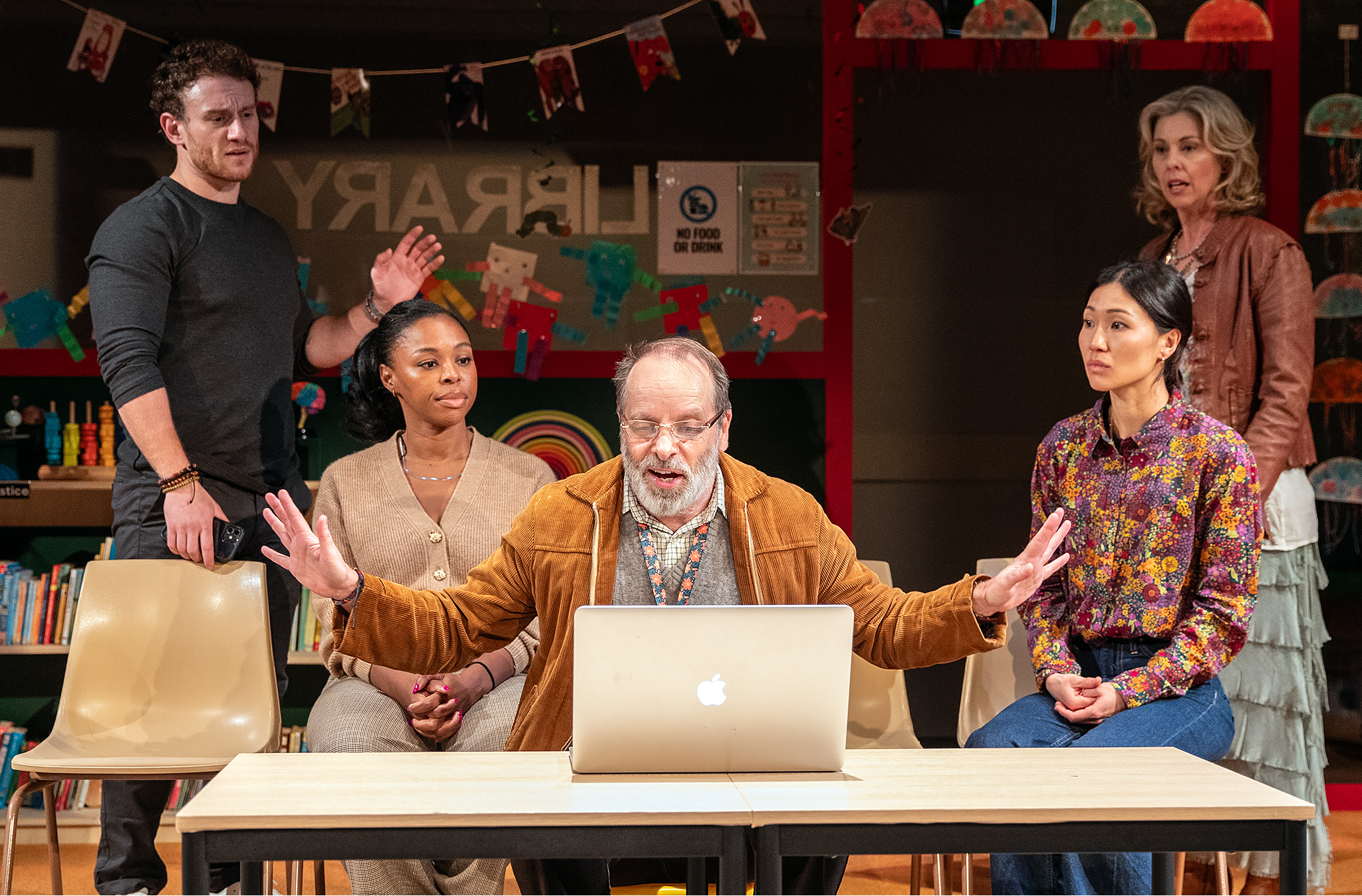
Cristabel Sved directs a wonderful production of this superb play. The staging is suitably and deliciously simple. Performances are excellent, offered in a gorgeous understatement that both highlights the glib naivety of those who deny realities greater than themselves, and which creates all the more poignancy when genuine vulnerability and passion are revealed.
Let me highlight a few moments of utter dramatic magic: the deeply human fragility of Ella Scott Lynch as Emma when she is simultaneously known to be unfaithful and aware the affair is over; Andrew Cutcliffe as Robert at a restaurant, cutlery in hand, barely containing his anger towards his supposed best friend; and Matt Hardie and Lynch as the two lovers, in the scene where their affair begins, so wanting to see life-affirming magic in what’s just a garden-variety curse; and Diego Retamales in a terrific comic cameo.
Paul Gilchrist
Betrayal by Harold Pinter
presented by Sport for Jove
until 10 Aug at the Old Fitz
Image by Kate Williams







 Theatre Red